Questions for a twenty-first century senior secondary curriculum
Rachel Bolstad
Abstract
This article looks at the current organisation of senior secondary curriculum in New Zealand, and raises some key questions that will need to be considered as we seek to develop a senior secondary curriculum designed for life in the twenty-first century. It asks: Do our current structures, for senior secondary curriculum, support goals and aspirations that have been articulated for twenty-first century senior secondary education, and, if not, what might need to change?
Introduction
In 2005, the Ministry of Education commissioned a background paper to inform their thinking on future development in the area of the senior secondary (Years 11–13) curriculum (Bolstad, 2005). This followed nearly a decade and a half of significant national changes affecting curriculum, assessment, and qualifications in secondary schools. With the new assessment regime, the National Certificate of Educational Achievement (NCEA), fully implemented at Years 11, 12, and 13, and a first draft of the revised New Zealand Curriculum scheduled for circulation in 2006, it was a timely opportunity to step back and reflect on the current organisation and purpose of senior secondary curriculum in New Zealand.
Most often, the senior secondary curriculum in New Zealand is thought about and discussed in terms of its constituent parts, i.e., as the individual and collective “subjects” that are taught in Years 11–13. As I will discuss in this article, two inter-related factors have contributed to, and perpetuated, this “subject-oriented” view of the senior secondary curriculum: the historical (and ongoing) need for the senior secondary years to prepare students for entrance into tertiary education; and the close coupling of the senior secondary curriculum with the structures and systems used to assess and qualify students. The difficulty with the subject-oriented view is that it may preclude broader questions about the overall shape and scope of learning in the senior secondary years. For example, what should students learn in their final few years of school? What kind of learning will school leavers need to equip them for life in the twenty-first century? What kind of people do we need, to build and support a twenty-first century society and economy? Do our current structures for senior secondary curriculum support our goals and aspirations for the future, and, if not, what might need to change? These are the sorts of questions that must be addressed by educators and curriculum policy makers alike.
For the most part, the policy drivers shaping the senior secondary curriculum in New Zealand since the early 1990s centred on the development of new assessment and qualification frameworks. The senior secondary curriculum itself was not the main focus of review and attention, and there have been few opportunities to debate questions such as those raised above. With the long-awaited changeover to the NCEA, there has been a partial decoupling of the relationship between senior secondary assessment qualifications structures, and the senior secondary curriculum. Social and economic forces1 have also changed the entire landscape of senior secondary education, leading to higher retention rates, and the need for much more flexible pathways through the senior secondary years. This article explores challenges to the existing senior secondary curriculum, as a consequence of these changes. While some see these as negative challenges, this article suggests that the changes have potentially opened up new opportunities to discuss, debate, and renegotiate, at a national level, the shape and scope of the senior secondary curriculum for young New Zealanders of the future.
How was the senior secondary curriculum organised in the past?
In order to understand how New Zealand's senior secondary curriculum works today, it is important to know how it worked in the past. Traditionally, one of the main purposes of senior secondary education was to provide students with the knowledge, skills, and entrance qualifications they would need to enter tertiary education. When this model was developed, only the minority of students who intended to go on to higher education tended to continue to study at school in the post-compulsory years (Dwyer, 1995). The majority of secondary students did not continue to the final years of schooling, and instead left school at the end of the compulsory years, equipped to move directly into trade apprenticeships or the (blue collar) workforce.
Figure 1 depicts what could be called a “traditional” or “conventional” model of senior secondary curriculum. This model is perhaps best described as a traditional British colonial or Anglo-American model. While no claims are made for its universality, this model does seem to adequately describe the structure of the senior secondary curriculum in New Zealand—at least until the 1990s. This is a reasonable facsimile of the way in which New Zealand's senior secondary curriculum was developed and regulated in the past, under the three main senior secondary qualifications: School Certificate; Sixth Form Certificate; and Bursary. In this model, the planned curriculum comprises a set of subject syllabus or curriculum documents, developed by subject knowledge experts—usually academics—and representatives from the teaching profession. Teachers use these documents as the basis for the school curriculum, teaching subjects which correspond in name and nature to the syllabus documents. The assessed curriculum is determined by examination prescriptions, which are developed to relate directly to the planned curriculum. Students are assessed by means of an external exam for each subject. If they pass their exams, they are eligible to enter tertiary education. If they fail, their options are: to get a job; enter work-based training; become unemployed; or some other non-tertiary education outcome.
Under the “old” qualifications system, most senior secondary subjects were therefore constructed “top-down” from the conventional subject disciplines of universities, and curriculum development was a centrally-controlled process. All qualifications' subjects had some kind of “official” national document outlining what students should be learning in that subject. These documents were of two main types: syllabuses or curriculum statements—developed by the Department of Education, and later the Ministry of Education—for some, but certainly not all, senior subjects; and examination prescriptions and course statements, issued to schools in a yearly School Qualifications Handbook (NZQA, 2001).
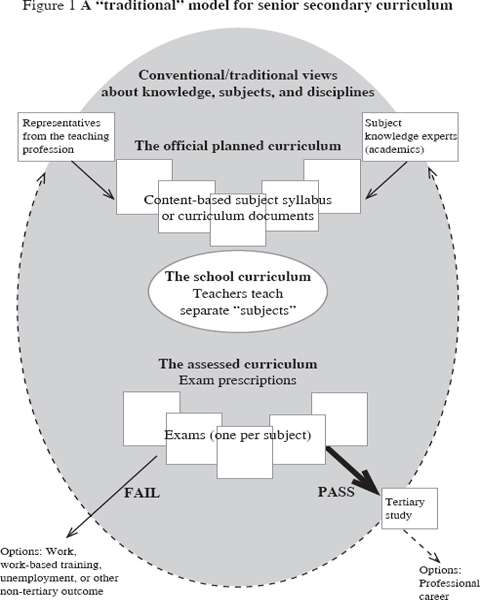
These documents gave clear indications about what students should be learning in various subjects, and which aspects of that learning they could expect to be assessed for qualification.
School Certificate was controlled by the Department of Education, and, from time to time, curriculum committees were formed to develop School Certificate prescriptions. University Entrance, University Scholarship, and later, University Bursary, were controlled by the University Entrance Board. This board had a subject committee for each subject, sometimes with others co-opted when needed, who developed and revised the University Entrance or Bursary course prescriptions as needed (Andy Begg, personal communication). Pressure from groups of teachers (sometimes with the support of university academics) was the major reason for the creation of any “new” subjects; for example, the emergence of media studies in secondary schools in the early 1980s (Horrocks & Hoben, 2005), or the introduction of PE as a Bursary subject. These could become nationally recognised subjects for School Certificate, Sixth Form Certificate, or University Bursary, provided they gained central approval from the Department of Education, New Zealand Qualifications Authority (NZQA), or the University Entrance Board. At Sixth Form level, in addition to teaching nationally recognised Sixth Form Certificate subjects, schools were also able to develop “local” subjects. However, in doing so, they were required to submit a course prescription, or a description of assessment methods, to the NZQA for approval.
What has changed?
Today, the landscape of senior secondary education has changed considerably. For example, in New Zealand and many other Western countries, economic and social changes during the last few decades resulted in a marked increase in the number of students staying in school beyond the minimum school-leaving age. Schools have to cater for a larger and more diverse cohort of senior secondary learners, with more complex and varied curriculum needs, than under the traditional model. Contemporary ideas about knowledge and the future of society and economy also support the idea that all learners should be encouraged to stay on through senior secondary school—even those not intending to go directly on to university. In the past, those who left school early could easily find work in occupations that did not require high levels of education or qualifications. However, in the new “knowledge economy”, it is believed to be crucial to have a well-educated (and creative/innovative) population, who can transform knowledge and ideas into marketable commodities. This means more education is needed for more people, and perhaps even new kinds of education than were available in the past (Gilbert, 2005).
Many of the economic and social changes that led to increasing retention in secondary schools during the 1980s and 1990s had similar impacts on the tertiary education sector (McLaughlin, 2003). With the emphasis on supporting more people to get more education, participation in tertiary education expanded enormously, as did the variety of tertiary education options available to students. This posed new challenges for the secondary sector: if students have such a wide array of possible pathways to choose from when they leave school, what is the school's role in preparing them for these different pathways? Furthermore, to what extent does tertiary education represent an alternative to senior secondary school for students in the post-compulsory years?
In light of the trends and pressures described above, there has been an international trend towards reforming senior secondary education (le Métais, 2003), in order to:
•&;&;accommodate the changing needs of an expanded post-compulsory student population;
•&;&;expand the range of opportunities and pathways for learners aged 15/16 to 18/19;
•&;&;create clearer links and transitions between schooling, further education, vocational training, and the workforce; and
•&;&;support a “lifelong learning” approach to formal education.
However, generally this has involved changing assessment and qualification structures, rather than changing curricula per se. In New Zealand, this trend was reflected in the formation of the NZQA, and the development of a National Qualifications Framework (NQF), which aimed to support lifelong learning by making it easier for people to move freely between different parts of the education sector, receive appropriate recognition of prior learning, and access information about the full range of education options available.
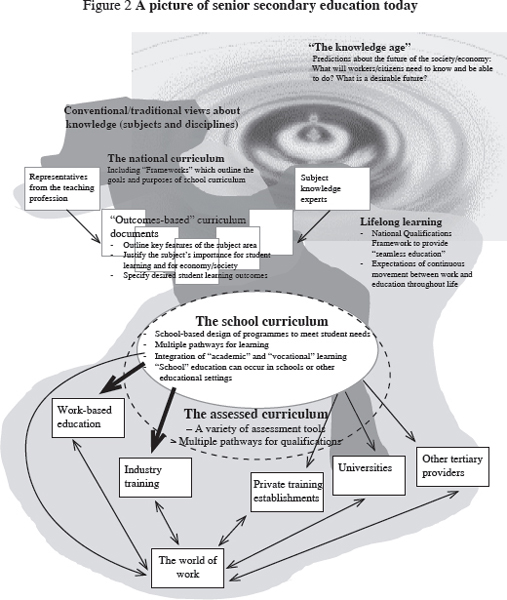
So, what does all this mean for our “traditional” model for senior secondary curriculum development? Figure 2 attempts to show some of the more significant aspects of senior secondary education in New Zealand today, and how various pressures have altered and shifted the traditional model. Compared to Figure 1, this picture is much messier. Some elements of the traditional model are still visible (the dark grey field). However, the school curriculum is now also subject to the influence of the notions of “lifelong learning”, and the expectation that people should be able to move through different educational settings, and the workplace, in a flexible way (the light grey field). The NQF, which allows for multiple qualification pathways for senior secondary and tertiary students, supports this. The range of pathways into and through tertiary studies has also expanded, and there has been a partial decoupling of curriculum and assessment, to allow greater flexibility and choice for schools and learners. Unlike the traditional model, in Figure 2 there is no longer a simple one-to-one correlation between the planned curriculum, the school curriculum, and the assessed curriculum. Instead, schools can choose from a variety of assessment tools, and offer students a range of qualifications.
The top right-hand side of the diagram depicts, as a ripple, the influence of future-focused thinking about education, knowledge, the economy, and society in a “knowledge age” (Gilbert, 2005; Miller, 1996). The ripple effect suggests that this kind of thinking does have, or should have, some effect across different elements of the senior secondary education landscape. However, at present this may currently be a less visible aspect of the debate and discussion around the senior secondary curriculum in New Zealand.
The key idea to be drawn from the discussion above is that a “traditional/conventional” model for senior secondary curriculum (such as the one represented in Figure 1) seems to be fitting less and less well with current needs and priorities for education in a twenty-first century learning and working environment. The environment surrounding this model has changed considerably, and this has triggered a series of shifts and developments in the senior secondary education sector. In New Zealand and other countries, the most common response to these pressures and changes has been to retain aspects of the traditional/conventional model at the core of the system, while intermittently reviewing and reforming partial aspects of this system in response to different pressures (or sometimes, political imperatives). In today's picture, school-based decisions about curriculum and assessment are of vital importance. With so many options available to students in the new curriculum and qualification environment, school-based decisions have become a key element in determining which learning experiences and opportunities are available for students, and how they will gain accreditation that will give them access to other environments for work or further learning. Is this where the primary level of decision making should be occurring? What, if any, role should central government agencies play in giving direction or shape to the overall portfolio of learning accrued by New Zealand senior secondary students? I explore these questions next.
Should the senior secondary curriculum be nationally specified?
Perhaps, as we move into a new era for senior secondary education, what we need is an overall national vision to guide the current and ongoing evolution of the senior secondary curriculum. The 1993 New Zealand Curriculum Framework (NZCF) (Ministry of Education, 1993), which is in the process of being revised, and which will eventually be superseded by the new New Zealand Curriculum (see http://www.tki.org.nz/r/nzcurriculum/), represented a best attempt to provide a broad consensus on what it is important to learn at school. New Zealand's national curriculum is compulsory for students in Years 1–10.2 The NZCF specified seven essential learning areas (ELAs) to be included in the curriculum for students in these years (with an eighth being added in the new draft curriculum). It also indicated a range of essential skills, attitudes, and values that all students should develop through the curriculum. Since students need to pass reasonably smoothly from the compulsory to the post-compulsory curriculum, it seems reasonable to expect that a national curriculum might provide some degree of guidance for all the years of schooling. However, the framework's directives regarding the overall composition of the curriculum for the senior secondary years were quite general. Students in Years 11–13 should have access to a “balanced curriculum, building on the balanced and broad education of their earlier years” (Ministry of Education, 1993, p. 9).
They should have the “opportunity to continue studies in each of the learning areas … [and] continue to develop the full range of essential skills” (p. 9). Students in Years 12 and 13 should be able “to make informed personal choices from a wide range of courses, which lead to further study or to work and training opportunities” and “will be able to undertake studies in greater depth” (p. 9).
This fairly open and general level of guidance was appropriate at the time the NZCF was written, when the old qualifications system more or less set the parameters for the Years 11–13 curriculum. The relationship between the NZCF and the ELAs could comfortably remain ambiguous, because each subject had its “own” de facto curriculum, in the form of annual NZQA examination prescriptions and/or course statements. This being the case, it was therefore interesting that, during the curriculum developments of the 1990s, some senior subjects such as physics, biology, and chemistry also gained their own Years 11–13 curriculum statements over and above the seven ELA curriculum statements, while many other established senior secondary subjects did not (for example, economics, media studies, history, or geography). Most likely, this can be attributed to successful lobbying and political support for the former subjects. However, it created dissatisfaction amongst teachers and subject associations in other disciplines, particularly since the abolishment of School Certificate, Sixth Form Certificate, and Bursary. With the old national exam prescriptions and course statements now obsolete under NCEA:
There is a perception that, for many of the senior subjects, there is no national statement available to teachers telling them what 'subject experts' deem to be a balanced and coherent curriculum around which they should organise their teaching and assessment (or choose to deviate from, given good reasons).
(Alison, 2005, p. 1)
Consequently, there has been pressure from teachers and different subject associations to develop curriculum statements for subjects that don't currently have their “own” document, that aren't sufficiently covered within one of the ELA Years 11–13 curriculum statements, or that are perceived to belong across multiple ELAs. Some groups have simply gone ahead and developed their own curriculum guidelines; for example, the NZCETA Accounting Curriculum Statement for New Zealand Schools. Is this a good thing? Does more effort need to be put into creating national curricula for all the subjects taught at this level? If so, who should initiate and manage this process?
Do all subjects actually need a curriculum statement?
To answer this question, we need to consider the purpose a curriculum statement actually serves. It seems that a curriculum statement can do a variety of things. A curriculum:
•&;&;gives a subject “status”. For example, the existence of a curriculum statement in a subject like biology suggests that, as a country, we think biology is an important subject for students to learn at secondary school;
•&;&;(potentially) underpins the development of new assessment tools, such as achievement standards;3
•&;&;provides some kind of “consensus” about what the subject is “about”, and what is most important to know/do/learn/teach;4 and
•&;&;can frame (or reframe) the ways teachers think about their subject, if it (the curriculum) expresses a clear and coherent philosophical approach.5
One argument for developing curriculum statements for all senior secondary subjects is that, post-NCEA, teachers feel in need of guidance and pointers on how to give coherence to their school or classroom curriculum. In the past, it could be argued that teachers generally had much less room for curriculum decision making in the upper levels of secondary education, because what they taught was closely tied to examination prescriptions. Hence they may have been accustomed to thinking of their subjects as a series of prescribed “topics” and “content”, with their own responsibilities as interpreters of the curriculum focused mainly on pedagogical decisions. However, this model of curriculum interpretation comes under pressure when education is in a turbulent time of rapid change, and when critical questions about the purposes of senior secondary education, and the markers of a “successful school leaver”, are under discussion. Curriculum statements for the senior secondary subjects could assist during this time, by helping teachers to think about what schools need to do differently to prepare students for the “knowledge society” (Gilbert, 2005; Miller, 1996), or by helping them to discuss what it really means to prepare students to be “lifelong learners” (Bryce & Withers, 2003), in the context of their particular subject or knowledge domain.
Of course, this would mean that curricula would have to be written with these kinds of ideas at the forefront. This is quite different to producing curricula that simply prescribe the content that subject experts believe students should learn in a specific discipline, with formal examinations in mind. The need for discussion of such matters will increase as teachers, and society at large, engage with future-focused ideas about education. Furthermore, if we intend to move the senior secondary curriculum towards future-focused views of knowledge, it may be counter-productive for subject associations and sector groups to develop their own senior subject curricula, unless there is a process for high-level discussion and cross-fertilisation of ideas and concepts across different knowledge domains. We may even have to reassess our traditional understanding of which kinds of knowledge “belong” to which subjects or knowledge domains, and create supporting mechanisms for interdisciplinary curricula. Imagine, for example, the development of a Year 13 “bioinformatics” course. Bioinformatics (or computational biology) is the use of techniques from applied mathematics, informatics, statistics, and computer science, for solving biological problems. Bioinformatics has assumed central importance in modern bioscientific research in the last few years. A bioinformatics course for secondary students could potentially be designed for assessment that integrated existing achievement and unit standards from biology, statistics, and computing. The challenge would be to make strong contextual links to bring coherence to the new “subject”, without in the process losing a focus on the strengths and intellectual tools that each traditional discipline brings to this new area of active knowledge-building. If a school wanted to develop such a course, who should decide whether or not it meets the intent of the three learning areas implicated? Who is best qualified to determine this? Could senior curricula that covered all these areas provide the necessary guidance in this type of situation, or would some new process be needed?
Should schools design their own senior subjects?
With a shift to the NCEA, any school can theoretically put together a “new” subject—such as the bioinformatics example above—and assess it using any mixture of unit standards and achievement standards, providing they meet the requirements of NCEA, or of any of the other National Certificates available to senior secondary learners. Schools can also create new variations of conventional subjects like mathematics and English, as Hipkins, Vaughan, Beals, and Ferral (2004) found occurring in case study schools from the very first year of NCEA implementation. This is similar in principle to the provision for “local” subjects to be developed under Sixth Form Certificate; however, an important difference is that schools do not have to submit a course prescription, or a description of assessment methods, to be used for NZQA approval.
The power to develop new subjects, or to change existing subjects, therefore appears to have shifted, at least in theory, from being mostly centrally-determined, to being mostly school-determined. However, at least two other factors serve to indirectly standardise and regulate the senior secondary curriculum at a national level. These are: the nature of the assessment standards available to assess and accredit students' learning, and the requirements for students seeking to gain entry into university. Are these the appropriate tools for providing some degree of uniformity and equality of curricula across different schools, or for providing an overall senior curriculum that meets current and future needs?
Are the assessment standards the new de facto national curricula?
Under NCEA, students generate credit for achievement in senior curriculum subjects, through a mixture of internal and external assessment, using two kinds of assessment standards: “achievement standards”, developed specifically for the NCEA; and unit standards, developed for assessment in a variety of school subjects from the 1990s onwards (New Zealand Government, 1999). The idea is that schools can offer courses that “package together combinations of achievement standards and unit standards”, thereby giving students “greater choice about the subjects they take and the qualifications they work towards” (p. 34).
The following analogy may help to illustrate the effect of the change to the NCEA, for the senior secondary curriculum. Under the “old” qualifications system, the senior secondary curriculum was somewhat like a fast-food burger restaurant. Schools (and students) could order various kinds of burgers (i.e., centrally-designed subjects), but the makeup of those burgers was already determined in advance. The restaurant (i.e., the curriculum and assessment authority) had already designed each burger, and decided what belonged in it—as prescribed by national examination prescriptions and course statements.
Under the NCEA, it's more like a make-your-own sandwich restaurant. The restaurant doesn't design the sandwich, the consumer does (i.e., schools or students). However, the ingredients that the restaurant provides (i.e., the assessment standards), create the parameters for the kinds of sandwiches the consumer can create. If the restaurant wants to place any kinds of controls on what the consumer creates, they can do so by only providing certain kinds of bread, or filling, or only a fixed number of filling choices, and so on. They can also provide some recommended sandwich recipes that the consumer might choose to follow. In doing so, the restaurant can assure some level of quality, consistency, and palatability in their product, no matter how the consumer chooses to put their sandwich together.
While this analogy is rather fanciful, it serves to illustrate the point that deciding how the achievement standards would be developed, and for which areas of learning, was a pivotal step in shaping the possibilities for the senior curriculum from that point forwards. The official message transmitted to schools and the public was that the changeover to NCEA was not going to substantially change the curriculum, beyond broadening the range of options and possibilities for students. Given the scale of change involved with NCEA implementation, it is not surprising that teachers, students, and the public, needed reassurance that there would be continuity of teaching and learning in the “core” subjects, when the new assessment regime was implemented. Therefore, the process for developing the achievement standards was one which essentially conserved existing practices and ideas about the senior curriculum. For example, it was decided that the achievement standards would only be developed for the “conventional” school subjects (Ministry of Education, 1999), as well as for a few subjects that were not previously School Certificate or Bursary subjects, but which had an existing curriculum statement (e.g., social studies), and at least one subject (media studies) that had neither a curriculum statement nor a prior existence as a Bursary subject.6 Using the sandwich analogy, the development of the assessment standards involved taking a range of well-established, tried-and-true sandwiches, and breaking them down into their component parts. Consumers might want to repackage these slightly differently to the original recipe (e.g., leaving out a pickle here, or a dressing there), but if they want to retain the essence of their familiar sandwich (subject), they won't stray too far from the recommended recipe. Of course, creative types can recombine the traditional sandwich fillings in new and interesting ways, but they are limited by the choices that are available. They can't, for example, make a pizza or a kebab.
How do university entrance requirements shape the curriculum?
For students who plan to move from secondary to tertiary education, the need for an agreed tertiary entrance standard remains.7 Stretching the fast-food analogy to its limits, this might be like having a nutritionist stationed at the checkout counter, who decides whether or not each student's sandwiches contain the nutritional balance appropriate to receiving a Heart Foundation “tick”. Rather than having to test every single sandwich as it comes past, it is much easier for the nutritionist to prescribe some recipes that they already know will meet the required nutritional standards, and then to approve these recipes as they come past. Therefore, in the late 1990s, a working party was convened to develop models for University Entrance under the NCEA (NZQA, 2000). In the absence of the Bursary examinations, the working party felt that there needed to be an agreed “canon of subjects” that prepared students for degree-level courses (Ministry of Education, 2000). This has become the Vice Chancellors' “approved subjects” list (see Table 1), most recently updated on 1 June 2006.
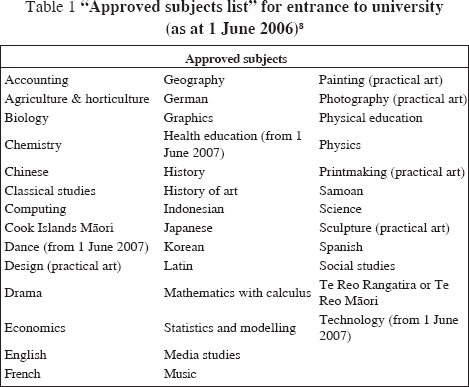
At the time of writing, a number of other established school subjects were in the process of lobbying for inclusion on this list (e.g., health, and home economics). Currently, there are strong disincentives for students to choose excluded subjects, if they intend to study at university.
After exploring several different options, the working party also developed a “standard” for university entrance. This specifies the credit total to be achieved, and the way in which those credits must be distributed between “approved subjects”. Students must also earn a specified number of literacy and numeracy standards (see Table 2).
Table 2 Current standard for university entrance (as at December 2005)9
•&;&;A minimum of 42 credits at Level 3 or higher on the National Qualifications Framework, including a minimum of 14 credits at Level 3 or higher in each of two subjects from the “approved subjects” list, with a further 14 credits at Level 3 or higher taken from one or two additional domains on the National Qualifications Framework or approved subjects;
•&;&;A minimum of 14 numeracy credits at Level 1 or higher in mathematics or Pangarau on the National Qualifications Framework; and
•&;&;A minimum of 8 literacy credits at Level 2 or higher in English or Te Reo Maori; 4 credits must be in reading and 4 credits must be in writing.
Within the terms of this standard for university entrance, for a school to offer a newly-designed subject (such as the hypothetical bioinformatics example), it could be seen as a high-risk undertaking. Students who chose such subjects may well earn the credit total needed for university entrance, but these credits might be distributed across too many conventional subjects. While the university entrance standard discourages a superficial skimming of knowledge areas—for example, the hotch-potch accumulation of achievement and unit standards across different subject areas—it may also act against innovation, even when a new subject has a coherent logic to its construction. For example, a student or a school might “invent” a new sandwich that is both palatable and nutritionally balanced, or they may have discovered and followed a recipe that is hugely successful and popular in the world outside the restaurant, but which is not yet familiar to the nutritionist. Will the “nutritionist” (i.e., the committee that determines the standards for university entrance) be flexible and adaptable to these new ideas, or will it be too hard to incorporate new sandwich recipes into the nutritionist's “approved” list?
Is there a need for a principled curriculum design in the senior secondary years?
A key message to be drawn from the discussions above is that, since the 1990s, many “decisions” about the New Zealand senior secondary curriculum have been implicit decisions made in the context of explicit decisions about assessment and qualifications. For example, the decision to develop a broad array of unit standards in the 1990s, and the decision to enable both unit standards and achievement standards to count towards NCEA, entailed an implicit decision to have a wide range of curriculum options, beyond the “traditional” subjects, available to senior secondary learners. On the other hand, the decision to develop achievement standards for the conventional School Certificate/Bursary subjects entailed an implicit decision to maintain the organisation of parts of the senior secondary curriculum around familiar “academic” subjects. Furthermore, decisions about what would be specified in the achievement standards for each subject were implicit decisions about what students should be learning in that subject. While there may have been logical reasons behind all of these decisions, it does seem as though these decisions were made without an explicit overarching plan or philosophy on the purposes of the senior secondary curriculum as a whole. Have we, as a nation, a clear view about what students should be learning and doing in their final years of school? If we do, is this view based simply on the past—on what we experienced at school—or is it based on ideas about the future, and on what kind of educated young people we want or need in the twenty-first century?
Returning to the restaurant analogy one last time, perhaps we need to break away from our old ideas for a moment, and allow ourselves to think about the senior curriculum in an entirely new way. For example, in all of the scenarios discussed, schools and students are set up as consumers of curriculum. The sandwich ingredients are different pieces of subject and disciplinary knowledge that students are choosing, combining, tasting, and digesting. The students' sandwiches may provide them with a satisfying meal, and contribute essential nutrients to their bodies and minds, enabling them to go on to do great things when they leave the restaurant. If they develop strong tastes for particular sandwiches, they may even go out and start making those kinds of sandwiches outside the restaurant. Conversely, their experience in the restaurant may be so dissatisfying that it turns them off sandwiches for life.
What if, instead of being consumers, we set up our senior secondary education system so that students were knowledge producers? Many educationists are arguing that the school system needs a major overhaul if it is to meet the needs of the post-Industrial “knowledge age” (see, for example, Gilbert, 2005). The move away from Industrial-Age thinking involves many important developments. For schools, however, the most significant of these is probably the focus on creating new knowledge—as opposed to the “old” focus on reproducing existing knowledge—and the associated shift in the meaning of knowledge. This shift has major implications for how we think about teaching and learning in schools, especially secondary schools. Secondary education needs to move away from the Industrial-Age, one-size-fits-all, production-line, model of education, to approaches that focus more on the learning needs of individuals.
Gilbert (2005) and other educationists suggest that, to participate successfully in twenty-first century society, people need to go on learning long after they leave school. To do this, they need to know quite a lot about learning: how they themselves learn; how others learn; and how to help other people learn. They need to be able to learn in groups as well as on their own, and they need to know how to create new knowledge. Gilbert notes that this does not mean that the “old” knowledge that is the basis of the present curriculum is no longer important. It is still important, and students still need to learn it, but in the post-Industrial Age, the reasons for learning it are now different. Instead of learning it for its own sake, or so that it can be preserved and passed on, students need to understand “old” knowledge so that they can use it to develop new knowledge. Gilbert argues that if they are to do this, they need to understand it at the “big picture”, “systems” level, not just at the level of detailed facts. They need to understand how different knowledge systems are constructed, how they work, and what their particular strengths and weaknesses are. Traditionally, this kind of understanding was developed only in those who went on to higher education (where they were trained to be the developers of new knowledge). Gilbert (2005) argues that an important aspect of our move into post-Industrialism, however, is that everyone now needs this kind of understanding—which of course has major implications for curriculum and pedagogy, at all levels of schooling.
For example, using the restaurant analogy, instead of being consumers, students could be trainee restaurateurs. This would provide them with an entirely different kind of experience of being in the “restaurant” (i.e., their school or main place of learning). For example:
•&;&;Instead of just seeing and choosing from the available ingredients (chunks of subject/disciplinary knowledge), the students would have opportunities to learn where each of those ingredients came from. Where was it grown? (Where did this knowledge come from?) Who brought it here? (Who decided it was important enough to be in the curriculum?) Who sliced it up this way? (Who decided that the knowledge should be partitioned into these particular groupings/chunks?)
•&;&;Instead of just learning which ingredients are considered “nutritious” (educationally valuable), they could investigate what makes them nutritious (i.e., why they may be thought to promote critical, higher-order thinking—or communication skills, or other attributes of an educated person). They could investigate whether the same “nutrients” can also be sourced in other foods.
•&;&;Instead of just accepting the sandwich recipes (subjects and disciplines) that the restaurant already knows, they could go and find out which recipes and foods (new subjects and disciplines) are becoming popular in the rest of the world, and investigate whether such recipes are nutritionally balanced (educationally valuable), and whether they meet the needs/tastes of the New Zealand market.
•&;&;They can learn how the “restaurant” business works (i.e., the education system and the rest of society), what it takes to be entrepreneurial, and how to operate successfully in environments which involve interactions with many other kinds of people (e.g., society, the working world, etc.).
•&;&;They can learn to grapple with the moral and ethical issues involved in operating a “restaurant” (i.e., a business, a community, a society, or a national economy). Does our food come from sustainable sources? Are our food products good for New Zealanders' health and wellbeing? Do we use food or products from sources that involve unethical labour? Can we limit or reduce the harmful impacts of our restaurant on the environment? How can we balance the social and ethical responsibilities with sustainable and successful business practice?
One final question
A final question to consider is this: What should the Ministry of Education's role be in shaping the New Zealand senior secondary curriculum? Should it be a developer, broker, and/or “checker” of the senior school curriculum? What other possible roles could the Ministry have in the future of New Zealand's senior secondary curriculum? The above discussion outlines areas of tension and uncertainty, in the current situation, that are in need of resolution. However, it is not clear that simply developing new curricula, or setting in place systems for checking each teacher's or each school's curriculum designs, will comprehensively address these issues. The societal changes described in the “knowledge era” literature are complex, and have far-reaching implications for the whole education system. Therefore, it seems that all of us, including teachers, school leaders, students, the public, and the Ministry of Education, may need to take a more holistic look at the senior secondary curriculum. This means rising above looking at its constituent parts, to consider its overall effectiveness in preparing students to live in (and create) the twenty-first century world. As Deer and Seddon (1992) point out:
… the difficulty of defining curriculum for the post-compulsory years goes beyond simply accurately analysing contemporary developments in society and curriculum. Analysis is an important first step but we cannot shape the present course of schooling unless we have a vision of the future. (p. 11)
In this case, it does seem clear that an appropriate role for the Ministry of Education would be to facilitate deeper discussion on the relationship between curriculum, assessment, and pedagogy, and to examine whether our current curriculum and assessment practices are consistent with some of the goals and aims that have been articulated for twenty-first century senior secondary education.
References
Alison, J. (2005, 11 May). Issues around the senior curriculum. Unpublished paper presented to the Curriculum Project meeting, Brentwood Hotel, Wellington.
Bolstad, R. (2004). School-based curriculum development: Principles, processes, and practices. Wellington: New Zealand Council for Educational Research.
Bolstad, R. (2005). The shape and scope of the senior secondary curriculum: A background paper. Report prepared for the Ministry of Education. Wellington: New Zealand Council for Educational Research.
Bryce, J., & Withers, G. (2003). Engaging secondary school students in lifelong learning. Melbourne: Australian Council for Educational Research.
Deer, C., & Seddon, T. (1992). The challenges of post-compulsory education and training. In T. Seddon & C. Deer (Eds.), A curriculum for the senior secondary years (pp. 3–13). Melbourne: Australian Council for Educational Research.
Dwyer, P. (1995). Pathways in post-compulsory education—from metaphor to practice. Australian Journal of Education, 39(2), 146–162.
Gilbert, J. (2005). Catching the knowledge wave? The knowledge society and the future of education in New Zealand. Wellington: NZCER Press.
Hipkins, R., Conner, L., & Neill, A. (2006). Shifting Balances 2: The impact of NCEA implementation on the teaching of geography and home economics. Wellington: New Zealand Council for Educational Research.
Hipkins, R., Vaughan, K., Beals, F., & Ferral, H. (2004). Learning curves: Meeting student learning needs in an evolving qualifications regime. Shared pathways and multiple tracks: A second report. Wellington: New Zealand Council for Educational Research. Retrieved 30 June 2004, from http://www.nzcer.org.nz
Horrocks, R., & Hoben, N. (2005). Media studies and English in the New Zealand curriculum. Paper prepared for the New Zealand Ministry of Education New Zealand Curriculum/Marautanga Project. Wellington: Ministry of Education.
le Métais, J. (2003). International developments in upper secondary education: Context, provision, and issues. Dublin: National Council for Curriculum and Assessment. Retrieved 22 April 2005, from http://www.inca.org.uk/pdf/cav_final_report.pdf
McKinley, E., & Waiti, P. (1995). Te Tauākī Matauranga Pūtaiao: He tauira—the writing of a national science document in Māori, SAMEpapers (pp. 75–95). Hamilton: University of Waikato.
McLaughlin, M. (2003). Tertiary education policy in New Zealand. Wellington: The Ian Axford New Zealand Fellowship in Public Policy.
Miller, R. (1996). Measuring what people know: Human capital accounting for the knowledge economy. Paris: Organisation for Economic Co-operation and Development.
Ministry of Education. (1993). The New Zealand curriculum framework. Wellington: Author.
Ministry of Education. (1999). Introducing the National Certificate of Educational Achievement: Developing achievement standards. National Certificate of Educational Achievement, issue 1, June.
Ministry of Education. (2000). Report from the secondary schools sector forum. National Certificate of Educational Achievement, April.
New Zealand Government. (1999). The national qualifications framework of the future: White paper. Wellington: Ministry of Education.
New Zealand Qualifications Authority. (2000). University Entrance and the National Certificate of Educational Achievement: A consultation document prepared by the University Entrance Working Party. Wellington: Author. Retrieved 20 June 2005, from http://www.nzqa.ac.nz/publications/ue-under-ncea.pdf
New Zealand Qualifications Authority. (2001). School qualifications handbook: Regulations, prescriptions. Wellington: Author.
Reid, W. (1987). The functions of SBCD: A cautionary note. In N. Sabar, J. Rudduck, & W. Reid (Eds.), Partnership and autonomy in school-based curriculum development (pp. 115–124). Sheffield: University of Sheffield, Division of Education.
Notes
1&;&;For example, a decline in the proportion of “blue collar” jobs and an increase in the proportion of “white collar” jobs, which are believed to require more education; and the emergence of the view that all students should be encouraged to stay in school for as long as possible.
2&;&;However, school is compulsory for students until they turn 16, which may occur when the student is in school Year 11.
3&;&;In the development of NCEA achievement standards, the existing curriculum documents in each area were cited as one important source of guidance for the standards developers.
4&;&;This in turn raises questions about whose views are, or should be, represented in the development of curriculum statements, and whose views are typically excluded (Bolstad, 2004; McKinley & Waiti, 1995; Reid, 1987).
5&;&;For an example of this in a New Zealand secondary school subject, see the discussion of changes to teaching practice in home economics in the recent Shifting Balances 2 research (Hipkins, Conner, & Neill, 2006).
6&;&;Media studies was a Sixth Form Certificate subject and there had been a history of lobbying for it to become a Bursary subject. It was probably on this basis that it was included in the list of subjects to have achievement standards developed (see Horrocks & Hoben, 2005).
7&;&;Section 257 of the Education Act 1989 requires the NZQA to set a common standard for entrance to university. In doing so, it must consult with the universities and the New Zealand Vice Chancellors' Committee.
8&;&;Source: the New Zealand Vice Chancellors' Committee website: see http://www.nzvcc.ac.nz/default.aspx?l=4&p=32
9&;&;Source: the NZQA website: see http://www.nzqa.govt.nz/ncea/acrp/secondary/6/62.html
The author
Rachel Bolstad is a researcher at the New Zealand Council for Educational Research. In 2005, she was commissioned to prepare a background paper on the senior secondary curriculum for the leaders of the New Zealand Curriculum/Marautanga Project.
Email: rachel.bolstad@nzcer.org.nz