Reframing, refocusing, and revitalising:
The inclusion of identity in the
New Zealand curriculum
Alexis Siteine
Abstract
The social phenomenon that is “identity” appears to have gained prominence in the landscape of New Zealand educational curriculum during the three decades of curriculum development, review, and change that began in the 1980s. While the term identity is a recent addition in national curricula, the concept of identity has been a constant inclusion in the goals, rationale, and purposes of state education. However, the nature and use of this concept has shifted. This article sets the term apart from the concept and argues that the explicit use of the term in 21st century curricula, if unchallenged, can have deleterious effects for New Zealand learners.
Introduction
The term identity is ubiquitous within society and in popular culture. Phrases like identity theft, identity crisis, identity cards, and identity disorders are now common in daily conversations. In spite of its widespread and frequent usage, it is a relatively new term that gained popularity amongst social scientists in the 1950s (Gleason, 1983). The pervasiveness of its use in popular culture is reflected in its relatively recent appearance in New Zealand curricula. In fact, it appears to have gained prominence in the landscape of New Zealand curriculum during the three decades of curriculum development, review, and change that began in the 1980s. This article examines the inclusion of identity in curriculum and questions why it has appeared and how it is to be understood. I set apart the term identity from the concept of identity and argue that the explicit use of the term in 21st century curricula signals a change in the way the concept of identity is understood and the way curricula are enacted. The unchallenged inclusion of the term and uncritical acceptance of the concept has the potential to disadvantage all learners, but especially learners from historically marginalised groups for whom the recognition of identity was part of a plan intended to promote educational success.
Theoretical framework
A social realist lens is used to critique the inclusion of the term identity in the curriculum and to explain the implications of this inclusion. Social realism is a critical theory that takes as its starting point the concern of educational sociologists that one of the most fundamental inequalities in education is access to knowledge. Two oppositional solutions to this concern are held within the sociology of education: constructivist/relativist and realist. Constructivist solutions have been to give voice to historically silenced and marginalised groups in order to interrupt the reproduction of what are seen as dominant, conservative, and elitist views in curriculum. Knowledge is believed to be socially constructed, grounded in the experiences of those who hold that knowledge and, as such, it reflects the historical and social conditions under which it was produced. This view of knowledge can be understood in the context of Popper’s (1945/2003) description of social constructivism as:
the theory that our thoughts and opinions are dependent on our class situation, or upon our national interests . . . It gives a determining power to forces outside our control. It is the belief that ‘we think with our blood’, or ‘with our national heritage’, or ‘with our class’. (p. 260)
Young (2010) refers to this relativist view of knowledge as “knowledge of the powerful” and explains that this approach to curriculum prioritises the knower over the knowledge (p. 11).
A social realist view, on the other hand, affirms the idea that knowledge is socially constructed but also recognises that knowledge has emergent properties that allow it to transcend the social and historical contexts of its production (Moore, 2007). As such, knowledge can be accessed by any knower, in any place, and at any time. The knowledge is public and open to critique and judgement according to methods of various disciplinary communities. A social realist approach differentiates this form of knowledge (that which is open to disciplinary critique) from social knowledge (that which is acquired in the course of one’s social experiences) or closed knowledge (that which can only be known as a group “insider”). Neither social nor closed knowledge are open to critique—they are both produced and understood within the confines of experience and/or culture.
This differentiation of knowledge is fundamental to the social realist position. It is based on Durkheim’s (1926) theorising of the profane and sacred orders of knowledge, conceptualised by Bernstein’s (1999) horizontal and vertical discourses, and more recently described by Young (2010) as “knowledge of the powerful” and “powerful knowledge”. Each of these binaries acknowledges but separates knowledge that is related to the experiential and everyday from disciplinary knowledge. Furthermore, Bernstein’s development of the idea of boundaries is useful as a means of separating knowledge from experience. He explains that these boundaries are the social basis of people’s identities and that without the boundaries that exist between home and school, learners can be trapped in their experience and never move beyond it. This explanation is significant for two reasons. First, it is the basis for the social realist position that the central purpose of schooling and of the curriculum is to provide access to powerful knowledge that takes learners beyond their experience. Second, the idea that boundaries exist separating knowledge from experience is central to literature on identity (see, for example, Brewer, 2003). This article supports these views by arguing that the explicit inclusion of the term identity within the curriculum has allowed a greater emphasis on the social and experiential which, in turn, is “symptomatic of a trend” (Ormond, 2011) in New Zealand curriculum that has led to “to a reduction or even an ‘evacuation of content’” (Young, 2010, p. 21), namely powerful knowledge.
Methodology
Critical discourse analysis (CDA) was used as a methodological strategy to examine contemporary curriculum change: the recent inclusion of the term identity in the New Zealand curriculum. The first stage of CDA is to focus upon the problem under study and consider it within a broader social and political context. CDA asks “What changes have taken place and are taking place in forms of interaction around political and social issues?” (Fairclough, 2001, p. 230). In this study, both curriculum change and evolving conceptualisations of New Zealand identity (Callister, Didham, & Kivi, 2009) provide a wider backdrop to the study. Codd’s (1988) description of educational policy aligns with this kind of analysis:
Policies produced by and for the state are obvious instances in which language serves a political purpose, constructing particular meanings and signs that work to mask social conflict and foster commitment to the notion of universal public interest. In this way, policy documents produce real social effects through the production and maintenance of consent. (p. 237)
Beginning with the wider context rather than a specific research question makes clear the critical intent of this methodology: “the production of knowledge that can lead to emancipatory change” (Fairclough, 2001, p. 236). The current New Zealand curriculum (Ministry of Education, 2007) and the immediately preceding curriculum statements were examined for their use of the term identity. The text of these curricula was analysed using identity as a marker. The number of appearances was counted and each time the word appeared information was collected about where it was located, how it was used, and how it was framed. The text was also examined for the absence of the term, and questions raised about why it did or did not appear.
While CDA is concerned with textual language analysis, it is not confined to the text alone. CDA provides a way to move between the textual analysis and the social context of the problem under study. CDA draws on critical theory in the sense that it seeks to question and clarify the ways in which language can be used to obscure underlying meaning or intentions. Its purpose is “to show non-obvious ways in which language is involved in social relations of power and domination, and in ideology” (Fairclough, 2001, p. 229). This aspect of critical discourse analysis links the methodology to the social realist theoretical framework. Both the theory and the methodology raise questions about power and ideology associated with the problem under study. In the following sections, curriculum review in New Zealand and the notions of identity that are part of the curriculum are discussed in order to set out the problem of identity’s inclusion in the curriculum. The discussion begins by focusing on curriculum review relating to the 2007 national curriculum then looks back to preceding decades in order to contextualise these developments.
Curriculum revision and refocusing on identity
The most recent New Zealand national curriculum was published in 2007, following a curriculum stocktake that analysed the curriculum reform of the 1990s. The stocktake was concerned with the educational, social, and economic relevance of the curriculum as a whole (Ministry of Education, 2002). Two key ideas noted in the stocktake are germane to this article. First, the stocktake noted the shift in curriculum policy from a focus on content to that of outcomes. This shift is reflected in the development and publication of The New Zealand Curriculum Framework (Ministry of Education, 1993) and the National Curriculum Statements in each of seven essential learning areas. The New Zealand Curriculum Framework outlined a “seamless” progression of learning through eight levels of achievement from Year 1 to Year 13 of schooling with a view to providing equal learning opportunities for all students irrespective of “experiences, interests, and values” (Ministry of Education, 1993, p. 7) or ethnicity, gender, religion, or ability. The educational focus was adjusted from what students might learn about, as previously detailed in New Zealand school syllabi, to the processes of learning, in other words, the “how” over the “what”, or skills over knowledge. I will return to this idea and the reasons for this change later in this article.
Second, the report acknowledged the influence of societal change on educational aspirations and suggested the need to balance the social outcomes of education with academic achievement. Societal changes such as increased globalisation and educational orientations towards a future focus can be linked with the recommendation that “developing self-knowledge” (Ministry of Education, 2002, p. 3) be included as an essential skill in the 2007 curriculum. While this recommendation did not survive the process of curriculum revision, the notion of selfhood itself did, and is reflected in the many references to student identity in The New Zealand Curriculum (Ministry of Education, 2007). In all, the term identity or identities appears 17 times in the curriculum. The majority of references pertain to a student’s personal identity and address curriculum aspirations that students’ identities are recognised, considered, affirmed, strengthened, and understood. Further references relate to affirming and recognising a New Zealand national identity, understanding language as an expression of identity, and knowing about identity. Two single specific references are made to strengthening Mäori students’ identities, and the notion of multiple identities is acknowledged (see Figure 1). The significance of these references can be appreciated when compared with the usage of other terms that might be considered important in a national curriculum. The term citizen or citizenship, for example, appears 9 times, while the word learner features 16 times. There can be little doubt that the notion of identity holds a place of some significance in The New Zealand Curriculum.
To understand how identity was raised to this position in the 2007 national curriculum, examining the period of curriculum change prior to its publication is important in order to reveal its origins and the rationale for its inclusion. The next section presents data from curriculum statements immediately preceding the 2007 curriculum to support the claim made in the introduction of the article that the term identity appears to have gained prominence in curriculum. This statement suggests not just the presence of the term but also its importance and shifting meaning. The inclusion of data in this section is given as evidence of the pervasiveness with which the term appeared.
Figure 1. References to identity in The New Zealand Curriculum(2007)
| Vision | Positive in their own identity (p. 8) |
| Principles | The curriculum is non-sexist, non-racist, and non-discriminatory; it ensures that students’ identities, languages, abilities, and talents are recognised and affirmed and that their learning needs are addressed. (p. 9) |
| Key competencies | Opportunities to develop the competencies occur in social contexts. People adopt and adapt practices that they see used and valued by those closest to them, and they make these practices part of their own identity and expertise. (p. 12) |
| English | The study of New Zealand and world literature contributes to students’ developing sense of identity, their awareness of New Zealand’s bicultural heritage, and their understanding of the world. (p. 18) |
| Health education | Students build resilience through strengthening their personal identity and sense of self-worth, through managing change and loss, and through engaging in processes for responsible decision making. (p. 23) |
| Learning Languages | As [students] move between, and respond to, different languages and different cultural practices, they are challenged to consider their own identities and assumptions. (p. 24) |
| Learning in years 1-6 | The transition from early childhood education to school is supported when the school: fosters a child’s relationships with teachers and other children and affirms their identity (p. 41) |
| Principles | These principles put students at the centre of teaching and learning, asserting that they should experience a curriculum that engages and challenges them, is forward-looking and inclusive, and affirms New Zealand’s unique identity. (p. 9) |
| Official languages | Te reo Mäori is indigenous to Aotearoa New Zealand. It is a taonga recognised under the Treaty of Waitangi, a primary source of our nation’s self-knowledge and identity, and an official language. By understanding and using te reo Mäori, New Zealanders become more aware of the role played by the indigenous language and culture in defining and asserting our point of difference in the wider world. (p. 14) |
| By learning te reo Mäori, students are able to: . . . strengthen Aotearoa New Zealand’s identity in the world. (p. 14) |
| English | Translation of the whakataukï: Ko te reo te tuakiri, Ko te reo töku ahurei, Ko te reo te ora. Language is my identity, Language is my uniqueness, Language is life. (p. 18) |
| Learning Languages | Translation of a whakataukï: Ko tou reo, ko toku reo, te tuakiri tangata. Tihei uriuri, tihei nakonako. Your voice and my voice are expressions of identity. May our descendants live on and our hopes be fulfilled. (p. 24) |
| Languages and cultures play a key role in developing our personal, group, national, and human identities. (p. 24) |
| Social Sciences | Conceptual strand: Identity, Culture, and Organisation – Students learn about society and communities and how they function. They also learn about the diverse cultures and identities of people within those communities and about the effects of these on the participation of groups and individuals. As they explore how others see themselves, students clarify their own identities in relation to their particular heritages and contexts. (p. 30) |
| Official languages | By learning te reo and becoming increasingly familiar with tikanga, Mäori students strengthen their identities, while non-Mäori journey towards shared cultural understandings. (p. 14) |
| Dance | [Students] explore and use dance elements, vocabularies, processes, and technologies to express personal, group, and cultural identities, to convey and interpret artistic ideas, and to strengthen social interaction. (p. 20) |
Identity in the curriculum from 1994 to 2000
In The New Zealand Curriculum (Ministry of Education, 2007) the use of the term identity is most commonly found in overarching aspirational goals related to a student’s personal identity. Where it features in specific subject or learning areas, it can be found in English, Health and Physical Education, The Arts, and Social Sciences. For the most part, these learning areas present the affirmation of identity as end goals or the outcome of education. While each of these references to identity is succinct, due to the condensed nature of The New Zealand Curriculum, they have their genesis in preceding curriculum statements where fuller references are found (see Figure 2).
Figure 2. References to identity in curriculum statements prior to 2007
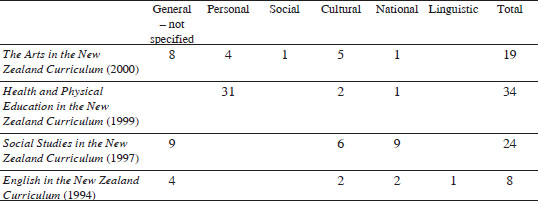
In Health and Physical Education in the New Zealand Curriculum (Ministry of Education, 1999) particular emphasis is placed on developing “students who know who they are” (Bolstad, 2004, p. 85). Personal identity is found in the achievement aims, achievement objectives, and strands at all levels of learning. It is coupled with the concept of “self-worth” in one of the named foci for the achievement objectives, a second focus being “identity, sensitivity, and respect”. Both foci are dispositional, emphasise the self, and are contextualised in personal experience. Each of these elements can be seen in the achievement objective written under the focus of “Personal identity and self-worth” for Level 7: “Students will critically evaluate societal attitudes, values, and expectations that affect people’s awareness of their personal identity and sense of self-worth in a range of life situations, for example, in relation to marital customs, child-rearing patterns” (Ministry of Education, 1999, p. 26). The fact that the term identity features 40 times in this curriculum statement is testament to the pervasiveness with which identity appeared in the newly blended learning area of Health and Physical Education.
Although appearing less frequently than in the Health and Physical Education curriculum, statement, personal identity also features in The Arts in the New Zealand Curriculum (Ministry of Education, 2000). The concept of identity, however, is widened beyond the personal to include national and cultural identity. In the 19 references to identity, the personal features four times and in two occurrences is coupled with cultural identity. National identity is mentioned only once as “a distinctive, evolving national identity” that incorporates and reflects “the arts of the Mäori” (p. 9). Cultural identity is more prominently featured as the arts are described as “a source of cultural experience and a vehicle for cultural expression” (p. 104). Where Health and Physical Education focuses only on developing students’ personal identity, The Arts focuses on the affirmation of a cultural identity.
Fewer references to identity are found in English in the New Zealand Curriculum (Ministry of Education, 1994). Personal identity is not specifically named, but “a sense of identity” (p. 6) as well as a cultural and national identity are referred to in the descriptions and explanations about the principles and characteristics of learning and teaching in the English learning area. One of the eight references to identity concerns learners’ use of first language as a means of affirming identity: “Confidence and proficiency in one’s first language contribute to self-esteem, a sense of identity, and achievement throughout life” (p. 6). Four references are general in their reference to identity, for example, “Language expresses identity” (p. 10); but the remainder are concerned with “New Zealand’s identity” (p. 7) rather than the learner’s identity. These references suggest that learning language and studying literature will develop and increase a sense of identity for learners or the nation.
Where Health and Physical Education and The Arts have a dispositional focus in The New Zealand Curriculum (2007), Social Sciences positions identity as content knowledge. In its preceding document, Social Studies in the New Zealand Curriculum (Ministry of Education, 1997), identity features throughout the statement in: a description about how the aim of social studies is met; concepts, settings, perspectives; and the strand of Culture and Heritage; but most significantly in two areas related to content. First, it features in a summary of essential learning about New Zealand Society where students will study New Zealand identity. Second, it features within the strands of Culture and Heritage and Place and Environment where students will develop knowledge and understanding about or related to identity. In contrast to Health and Physical Education and The Arts, which mention personal, cultural, and national identity, social studies focuses solely on the development of students’ cultural and national identity. Like Health and Physical Education, references to identity can also be found in the achievement objectives signalling the intention that students should develop knowledge and understanding about their own national and cultural identity as well as New Zealand’s identity. General references to identity are made, but these are most often as an expression of the contribution of culture and heritage to identity. Furthermore, social studies education is also concerned with the development, maintenance, expression, and challenges to New Zealand’s national identity. In each of these curriculum statements, students will develop knowledge and/or dispositions that will help them know themselves, their heritage, and their national distinctiveness.
The preceding data documents the way in which the term identity was included in recent curriculum and new conceptualisations of personal and cultural identity were included to expand the traditionally recognised view of national identity. I will now return the question of why the term identity features so prominently in the curriculum. Following 10 years of development and implementation of the curriculum statements discussed above, a stocktake was undertaken. The stocktake sought to assess the manageability of the national curriculum and the capability of teachers to implement it. Furthermore, modifications to the curriculum were considered necessary in order to meet the Government’s goals for education: to “build an education system that equips New Zealanders with 21st century skills” and to “reduce systemic underachievement in education” (Cubitt, 2006, p. 196). Each of these goals, I contend, was the reason for a stronger focus on the concept of identity and the explicit inclusion of the term in recent curricula. Both required the rethinking of the established centralised model of curriculum decision making and the acknowledgement of minority groups that would begin to expand conceptualisations of identity beyond the national to include personal and cultural identity.
Reframing, refocusing, and revitalising curriculum
The building of a 21st-century education system and the reduction of underachievement in education required significant change. In fact, The New Zealand Curriculum Project (NZCP) commenced in 2003 with the aim of “reframing, refocusing, and revitalising” the national curriculum (Cubitt, 2006, p. 200). One aspect of the reframing, refocusing, and revitalising involved revisiting an idea that was raised and, for the most part, declined in the 1980s. The notion of school-based curriculum development (SBCD) was promoted as an alternative to centralised national curriculum decision making or a “top-down” model of curriculum design that was a feature of school curriculum since the inception of universal education in New Zealand (Bolstad, 2004).
While a hierarchically organised, centralised model of school curriculum was firmly entrenched in New Zealand’s educational history, it was becoming increasingly difficult to maintain. It was being threatened from two sources both beginning in the 1970s. First, it began to be challenged by writers influenced by neo-marxism, critical theorists, and sociologists in the “new” sociology of education who wrote a more critical analysis of the education system (see, for example, Shuker, 1987), and as teachers and schools sought a redistribution of power and a shift in the locus of decision making. Those calling for reform from the political left considered that the current system reproduced educational disadvantage for minority groups, such as the working class, women, and Mäori. Mäori and feminist activists called for equity and representation in what they regarded as “conservative, male-dominated Päkehä educational bureaucracy, with a view to both empowering their respective constituencies and increasing their own power base” (Codd & Openshaw, 2005, p. 158). Some 20 years later, these claims were substantiated in reports that showed marginalised groups, including Mäori and Pasifika students, were overrepresented in negative educational statistics, such as literacy and numeracy levels (Alton Lee, 2003; Organisation for Economic Co-operation and Development, 2001). These students were classified as priority learners by the Ministry of Education in their attempt to recognise and address systemic underachievement. One of the principal solutions for addressing underachievement was to focus on affirming marginalised students’ identities. The Pasifika Education Plan 2009–12, for example, specifically connects Pasifika students’ achievement with their cultural identity “Success in education requires harnessing Pasifika diversity within an enabling education system that works for young people, their families and communities. This requires the education system, leadership, and curricula to start with the Pasifika learner at the centre, drawing on strong cultures, identities and languages” (Ministry of Education, 2009).
The second attack on the established, centralised system began as an economic one. Successive New Zealand governments had attempted to control and reduce costly educational expenditure due to the unavoidably large educational bureaucracy. This unwieldy system had become overly burdensome for the centralised government agencies tasked with operationalising government policy, and also for the government itself, which had the unenviable task of trying to satisfy a growing range of diverse interests groups who were making their competing and contradictory educational goals and aspirations more widely and actively known. Each of these groups believed they had the right and obligation to influence education and what should be taught at school. Employers, for example, claimed rights as future consumers of knowledge acquired by learners. The perspective of this group is captured in the following way:
Few bosses are going to be interested in whether a prospective employee can paste up a montage, splice a film, paint a poster or simulate a hot cross bun! But they will certainly be interested in whether he (or she) can read, write, speak and think effectively . . . Most schools are run on public money and the community at large including parents and employers have every right to expect a well-grounded, literate and competent product. (Christchurch Press, 14 September 1977. Cited in Snook, 1985, p. 256)
Devolving these responsibilities to schools through the model of SBCD was promoted as a solution to these problems:
These [problems] included perceptions that centralised curricula were too slow to keep pace with changing social and educational environments. SBCD was also strongly tied to a view that teachers should be developers, rather than simply transmitters, of curriculum. Today, central concerns for SBCD include developing school curricula to reflect local needs, bringing students and other people into the school curriculum development process. (Bolstad, 2004, p. 1)
Furthermore, the promotion of SBCD was seen to be more aligned with the culture of curriculum development and change in New Zealand education mentioned earlier: consultation with and participation of the voices of important stakeholders, i.e., schools, teachers, and their parent communities.
Not only was this a significant shift in the way decisions about curriculum would be made but also to the way curriculum was to be understood. William Reid, from the University of Sheffield, writing about SBCD in the 1980s explained that the “means by which the curriculum is planned affects the conception we have of what the curriculum is” (1987, p. 116). SBCD promoted a shift in the location of where and who would decide what was to be included in the curriculum as well as a shift in thinking away from curriculum as “a collection of things-to-be-learned” (Reid, 1987, p. 118) and towards a view of curriculum “as a tool for shaping identity” (Bolstad, 2004, p. 85). The notion of curriculum as a tool for shaping identity has implications for the fundamental concern of social realists discussed earlier in this article: what is taught at school? Hipkins (2006), in a background paper exploring the nature of “key competencies”, explained the importance of the competencies to foster lifelong learning. In so doing, she argued against the practice of teaching content in favour of helping students to “become the people they aspire to be—to develop identities that last well beyond school” (p. 53). The development of identity, thus, gains prominence as the knower’s experiences are prioritised over knowledge in curriculum. This refocusing on the experiences of learners has led to what has been described earlier in this article as an “evacuation of content” (Young, 2010, p. 21) and more recently explained by Wood and Sheehan (2012) as a dislodging or sidelining of powerful knowledge from the New Zealand curriculum. There is a risk in the shifting of focus in relation to identity that learners may not be expected to engage with knowledge about identity and how personal, group, and national identities are constructed and maintained. Opportunities to acquire the powerful knowledge that supports critical citizenship and critique of social developments and structures are potentially reduced.
Conclusion
The inclusion of the term identity in the national curriculum, therefore, can be understood as being integral to achieving the stated goals of developing a 21st century education system and for addressing systemic underachievement. As a result, the relatively swift and unproblematised appearance of identity in the curriculum has a two-fold deleterious effect. First, a focus on developing dispositions related to identity changes the nature of curriculum because it has the potential to displace subject knowledge in the curriculum. I have argued earlier that the displacement of knowledge undermines the central purpose of schooling, namely to provide equitable access to powerful knowledge. Those students who do not have access to such knowledge in other spheres of their lives are disadvantaged as a result of the curriculum provided at school. Second, I acknowledge that the inclusion of identity as a way of ensuring that marginalised groups are recognised and affirmed in the context of school is an important pedagogical practice. However, the conflation of culturally responsive pedagogies with the content of curriculum does not provide opportunities for students to move beyond their social identities. It has the potential effect of trapping them within their experiences and limiting their learning to that which they already know or have access to elsewhere.
The purpose of this article has been to draw attention to the changes that have accompanied the inclusion of identity in curriculum and to raise a voice of caution that these changes may disadvantage learners in general and result in greater inequality for learners who are already disadvantaged. Young and Muller (2010) warn against educational initiatives and pedagogies such as these that have the effect, despite their best intentions, “to render the contours of knowledge and learning invisible to the very learners that the pedagogy was designed to favour—namely the learners, invariably but not always those from low income homes, who fall behind their peers” (p. 19). If the use of the term identity remains unchallenged and its inclusion in curriculum is not critiqued, then not only will it undermine the goals its inclusion attempts to address, but its inclusion may further disadvantage the groups it attempts to serve.
References
Alton-Lee, A. (2003). Quality teaching for diverse students in schooling: Best evidence synthesis. Wellington: Ministry of Education.
Bernstein, B. (1999). Vertical and horizontal discourse: An essay. British Journal of Sociology of Education, 20(2), 157–173.
Bolstad, R. (2004). School-based curriculum development: Principles, processes, and practices. A background paper on school-based curriculum for the New Zealand curriculum project. Wellington: New Zealand Council for Educational Research.
Brewer, M. B. (2003). Optimal distinctiveness, social identity, and the self.
In R. Leary & J. P. Tangney (Eds.), Handbook of self and identity (pp. 480-491).
Callister, P., Didham, R., & Kivi, A. (2009). Who are we? The conceptualisation and expression of ethnicity. Official Statistics Research Series, 4, 1–56. Retrieved from http://www3.stats.govt.nz/statisphere/Official_Statistics_Research_Series/Who_are_we_The_Conceptualisation_and_Expression_of_Ethnicity.pdf
Codd, J. A. (1988). The construction and deconstruction of educational policy documents. Journal of Education Policy, 3(3), 235–247.
Codd, J., & Openshaw, R. (2005). The education system in Aotearoa New Zealand. In P. Adams, R. Openshaw, & J. Hamer (Eds.) Education and society in Aotearoa New Zealand (pp. 155–186). Melbourne, VIC: Thomson Dunmore Press.Cubitt, S. (2006). The draft New Zealand curriculum. Curriculum Matters, 2, 195–212.
Durkheim, E. (1926). The elementary forms of religious life (J. W. Swain, Trans.). London: Allen & Unwin. (Original work published 1912).
Fairclough, N. (2001). The discourse of new labour: Critical discourse analysis. In M. Wetherell, S. Taylor, & S. J. Yates (Eds.), Discourse as data: A guide for analysis (pp. 229–266). London: Sage.
Gleason, P. (1983). Identifying identity: A semantic history. The Journal of American History, 69(4), 910–931.
Hipkins, R. (2006). The nature of the key competencies. Wellington: New Zealand Council for Educational Research.
Ministry of Education. (1993). The New Zealand curriculum framework. Wellington: Learning Media.
Ministry of Education. (1994). English in the New Zealand curriculum. Wellington: Learning Media.
Ministry of Education. (1997). Social studies in the New Zealand curriculum. Wellington: Learning Media.
Ministry of Education. (1999). Health and physical education in the New Zealand curriculum. Wellington: Learning Media.
Ministry of Education. (2000). The arts in New Zealand curriculum. Wellington: Learning Media.
Ministry of Education. (2002). The curriculum stocktake report. Retrieved from http://www.educationcounts.govt.nz/publications/curriculum/5815
Ministry of Education. (2007). The New Zealand curriculum. Wellington: Learning Media.
Ministry of Education. (2009). Pasifika education plan 2009–2012. Retrieved from http://www.ero.govt.nz/National-Reports/Improving-Education-Outcomes-for-Pacific-Learners-May-2012/Introduction/The-Pasifika-Education-Plan-2009-2012.
Moore, R. (2007). Sociology of knowledge and education. London: Continuum.
Organisation for Economic Co-operation and Development. (2001). Knowledge and skills for life: First results from PISA 2000. Paris: Author.
Ormond, B. (2011). Shifts in knowledge teaching: The unexpected consequences of assessment practices on secondary history. Pacific-Asian Education, 23(1), 5–22.
Popper, K. (2003). The open society and its enemies. London: Routledge. (Original work published 1945).
Reid, W. (1987). The functions of SBCD: A cautionary note. In N. Sabar, J. Rudduck, & W. Reid (Eds.), Partnership and autonomy in school-based curriculum development (pp. 115–124). University of Sheffield: Division of Education.
Shuker, R. (1987). The one best system?: A revisionist history of state schooling in New Zealand. Palmerston North: Dunmore Press.
Snook, I. (1985). Contesting the curriculum: The politics of ‘basics and frills’. In R. Harker, J. Codd, & R. Nash (Eds.), Political issues in New Zealand education. Palmerston North: Dunmore Press.
Wood, B., & Sheehan, M. (2012). Dislodging knowledge? The New Zealand curriculum in the 21st century. Pacific-Asian Education, 24(1), 17–30.
Young, M. (2010). Why educators must differentiate knowledge from experience. Pacific Asian Education, 22(1), 21–32.
Young, M., & Muller, J. (2010). Three educational scenarios for the future: Lessons from the sociology of knowledge. European Journal of Education, 45(1), 11–27.
The author
Alexis Siteine is a senior lecturer in the School of Critical Studies in Education, Faculty of Education at the University of Auckland. Her current research focuses on theorising the relationship between identity, knowledge, and curriculum from a social realist perspective. Recent projects include social sciences curriculum development in the Republic of Nauru.
Email: a.siteine@auckland.ac.nz