Key competencies: a new way forward or more of the same?1
Alan Reid
Abstract
This article explores and critiques the different ways in which the concept of “key competencies” has been understood and represented in the curriculum. It is argued that if competencies are to go beyond simply reinforcing the curriculum status quo, the role they play in the curriculum needs to be better understood. The article develops one approach to understanding competencies that will, it is argued, enhance their transformative potential.
Introduction
The idea/language of key competencies has been around for the past 20 years. The concept has travelled, being taken up in many places at different times, in new forms and with new emphases. Like most educational ideas, key competencies can be vehicles for simply reproducing the curriculum status quo, or for transforming the curriculum for social justice purposes. In my view, their various manifestations have been more of the former than the latter, but it does not have to be that way. I will argue that if key competencies are to fulfil their transformative potential, there is a need to understand how they can be understood, represented, and practised in curriculum terms.
The article is in three parts. In the first, I will describe how competencies have been, and are, understood and represented in curriculum, using mainly Australian examples. In the second, I will critique these dominant understandings on two major grounds: (a) that competencies lack a sturdy rationale; and (b) that competencies have not been understood adequately in curriculum terms. I will use this critique to develop a reconceptualised version of competencies. In the third part, I will speculate on the benefits that a different approach to understanding key competencies might bring.
Section A: What are key competencies and where have they come from?
In its first manifestation, the concept of key competencies was (and still is, in some countries) a term used to describe generic skills for the workplace. That is, key competencies were economically motivated—with the workplace being their major reference point. For example, key competencies, developed in Australia in the late 1980s to early 1990s, were defined in the Mayer (1992) report as:
… competencies essential for effective participation in the emerging patterns of work and work organisation. They focus on the capacity to apply knowledge and skills in an integrated way in work situations. Key Competencies are generic in that they apply to work generally rather than being specific to work in specific occupations and industries. This characteristic means that the Key Competencies are not only essential for effective participation in work but are also essential for effective participation in further education and in adult life more generally. (p. 7)
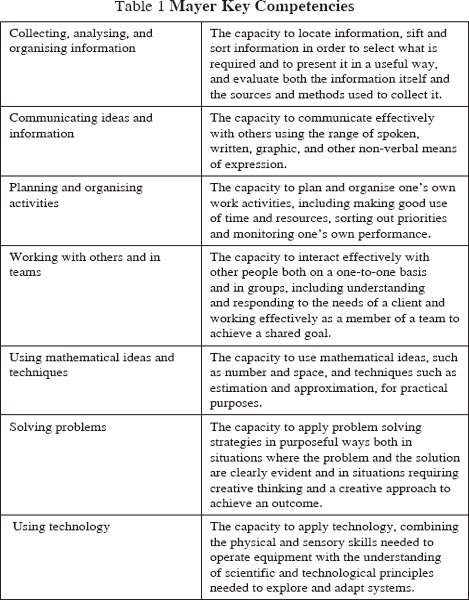
The Australian Mayer Key Competencies comprise competencies that are skills or attributes (see Table 1). They are seen as transcending traditional subject boundaries, and as therefore being “cross-curricular”. Whilst they can be developed within a specific subject area, the skill or attribute is not exclusive to a particular discipline. For example, “working in a team” is a generic skill. Students can learn to do this in many different contexts.
The Key Competencies are also seen as being important for all young people “regardless of the education or training pathway they follow” (Mayer, 1992, p. 1), and indeed as a bridge between general and vocational education (Mayer, 1992). That is, while they may have been motivated for economic reasons, they are also applicable to other aspects of life.
There were similar moves in other countries, such as the Scottish Core Skills, English Key Skills, New Zealand's Essential Skills, key competencies in a number of European countries, and the US Secretary's Commission on Achieving Necessary Skills, Workplace Know-How (Werner, 1995).
If the push for key competencies had developed as a result of employer demands, during the 1990s they began to be (re)shaped by educators who grappled with the task of working them into the curriculum. During this process, the narrow focus of employability skills began to expand in response to a number of critiques, which took two broad forms.
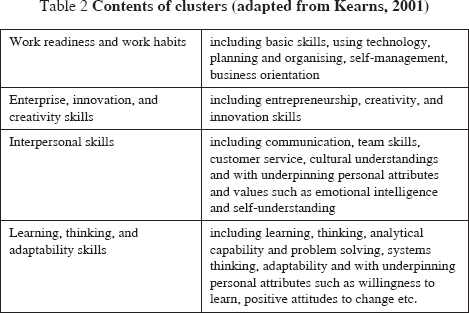
First, there were those who did not contest the fact that the competencies had an economic emphasis, but who argued that the key competencies were narrow in their description of employability capacities. In particular, they maintained that the lists of competencies were conceptually confused and neglected the human factors: the cognitive processes and the motivation that influenced the acquisition of competencies. For example, a report written for the National Centre for Vocational Education Research (Kearns, 2001) in Australia argued that a more holistic model was required. The report proposed clusters of key generic skills, all of which contributed to the development of autonomy, personal mastery, and self-direction. The contents of these clusters are shown in Table 2.
In a number of countries, as a consequence of this sort of critique, attempts were made to expand the focus of the key competencies to include personal attributes and values, even while the rationale remained primarily an economic one.
Secondly, there were those who saw this approach as giving in to economic interests—harnessing human capital (Collins, 1995), and making schools “servants of the economy” (Crittenden, 1995, p. 30). At the same time, these critics recognised the value of generic competencies. They wanted to expand the purpose of key competencies to encompass the social, cultural, environmental, personal, and political dimensions of life—and not only the economic dimensions. Gradually, these expanded versions of generic competencies began to appear in official curricula around the world. For example, a number of Australian states have coined the term “essential learnings” to encompass a range of competencies.
In the South Australian official curriculum—the South Australian Curriculum, Standards and Accountability (SACSA) Framework—for example, there are five essential learnings: communication; futures; identity; interdependence; and thinking. The SACSA Framework describes essential learnings as:
understandings, dispositions and capabilities which are developed through the learning areas and form an integral part of students' learning. They are resources which are drawn upon throughout life and enable people to productively engage with changing times as thoughtful, active, responsible and committed local, national and global citizens.
(South Australian Department of Education,
Training and Employment, 2001, p. 7)
There are a number of countries across the world, such as New Zealand, which have developed similar lists, and which are seeking to make these a central part of their curriculum. So, too, are many universities. For example, the University of South Australia describes the sort of graduate it is seeking to develop in all programmes, as one who:
1.&;&;operates effectively with and upon a body of knowledge of sufficient depth to begin professional practice
2.&;&;is prepared for lifelong learning in pursuit of personal development and excellence in professional practice
3.&;&;is an effective problem solver, capable of applying logical, critical, and creative thinking to a range of problems
4.&;&;can work both autonomously and collaboratively as a professional
5.&;&;is committed to ethical action and social responsibility as a professional and citizen
6.&;&;communicates effectively in professional practice and as a member of the community
7.&;&;demonstrates international perspectives as a professional and as a citizen.
(University of South Australia, 2006)
In summary, when we talk about key competencies it is important to recognise that we may be talking about very different conceptions of their purpose and their representation. I have suggested that there seems to be at least two broad approaches to key competencies. The first has a utilitarian economic focus, and is organised around an intention to develop competencies for the workplace and the new economy. The second has a liberal humanist focus, and is organised around an intention to develop competencies, in every individual, for civic and personal as well as economic life.2
Section B: The critique
I wish to raise two major concerns regarding the ways in which key competencies are being understood and practised in various countries. First, they lack a sturdy theoretical rationale; and secondly, they have not been theorised in curriculum terms. I will deal with each in turn.
The critique: rationale
In my view, the two versions of competency described above are inadequate as they currently stand. The economic version is instrumental, and runs the danger of limiting education to simply being a servant of the economy. The education version is too individualistic, placing too much emphasis on education as a private benefit, and too little on education as a social and public good, as well as a private benefit. I wish to suggest that there is an urgent need to develop a rationale for key competencies that goes beyond the economy and individuals, that is based on a commitment to democracy and social justice. I do not have the space here to argue a detailed rationale along these lines, but I will try to sketch out the bare bones of such an argument.
I wish to draw on the work of Sen (1992, 1999, 2002), and Nussbaum (2000), who have tried to reframe understandings about social justice and equality in development studies and welfare economics. Both have developed what has been called the capabilities approach, arguing that instead of economic growth, the indicator of a nation's quality of life should be capabilities—what people are actually able to do and be. “Capabilities to function” are the basis of a just society, because they ensure not only that people have rights, such as the right to political participation, but also that they have the capabilities to exercise those rights. Therefore, “capabilities to function” are a combination of the knowledge, skills, and dispositions that enable people to function in and on the world. They comprise the key ingredients for personal and collective agency. They are important indicators of what a person is able to do and to be in different arenas (e.g., work, civic, community, and personal life), and therefore the extent to which citizens in any society possess capabilities is an important measure of the civic health of that society. Education is central to their development.
From this perspective, the starting point for curriculum planning is (a) an identification of the capabilities needed to live enriched lives and to participate actively in democratic life, and (b) a description of the underlying principles inherent in the capabilities. These principles will guide subsequent practice. The initial curriculum question is: What are the capabilities, how do we understand them, and what are the principles and processes that will be used to facilitate their development?
Since the approach is based on a view of education as an end in itself, it has a democratic logic, suggesting that all capabilities should be developed to their fullest potential in all people. In a truly democratic society, educational provision must go beyond an aspiration for economic success or social control. This is not just for the pragmatic reason that people are more likely to be productive citizens and workers if they have not been alienated by their educational experiences, or if their human potential has been fully developed. It is primarily because such an aspiration must surely be the foundation of any democratic society. As John Dewey argued, it is a part of the essence of democracy that it “makes provision for participation in its good of all its members on equal terms” (Dewey, 1916, Chapter 7, summary, cited in Edwards & Kelly, 1998, p. 8). It makes little sense to construct an education system for a democratic society based on the idea that some capabilities can be developed in some students but not others, or in restricting the range of capabilities developed to those that, for example, only contribute to the economic health of a society. Surely, a democratic society demands equality of opportunity and entitlement for all, regardless of wealth, social class, gender, or ethnicity. It is the role of schools to develop the capabilities of all students to the fullest extent possible.
I wish to suggest that versions of generic skills and understandings—whether they are called essential learnings, graduate qualities, or competencies—can be understood in the same way as capabilities. This understanding rejects a single economic focus, and suggests that key competencies should represent the personal capacities that might be required to live, work, sustain relationships, and be a citizen in a nation-state in a globalising world.3
You may reject this rationale, but my point is that the nature of the rationale will largely determine what the key competencies are, and how they might be understood. The rationale I have outlined suggests that the two understandings of key competencies described earlier are inadequate.
The critique: the role of competencies in curriculum terms
The second aspect of the critique is that competencies have not been adequately theorised in curriculum terms. That is, not enough work has been done to understand the role that generic skills and understandings play as curriculum artefacts, such as their relationship to the learning areas/subjects. The focus always seems to be on the “content” of the competencies.
Now, in developing this critique, I will focus on the official or intended curriculum, recognising that what is intended is often at variance with what is enacted. But the written text does influence discourse and practice, and it does represent considered thinking about the place of aspects of the curriculum architecture such as competencies. It provides some sense of how competencies are being imagined/understood, and therefore the possibilities for practice.
From my investigations of official curricula around the world, there appears to be three main ways in which generic skills and understandings are represented.
1.&;&;The “name and hope” model: Here, there is a rhetorical flourish in the official document, with an exhortation that teachers pick these up and ensure that they are taught in their subjects. However, the rest of the document rarely returns to them, and certainly there seems to be no connection between the competencies and what is taught and assessed. In this model, there is no attempt to understand the role of competencies, nor how they might be enacted. They seem to be more like broad educational aims that will be delivered by the subjects or learning areas.
2.&;&;The “raising consciousness” model: Here, curriculum designers and teachers are asked to be conscious of the competencies when they design curricula. Some university models of graduate qualities, for example, expect that curriculum designers will apportion percentages to each graduate quality within a course and programme, with the expectation that there will be an equal coverage. Whilst such an approach does focus attention on the qualities, it fails to address the relationship between subjects/disciplines, assuming instead that a crude quantification will result in curriculum change.
3.&;&;The “embedded” model: Here, there is an attempt to describe the competencies inside the Learning Areas. This happens in a range of ways. For example, in the SACSA Framework, each key idea and learning outcome designates which essential learnings and key competencies should be developed. Apart from removing, from teachers, the capacity to decide when and how to develop particular competencies, the model atomises/fragments the competencies, and makes them subservient to the subjects/Learning Areas.
In my view, all three approaches are inadequate—because too little effort has been expended in thinking about the competencies as curriculum artefacts. As a consequence, they have little chance of disturbing the dominant grammars of the curriculum (Tyack & Tobin, 1994). They are simply accommodated inside traditional approaches, thereby reproducing the curriculum status quo. In summary, then, I think there is need to consider more deeply: (a) the nature of the dominant curriculum; and (b) how to understand the place and function of competencies in new curriculum approaches. What follows is a preliminary effort to do that.
Some reflections on the curriculum role of competencies
The dominant model of curriculum is represented in Figure 1 below.
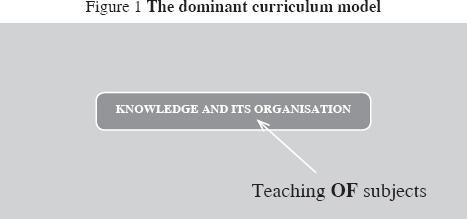
Since the starting point for the dominant model is the acquisition of knowledge content, a key curriculum question relates to how that knowledge is organised. Ivor Goodson (1997) has powerfully demonstrated that forms of knowledge organisation are not natural—they are socially constructed. In the twentieth century, knowledge content was typically packaged into subjects. These have taken on a life of their own, with their own hierarchies, status, traditions, and professional gatekeepers. Many of these are linked to disciplines. In the last decade of the twentieth century in Australia, the dominant form of curriculum organisation changed from subjects to Learning Areas. These are a hybrid mix of discipline-based knowledge and the grouping of “similar subjects”, and are slowly building a professional constituency of support.
When curriculum planning starts with knowledge content, the form of the curriculum largely determines the purposes of the curriculum—i.e., the teaching of subjects/Learning Areas becomes an end in itself. This makes the organisation of knowledge the focus of curriculum debate in relation to the official curriculum. Therefore, when the Learning Areas were formed in the early 1990s in Australia, the professional subject associations took up the cudgels—some lauding the new arrangements, others claiming that their subject interests had been neglected or watered down by them. Another form of this focus on knowledge content is the argument that the official curriculum is too crowded. However, although each of these approaches has a very different view on how knowledge content should be organised, they are similar in one very important respect: by accepting knowledge content as the starting point, they fail to shake free from the fundamental grammars of the dominant curriculum.
Where the dominant curriculum tradition has incorporated something like the concept of competencies, it has always been defined in relation to knowledge content, usually organised through subjects or Learning Areas (as per the three models outlined above). This has led to the competencies being marginalised, despite the rhetoric of curriculum documents. The power of the dominant curriculum grammars causes them to be absorbed into the logic of the subjects/Learning Areas, with the attendant problems of content atomisation and linear approaches to learning.
An alternative approach is to separate key competencies from knowledge content, and to understand each as playing distinct but complementary roles. This approach is presented in Figure 2 below.
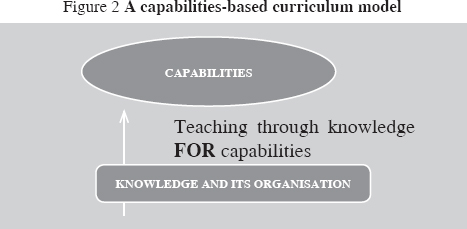
In this model, there are two parts to the official curriculum. The idea is to teach through one part—knowledge—in order to develop the second part: key competencies/capabilities. There are some key features of each part that need to be understood. It seems to me that key competencies should be understood and developed holistically. Each competency should be richly described in terms of procedural principles which describe what it is, and what the processes are for its development. The important requirement of these descriptions is that they do not atomise the competency by breaking it into many parts and expressing these parts as objectives or outcomes; instead, the procedural principles will seek to represent each competency as a whole, rather than as a sum of its parts. There may of course be variations in descriptions of each competency at different points in formal schooling, but these differences will be on the basis of an increasing complexity or sophistication of the whole competency—not as an aspiration to developing parts that will be aggregated. The pedagogical challenge is to plan learning experiences with reference to the whole competency/capability, even while one aspect of it might be the focus of a specific experience.
In this approach, the knowledge content part of the curriculum is no longer the starting and finishing point for curriculum planning, as it is in the dominant model. But rather, there is a dynamic interaction between the two. There will always be two things happening. Often the starting point will be content—say a key concept or idea from a discipline—but the design challenge is not only to decide how to introduce students to the concept, but also to decide which one or more of the competencies can be developed through that concept. That is, the knowledge/content is important in its own right and as the vehicle through which capabilities are developed.
This important shift makes the organisation of knowledge content a pedagogical activity—where the educator is selecting knowledge content with reference to its role in developing a competency, not solely as an end in itself. And it also changes traditional modes of assessment and reporting. Instead of assessment being related solely to how much knowledge content a student has learned, the focus is also on the extent to which the student can demonstrate a continued competency growth. This clearly has implications for the types and forms of assessment that are selected. Similarly, reporting on student progress—both to students and parents/guardians—will change. Rather than there being only a sole focus on subjects/Learning Areas, reports will also describe competency development, and this might be supplemented by student portfolios demonstrating the ways in which competency development has happened in other non-formal learning situations.
This might seem an unremarkable change, but in my view it fundamentally alters the nature of curriculum debate. In the following, and last, section, I wish to speculate on some ways in which a different understanding of competencies might address a number of apparently intractable/long-term curriculum questions and tensions.
Section C: What are some benefits of a reconceptualised approach to competencies?
It has the potential to address long-standing issues relating to equity in curriculum work.
The competencies-based approach provides a way to conceptualise equity, by addressing a number of the problems with previous approaches. Therefore, rather than understanding equity as a curriculum that is common to all—an approach that invariably favours those students whose knowledge is selected as the common/core knowledge—or as providing a range of diverse subject offerings—an approach that invariably results in hierarchies of subjects—the competencies-based approach seeks to promote “unity in difference, rather than disunity through sameness” (Kelly, 1995, p. 110). The aspiration to develop the broadly-described competencies to the fullest extent possible for all students provides the unity. The difference is catered for by the flexibility to select strategies for achieving the competencies that are appropriate to the needs of students in local contexts. The key point is that the development of the key competencies is an aspiration for all students. They cannot be differentially developed, even though students might take different pathways to achieving them.
It has the potential to address long-standing issues relating to hierarchies of knowledge.
The dominant curriculum is hierarchical, with those subjects comprising what Connell (1998) calls the competitive academic curriculum enjoying a reputation as the most rigorous, and being taken by those pursuing a university pathway. Non-academic subjects are relegated to the margins, invariably populated by the “weaker” students. For decades now—and always without success—curriculum designers have pursued the holy grail of “parity of esteem”, urging that subjects are treated equally. The fact is, that “subjects” have become the battle grounds of education—with turf wars being fought by subject guardians. Those subjects at the top of the pile refuse to concede ground.
Competencies may be the Trojan horse needed to destroy curriculum hierarchy. If competencies were taken seriously through being consciously and systematically taught, assessed, and reported on, they would assume an importance currently assigned to subjects. This would result in subjects becoming the vehicles through which competencies are achieved, rather than as ends in themselves. The first steps in reducing the cause of curriculum hierarchies will have been taken.
It has the potential to provide more educative forms of accountability.
The approach provides a focus for forms of accountability that are educative and do not narrow the curriculum. The current emphasis on literacy and numeracy tests and benchmarks has been criticised on at least two counts: that it promotes a constrained view of these important capacities; and that it assumes that they can be developed prior to and independently of other capacities. A competencies-based curriculum offers a mechanism for resolving these issues. For example, in many countries, literacy and numeracy are described as part of the broader competency of communication and multiliteracies. Understanding literacy and numeracy in this way means that when governments highlight them for accountability purposes, they are not isolated or constructed as an old version of the “Three Rs”. Rather, they are seen as being connected to associated functionings, and thereby defined as part of a larger whole.
Of course, this approach to accountability is applicable to all the competencies. Therefore, at various times one or more aspects of a competency might come into the spotlight for accountability purposes, leaving other aspects in the wings as the supporting cast. The spotlight may shift periodically, as different aspects are brought into focus and those previously foregrounded recede into the shadows but remain part of the cast. In addition to this, it would be possible to eventually benchmark the competencies and use them as the basis for gathering information about the health of education in a particular system. This work would require a great deal of trialling and research, but such activity would contribute to the development of deeper understandings about the competencies themselves, whilst providing a logic and coherence to national accountability structures and processes.
It has the potential to dissolve a number of the binaries that have dogged curriculum work for so long.
Competencies suggest a way to break down a number of unproductive curriculum binaries. These include:
Disciplinary v interdisciplinary
In the dominant approach to curriculum, issues such as disciplinary versus interdisciplinary knowledge are decided upon during the process of constructing the official curriculum. They are determined prior to the process of curriculum planning and teaching in schools. In a competency-based official curriculum, however, such decisions are taken by teachers on the basis of judgements about how best to develop a particular capability in her/his local contexts. Sometimes, it might be deemed appropriate to teach within a discipline or subject—at other times the decision will be to teach across a number of disciplines.
In this way, the approach doesn't set up an unproductive disciplinary versus interdisciplinary binary. No matter how knowledge content is organised in the official curriculum, the decision about whether or not to work within or across discipline boundaries is a professional one that is taken at the classroom level—as teachers work through the issue of how best to develop the competencies. It is not a decision that needs to be pre-determined. As a consequence, the model does not force the many professional associations that have been established around subjects/disciplines, to circle the wagons and defend their territory (e.g., Goodson, 1996). But, rather, it will encourage an ongoing classroom and eventually whole-of-profession consideration of the many different disciplinary—and interdisciplinary—ways of developing competencies. It is an approach that respects the status of discipline-based knowledge, whilst facilitating interdisciplinary work.
The top-down versus bottom-up approaches to curriculum change
A competencies-based curriculum dissolves the top-down/bottom-up binary that has dogged curriculum work for so long. This is because the structure is non-hierarchical and flexible. There is an interactive relationship between the competencies and the knowledge content, each part requiring the other. This enables a system-wide approach (competencies) with a lot of room for local interpretation. There will be many different ways to work towards the same competency, suggesting that top-down imposition will be less successful in terms of curriculum change than ongoing professional discussion, exchange of examples of good practice, and the development of appropriate resources. At the same time, the approach is not entirely locally-based and laissez-faire (i.e., bottom-up). The competencies and the associated accountability requirements ensure a commonality of purpose across a state, or indeed, as a national curriculum approach across Australia.
It has the potential to ground the notion of lifelong learning.
If the competencies define what people are able to do and to be, in a knowledge society they need to be developed throughout a person's life, not just during the years of schooling. Put another way, in a knowledge society, the idea of curriculum must go beyond the formal institutions of education—to embrace workplace, community, and recreational settings. The competencies-based approach is one way by which to ground the concept of lifelong learning in a knowledge society. The development, maintenance, and enhancement of competencies is something that should be a common community aspiration, and there are any number of ways that might happen. For example, why should processes for the development of government policy not require an educational impact statement (will this policy enhance or hinder the process of competency development?) in much the same manner as environmental impact statements are required? Could those who develop public spaces be required to consider how the space might be used to enhance certain competencies? Whether or not these are practical ideas, the point remains that an always provisional list of competencies provides a focus for the rhetoric of lifelong learning.
It has the potential to provide a focus for an ongoing curriculum conversation in the profession.
The dominant curriculum model establishes the official curriculum as a “thing”: something that is redeveloped every few years and then “implemented”. In this way, the official curriculum is constructed as a fait accompli, and the role of the teacher is confined largely to technical rather than conceptual considerations. As a consequence, professional conversations about curriculum issues are limited. By contrast, the competencies-based approach constructs the official curriculum as the starting point for curriculum discussion. This means that teachers are involved in ongoing discussion at two levels: at the wider across-system level, where discussion focuses on the nature of competencies; and at the local level, where discussion focuses on how to teach through knowledge content to achieve the competencies. In this way, the approach offers a way to generate stimulating professional debate—and, at the same time, to focus that debate. The official curriculum can be refined as the conversation proceeds, therefore constructing it as an evolving and dynamic resource—rather than one that is static and inert.
It has the potential to be a mechanism that democratises the curriculum and its processes.
In my view, curriculum discussions should be an important part of any democracy. However, there has always been a tension between (a) the involvement of the general community in discussion about curriculum, and (b) the fact that curriculum making demands professional educational expertise. The structure of the competencies-based approach I have described provides a way to resolve this tension. The competencies part of the curriculum should be the subject of general community debate and discussion, not least because it offers a focal point for ongoing discussion on the kind of society we want, and on what is needed for all citizens to live productive and enriching lives. These are democratic questions that should involve the citizenry of a nation-state, not be confined to professional educators. However, the knowledge content part of the curriculum, and the associated pedagogical issues including the selection and organisation of content and models of teaching and assessment, are matters that are the province of professional educators who have the expertise to make judgements in relation to these matters. Therefore, the two-part nature of a competency-based curriculum offers a natural way of encouraging democratic involvement in the curriculum of schools, whilst preserving the professional integrity of educators.
Conclusion
In this article, I have argued that the competencies/capabilities approach could be more of the same, or it could serve to transform the curriculum in more socially-just and democratic ways. I have suggested that in its various forms around the world, it has tended to be more of the former than the latter, for at least two main reasons. First, key competencies have lacked a sturdy rationale, and secondly, key competencies have been inadequately theorised in curriculum terms.
I have proposed one possible way of reconceptualising the key competencies, and have speculated about some possible benefits that this approach might bring in addressing a number of intractable curriculum issues. However, since we do not have sufficient empirical data upon which to base curriculum policy in this area, I want to urge that educational jurisdictions move gradually and systematically, using professional research and inquiry to test out the ideas in practice. Further to this, it should be possible to use competencies to create a curriculum conversation across countries, as educators grapple with the exciting conceptual issues they present, and share ideas and resources in relation to the ways in which they are working with these intriguing curriculum ideas in particular contexts and settings.
References
Collins, C. (Ed.). (1995). Curriculum stocktake. Canberra: Australian College of Education.
Connell, R. W. (1998). Social change and curriculum futures. Change: Transformations in Education, 1(1), 84–90.
Crittenden, B. (1995). Liberal and vocational education: Convergence or confusion? In C. Collins (Ed.), Curriculum stocktake (pp. 23–31). Canberra: Australian College of Education.
Edwards, G., & Kelly, A. V. (1998). Experience and education—towards an alternative national curriculum. London: Paul Chapman.
Goodson, I. (1996). Studying school subjects. London: Falmer Press.
Goodson, I. (1997). The changing curriculum: Studies in social construction. New York: Peter Lang.
Kearns. P. (2001). Generic skills for the new economy: Review of research. Leabrook, South Australia: National Centre for Vocational Education Research.
Kelly, A. V. (1995). Education and democracy. London: Paul Chapman.
Mayer, E. (Chair). (1992). Report of the committee to advise the Australian Education Council and Ministers of Vocational Education and Training on employment-related key competencies for post-compulsory education and training. Carlton: Australian Education Council.
Nussbaum, M. C. (2000). Women and human development: The capabilities approach. New York: Cambridge University Press.
Reid, A. (2005). Rethinking national curriculum collaboration: Towards an Australian curriculum. Canberra: Department of Education, Training and Science, Australian Government. Retrieved from http://www.dest.gov.au/research/publications/national_curriculum/default.htm
Sen, A. (1992). Inequality re-examined. Oxford: Clarendon Press.
Sen, A. (1999). Development as freedom. Oxford: Oxford University Press.
Sen, A. (2002). Rationality and freedom. Harvard: Harvard Belknap Press.
South Australian Department of Education, Training and Employment. (2001). South Australian Curriculum, Standards and Accountability Framework. South Australia: Author.
South Australian Government. (2006). Success for all: Ministerial review of senior secondary education in South Australia. Adelaide: Hyde Park Press.
Tyack, D., & Tobin, W. (1994). The grammar of schooling: Why has it been so hard to change? American Educational Research Journal, 31(3), Fall, 453–480.
University of South Australia. (2006). Graduate qualities. Retrieved 31 July 2006, from http://www.unisanet.unisa.edu.au/gradquals
Werner, M. C. (1995). Australian key competencies in an international perspective. Adelaide: National Centre for Vocational Education Research.
Notes
1&;&;This article is based on a paper delivered as the keynote address to the annual conference of the New Zealand Council for Educational Research held in the Wellington Convention Centre, Tuesday 18 April 2006. The second part is derived from a section of a Department of Education, Training and Science publication (Reid, 2005).
2&;&;It is interesting to note that, as educators have begun to use the concept of competency in its second or expanded form (albeit incorporating work skills), employers have begun to grow uneasy, and in Australia now, employability skills are being developed by business in parallel with the expanded versions of essential learnings.
3&;&;I have recently been involved in a major review of senior secondary education in South Australia. The recently released report argues that the following capabilities should be at the heart of the new certificate: communication; civic participation; health, wellbeing and personal development; work and knowledge work (South Australian Government, 2006).
The author
Alan Reid is Professor of Education at the University of South Australia. His research interests include educational policy, curriculum theory, and education and social justice. He has been involved in a number of key curriculum developments in Australia, most recently the review of senior secondary education in South Australia. He is an invited keynote speaker at many state, national, and international conferences each year. In 2004, he was awarded the Australian College of Educators' inaugural MacKillop Medal for distinguished services to education.
Email: alan.reid@unisa.edu.au