Listening to student voice
Mauricette Hamilton
Abstract
This article explores the value of listening to and heeding student voice. By doing so, teachers learn about the life experiences of students, and about how these contribute to the more formal learning environment of the classroom. They also learn the importance of explicitly articulating and adopting a relevant learning theory that acknowledges the classroom as a learning community, and so enables learning.
Introduction
The ability to listen to the student voice is, I believe, the most significant enabling factor for the building of caring, empowering relationships in the development of a learning community. In this article, I discuss this belief in the context of the emerging contemporary world view and the related understandings of connectedness and contextualisation. I also discuss a theory that understands learning holistically. This is enactivism. The theory of enactivism emanates from an ecological world view. This theory is useful, because an ecosystem and a learning situation exhibit similar characteristics. Belief in the importance of truly listening to student voice emerged from my research in a Year 7 classroom. Year 7 is the first year of secondary school in Victoria, Australia. It usually coincides with a move by the student to a school different from that in which he/she completed the seven years of primary schooling (the first year of schooling is called “Prep”: the Preparatory Year). After presenting the relevant literature, I include the stories of students as they communicate them—because they speak so powerfully about the experience we call learning in a connected environment (for more detail see Hamilton, 2005).
Relevant literature
Emerging contemporary world view
Until the second half of the twentieth century, the physical world was conceived as a series of contained entities arranged in a hierarchical order (Edwards, 1999; Macy, 1983; Morwood, 1997). The emerging contemporary world view understands everything as being interconnected. This world view does not see physical life as disconnected, separate entities, but as entities that are interrelated. As Macy (1983) puts it:
What had appeared before as separate entities dissolve into flows, and are seen to be patterns in these flows—patterns that sustain each other by means of their relationships and exchanges. Atoms, cells, plants, people, societies. … All are dynamic patterns, or open systems within systems. They influence each other so deeply that it is hard to decide where one leaves off and the other begins. (p. 119)
Macy describes all of these systems as manifesting flexibility and intelligence, as they integrate and differentiate in order to survive. This involves a process that all must embrace in order to develop (Capra, 1996, 2003; Macy, 1983). Part of this interdependent process is to “engage and enhance their own and each other's capacities” (Macy, 1983, p. 31).
The importance of interdependence is also emphasised in complexity theory, which states that systems, while consisting of parts, are best studied as wholes, since new properties emerge that cannot be predicted by an analysis of parts (Capra, 1996, 2003). As the whole exhibits properties that are not evident in any of the parts, “the nature of whole is always different from the mere sum of its parts” (Capra, 1996, p. 29). Each element is described in terms of its relationship to other elements. All are connected and interdependent, and the terms “connectedness” and “interdependence” are further developed by psychologists and educationalists.
Connectedness and contextualisation
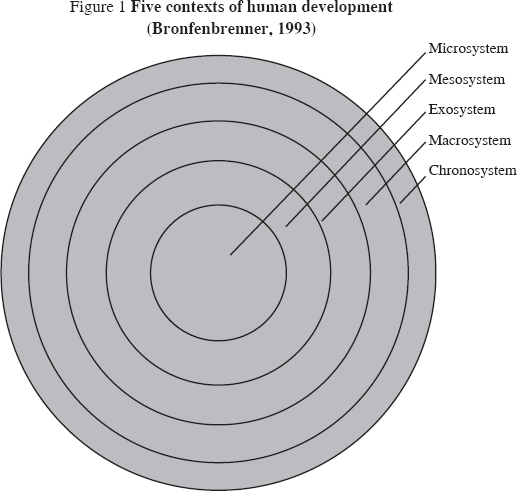
Contemporary psychologists have developed the term “connectedness” for expressing an essential ingredient for human living (Bernard, 1997). Discussion and debate continually returns to the concept, and understands its enaction as absolutely essential, if schooling is to be effective (Bernard, 1997; Hill & Russell, 1999). Therefore, relationships are core. Bronfenbrenner (1993) has also applied this directly to education, as he understands children's development to be contextualised within the relationships formed within their environment. Through the promulgation of his general ecological model of human development, Bronfenbrenner translates the notion of interdependence into the educational psyche. He describes human development as a complex, reciprocal, interactive, and evolving process, involving the immediate and remote environments in which a child interacts on a regular basis. Bronfenbrenner defines five contexts of development. The first is a microsystem consisting of the elements, both human and otherwise, of the environment in which the child interacts closely and regularly. Important in this context are family and school. The second context comprises the links established between settings in which the child interacts. Therefore, the relationship between family and school constitutes a mesosystem. A mesosystem incorporates a system of microsystems. The third context is defined by Bronfenbrenner as an exosystem, which is the combination of a number of settings—one of which does not contain the child. This may be the relationship between family members and their workplaces. The fourth, the macrosystem, combines microsystems, mesosystems, and exosystems, and pertains to the culture of the community in which the child resides. The fifth, the chronosystem, pertains to all of these, but in addition acknowledges changes over time that affect the community—and so affect the child—even though significant events may have occurred some time before the child was born. Therefore, educators are alerted to the environment, both immediate and remote, as interconnected and interdependent contexts in which the child develops. Figure 1 is a graphic interpretation of these five interrelated systems.
An understanding of the importance of the context in which the child exists is insufficient if the theory of learning espoused by a school, either explicitly or implicitly, cannot accommodate a broad range of learning experiences and assessment procedures. The learning theory that I think best supports student learning, as a complex reciprocal interactive process, is enactivism.
Enactivism: a biological theory of cognition
Enactivism is a theory of cognition emanating from an ecological paradigm. It is grounded in an analysis of living systems and cognition (Whitaker, 1995), and emanates from a world view as described by Macy (1983). It stems from the premiss that “cognition is a biological phenomenon and can only be understood as such” (Maturana & Varela, 1980, p. 7). Maturana and Varela (1992) describe knowing as “effective action, that is, operating effectively in the domain of existence of living beings” (p. 29). They maintain that “cognition is effective action, an action that will enable a living being to continue its existence in a definite environment as it brings forth its world” (pp. 29–30). Cognition is not “a representation of the world 'out there', but rather an ongoing bringing forth of a world through the process of living itself (p. 11). Knowledge, therefore, is effective behaviour in a given context, where the context is understood to be cultural in nature. Needless to say, such a conception of cognition and knowledge is at variance with the “normal” understanding of these terms in schools.
Self-organisation, or autopoietic theory, develops this understanding in the context of a system in which an organism engages with its environment (Whitaker, 1995). The identity of an organism is developed within the system, and both collective and personal identity are enhanced (Davis, Sumara, & Luce-Kapler, 2000). Systems that continually recreate themselves are defined as autopoietic, which involves acting to adjust to local conditions (Reid, 1998). This implies the interrelatedness of components of any system. Cognition is therefore understood by Maturana and Varela (1980) as interactivity, when they say “living systems are cognitive systems and living as a process is a process of cognition” (p. 13). The world we bring forth is done so in co-existence with others, as “we are continually immersed in this network of interactions. Effective action leads to effective action: it is the cognitive circle that characterizes our becoming” (Maturana & Varela, 1992, p. 241). Effective action, or cognition, is fundamental to existence, as “we only have the world we bring forth with others, and only love helps us bring it forth” (p. 248). If these notions are taken seriously, then clearly a new conception of what happens in school classrooms will emerge.
Enactivism: an educational theory
Enactivism is an emerging educational theory. Davis and Sumara (1997) developed the theory, reacting negatively to “the limitations of a mechanically based model of a complex human mind” (p. 108), and to the consequent understanding of knowledge as something external that must be acquired. Learning occurs in context in all domains of existence, and—in an enactivist understanding—both the identity of the learner and the nature of the context change as the learning occurs, because “[e]verything is inextricably entwined” (p. 111). Therefore, “cognition is understood as embodied” (Davis et al., 2000, p. 66), as learning is holistic. Learning, for Davis et al., is “participation in the world, a co-evolution of knower and known that transforms both” (p. 64).
Begg (2000) understands enactivism as “a recent development from constructivism” (p. 51). Constructivism is generally understood in educational literature as the engagement of learners in a process of meaning and knowledge construction, rather than passively receiving information (Zyngier, 2003). A constructivist classroom is student-centred (Applebee, 1993). Bruning, Schraw, and Ronning (1999) define constructivism as a psychological learning theory, which “generally emphasizes the learner's contribution to meaning and learning through both individual and social activity … In the constructivist view, learners arrive at meaning by selecting information and constructing what they know” (p. 215).
Social constructivists (e.g. Vygotsky, 1975) embrace a distributed view of knowledge, and understand it as evolving from experience, action, and interaction. The constructivist understanding of the fabric of relations, in which one individual is fundamentally entwined with all others in a community, acquires a further dimension with enactivism. Enactivism understands learning as a complex emergent process, taking place within a learning system that is dynamic and robust in adapting to changing circumstances (Begg, 2000). The advantage of enactivism over constructivism, according to Begg, is twofold. Enactivism emphasises knowing, rather than knowledge, and changes the emphasis from the identifiable entities of individual and society to that of a system. Enactivism develops the concept of the complexity of learning beyond the social to the ecosystem, where the entire system is affected by the cognitive development of each individual. Cognition, too, is broadened in its definition—to include not only rational thinking, but all forms of learning, both conscious and unconscious (Caine & Caine, 1991), and formulated and unformulated (Begg, 2000). This complexity has implications for teachers, as learner growth must be the basis from which to operate—since learning refers to transformations that expand the learner's potential range of actions, which in turn affects the entire web of being. The teacher is co-learner and facilitator, as collective action is not for individual sense making, but as a location for shared meanings and understandings (Davis & Sumara, 1997). In order to develop shared meanings and understandings, it is necessary to listen to the voice of the learner.
Listening to student voice
Listening to the voices of the members of school communities is paramount for student learning, and therefore essential when undertaking any educational reform. School communities have many voices—both harmonious and competing. Student or pupil voice is linked explicitly to school improvement (MacBeath, 2004; Mitra & Frick, 2004; Ruddock, 2004; Trafford, 2004), and to the development of curriculum at state level in Australia (Keighley-James, 2002). When student voice is really heeded, students feel respected, understand their views make an impact, have greater control over their learning—in that they are able to articulate their learning, and devise methods of improvement—and generally feel more positive about school. Teachers, too, have an enhanced opinion and understanding of student capabilities, and are more likely to change practice in accord with their increased understanding of their students. Hence they exhibit a renewed zest for teaching (Ruddock, 2004).
Unfortunately, many schools understand listening to student voice as yet another area to be addressed in an already overcrowded curriculum and timetable (MacBeath, 2004; Ruddock, 2004). When this is the case, listening to student voice more likely than not becomes tokenistic, as it is not treated as fundamental to the teaching and learning partnership (Dutson-Steinfeld, 2004). There is also the very real danger of listening to, but not hearing, student voice (Crane, 2004). There are well-documented examples of genuine consultation with students in the areas of behaviour management, the compilation of disciplinary rules and regulations, and the organisation of the school—usually within the context of membership of the school council (Trafford, 2004). While these instances are successful, and commendable, there are two areas that are problematic. The first is that there is a very real danger that only strident or articulate voices may be heard, therefore causing many other students to feel disenfranchised (Ruddock, 2004). This reinforces already imbalanced power relations in the schools, and, while students must understand that democracy does not mean everyone is heard equally, schools are not justified in merely maintaining the dominant culture in this way (Crane, 2004).
The second problem is that student voice is not often heard in relation to student learning (Zyngier, 2004). This tends to be overshadowed by other reasons for listening to student voice; for example, to lessen school refusal or absenteeism (Zyngier, 2004), and to treat students as customers (Findlay, Fitzgerald, & Hobby, 2004). The key reason, however, for listening to student voice, is surely to improve student learning, by allowing the students to articulate their thoughts about their learning, so that teachers are able to plan curriculum and methods of delivery that suit their students' needs. The fact still remains that, within the educational community, students are the most disenfranchised group, particularly in the area of learning (Keighley-James, 2002). Recent research (Mitra & Frick, 2004) demonstrates the ability of students to speak honestly in an attempt to work with their teachers to make their school a better learning community. This has also been highlighted in a project undertaken in Melbourne (Zyngier, 2004). The participating students, who were deemed “at risk”, were well able to articulate their learning needs. One girl commented:
If they taught in a way that people would actually want to learn it in the first place, you wouldn't have to keep going over it to keep it in people's heads. (p. 2)
A boy commented:
I hate working in tight small spaces. If I had lots of space, I could let my imagination take over. (p. 3)
Change, therefore, may be quickly expedited by listening and truly hearing student as well as teacher voice.
Schools that engage with student voice find:
•&;&;relationships are better between students and teachers;
•&;&;young people are willing to take and exercise responsibility;
•&;&;discipline is improved;
•&;&;feelings of safety are increased;
•&;&;alienation and truancy are reduced;
•&;&;inclusion and motivation are increased;
•&;&;confidence and self-esteem are raised;
•&;&;challenge is readily accepted;
•&;&;high expectations are the norm; and
•&;&;standards of attainment rise (Trafford, 2004).
The Year 7 learning environment
The focus of my research (Hamilton, 2005) was the practice of students and teachers in Year 7. My aim was to identify factors that enable or impede:
•&;&;the connection of students within a learning community;
•&;&;the ability of students to experience a sense of belonging at school;
•&;&;the empowerment of students; and
•&;&;student learning. (p. 3)
My methods included observation, the completion of a questionnaire by all students, and individual or focus group interviews with students who volunteered. Working within an ecological model encouraged the generation of data by as wide a group as possible. The following scenarios emanate from my data generated by groups of Year 7 students. They demonstrate the importance of listening to student voice in order to:
1.&;&;contextualise the learning experience;
2.&;&;develop shared meaning and understanding; and
3.&;&;develop a connected learning environment.
Contextualisation of the learning experience
The importance of environment in the learning process, as described by Bronfenbrenner (1993), is aptly described in this interview with Jim, a student in Year 7. He discusses the involvement of significant family members in the learning process for him, in that this impacts directly on his learning at school. When I asked Jim the subject he liked best, I was very surprised at his response—“geography”—since this was quite at variance with virtually all other student responses.
For example, when asked, “Do you find anything hard to learn?” most students' reaction was somewhat similar to Anne's:
Geography especially, because there's so much stuff, contour lines and graphs. I'm all over the place.
Jim however, replied: “Oh, geography is a subject I like.”
I questioned further: “What makes you like it?”
[Jim] I like maps and stuff.
[Interviewer] Do you use maps much?
[Jim] Yeah, when we travel, me and my dad, we go fishing a lot and so we use the maps.
This really took my interest, so I continued:
[Interviewer] So where would you go boating?
[Jim] Oh, we usually just go to … Sometimes we fish along the river and the map helps. It's a fire map—shows every road.
This inspired me to further questioning, as, in my experience, fire maps are not particularly easy to read. I asked: “Can you use that knowledge at school?” Jim replied: “Mapping in geography, that type of thing, dad's taught me about that.” We continued talking, and then I asked what else he had learnt by working on the boat. Jim replied: “[p]robably the joins in woodwork, dad's taught me about that.” After my further comment acknowledging his father's contribution to his learning, and enquiring as to whether there was any other skill he had learnt from family members, he smilingly volunteered: “[p]robably Charlie teaching me how to play the drums and music and stuff.” Then, as an afterthought, he added: “Yeah, and dad's taught me first aid, so I know how to do that sort of stuff.” And, as a further afterthought: “[h]e's taught me how to do knots.”
As the interview progressed, Jim relaxed more and more. He was impressed that I was impressed. It became clear that this was the first time he had talked to anyone at school about the importance of his dad's teaching. Because I addressed him “in the adult” (MacBeath, 2004), he responded accordingly. Jim had spent his primary years in a very small school, where the family context is very well known. From some of his other comments, I realised he found the transition to a large school campus rather difficult. One outcome of this was that he had indulged in some unacceptable behaviour in the playground. He was still coming to terms with the differences between his new and old schools. Therefore, it was important for him to understand that someone else valued the learning that had emanated from his home. He could make the links between that and the more formal learning situation at school, but this had, up until this moment, remained his property alone. This gave me the opportunity to discuss with him areas of learning with which he was having difficulty. I left the interview once again struck by the importance of real-life learning that happens in the family context, and the relationship between that and learning at school. As Bronfenbrenner (1993) illustrates, the necessity to interrelate the systems in which the child operates is paramount in order to enable learning. This certainly was Jim's experience, as he was easily able to construct meaning, and so developed in these areas.
The three areas Jim and I had discussed also coincided, not surprisingly, with his three favourite subjects at school. Therefore, the concept of learning in the family context is inextricably entwined with the concept of relevance and participation in learning at school, and it is only by listening to students' stories that this can be understood. I hope, in addition, that he found our conversation empowering. The indications were that this was so.
Developing shared meanings and understandings
Davis and Sumara (1997) understand an enactivist approach to learning as enabling shared meanings and understandings. The difficulty of developing shared meanings and understanding is highlighted in the following interviews with students. It becomes apparent that the difficult becomes well-nigh impossible if their voices go unheeded.
Student views of the teaching of English language rules were discussed by Jim, Carl, Brian, Bill, and Claude in their focus group interview. They did not view this learning, presented in their classes in a mechanistic manner, as an achievable challenge. Carl began by declaring English rules as being unnecessary, and defined them as “nouns and verbs and all that, like you learnt in primary school”. Immediately, there is a sense of lack of progress. The ensuing conversation requires reporting in full, and in narrative form, as each contribution is significant, as well as the order of contribution. Brian, throughout the conversation, being sure that he has the answer, persists and eventually triumphs. He ignores Carl's comment, and relates the rules to their context: “But I reckon if we did more story writing, you wouldn't need to do English rules.” As there was no response from the others, I clarified by questioning: “['c]ause you'd use them in your stories?” Brian responded in the affirmative, and the others, who had obviously been thinking about the concept, agreed by nodding their heads. Brian continued, contrasting the collaboration of story writing to the isolation of rote learning and merely mastering the text (Groome, 1998). The tension between the constructivist and behaviourist approaches, of which Begg (2000) speaks, is highlighted: “[with] English rules you're just sitting down doing your work; [with] stories you're not.” They all agreed again that story writing was the way forward. Bill, however, interjected: “[A]nd without English rules.” Carl reiterated Brian's statement, and understanding: “English rules is just sit down by yourself and just do it; like with the stories you can sit down and talk about it with your friends.” At this point, Brian added the dimension of creativity, by saying, “and use your imagination more”. Claude then contributed, explicitly introducing the concept of learning: “[i]t's better if you can work in pairs, because you can discuss it more and then you really learn.” As a conclusion, Carl supported the approach through story writing, because: “We'd all be involved with it and want to get finished.”
This group does not see the method of learning English rules as relevant, and they do not understand it as a scaffolding process for creative writing. They view it as a non-participatory activity that they do not enjoy. Without the explicit connectivity being made between the product and the mode of creating it, they may not learn. The student comment recorded by Zyngier (2004), indicating the benefits of teaching in a manner that enables student learning, was reflected in this conversation. The subjectivity of the situation is highlighted, however, by another group of boys who expressed a mixed but largely opposite opinion when discussing the benefit of learning English rules.
Patrick declared them to be “[p]retty easy I reckon—sometimes”. Richard continued: “Sometimes it's pretty hard. You just get to learn more rules. Some of the rules you've never heard of or anything like that.” Mark then added another dimension: “Then you're in trouble for not doing them.” I then asked if they used the rules elsewhere. They all declared that they had, and Richard added: “You always use the rules.” I also asked if they thought learning the rules had improved their writing. They all replied in the affirmative.
This group of boys obviously saw the challenge as achievable, and largely relevant, and connected to another enjoyable aspect of literacy: creative writing. They felt they were making progress, and understood the scaffolding process as leading to achievement. It would appear that a sufficient number of the enabling factors were present for them to learn.
Developing a connected learning environment
As I stated at the beginning of this article, the ability to listen to the student voice is the most significant enabling factor for the building of caring, empowering relationships, and for the development of a learning community. The following group discussion sets connectedness and learning in context, and made me increasingly aware of the powerful articulation of student voice within this student community, and the degree to which it contributes to student learning.
Barbara responded first when I asked the group why they had chosen mathematics to write about in their questionnaire. She offered: “[b]ecause Mr Smith is very good, and if you have a question he'll answer it and you can understand it.” The other three nodded in agreement. Here, already we see the positive attitude to the involvement of the teacher, and student recognition that learning is based on interconnectedness and means understanding.
Textbooks were also valued as giving them more control over their learning, as Anne said:
I like the way Mr Smith puts up the exercise and all the numbers you have to do, and then all you have to do is go to your textbook and work at your own pace.
The others indicated their agreement. They understand their self-direction to be extended to homework, as Suzanne describes Mr Smith as saying:
Well, maybe do that exercise tonight for homework if you haven't got it finished. Don't worry about the other ones.
When I commented on the obviously collaborative approach, all agreed that they really valued this, and Suzanne elaborated:
Just as long as he knows we understand what we're doing. If he knows we don't understand, he'll take you aside from everybody and go through it; like I had trouble with fractions and now I know my fractions.
From my observation, I can verify that Suzanne—through the learning experiences provided—bases her increased knowledge of fractions on more than manipulation of figures. Here, she highlights achievement through understanding. “Understand” is the operative word. Herein lies the difference between an approach that involves mastering the text, and that which develops a “to and fro” relationship with the text (Groome, 1998). Their understanding was also enhanced by other students, as Suzanne volunteered:
At our table, there's me and Anne, and there's Annabelle and Jenny as well, and if we don't understand it we help each other.
William, their teacher, independently discussed his approach to teaching and learning, validating all avenues through which the students may gain understanding, and in doing so highlights the learning web that exist in his classroom:
With the group situations, as long as it doesn't get out of hand, I'm quite happy for the kids to get the explanation no matter where it comes from; and a lot of the time their friend next to them or on the other side of the table can actually give them the explanation that I may not be getting through.
Team teaching, which is an integral part of the mathematics programme in the school, is also acknowledged as significant, as William says: “[t]he other teacher will often give them an explanation which may be slightly different, but may be more understandable.” He also values the modelling that happens for students:
Sometimes the other teacher will say, 'Mr Smith I don't understand this, can you go over it again?' We can then go over it again, or in some other way, and it also shows the kids that if there's a problem that's when you ask for help, and that's where the team teaching situation is really good.
I also observed William presenting a practical class on the estimation of fractions. Students fondly referred to this activity as “the rope and peg thing”. The activity was highly collaborative, and students were busily engaged in the exercise. As I talked with the groups, they certainly gave an indication that they were progressing in their understanding of the concepts involved—as their estimates were improving as the class progressed. They were also obviously enjoying the process, and learning through it.
This interview and observation indicate that students understand mathematics as a relevant, achievable challenge. It is obvious that they both enjoy learning and feel they have control over their learning, and that they also value the incorporation of friends, teachers, and family into the learning experience. Therefore, the approach successfully contextualises learning, and creates an environment that connects and empowers both teachers and students. It is in the creation of this environment—where student voice is clearly articulated and heeded—that learning is enabled.
Conclusion
The key reason for listening to student voice is to improve student learning, by allowing the students to articulate their thoughts—so that teachers are able to coplan learning experiences that suit their students' needs. I encourage further, deeper listening to student voice, regarding curriculum design and delivery, as I have been privileged to listen to students who understand and can articulate the factors that enable their learning. They were not daunted by my questioning, but happily and enthusiastically communicated their understandings—both verbally and non-verbally. They were well able to communicate “in the adult” (MacBeath, 2004), and they know which approaches to learning actually enable their learning. Why, therefore, are students not consulted more often and in a much wider context than this school?
The answer generally proffered to this question is the scarcity of time to listen productively. Certainly, this school considered my involvement in this research a welcome luxury. From my observation, students are capable of responding metacognitively within their learning experiences—and do so. If these metacognitive responses were formalised, teachers could then avail themselves of the opportunity to listen to student voice more effectively to promote student learning. This enables teachers to imbed metacognition into their learning programme. While this requires time, it is far less time consuming than an interview process. Teachers are then able to use these reflections, which give them an enhanced opinion and understanding of their students' capabilities, to develop teaching and learning approaches that enable students to make their own meaning within all areas of the curriculum. This, in turn, enables teachers to develop the confidence to challenge school administrations, education systems, and governments, by providing their own dependable data—because they have developed the capacity to examine this data and make sense of it (Pekrul, 2004). This empowers both teachers and students. Achievement of this goal, if prioritised, is desirable and attainable.
In conclusion, I reiterate the understanding that we are all part of an interdependent ecosystem, in which all members “engage and enhance their own and each other's capacities” (Macy, 1983, p. 31) in order to survive and thrive. The voice of every member of the ecosystem is integral to the effective action of that system. I therefore encourage teachers to listen to the voices of their students, and to explicitly explore enactivism as a theory of learning that will best enable this process.
References
Applebee, A. N. (1993). Literature in the secondary school: Studies of curriculum and instruction in the United States. Urbana, IL: National Council of Teachers of English.
Begg, A. (2000, 22 August). Enactivism: A personal interpretation. Paper presented at Stirling University. Retrieved 6 August 2003, from http://www.ioe.stir.ac.uk/docs/Begg%20Enactivism%20.DOC
Bernard, B. (1997). Turning it around for all youth: From risk to resilience. Resiliency Associates, July, 1–14.
Bronfenbrenner, U. (1993). The ecology of cognitive development: Research models and fugitive findings. In R. H. Wozniak & K. Fischer (Eds.), Development in context: Acting and thinking in specific environments (pp. 3–4). Hillsdale, NJ: Lawrence Erlbaum Associates.
Bruning, R., Schraw, G., & Ronning, R. (1999). Cognitive psychology and instruction. Columbus, OH: Merrill Publishing.
Caine, R., & Caine, G. (1991). Making connections: Teaching and the human brain. New York: Addison-Wesley.
Capra, F. (1996). The web of life. London: Harper Collins.
Capra, F. (2003). The hidden connections. London: Flamingo.
Crane, J. (2004, September). Hearing student voice depends on school ethos. Paper presented at the iNet Listening to Student Voice online conference. Retrieved 25 September 2004, from http://www.cybertext.net.au/inet/focuspapers/fl14.htm
Davis, B., & Sumara, D. (1997). Cognition, complexity and teacher education. Harvard Educational Review, 67(1), 105–125.
Davis, B., Sumara, D., & Luce-Kapler, R. (2000). Engaging minds. Mahwah, NJ: Lawrence Erlbaum Associates.
Dutson-Steinfeld, A. (2004, September). Student voice: No longer an optional novelty. Paper presented at the iNet Listening to Student Voice online conference. Retrieved 24 September 2004, from http://www.cybertext.net.au/inet/focuspapers/fl14.htm
Edwards, D. (1999). The God of evolution. New York: Paulist Press.
Findlay, J., Fitzgerald, R., & Hobby, R. (2004, September). Learners as customers. Paper presented at the iNet Listening to Student Voice online conference. Retrieved 26 September 2004, from http://www.cybertext.net.au/inet/focuspapers/fl14.htm
Groome, T. (1998). Educating for life: A spiritual vision for every teacher and parent. Allen, TX: Thomas Moore RCL.
Hamilton, M. (2005). We grow in the shade of each other: A study of connectedness, empowerment and learning in the middle years of schooling. EdD thesis, Australian Catholic University.
Hill, P., & Russell, J. (1999). Systemic, whole school reform of the middle years of schooling. Paper from the Centre for Applied Educational Research, the University of Melbourne.
Keighley-James, D. (2002). Student participation and voices in curriculum development: The view from a curriculum development agency. Curriculum Perspectives, 22(1), 1–7.
MacBeath, J. (2004, September). A chain of voices. Paper presented at the iNet Listening to Student Voice online conference. Retrieved 20 September 2004, from http://www.cybertext.net.au/inet/focuspapers/fl14.htm
Macy, J. R. (1983). Despair and personal power in the nuclear age. Philadelphia: New Society.
Maturana, H., & Varela, R. (1980). Autopoiesis and cognition: The realization of the living. In R. S. Cohen & W. W. Marx (Eds.), Boston studies in the philosophy of science (Vol. 42). Dordecht, Holland: D. Reidel.
Maturana, H., & Varela, F. (1992). The tree of knowledge: The biological roots of human understanding. Boston: Shambhala.
Mitra, D., & Frick, W. (2004, September). A typology of student voice in school reform: From listening to leadership. Discussion from the iNet Listening to Student Voice online conference. Retrieved 26 September 2004, from http://www.cybertext.net.au/inet/focuspapers/fl14.htm
Morwood, M. (1997). Tomorrow's Catholic: Understanding God and Jesus in a new millenium. Melbourne: Spectrum.
Pekrul, S. (2004, September). Student voice: The voices of today and tomorrow. Paper presented at the iNet Listening to Student Voice online conference. Retrieved 23 September 2004, from http://www.cybertext.net.au/inet/focuspapers/fl14.htm
Reid, D. A. (1998, 6 June). Enactivism. Retrieved 8 August 2003, from http://www.ace.acadiau.ca/~dreid/enactivism/
Ruddock, J. (2004, September). The contribution of student consultation to school improvement: Claims, conditions and cautions. Discussion from the iNet Listening to Student Voice online conference. Retrieved 22 September 2004, from http://www.cybertext.net.au/inet/focuspapers/fl14.htm
Trafford, B. (2004, September). Student participation and school improvement. Paper presented at the iNet Listening to Student Voice online conference. Retrieved 21 September 2004, from http://www.cybertext.net.au/inet/focuspapers/fl14.htm
Vygotsky, L. S. (1975). Thought and language (E. Hanfmann & G. Vakar, Trans., Eds.). Cambridge, MA: The MIT Press.
Whitaker, R. (1995). Overview of autopoietic theory: Background for Maturana and Varela's work. Retrieved 31 October 2003, from http://www.acm.org/sigois/auto/ATReview.htm
Zyngier, D. (2003). Getting connected—isn't it time that education came out from behind the classroom door! Teacher Learning Network, 10(2), 4–7.
Zyngier, D. (2004, 26 September). What school kids want: A film about student voice. Discussions from the iNet Listening to Student Voice online conference. Retrieved 27 September 2004, from http://www.cybertext.net.au/inet/focuspapers/fl14.htm
The author
Dr Mauricette Hamilton is currently employed by the Catholic Diocese of Ballarat, Victoria, Australia. She is a senior education officer in the area of Curriculum and School Improvement. Mauri has an extensive background in teaching dance and drama in secondary school, where she was privileged to experience the interdependence of a learning community—which enabled her to co-teach with some of her senior students. In 2004, she was then able to listen to student voice in a different way, by researching a group of 83 Year 7 students in the areas of connectedness, empowerment, and learning. From February 2007, Mauri will work from her own educational consultancy.
Email: maurihamilton@netspace.net.au