Examining resources for and about social justice in senior social studies
Maria Perreau
http://dx.doi.org/10.18296/cm.0002
Abstract
This article presents findings from a qualitative document analysis of selected resources for and about social justice in senior social studies, and argues that effective resources can facilitate transformative social-justice learning. During the study, analytic criteria were formed to examine purposively selected resources. This framework emerged from the work of multicultural education scholar James Banks and other research and literature. The study found two broad types of resources: those with an assessment focus and those with a curriculum focus. While the analysis of resources produced specifically for the assessment of social-justice actions revealed limitations from the perspective of social-justice education, some of the curriculum focused resources presented the transformative possibilities of social-justice resources. Although the study focused on senior social studies, this article makes a contribution to social studies education at any level, and also aims to inform the wider area of curriculum resourcing in New Zealand.
Introduction
Young New Zealanders are growing up in a democratic society made up of a diverse range of citizens who operate in a global sphere. The dilemmas facing them are complex, interrelated, and interconnected. Equipping young people with the knowledge, skills, and attitudes to understand their place in the global dimension and a shared responsibility for others is a significant part of what educators should do (Banks, 2004, 2006; Bickmore, 2008; Gilbert, 2006). The learning area of Social Sciences in The New Zealand Curriculum (NZC) is about understanding “how societies work” and learning how to “participate and take action as critical, informed, and responsible citizens” (Ministry of Education, 2007, p. 17). Social justice features prominently in the Social Sciences learning area as it is identified as a key concept, and understanding how social justice is promoted is an explicit achievement objective at level 6 of the senior social studies1 curriculum (Ministry of Education, 2007). Three of the Level 1 National Certificate of Educational Achievement (NCEA) achievement standards used to assess learning at level 6 of NZC also make it explicit that the social inquiries and social actions which students personally undertake or critique must be related to the concept of social justice (NZQA, 2015a, b, c). Social justice is therefore deemed to be important for adolescent New Zealanders to learn about and take action towards. But what is social justice? How is it defined, presented, explored, and analysed in resources for senior social studies? This article draws upon a qualitative document study which collated and analysed a selection of resources available for exploring social justice.
The work of multicultural education scholar James Banks and other research and theoretical literature formed the basis of evaluative criteria used to carry out template analysis2 (Newby, 2010) of the resources. While the study focused specifically on senior social studies, the findings and discussion may be of interest to educators across a broad range of year levels and learning areas. In presenting some limitations and possibilities of social-justice resources found in the study, I hope to provoke further discussion about the creation and selection of effective resources. Moreover, it is my hope that the evaluative criteria for analysing resources from a social-justice perspective is a useful tool that will enable teachers to make more critical and theoretically informed decisions when it comes to selecting and developing resources, whatever their learning area. The obvious limitations of a study which looks solely at resources and not how they are used in teaching and learning practice are acknowledged, and an important area for further study is highlighted.
Social studies, citizenship and social justice: A summary of the literature
To understand the context of the topic, I reviewed the international and national literature in three interrelated areas: social-studies education, citizenship education, and social-justice education. The figure below synthesises the literature and shows the relationship of social justice within the senior social-studies curriculum in New Zealand. It is a concept related to citizenship aspirations and what it means to participate and contribute to society, which is itself part of the subject of social studies. This is the context of the resources being analysed in this study. Each area of review is complex and subject to tensions of meaning and understanding, and these will be discussed thematically in this section.
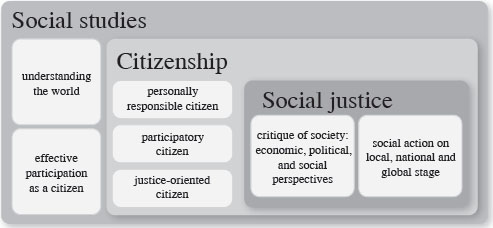
Figure 1. The place of social justice in the senior social-studies curriculum
Social studies in the New Zealand curriculum has been a contested area for many decades (Aitken, 2005; Barr, Graham, Hunter, Keown & McGee, 1997) and has created much interest and research especially in the 1990s and early 2000s as the new curriculum documents and framework were being developed and implemented. The authors of the 1997 position paper Social Studies in the New Zealand School Curriculum acknowledge that there are generally two broad goals agreed upon for the teaching of social studies: understanding the world, and effective participation as a citizen (Barr et al., 1997). These two goals are resonant in the current curriculum statement for the Social Sciences learning area, which states: “In the social sciences students explore how societies work and how they themselves can participate and take action as critical, informed, and responsible citizens” (Ministry of Education, 2007, p.17). The statement in the senior social-studies teaching and learning guide is almost identical. But exactly what should be taught in social-studies classrooms has been, and continues to be, a source of tension (Aitken, 2005; Barr et al., 1997; Barr, 1998; Mutch, Hunter, Milligan, Openshaw, & Siteine, 2008; Ormond, 2012).
The focus on citizenship in social studies is therefore clear, even though it is not the sole source of citizenship education in New Zealand (Mutch, 2013). The field of citizenship offers a diverse range of perspectives and beliefs about what citizenship is, and the purpose and place of citizenship in the classroom. As Gilbert (2004) states:
Some definitions emphasise the nation state as an entity to which people should give allegiance and loyalty. Other definitions emphasise individual rights or a shared sense of community. Others focus on citizen participation in government. A comprehensive approach to civics and citizenship education will combine a number of these approaches. (p. 140)
Westheimer and Kahne (2004) distinguish between three kinds of citizens in a democracy: the personally responsible citizen, the participatory citizen, and the justice-oriented citizen. They argue that education programmes often align their goals with one of these kinds of citizenship, and although they do not necessarily have to be independent of each other, they believe that what matters most in preparing citizens for democracy is what the goals of citizenship are. Their findings are clear: if we want citizens who participate in society and work towards a more socially just society, then these two goals must be explicitly incorporated into the curriculum. That the International Citizenship and Civic Education Study found justice-oriented citizenship is not a widespread goal of citizenship and civic education in New Zealand schools (Bolstad, 2012) is therefore not surprising as it is not explicit in the curriculum statement, whereas participation and responsibility are.3
The term social justice is difficult to define (Denti & Whang, 2012; Tyson & Park, 2008). The literature acknowledges traditions of distributive justice, or legal justice, or some combination of both (Wade, 2007). Social-justice literature in an education context centres around two notions: education for social justice, and education about social justice. Education for social justice is concerned with creating and working within a framework of social justice to bring about a more socially just world; it advocates a social-justice pedagogy and approach to teaching. Education about social justice engages students with positive examples of what social justice looks like, as well as exploring what injustices have taken place, why they existed, and how they have been overcome. Social justice is thus a process and a goal.
In the New Zealand senior social-studies guide social justice is defined as: “an outcome of social action taken to develop fair treatment and equity for all” (Ministry of Education, 2013, p. 4). The focus on fairness and equity in the definition is also clearly evident in the literature (Ayers, Quinn & Stovall, 2009; Wade, 2007). However, some of the most emphasised attributes of social justice in the literature are overlooked in this simplified definition. Being critical and analytical of society, how it came to be structured, and how that structure works to perpetuate hierarchies of race, ethnicity, class, gender, and sexuality is one of the key components of social justice (Ayers et al., 2009; Banks, 2004; Wade, 2007; Westheimer & Kahne, 2004). This article argues that the selection and use of resources in a way that highlights these systemic injustices is essential in the process of working towards, and bringing about, social justice.
There are endless possibilities in the selection of topics and issues to include when teaching about social justice. What is commonly suggested in the international literature is an approach which includes selecting content that:
•is inclusive—it is grounded in the lives of the students (Wade, 2007; Bickmore, 2008)
•develops empathy and compassion (Bickmore, 2008; Whang, 2012)
•uses controversial issues, issues to do with justice and dealing with value-laden questions in meaningful contexts for students (Bickmore, 2008; Kahne & Westheimer, 2006)
•explores economic, political, and social contexts (Ayers et al., 2009; Bickmore, 2008)
•presents global perspectives (Banks, 2004; Bickmore, 2008; Wade, 2007)
•is academically rigorous (Ayers et al., 2009; Wade, 2007).
Social-justice education should also aim to develop social literacy (Ayers et al., 2009) or multicultural literacy (Banks, 2004), be participatory and experiential (Bickmore, 2008; Wade, 2007) and activist (Ayers et al., 2009; Bickmore, 2008; Wade, 2007).
Teaching for conceptual understandings
The social sciences, and social studies in particular, has the role of developing young people’s understanding of society and how they can effectively participate and take action in the societies they belong to. This is often contentious work (Wood, Milligan & Morgan, 2013). Teachers are ultimately left to select the content and contexts of their learning programmes, and to resource them.
The Senior Social Studies guide (Ministry of Education, 2013) does not specify what content is to be taught, but identifies several key concepts which students should gain an understanding of through senior social studies: society, culture, change, perspectives, rights, values, and social justice. Gilbert (2011) states that concepts are “the key tools for making sense of the world, and are therefore at the heart of the curriculum” (p. 69). Milligan and Wood (2010) emphasise the crucial position of a concept-based approach, but argue that in social studies, concepts and conceptual understandings are changeable, contextual, and contestable; they are transition points rather than endpoints and “must always be presented at all stages of learning and assessment as highly debatable propositions and as the subject of further inquiry” (Milligan & Wood, 2010, p. 498 [emphasis in original]) in order to make sense of a fast changing and increasingly complex world.
Choosing contemporary controversial issues and presenting conceptual understandings as fluid, contestable, and contextual has significant implications for educators in terms of finding and selecting relevant resources. Indeed, Milligan and Wood (2010) conclude their article with a challenging question: “What could a teaching resource that uses less certain versions of knowledge about contested concepts (such as citizenship, identity, or globalisation) look like?” (p. 499). It is my hope that this article will contribute to the discussion about what elements such a resource may consist of.
Analytical framework
This study took a critical-studies approach as it aimed to expose the need for change (Newby, 2010). The work of multicultural education scholar James Banks was used as an analytical framework. Banks has spent over three decades on a quest “to understand, interpret, and reduce racial inequality and advance social justice” (Banks, 2006, p. 3). He identifies five dimensions of multicultural education: content integration; the knowledge construction process; prejudice reduction; an equity pedagogy; and an empowering school culture and social structure. These core elements of Banks’ writing serve both as a lens through which to view social-justice resources and as a filter through which resources can be analysed to evaluate their acceptability as social-justice resources. While the significance of all five dimensions and their interconnectedness is important, this article focuses on the two dimensions of the knowledge-construction process and content integration.
Banks believes that “the knowledge that people create is heavily influenced by their interpretations of their experiences and their positions within particular social, economic, and political systems and structures of a society” (2006, p. 147). School knowledge is identified as one of five types of knowledge4 by Banks, who argues it relies on a complex interrelation between all types of knowledge. This traditionally advantages students whose personal and cultural knowledge is from the same traditions as school knowledge—Western academic and White middle class. Banks (2006) believes that educators should incorporate personal and cultural knowledge into school knowledge, at least as a beginning point for the school knowledge, as a way of acknowledging differing perspectives and motivating learners, as well as deepening understanding offered in textbooks. Teachers discuss with their students how knowledge is created and how it is influenced by factors of race, ethnicity, gender, and social class (Banks, 2006). Teachers should also enable students “to develop the understandings and skills needed to become knowledge builders themselves” (Banks, 2006, p. 159).
This approach to the construction of knowledge embodies an approach to content integration that is transformative and focused on social action. Here, content and perspectives are not merely added to curriculum, but the fundamental goals, structure, and perspectives of curriculum are changed; perspectives of diverse ethnic and cultural groups are sought; students make decisions on important social issues and take actions to help solve them; and teachers are agents of social change who promote democratic values and the empowerment of students (Banks, 2006). In Banks’s four levels of content integration, the transformative approach is level 3, and the social action approach is level 4. Levels 1 and 2 are the contributions approach and the additive approach.
In addition to the work of Banks, the approach, structure and findings of the Effective Pedagogy in Social Sciences / Tikanga a Iwi: Best Evidence Synthesis Iteration (BES) (Aitken & Sinnema, 2008) provided me with a guide for selecting effective resources in the social sciences, as well as providing an example of a resource that embodies the values and processes of social-justice education. In brief, the studies reviewed in the BES revealed that resources in the social sciences are most effective when they are designed to maximize learner interest, aligned transparently to learning outcomes, and connect to students’ lives and make diversity visible (Aitken & Sinnema, 2008).
Drawing from the BES, Banks and other literature reviewed, I developed a set of evaluative criteria to 1) determine whether a resource would be relevant for inclusion in the study and 2) subsequently carry out template analysis (Newby, 2010) of the selected resources. In developing the criteria, I adapted the framework outlined by Tomasevski’s (2001) paper on human-rights obligations. I wanted to find out what resources are available, how accessible they are, how acceptable they are from a social-justice perspective, and how adaptable they are to alignment with the achievement objectives of the senior social-studies curriculum.
Methodology
The study was a qualitative document analysis that used deductive thematic search and inductive thematic categorisation techniques. It was undertaken from March to June in 2014 and focused on senior social-studies resources made available to teachers by government departments, non-government organisations, other professional organisations, and educational publishers. However, I was also granted access to resources created and published by senior social-studies teachers in a private Facebook group set up for the purpose of sharing ideas, answering questions and posting resource links and document files. Brief mention will be made of this important source later in the article.
As outlined above, I decided that an analytic framework was required. To develop the evaluative criteria for this framework I asked two broad questions: what makes a resource effective for teaching and learning in the social sciences? And what is essential to the conceptual understanding of social justice? Table 1 was then created.
Table 1. Evaluative criteria for a template analysis of a social-justice resource
| Criteria | Questions asked of resource |
| Availability | •Am I able to get hold of the resource without difficulty? •Is it current—was it produced in the last 10 years? |
| Accessibility | •How accessible to all is the information/content/ knowledge of the resource? This includes: –the ability to access the resource physically—e.g., online, from library, through publisher –the language level –the use of visual language—illustrations and pictures, videos and animations, diagrams with keys and legends, and multimedia tools, simulations and games. |
| Acceptability | •Is diversity visible? Does content/knowledge reflect complexity of culture, gender, race, disabilities, sexualities, and religious interests, values and perspectives? •Is knowledge presented as positional, relating to knowers’ values and experiences, and imply action? •Are cultural, national and/or global identifications acknowledged and their development valued? •Are contexts relevant and connections made to students’ lives? •Are successful social-justice movements included—does the resource make social justice an achievable goal or provide hope for students? •Is a critique of society and its structure apparent? (Ideals of freedom and equality vs realities of oppression and inequality.) •Is there a focus on integral role of action in improving a democratic society? |
| Adaptability | •Is the resource flexible? •Does it align with important learning outcomes and the achievement objectives? •Will it adapt to different cultural and social settings? Can students of lower ability, and students who need extension, gain something from the resource? |
Resources were selected using purposive sampling techniques. The sample size was determined by “fitness for purpose” (Cohen, Manion & Morrison, 2011, p. 161), a common approach in qualitative research. Purposive sampling was also used iteratively during this study due to the vast number of resources available, especially online. In fact, there were so many different resources online that broadly fit the evaluative criteria (Table 1), I developed further criteria to determine which resources would be selected for greater depth of analysis in the study. The final purposive sample was arrived at by selecting resources that dealt with themes or issues raised in the literature as being significant to social justice, and were a) recommended as a suggested resource for senior social-studies teachers by the Ministry of Education, b) linked to one of the resources suggested by the Ministry of Education, or c) suggested by experts in the field.
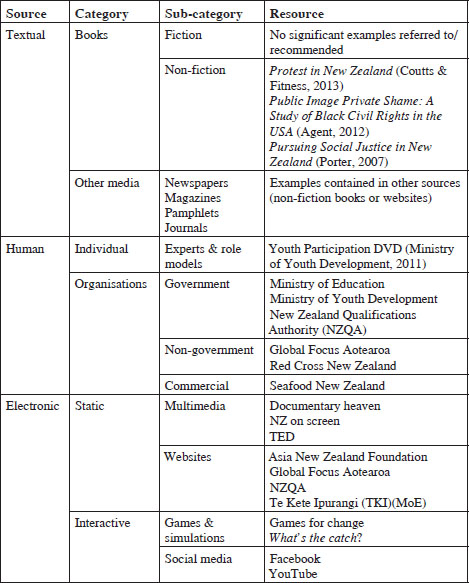
Resources were analysed from multiple sources, reflecting the eclectic and random nature of curriculum resourcing in New Zealand. Table 2 shows the diverse range of resources that met the selection criteria.
All of the resources above were analysed in detail for their availability, accessibility, acceptability, and adaptability from a social-justice education perspective. Following this deductive template approach, the data were inductively coded and broad categories emerged through the iterative process. The article will now present examples from a couple of the resources, highlighting some limitations and possibilities that emerged from both layers of thematic analysis.
Findings and discussion
It was evident in my findings that the majority of the resources available came from electronic sources, and that two distinct types of information for and about social justice were apparent in these resources: social justice in assessment, and social justice in the curriculum. The discussion that follows focuses on the acceptability criteria from Table 1.
Social justice in assessment-focused resources
An emergent but significant finding in the study was that the NCEA achievement standards and the accompanying resources provided, or approved, by NZQA are determining the content of senior social studies and how teachers structure the resources they create for their students. As an illustration of this I provide a detailed analysis of one resource for Achievement Standard 91042 Social Studies 1.4 (Ministry of Education, 2012). It is an NZQA approved NCEA resource. Achievement Standard 91042 requires students to “report on personal involvement in a social justice and human rights action” (Ministry of Education, 2013, p. 43).
Table 2. Sources of resources selected for analysis
The Ministry of Education (2012) states “background information” is required about the social justice and human rights issue, and students are also required to “describe and discuss advantages/disadvantages of alternative social justice and human rights actions that you could have taken” (p. 4).
In the evidence/judgements for achievement table that follows “for teacher use” (Ministry of Education, 2012) example sentences and paragraphs are presented for each level of Achieved, Merit and Excellence. The differences in the example given for answers at the three levels occur only in the description of their personal involvement in the action, not in their identification of the issue, the intended purpose of the action, or how the social action promotes social justice and human rights.
For Achievement with Excellence the student needs to include alternative or additional actions and an evaluation of the effectiveness of these alternative actions. The evidence given as an example of Achievement with Excellence follows:
An alternative action would have been to get the students to make their own red hand print in paint to place on the sheet. Our group decided not to do this as we were concerned about the mess. The end result would have been the same but the possibility of students getting paint on their uniform or around the school made us reject this alternative as not being effective.
Another action that we considered was to make gingerbread men (shaped and decorated as child soldiers) and sell them. We decided this action would not be very effective as it would not have made as much money for Amnesty as out [sic] red hand banner did. We would have had to charge $5 to ensure that we reached our target. Students at our college would not have paid that much money just for a gingerbread man. (Ministry of Education, 2012)
The example provided to teachers shows what is deemed to be valuable in the reporting of the students’ involvement in a social justice and human rights action. It seems that the students’ understanding of the social justice and human rights issue, how their action may bring about change, or the awareness of the need for change are overlooked; the acceptability of the resource from a social-justice perspective is low. The assessment is focused on students’ ability to write a reflection of their individual participation and contribution, and how they managed themselves in terms of organisation and decision-making. It is also worth noting that in the February 2014 Moderator Newsletter on the NZQA website, teachers are reminded to “encourage students to use ‘I’ statements when they are explaining what they did for their social action” (NZQA, 2014) in the personal involvement standards. This echoes the key competencies participating and contributing and managing self, and aligns the resource with Westheimer and Kahne’s (2004) notions of the personally responsible and participatory citizen, thus further highlighting the limitations of these assessment resources from a social-justice perspective.
Teachers are following these official examples and preparing their students to submit reports which contain details of an individual participatory nature, rather than showing their understanding of how individuals, groups, and organisations can promote social justice and human rights actions. This is evident in the comments the teachers made in the private Facebook group, and in the assessment schedules and resources uploaded for the group to use. Accompanying several uploaded documents is a comment making it clear that the assessment schedules uploaded in the private site are not moderated or NZQA approved. These teachers have become resourceful in response to the needs of their subject, and are happy to share the resources that they are creating, but they are also very aware of the rules of the game, as it were. The disclaimer echoes another theme in the posts: uncertainty. The “Am I doing this right?” type of comment is always linked to a specific achievement standard, and suggests a lack of confidence in resourcing their courses to meet the specifications of an assessment body. The fact that the assessments designed to measure the students’ understanding of social-justice actions do not seem to really assess the achievement objective is another limitation that needs to be addressed.
Social justice in curriculum-focused resources
The curriculum focused resources that were analysed in the study offer transformative possibilities. For example, NZC encourages students to value “equity, through fairness and social justice” (p. 10), showing a desire which extends beyond a conceptual understanding of social justice to an intention of education for social justice, as it is a value that should be embedded throughout all learning. In senior social studies the focus is on social justice as “an outcome of social action taken to develop fair treatment and equity for all” (Ministry of Education, 2013, p. 4). Students studying a senior social-studies course should learn to think critically about social issues and investigate how they can “contribute to society by taking effective social action” (Ministry of Education, 2013, p. 3). At level 6 of the social studies curriculum, typically studied by Year 11 students, Achievement Objective 6.1 is “that students will gain knowledge, skills, and experience to: understand how individuals, groups and institutions work to promote social justice and human rights” (Ministry of Education, 2013, p. 42). Table 3 provides examples of curriculum resources that demonstrated an understanding of the transformative possibilities of social-justice education.
Table 3. Overview of selected curriculum-focused resources
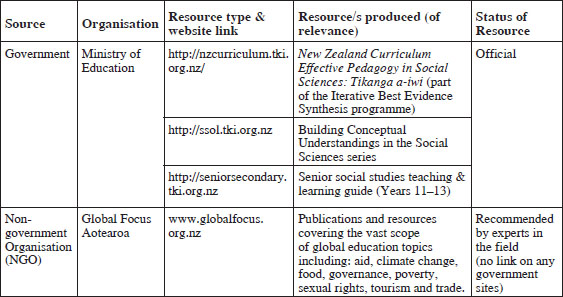
While several resources that were analysed contained acceptable elements, there was one source that exemplified the possibilities of social-justice resources despite not being linked to or recommended by any of the Ministry of Education website resource lists, or even by teachers in the Facebook group. The Global Focus Aotearoa website (http://www.globalfocus.org.nz) is a global education resource with publications and resources covering a wide range of topics which are grouped into the nine categories of: aid; climate change; food; governance; poverty; sexual rights; tourism; and trade. Each of the nine thematic pages contains three basic elements: a general introduction to the issue, curriculum links, and resource links.
The Global Focus Aotearoa resources are written from a social-justice perspective, meaning that these are resources not only about social justice issues, but they also advocate for social-justice processes as well as social justice as a goal. This transformative approach (Banks, 2006) makes this a highly acceptable resource. Diversity along cultural, ethnic, gender, and class lines are visible, and the resources can be used to develop cultural, national, and global identifications (Banks, 2004) as links are made to local, national, and global contexts. There is a particular focus on the Pacific region, and New Zealand’s relationship with other Pacific nations. Banks argues that it is essential that students develop “thoughtful and clarified identifications” (Banks, 2004, p. 301) with their cultural communities and their nation-states as a precursor to developing global identifications and deep understandings both of what it is to be global citizens and of their roles in an increasingly difficult world community. Knowledge is presented from perspectives other than the dominant discourse, which is made explicit, as is the critique of society and the need for young people to be engaging with global issues from a critical perspective. Lastly, the resources have an action focus, providing information about existing campaigns that students can join, or guiding them towards ways in which they can initiate their own actions on particular issues.
To illustrate the acceptability of the resources on the Global Focus Aotearoa website, I will use the example of how the issue and concept of poverty is examined in three magazine issues: Global Issues no. 10 (Global Education Centre, 2004), Global Perspectives no. 4 (Beals, 2010), and Just Change no. 15 (Dev-Zone, 2009). Each of the three specific resources approaches the topic of poverty in a similar way. First, they examine definitions of poverty and the ways in which it can be measured. In this example from the Global Perspectives magazine the position of the “definer” is presented as more important than the actual definition:
Often the ones doing the defining are the ones with money and they often represent an Anglo-American (western) point-of-view which tends to be white, middleclass, adult and, predominately, male. This point-of-view often leaves out indigenous and gendered perspectives. It even leaves out the perspectives of the very young and very old. (Beals, 2010, p. 6)
Second, differing perspectives of poverty are explored. These are wide ranging and further highlight the complexities of the interrelated and interdependent facets of poverty. Some examples of perspectives explored are the militarisation of poverty, poverty reduction strategies, power and control in the poverty and development relationship, poverty in the Pacific, and poverty and young people. Third, a critical look at perceptions and assumptions of poverty and the poor is undertaken, including the media portrayal of black as poor, and the poor as helpless people waiting to be helped by the rich. Dominant discourses are thus highlighted and challenged—the knowledge construction process is an explicit discussion point as Banks (2006) recommends it should be. And fourth, there is a concluding section on action (echoing Banks’ fourth level of content integration—a social action approach) and further resource suggestions. This pattern is not only seen in the resources about poverty; it is indicative of the way all the resources are written.
Conclusion
The creation and selection of resources for and about social justice have the power to transform the way young people think about society and their ability to make it more just for all. As noted earlier, Milligan and Wood (2010) ask: “What could a teaching resource that uses less certain versions of knowledge about contested concepts (such citizenship, identity and globalisation) look like?” (p. 499). In this article, I suggest that the resources produced by Global Focus Aotearoa model the possibilities of social-justice resources. However, their service is no longer funded, and their resources are no longer updated so this website is not ideal in terms of its availability. The contemporary nature of social studies teaching requires current resources such as the magazines Global Focus Aotearoa used to publish. This study has shown that these resources embody the multicultural dimensions identified by Banks (2006) and exemplify the type of resources students and teachers need to facilitate the development of deep understandings and present the range of perspectives required to be truly “informed, critical, active and responsible citizens” (Ministry of Education, 2013, p. 2).
In conclusion, the senior social-studies curriculum and its supporting documents indicate the desired teaching and learning approach for the subject is one that integrates a social-justice perspective. However, the explicit emphasis on social-justice action as individual contribution and participation in assessment-focused resources overshadows the transformative possibilities of the curriculum as expressed in the subject guide. This article contributes to the small body of research currently available for senior social studies, and is the only research that specifically analyses resources available for teaching social justice in the senior subject. The findings outlined in this article provide some insight into the ways in which future senior social-studies resources can define, present, explore, analyse, and reflect upon social justice. An analytic framework for doing so is presented. Moreover, the article draws attention to the need for NZQA to review the assessment exemplars provided to teachers so that they align more closely with the curriculum and achievement objectives, and for the Ministry of Education to fund and encourage the development of more appropriate, robust, and relevant resources.
For young New Zealanders to be reflective and empowered citizens who are capable of, and committed to, taking democratic social-justice-oriented action, teachers must have access to resources that facilitate that very outcome. And we must have teachers who are comfortable and confident in their ability to use those resources for transformative social justice to take place. The study outlined in this article did not extend to the use of resources in the classroom, leaving a rich and worthwhile area to be explored in the future.
Acknowledgements
I would like to thank Dr Carol Mutch for her advice, support and guidance through this research and writing process. I also wish to acknowledge the anonymous reviewers and the editor whose detailed and thoughtful comments and suggestions helped to shape this article in various ways.
Notes
References
Aitken, G. (2005). The purpose and substance of social studies: Citizenship education possibilities. In P. Benson & R. Openshaw (Eds.), Towards effective social studies (pp. 85–112). Palmerston North: Kanuka Grove Press.
Aitken, G. & Sinnema, C. (2008). Effective pedagogy in social sciences/Tikanga a iwi: Best evidence synthesis iteration (BES). Wellington: Ministry of Education.
Ayers, W., Quinn, T., & Stovall, D. (Eds.). (2009). Handbook of social justice in education. New York, NY: Routledge.
Banks, J. A. (2004). Teaching for social justice, diversity, and citizenship in a global world. The Educational Forum, 68(4), 296–305. http://dx.doi.org/10.1080 /00131720408984645
Banks, J. A. (2006). Race, culture, and education: The selected works of James A. Banks. New York, NY: Routledge.
Barr, H. (1998). The nature of social studies. In P. Benson & R. Openshaw (Eds.), New horizons for New Zealand social studies (pp. 103–120). Palmerston North: ERDC Press.
Barr, H., Graham, J., Hunter, P., Keown, P., & McGee, J. (1997). A position paper: Social studies in the New Zealand school curriculum. Hamilton: The School of Education, University of Waikato.
Beals, F. (2010). Poverty: Rewriting our definitions of poverty. Global Perspectives, 4. Retrieved from http://www.globalfocus.org.nz/wp-content/uploads/2014/09/Global_Perspectives_4.pdf
Bickmore, K. (2008). Social justice and the social studies. In L. Levstik & C. Tyson (Eds.), Handbook of research in social studies education (pp. 155–171). New York, NY: Routledge.
Bolstad, R. (2012). Participating and contributing? The role of school and community in supporting civic and citizenship education: New Zealand results from the international civic and citizenship education study. Wellington: Ministry of Education.
Cohen, L., Manion, L., & Morrison, K. (2011). Research methods in education. Oxford, England: Routledge.
Denti, L., & Whang, P. (Eds.). (2012). Rattling chains: Exploring social justice in education. Boston, MA: Sense Publishers. http://dx.doi.org/10.1007/978-94-6209-107-8
Dev-Zone. (2009). What is poverty? Just Change 15. Retrieved from http://www.globalfocus.org.nz/uploaded/documents/Just_Change_15.pdf
Gilbert, R. (2004). Studying society and environment: A guide for teachers (3rd ed.). Southbank, Australia: Thomson Learning.
Gilbert, R. (2006). Educating world citizens: A curriculum for citizenship education. In J. Campbell, N. Baikaloff, & C. Power (Eds.), Towards a global community: Educating for tomorrow’s world: Global strategic directions for the Asia-Pacific region (pp. 199–207). Dordrecht, The Netherlands: Springer. http://dx.doi.org/10.1007/1-4020-4338-4_12
Gilbert, R. (2011). The knowledge base for studying society and environment. In R. Gilbert & B. Hoepper (Eds.). Teaching society and environment (4th ed., pp. 62–78). Melbourne, Australia: Cengage Learning.
Global Education Centre. (2004). Poverty. Global Issues, 10. Retrieved from http://www.globalfocus.org.nz/uploaded/documents/Global_Issues_10.pdf
Kahne, J., & Westheimer, J. (2006). Teaching democracy: What schools need to do. In E. W. Ross (Ed.), The social studies curriculum: Purposes, problems, and possibilities (3rd ed., pp. 297–316). Albany, NY: State University of New York.
Milligan, A. & Wood, B. (2010). Curriculum understandings as transition points: Making sense of a complex social world. Journal of Curriculum Studies, 42(4), 487–501. http://dx.doi.org/10.1080/00220270903494287
Ministry of Education. (2007). The New Zealand curriculum. Retrieved from http://nzcurriculum.tki.org.nz/The-New-Zealand-Curriculum
Ministry of Education. (2012). Internal assessment resource: Social studies 1.4A v.2. Retrieved from http://ncea.tki.org.nz/Resources-for-Internally-Assessed-Achievement-Standards/Social-sciences/Social-studies/Level-1-Social-studies
Ministry of Education. (2013). Senior social studies. Retrieved from http://seniorsecondary.tki.org.nz/Social-sciences/Senior-social-studies.pdf
Mutch, C., Hunter, P., Milligan, A., Openshaw, R., & Siteine, A. (2008). Understanding the social sciences as a learning area: A position paper. Retrieved from http://nzcurriculum.tki.org.nz/Curriculum-resources/NZC-resource-bank/Social-sciences/Key-resources
Mutch, C. (2013). What does a decade of research reveal about the state of citizenship education in New Zealand? New Zealand Journal of Educational Studies, 48(2), 51–68.
New Zealand Qualifications Authority (NZQA). (2014). Moderator’s newsletters February 2014. Retrieved from http://www.nzqa.govt.nz/qualifications-standards/qualifications/ncea/subjects/social-studies/moderator-s-newsletters/february-2014/
New Zealand Qualifications Authority (NZQA). (2015a). Achievement standard 91040. Retrieved from http://www.nzqa.govt.nz/nqfdocs/ncea-resource/achievements/2015/as91040.pdf
New Zealand Qualifications Authority (NZQA). (2015b). Achievement standard 91042. Retrieved from http://www.nzqa.govt.nz/nqfdocs/ncea-resource/achievements/2015/as91042.pdf
New Zealand Qualifications Authority (NZQA). (2015c). Achievement Standard 91043. Retrieved from http://www.nzqa.govt.nz/nqfdocs/ncea-resource/achievements/2014/as91043.pdf
Newby, P. (2010). Research methods for education. Harlow, England: Pearson.
Ormond, B. (2012). Aligning curriculum and assessment: Divergent approaches in the framing of knowledge. Curriculum Matters, 8, 9–32.
Tomasevski, K. (2001). Primer no. 3: Human rights obligations: Making education available, accessible, acceptable and adaptable. Gothenburg, Sweden: Sida.
Tyson, C., & Park, S. C. (2008). Civic education, social justice and critical race theory. In J. Arthur, I. Davies & C. Hahn (Eds.), The SAGE handbook of education for citizenship and democracy (pp. 29–40). http://dx.doi.org/10.4135/9781849200486.n4
Wade, R. (2007). Social studies for social justice: Teaching strategies for the elementary classroom. New York, NY: Teachers College, Columbia University.
Westheimer, J., & Kahne, J. (2004). What kind of citizen? The politics of educating for democracy. American Educational Research Journal, 41(2), 237–269. http://dx.doi.org/10.3102/00028312041002237
Whang, P. (2012). Section 2: Introduction. The personal is political. In L. Denti & P. Whang (Eds.), Rattling chains: Exploring social justice in education, (pp. 47–50). Boston, MA: Sense Publishers.
Wood, B., Milligan, A., & Morgan, J. (2013). Special issue, guest editorial: Emerging issues and research in New Zealand social science education. New Zealand Journal of Educational Studies, 48(2), 2–4.
Wood, B., Taylor, R., & Atkins, R. (2013). Fostering active citizenship though New Zealand social studies curriculum: Teachers’ perceptions and practices of social action. New Zealand Journal of Educational Studies, 48(2), 84–98.
The author
Maria Perreau is currently a doctoral candidate in the School of Critical Studies in Education at the Faculty of Education and Social Work, The University of Auckland. She is interested in finding out how young social activists in New Zealand conceptualise social justice and enact social change. Maria has a background as a secondary English, social studies, history and drama teacher and has taught in New Zealand schools as well as international schools in Germany, Thailand, China and the United Kingdom. Her experiences as a community and service coordinator in IB schools inspired her passion for social-justice education.
Email: m.perreau@auckland.ac.nz
1Senior social studies is a subject option for students in some secondary schools in New Zealand, typically in the final three years of secondary school education, Years 11–13.
2Template analysis is a qualitative research method that involves a deductive thematic search using nominated codes. In this study these codes were predetermined from significant themes in the literature.
3For a detailed discussion of active citzenship and social action in the New Zealand social studies curriculum see Wood, Taylor and Atkins (2013).
4The five types of knowledge that Banks (2006) identifies are: personal/cultural; popular; mainstream academic; transformative academic; and school. Banks asserts that though they are each distinct conceptually, they interrelate in dynamic and complex ways rather than being static.