Integrating Number and Algebra in The New Zealand Curriculum:
Implications for teaching
Chris Linsell
Abstract
The integration of Number and Algebra into one strand in The New Zealand Curriculum (Ministry of Education, 2007) raises questions about the relationship between these two branches of mathematics and about suitable approaches to teaching. This article argues that arithmetic and algebra are intimately linked and should not be taught in isolation. There needs to be an emphasis on generalisation within the teaching of arithmetic and consideration of prerequisite arithmetic skills and knowledge in the teaching of algebra.
Introduction
In 1993, The New Zealand Curriculum Framework (Ministry of Education, 1993) set out the learning areas and strands to be covered in New Zealand schools. After consultation and revision, a newer version, The New Zealand Curriculum, was distributed to schools in 2007 (Ministry of Education, 2007). The learning area of Mathematics and Statistics was divided into three strands rather than the previous six, with Number and Algebra being one strand. Why were the previous strands of Number and Algebra put together? Was this just a matter of convenience, in order to simplify the curriculum? If not, then what was the basis for combining the two strands? For many people, number appears to be concerned with computation, while algebra appears to be concerned with letters. The connections between these two parts of mathematics may not seem that obvious, and in order to appreciate them it is necessary to explore the nature of both.
Does, or should, the reorganisation of the curriculum have any implications for teaching? Are any number skills or knowledge prerequisites for learning algebra, or vice versa? What should we now be teaching at different levels of the curriculum? should the teaching of number and algebra be integrated and does this vary with curriculum level?
This article explores some of the background to recent curriculum developments in mathematics in New Zealand, describes the structure of the Number and Algebra strand in The New Zealand Curriculum and provides some suggestions for integrating the teaching of number with the teaching of algebra, with particular emphasis on equations and expressions.
Background
The previous curriculum statement for mathematics in New Zealand schools (Mathematics in the New Zealand Curriculum, Ministry of Education, 1992) was the first that encompassed all years of schooling and that clearly specified outcomes for students. In 2007, in keeping with the recommendations of the Curriculum Stocktake Report (Ferguson, 2002), there were few major changes, but the complexity of the mathematics and statistics curriculum was simplified and the number of strands reduced from six to three for levels 1–6. The strands are now Number and Algebra, Geometry and Measurement, and Statistics. This integration of number and algebra into one strand followed debate within the mathematics education community in New Zealand, with many submissions made in response to The New Zealand Curriculum: Draft for Consultation 2006 (Ministry of Education, 2006).
Collins Reference Dictionary of Mathematics defines algebra as “the branch of elementary mathematics that generalizes arithmetic by using variables to range over numbers, … in particular, the use of symbols standing for unknown quantities in order to determine their value by the elementary operations of arithmetic” (Borowski & Borwein, 1989). This definition immediately emphasises the use of symbols, and also links algebra to arithmetic.
Many authors take a broad view of what constitutes algebra and make explicit links to arithmetic. Lee (2001), for example, suggested that algebra is generalised arithmetic, a language, a way of thinking, an activity, a tool and a culture. Kieran’s (1992) view is that algebra is the symbolising of general numerical relationships and mathematical structures, and operating on those structures. Again algebra is seen as having its foundation in number, but generalising from there to mathematical structures. Carraher and Schliemann (2007) also stressed the continuity between arithmetic and algebra and suggested that many problems that students experience with learning algebra are caused by earlier difficulties with arithmetic. Kaput (2008) saw the traditional approach of teaching arithmetic and algebra as separate subjects as being dysfunctional, because arithmetic just focused on computation, while algebra was taught in a superficial way that led to teacher alienation and high student failure rates. Against this background The New Zealand Curriculum (Ministry of Education, 2007) integrated Number and Algebra into one strand.
Structure of the Number and Algebra strand
In order to understand the implications of this change, it is necessary to understand how number and algebra have been conceived in recent times, especially in relation to developments in The New Zealand Curriculum.
Algebra is commonly viewed as the use of symbols in mathematics. A narrow view such as this may lead to the teaching of only the manipulation of symbols within expressions and equations, with this work often starting at Year 9. In the past, this often resulted in a very abstract, skills-based approach, with little understanding by students. Algebra was frequently viewed as an academic pursuit, unrelated to real life or the needs of students. Classroom practices were often skills based, using algorithmic approaches that paid little regard to the stage of cognitive development of the students. However, The New Zealand Curriculum takes a much wider view of algebra, for all ages of students. This view encompasses generalising; communicating using words, symbols and diagrams; working with patterns and relationships using a range of representations; and forming and solving equations.
The implementation of The New Zealand Curriculum in number up to Year 10 of schooling is guided by the Numeracy Development Projects (NDPS), which provide a framework for students’ development in number. The achievement objectives of The New Zealand Curriculum are grouped to reflect the structure of The Number Framework (Ministry of Education, 2003), which details the number strategies that students use and the number knowledge required for these strategies. At levels 1–3 of the new curriculum, the Number and Algebra achievement objectives are divided up into four categories of “Number strategies”, “Number knowledge”, “Equations and expressions” and “Patterns and relationships”. At levels 4–6 “Number strategies” and “Number knowledge” are combined into one category. The New Zealand Curriculum is therefore completely consistent with the NDPS regarding the teaching of number.
The two categories of Algebra achievement objectives, “Equations and expressions” and “Patterns and relationships”, were also the categories within the Algebra strand of Mathematics in the New Zealand Curriculum, so superficially little seems to have changed. Looking in more detail, one finds that some of the achievement objectives have been combined to provide the desired reduction in complexity of the curriculum. However, the changes related to communication and generalisation, particularly at levels 1–3, are more profound. Within “Patterns and relationships”, at all levels, there are now achievement objectives specifying what generalisation students should do. Within “Equations and expressions”, at levels 1–3, there are new achievement objectives related to communication.
In the past, many primary schools’ mathematics programmes placed limited emphasis on algebra, and the work that was done was mainly on patterns. Achievement objectives relating to patterns are still there, but they now specify more clearly what the expectations of students are. The types of patterns specified at all levels are now sequential patterns, whereas in Mathematics in the New Zealand Curriculum, at level 1, repeating patterns were also included. Repeating patterns have few connections to the rest of school algebra, and primary teachers often saw little relevance of patterning work. Although sequential patterns are any patterns in which a member may be predicted by the previous members (and therefore include repeating patterns), it is sequential growing patterns that form the basis of further algebra. The expectations of students relating to sequential patterns are now explicit, and the achievement objectives form a clear progression through to the concepts of variable and relationship. The meaning of the achievement objectives can be illustrated by examining the sequential pattern in Figure 1.
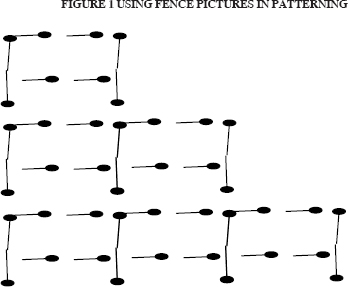
At level 1, we would expect students to be able to create and continue patterns similar to this. At level 2, we would expect them to find a rule: Such as, “there are always six matches added on”. At level 3, we would expect them to connect the pattern members to their ordinal positions—in other words, the first fence picture is number one, the second is number two etc. We would also expect them to use tables, graphs and diagrams to illustrate the connections between the pattern members and their ordinal positions. In addition, at level 3 we would expect students to be able to use the same techniques for describing number patterns. So, for example, we would expect students to be able to use tables, graphs and diagrams to illustrate the connections between 5, 8, 11, 14, and the ordinal positions of these members of the number sequence. At level 4, we also expect students to be able to use rules to describe the linear relationships found in spatial and number patterns. Whether they use natural language or symbolic equations, finding these relationships between variables poses significant challenges for many students. For the pattern above, the relationship between the number of matches and the fence length is y = 6x + 2.
However, when students look at the number of matches used, they see the sequence 8, 14, 20, 26 … The six times table is not immediately apparent. Many students see that six has been added on each time, and so an expression of the relationship between the two variables that includes the term plus two causes confusion. In summary, though, little has changed regarding this aspect of the curriculum relating to patterns and relationships.
However, under the heading of “Patterns and relationships” are now also achievement objectives at all levels relating to generalisation. John Mason has argued convincingly for a long time that generalisation is the very essence of algebra (Mason, 1996; Mason, Graham, & Johnston-Wilder, 2005). The generalisation that we expect from students is now very explicit for each level of the curriculum. For example, at level 2 the achievement objective is: “Generalise that whole numbers may be partitioned in many ways.” it is important to appreciate that this does not require students to use letter symbols. Although it can be argued that the type of generalisation required is algebra, it can also be argued that generalising number properties is just part of arithmetic. I would suggest that the argument is, in fact, irrelevant, and that this is one of the reasons why number and algebra are now put together as one strand. The important point is that teachers should be focusing on generalisation when teaching about number. This is the approach advocated within the NDPs, but it is sometimes misinterpreted. For example, even though partitioning a number into tens and ones is absolutely vital for students (because of the importance of base 10 in our number system), partitioning a number into other pairs is also essential for using many part-whole strategies. If all that is taught is partitioning by place value, students will not necessarily generalise and will not have the flexibility to solve problems by the easiest methods. Similarly, as well as partitioning a number into a pair of smaller numbers, students need to explore sets of three numbers that sum to a given number, sets of four numbers etc., in order to fully appreciate additive partitioning and to make links to multiplication.
The achievement objectives at levels 1–3 under the heading of “Equations and expressions” concern communication and recording. Students are expected to be able to explain and record their arithmetic strategies using a variety of representations. These representations include the students’ own words, diagrams and symbols, but the achievement objectives also provide teachers with the opportunity to introduce mathematical conventions. Again, it is arguable whether this is algebra or arithmetic. However, the NDPs emphasise the importance of students explaining their strategies, and so, yet again, the curriculum is consistent with current approaches in numeracy.
The “Equations and expressions” achievement objective at level 3, “record and interpret additive and simple multiplicative strategies, using words, symbols and diagrams, with an understanding of equality”, warrants an in-depth examination. The first part of the achievement objective is similar to those from levels 1 and 2, but the words “with an understanding of equality”, deceptive in their simplicity, hide an issue of crucial importance. Similarly the achievement objective at level 4, “Form and solve simple linear equations”, gives little indication of the major conceptual reorganisation that is being asked of students. A deconstruction of these two achievement objectives forms the remainder of this article.
Students’ strategies for solving equations
The next section examines the importance of students gaining a sound basis and an increasingly sophisticated understanding of equations and expressions, and patterns and relationships, as they progress through the mathematics curriculum.
An understanding of equality is crucial for the learning of algebra. Because much arithmetic in schools is presented as a computation ready to complete, for example, 4 + 3 = , and because pressing the equals button on a calculator performs a calculation on whatever has been entered, students usually understand equals as meaning compute now rather than is equivalent to (Booker, 1987). However, within algebra it is essential to view the equals sign as a statement of equivalence. Without this perspective we often see students trying to treat the right hand side of an equation as the answer. Also it is common to see students using “running arithmetic”, writing results of calculations as 3 + 6 = 9 + 4 = 13, rather than 3 + 6 = 9, with 9 + 4 = 13 as a separate calculation (because 3 + 6 certainly does not equal 13!). This misunderstanding of the meaning of the equals sign hinders students’ understanding and use of equations. It often leads them to do things such as ignoring which side of the equation numbers are on, considering 3x + 15 = 42 and 3x = 15 + 42 to mean the same thing. The change in perspective required is so significant that many researchers regard it as being a central feature of the transition from arithmetic to algebraic thinking.
Closely related to misconceptions about the equals sign is the use of an equation as a process, rather than an object that can be operated on (Sfard, 1991). Students initially see equations as the description of an arithmetic process (for example, 2 × 4 + 5 = x), and when presented with an equation to solve (for example, 2x + 5 = 13), they also see it as the description of an arithmetic process with guess and check as a natural way of finding x. Even the more sophisticated strategy of solving the equation by working backwards may result from a view of equations as processes, yet this is often not revealed until students encounter equations of the kind 2x + 5 = 5x – 10. It is no longer possible to regard the equation as the description of a process giving a result, and it is essential to view the equation as an object to be acted upon in order to solve it. Because an object view of equations is so difficult to achieve, we often see students reverting to the strategy of guess and check to solve equations of this type. The issue of operating on unknowns is another perspective on why equations with unknowns on both sides cause so many difficulties. Booker (1987) suggests that it is the shift from manipulation of numbers in order to solve for an unknown to the manipulation of unknowns themselves that marks the entry into algebra proper.
Evidence from interviews with students
So, if we are expecting students to form and solve equations, what strategies do they actually use? I consider that a lot of research adopts a deficit model approach, detailing what students can’t do. An alternative approach is to investigate what students actually do when presented with equations to solve and to examine the knowledge and skills associated with the various strategies that different students use. Kieran (1992) provides a useful summary of strategies used by students. She describes the use of known basic facts, counting techniques, guess and check, cover-up, working backwards and formal operations. In Otago we have built on this framework by carrying out diagnostic interviews with 621 Year 7 to Year 10 students (Linsell, 2008, 2009). What we have found has significant implications for teaching.
Our work has demonstrated how incredibly hard some equations are to solve compared with others. It has been known for a long time that students find equations with unknowns on both sides very difficult (Herscovics & Linchevski, 1994), and Sfard (1991) has even suggested that viewing equations as objects may be beyond the grasp of many students. However, we have now quantified the item difficulty. Educators need to appreciate how huge the range of difficulty is and not trivialise the solving of equations down to a few lessons on specific procedures.
Insights into why students found some equations so difficult to solve were obtained by examining the strategies they employed to solve them. It was clear that students used a wide variety of strategies to solve all equations. For one-step equations, many students obtained correct solutions by using known facts, counting strategies or guess and check, but never used an inverse operation. To attempt to move these students on to two-step equations would be courting disaster. Inverse operations are involved in all the successful strategies for two-step equations other than guess and check. If one attempted to teach these students to solve a two-step equation, it is likely they would be reduced to using guess and check or learning a specific procedure that applied only to specific structures.
Students’ solution strategies for two-step equations revealed a similar picture. Many students were obtaining correct solutions, but were only partially using the strategy of working backwards or were even using guess and check. The point that the strategy of working backwards is less homogeneous than previously reported is important. Many students are only just grasping the strategy and can use it only when the first step reveals a known basic fact to them for the next step. These students start by using the strategy of working backwards and then complete the solution by using a known fact. Other students are prevented from fully using working backwards because of lack of knowledge of multiplication and division facts. These students start by using the strategy of working backwards and then use guess and check. To attempt to move these students on to using formal operations would almost certainly be premature.
We found that very few students understood, or could use, formal operations, in spite of the fact that this strategy is the one that most secondary teachers demonstrate. When teachers suggest to students that an equation is like a balance pivoted about the equals sign, it is hard to imagine why it would be difficult to do the same thing to both sides of the equation and keep it balanced. However, this approach of using formal operations requires seeing an equation as an object that can be acted on and transformed (Sfard, 1991), and it was clear in our study that most students saw equations as processes. This has profound implications for solving more difficult equations at levels 5 and above, as the strategies taught require equations to be viewed as objects that can be transformed.
There was a clear hierarchy of strategies used by the students in our study. All students who were able to perform formal operations could also work backwards, and all students who could work backwards could also use inverse operations. The strategy of solving one-step equations by inverse operations was used by the more able students, and either known basic facts or counting strategies were used by less able students. These strategies in turn were used by more able students than those who solved one-step equations using guess and check. Similarly, the strategy of solving two-step equations by fully working backwards was used by more able students than those who only partially worked backwards. On any particular equation, students chose a strategy that was sufficient to solve the equation rather than using their most sophisticated strategy. However, I would suggest that the different strategies are not merely a matter of choice, and that the most sophisticated strategy that a student ever uses is indicative of conceptual development.
The impact of context on students’ ability to solve equivalent equations was very interesting. In general, contextual problems were found to be easier than symbolic equations, until the difficulty level of equations with unknowns on both sides was reached. However, most programmes in school focus on teaching skills for solving symbolic equations. Solving word problems is usually regarded as harder and introduced later as an application of these skills. An alternative perspective on contexts is to view them as models of the mathematics. Models are an important feature of Realistic Mathematics Education (Gravemeijer, 1997). Traditionally, models are derived from formal mathematics, whereas in Realistic Mathematics Education models are derived from real situations that students have experienced, and they are chosen to reflect the informal strategies of students. Initially, a model of a situation that is familiar to the students is used. Next, through generalising and formalising, the model becomes an entity in its own right. Finally, it becomes possible to use the model for mathematical reasoning. Gravemeijer describes this as a transition from model-of to model-for. The nature of a model therefore evolves from being highly context-specific to deriving its meaning from a mathematical framework. In contrast, when pre-existing models are given to students to help them solve problems, the students are expected to use them in prescribed ways that may not be clear to them. The results from our study were consistent with Gravemeijer’s perspective, and suggest that algebra would be better introduced in context rather than just as symbols.
The impact of context on the strategies that students used may help to explain why students found these problems easier. For one-step equations, there was much higher use of inverse operations than of less sophisticated strategies. It appears likely that contexts allow students to perceive the structure of a problem in more than one way. For example, the problem “When I shared a packet of lollies round my class of 20 students, they got 4 each. How many lollies were in the packet?” has the structure  , but may be viewed as “The number of lollies is 4 for each of the 20 students”, with a structure of n = 20 × 4. The context is therefore naturally leading the student into an inverse operation. If this is the case, then the role of the teacher should be to scaffold the writing of symbolic equations to describe contexts and to then explore and symbolise the solution strategies of the students. This approach would be consistent with the level 4 achievement objective that specifies that students should not only solve equations, but form them also.
There was a high correspondence between numeracy stage and the most sophisticated algebraic strategy a student was able to use to solve equations. Only when students were at the advanced multiplicative or advanced proportional-thinking stages did the majority solve equations by using the strategies of working backwards or formal operations. Students at lower stages of numeracy were largely restricted to less sophisticated strategies. The findings from the study strongly suggest that prerequisite numeracy should be considered when designing teaching programmes for algebra. There was also a very strong relationship between students’ knowledge of basic facts and their highest algebraic strategy. Any student who was at stage 6 or below on the Number Framework for basic facts was unlikely to be able to solve equations by the strategy of working backwards or by formal operations. This finding emphasises the critical importance of instant recall of all basic facts, including multiplication and division.
There were also strong associations between students’ highest algebraic strategies and their understanding of arithmetic structure, inverse operations, lack of closure, and equivalence. The relationship between students’ highest algebraic strategy and their understanding of equivalence was particularly interesting. Understanding of equivalence and, to a lesser extent, acceptance of lack of closure had much higher impacts on whether a student could use formal operations compared with using the strategy of working backwards than did the other areas of algebraic knowledge. Given the reasonably large number of students who could work backwards, and the very small number who could use formal operations, these findings may have significant implications for teaching.
Some suggestions for teaching
What strategies for solving equations should we be teaching to students? The obvious answer is that we should be carrying out diagnostic assessment of which strategies the students are currently using and then moving them on to more sophisticated strategies. However, some people argue that algebra proper starts when equations with unknowns on both sides are encountered, and that we should therefore start with equations of this kind in order to force the use of formal operations. There are indeed some excellent concrete representations of these kinds of equations that some people have used successfully for teaching (Ng, 2001).
I would argue, however, that we should consider the stage of conceptual development of the students and transform their current understandings into more sophisticated ones. Consistent with the perspective of Filloy and Sutherland (1996), I believe that the strategies used by students are not simply alternative approaches to solving equations but represent different stages of conceptual development. Therefore, instead of looking at how hard equations are to solve and whether students get them right, it would be more useful to look at the strategies that students use. This approach is very similar to that used in the NDPS, with strategy being separated out from knowledge required for strategy use. This would allow the classification of the students according to their most sophisticated algebraic strategy rather than by the most difficult equation they are able to solve. Within numeracy teaching, students are grouped for instruction according to their most sophisticated strategy. I would suggest that a similar approach to grouping students is likely to be beneficial for teaching students to solve equations. In any one class there are likely to be some students who do not even understand inverse operations, some who are confidently solving equations by working backwards and a small number who can use formal operations. These students have very different learning needs.
Before a student can use any particular strategy, they must have the prerequisite skills and knowledge. To use an efficient strategy to solve one-step equations, students need to understand inverse operations and to know their basic facts. To solve two-step equations by working backwards, students also need to understand arithmetic structure. To solve equations by using formal operations, students need to understand equivalence and also accept lack of closure. Therefore the diagnostic assessment of students needs to identify these prerequisite skills and knowledge. Once good diagnostic assessment has been carried out we then face the challenge of finding appropriate learning experiences.
It might surprise some people to learn that many students in Years 7 to 10 do not understand inverse operations. These students do not realise, for example, that addition of a given number “undoes” subtraction of that same number. There is an immediate link here to the levels 3 and 4 achievement objectives of generalising properties of addition, subtraction, multiplication and division with whole numbers. There is no need to use algebraic symbolism to develop these ideas as we can use “open box” notation, such as □ + 4 = 15. However, teachers need to realise that many children will solve this by using counting strategies or known basic facts. We need to scaffold students into writing the transformed statement of □ = 15 – 4. almost certainly the best way of doing this is by placing the original problem within a context, such as “sue had some money saved, was given $4 by her mother and now has $15. How much did she start with?” some students will solve the problem by subtracting 4 from 15, and the role of the teacher will be to scaffold the writing of this as a statement and to draw out the connections between the two equivalent statements. Within the NDPS the standard approach is to move students to visualising the context in order to solve related numerical problems, and to then increase the number size, for example, □ + 34 = 75, in order to push students into using the structural properties. There is no reason not to use this NDP teaching model for algebra. Teachers should also note that many students experience additional difficulties with using multiplication as the inverse of division, so students should get plenty of experience with equations that involve each of the four operators.
It is possibly less surprising that many students do not understand arithmetic structure and frequently just read equations and expressions from left to right. As teachers, we need to ask ourselves: How often do students learning arithmetic write, evaluate or even encounter a complex expression such as 4(3 + 5)? Although this arithmetic understanding is a prerequisite for working with algebraic expressions and equations, in most current programmes in schools there are probably few opportunities for students to work with complex arithmetic structures in authentic situations. The conventions for order of operations are often taught as decontextualised rules. However, by making links to other strands, there are some excellent contexts. The strand of Geometry and Measurement provides us with many formulae that are often not explored or utilised, while the strand of statistics also provides some useful formulae. Spreadsheets can then be used to make use of formulae for a range of numerical values.
Students’ misunderstandings of the equals sign need to be addressed from an early age. We need to move their understanding from “compute now” to “is equivalent to”. It is essential that teachers never write “4 + 5 =”, and instead either write “4 + 5 = □” or simply “4 + 5” with an instruction to find the sum. Nor must we ever use or accept running arithmetic such as 7 + 2 = 9 + 4 = 13. More positively, the use of open number lines, including the writing of equivalent symbolic representations, is a very visual approach to developing statements of equivalence. For example, by exploring students’ strategies for subtracting 49 from 83 utilising an open number line, it is likely that some students will choose to subtract 50 from 84. This provides the opportunity for recording their strategy as 83 – 49 = 84 - 50. An approach that can be used with more advanced students is to take equations such as 3x + 5 = 19 and, instead of asking them to solve it, ask “What else is true?” Students often treat the solving of equations as a learnt procedure, whereas writing statements such as 3x + 6 = 20 requires them to treat the equation as a statement of equivalence.
Acceptance of lack of closure, which Kieran (1981, p. 319) describes as the “ability to hold unevaluated operations in suspension”, is closely connected with understanding statements of equivalence. Unless a student comprehends that the difference between 49 and 83 might be the same as the difference between 50 and 84, even though we have not evaluated the difference, they will not be able to understand the statement of equivalence. Acceptance of lack of closure becomes even more important once we start to use letter symbols to represent unknown quantities, generalised numbers or variables. A typical response from students to an instruction to add 3 to x is “How can you add 3 if you don’t know what x is?” To accept an answer of x + 3 requires acceptance of lack of closure. Developing this acceptance requires generalisation of number properties by students. Generalisation, like understanding of equivalence, needs to be addressed from an early age. “A lesson without learners having the opportunity to express generality is not a mathematics lesson” (Mason et al., 2005, p. ix).
The New Zealand Curriculum specifies the type of generalisation required at different levels, but what might this look like in practice? A class could explore how high up a wall each child can reach with a paintbrush (links to statistics here), and then investigate how high they can reach when standing on a step, chair and ladder. The generalisation is that the height of the step, chair or ladder simply needs to be added to each child’s previous height. Again, spreadsheets are a valuable tool for this kind of work. “Think of a number” tricks are always popular with students. To then ask students to explain why a particular trick works, and to ask them to make up their own tricks, requires generalisation. Exploring calendar patterns provides many opportunities for generalisation. For example, if a square is drawn around any four numbers on a calendar, the diagonals multiplied together, and then one product subtracted from the other, the result is always seven. Explaining why this is so is a great challenge for students that requires them to generalise. It also provides an authentic opportunity for the use of letter symbols.
Conclusion
The integration of Number and Algebra into one strand is not merely a matter of convenience, but is consistent with the arithmetic basis of algebra. The focus of the strand gradually changes with levels of The New Zealand Curriculum, with number strategies and knowledge emphasised for younger students and more time spent on equations, expressions and relationships with older students.
Algebra, in the common conception of mathematics with letters, should not be introduced as something new at around Year 9. The prerequisite skills and knowledge of the students in number must be considered if we are going to teach algebra with understanding. The general approach towards the teaching of mathematics within the NDPs provides an excellent basis for the teaching of algebra. We should be using diagnostic assessment, grouping for instruction and using the NDP teaching model of concrete representations followed by visualisation and finally using structural properties.
For younger students it is debatable whether the work we are expecting them to do under the headings of “Equations and expressions”, and “Patterns and relationships” is algebra or arithmetic. However, approaches to teaching mathematics where opportunities to generalise are provided and discussed, and where the concept of equivalence is developed, are essential if students are going to understand algebra at higher levels of the curriculum.
References
Booker, G. (1987). Conceptual obstacles to the development of algebraic thinking. In J. C. Bergeron, N. Herscovics, & C. Kieran (Eds.), 11th conference of the International Group for the Psychology of Mathematics Education, Volume 1 (pp. 275–281). Montreal: International Group for the Psychology of Mathematics Education.
Borowski, E. J., & Borwein, J. M. (1989). Collins reference dictionary of mathematics. London: Collins.
Carraher, D. W., & Schliemann, A. D. (2007). Early algebra and algebraic reasoning. In F. K. Lester (Ed.), Second handbook of research in mathematics teaching and learning (Vol. 2, pp. 669–705). Charlotte, NC: Information Age Publishing.
Ferguson, S. (2002). Curriculum stocktake report. Wellington: Ministry of Education.
Filloy, E., & Sutherland, R. (1996). Designing curricula for teaching and learning algebra. In A. Bishop, K. Clements, C. Keitel, J. Kilpatrick, & C. Laborde (Eds.), International handbook of mathematics education, Volume 1 (pp. 139–160). Dordrecht, The Netherlands: Kluwer.
Gravemeijer, K. (1997). Instructional design for reform in mathematics education. In M. Beishuizen, K. Gravemeijer, & E. van Lieshout (Eds.), The role of contexts and models in the development of mathematical strategies and procedures (pp. 13–34). Utrecht, The Netherlands: Freudenthal Institute.
Herscovics, N., & Linchevski, L. (1994). A cognitive gap between arithmetic and algebra. Educational Studies in Mathematics, 27(1), 59–78.
Kaput, J. (2008). What is algebra? What is algebraic reasoning? In J. Kaput, D. W. Carraher, & M. L. Blanton (Eds.), Algebra in the early grades (pp. 5–18). New York: Lawrence Erlbaum.
Kieran, C. (1981). Concepts associated with the equality symbol. Educational Studies in Mathematics, 12(3), 317–326.
Kieran, C. (1992). The learning and teaching of school algebra. In D. A. Grouws (Ed.), Handbook of research on mathematics teaching and learning (pp. 390–419). New York: Macmillan.
Lee, L. (2001). Early algebra—But which algebra? In H. Chick, K. Stacey, J. Vincent, & J. Vincent (Eds.), 12th ICMI study conference: The Future of the Teaching and Learning of Algebra (pp. 392–399). Melbourne: University of Melbourne.
Linsell, C. (2008). Solving equations: Students’ algebraic thinking. In Ministry of Education (Ed.), Findings from the New Zealand Secondary Numeracy Project 2007 (pp. 39–44). Wellington: Learning Media.
Linsell, C. (2009). Students’ knowledge and strategies for solving equations. In Ministry of Education (Ed.), Findings from the New Zealand Secondary Numeracy Project 2008 (pp. 29–43). Wellington: Learning Media.
Mason, J. (1996). Expressing generality and roots of algebra. In N. Bednarz, C. Kieran, & L. Lee (Eds.), Approaches to algebra: Perspectives for research and teaching (pp. 65–86). Dordrecht, The Netherlands: Kluwer Academic.
Mason, J., Graham, A., & Johnston-Wilder, S. (2005). Developing thinking in algebra. London: Paul Chapman.
Ministry of Education. (1992). Mathematics in the New Zealand curriculum. Wellington: Learning Media.
Ministry of Education. (1993). The New Zealand curriculum framework. Wellington: Learning Media.
Ministry of Education. (2003). The Number Framework. Wellington: Author.
Ministry of Education. (2006). The New Zealand curriculum: Draft for consultation 2006. Wellington: Learning Media.
Ministry of Education. (2007). The New Zealand curriculum. Wellington: Learning Media.
Ng, S. F. (2001). Secondary school students’ perceptions of the relationship between the model method and algebra. In H. Chick, K. Stacey, J. Vincent, & J. Vincent (Eds.), 12th ICMI study conference: The Future of the Teaching and Learning of Algebra (pp. 468–474). Melbourne: University of Melbourne.
Sfard, A. (1991). On the dual nature of mathematical conceptions: Reflections on processes and objects as two sides of the same coin. Educational Studies in Mathematics, 22, 1–36.
The author
Chris Linsell is a senior lecturer at the University of Otago College of Education, where he is subject leader in mathematics. He has previously taught high school mathematics and served as secondary mathematics advisor to Otago and Southland. His research interests are in the area of children’s conceptual development in mathematics, particularly algebra.