A thinking curriculum
Pam Hook
“Last time I only failed by the narrowest of narrow margins.”
“You what? You walked in there, wrote,
'I am a fish', four hundred times,
did a funny little dance, and fainted.”
Rimmer and Lister in Red Dwarf
Abstract
This article explores how schools might develop a curriculum and pedagogy for the understanding of thinking, rather than the knowing of thinking. It suggests viewing the understanding of thinking processes through Bereiter and Scardamalia's interpretation of educational process in Popper's three-world schema. Such an interpretation leads schools to the development of a more purposive thinking schema, allowing approaches to the curriculum “key competency” called thinking to be aligned to a pedagogy based upon a structured overview of student learning outcomes, and appropriate interventions and assessment practices.
Introduction
The Curriculum Marautanga Project frames “thinking” as a key competency, a result of discussion of the international work by the OECD Defining and Selecting Key Competencies project (DeSeCo), where thinking is described as a performance-based competency essential for “a successful life and a well functioning society” (Rutherford, 2004; Rychen, 2002). Proficiency in thinking frees the individual from living a life manipulated, and enables the creation of new ideas for understanding the specific world(s) of their lived experiences.
The disjunction between Rimmer and Lister's differing understanding of the phrase “the narrowest of margins” captures an educative dilemma. If proficiency in thinking is a worthy endeavour, a valued goal, and a self-evident virtue, and recognising strengths and weaknesses in our own thinking is necessary for improving learning, then several questions for educators follow: How can we help students better know themselves as learners? How can we enhance self-regulation? How can we help students improve their thinking?
How can we teach for the understanding of thinking rather than the knowing of thinking?
This article explores these important questions. I have found Popper's three-world schema, expressed in an educational context (Bereiter & Scardamalia, 1996), useful for exploring ways we can teach for the understanding of thinking. This schema is outlined in Table 1. Within such a schema, World 3 emerges out of Worlds 1 and 2, and isolates the idea of thinking. This encourages students to reflect upon “thinking about thinking”, with the intent of enhancing metacognition and reflective practice.
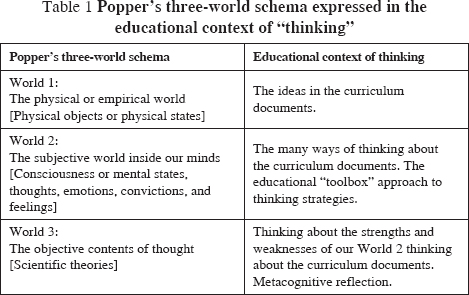
When students think about the ideas in the curriculum documents, we teach them to use thinking processes and strategies from World 2. Schools approach World 2 through pedagogies that introduce “thinking toolbox” approaches to thinking, as outlined in Figure 1.
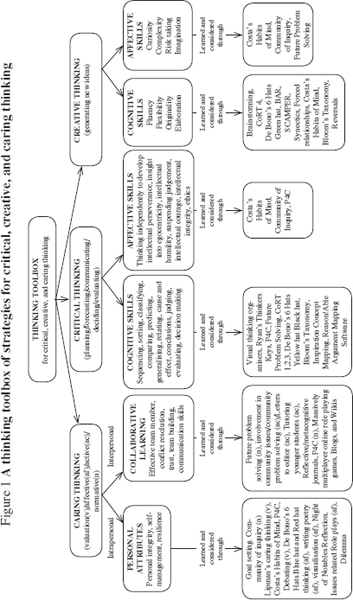
When schools create a “thinking toolbox” of skills and dispositions, they are teaching for the knowing of thinking, rather than the understanding of thinking. To teach for understanding of thinking, schools must create World 3 learning environments where thinking can be analysed and improved, and where pedagogies for reflection, pattern recognition, and connection, are encouraged. Students are working in World 3 when they are encouraged to think about the thinking processes and strategies in World 2, and to reflect upon how these affect understanding of World 1 ideas in the curriculum documents.
Wiske's (1998) framework for the logic of “teaching for understanding”, rather than “teaching for knowing”, encourages us to explore these three world interpretations of thinking through the following questions:
1.&;&;What is worthy of understanding in thinking?
2.&;&;What should students know, understand, and be able to do in thinking?
3.&;&;How can we enhance understanding in thinking?
4.&;&;How can we determine what students understand in thinking?
In the rest of the article, I address each of these questions in turn.
What is worthy of understanding in thinking?
This is a curriculum question in the widest sense of the term, and I address it in four parts, as follows.
What thinking might be
Thinking is a skill, disposition, personality, value, and idea, that can be improved. Enhancing the effectiveness of thinking makes it easier to solve problems, make decisions, and create new ideas, and makes it easier to live a “successful life”.
What is worthy of understanding is that thinking is a process, and that thinking has a context in schools, and in daily life. In schools, the context for thinking is often the physical world of ideas in the curriculum documents, World 1 (Bereiter & Scardamalia, 1996), and a “set of thinking tools” supports the process of thinking. In daily life, the context is much broader—apart from when in dreamless sleep, we are always thinking about something. The notion of “not thinking” is impossible to entertain. Internally (individual), and externally (social), the process of thinking has differing proficiencies—ranging from unreflective, unfocused thinking, to highly-reflective, tightly-focused thinking. Proficiency occurs through degrees of thinking, types of thinking, and regulation of when to enact this thinking. Convenience and conventionality in thinking will not necessarily lead to a “successful life in a well functioning society”, but the selection of thinking as a key competency reflects the belief that the application of conscious, deliberate, and systematic thought processes may.
Tensions and challenges in curriculum design
How schools understand learning influences the pattern of instruction, and the learning environment they provide for their students (Harpaz, n.d.). How schools understand thinking processes likewise influences the pattern of instruction and learning environments they provide for their students. For example, if schools represent thinking as existing in the subjective world inside our minds (World 2), they develop short-term interventions designed to teach thinking skills through pedagogies of imitation, and there is much talk of transfer. Alternatively, if schools represent thinking as an idea, as something that can be creatively improved (World 3), they immerse students in a learning environment that undermines habitual patterns of thinking—one where students are challenged to reflect on thinking as an idea, to reconstruct, and recreate their own thinking, to develop metacognition.
Limitations of current views of thinking curricula, and of the implementation of thinking curricula
Current views of thinking curricula focus on World 2, or “thinking toolbox”, approaches that support “knowing” about thinking. There are any number of World 2-type generic lists, taxonomies, components, categories, constituent skills, dispositions, and competencies, for what a person should know, feel, believe, and do, in order to become a successful thinker. Many of them are branded, pre-packaged, shrink-wrapped, and ready to be inserted into classroom practice, as summarised in the bottom row of Figure 1.
It is important that educators, who see thinking as a World 2 proficiency in a toolbox of cognitive skills and dispositions, clarify their purpose for enhancing student thinking, and consider the type of thinking curriculum and the classificatory framework of thinking processes that will target this purpose.
Schools need clarity around their reasons for wanting to enhance proficiency in thinking. Is the reason so that their students can better achieve individual, societal, economic, national, or global goals? If schools focus on societal goals, are these associated with entrepreneurship and innovation, with caring communities and spiritual connection, or with human rights and human conflict? If schools focus on individual goals, are these associated with examination success, open-mindedness, co-operation with others, or with autonomy?
A challenge in developing a thinking curriculum based on a World 2 framework is the limited research support for the delivery of thinking programmes in isolation. The preference is for programmes that both explicitly teach and infuse thinking, and for programmes that will explicitly encourage transfer across the core curriculum (Wegerif, 2002). Furthermore, awareness of World 2 thinking strategies will not necessarily change a student's World 3-type understanding of thinking—i.e., thinking about thinking. Another challenge lies in developing criteria for evaluating both content and process of thinking, rather than inferring that success in content acquisition stands as a proxy for thinking success. I return to this challenge on page 98.
Although many New Zealand schools have “thinking toolbox” World 2 approaches to the thinking process, in my experience, too few have established developmental guidelines for the overall curriculum into which they introduce such approaches. In this regard, the Victorian Curriculum and Assessment Authority's Essential Learning Standards (VELS) for the interdisciplinary learning strand Thinking Processes (VCAA, 2005), is a potential catalyst for reframing developmental approaches for World 2 thinking curricula. The VELS Thinking Processes domain is organised into six sections, one for each level of achievement from Level 1 to Level 6. Each level includes a learning focus statement and standards organised by three dimensions: reasoning, processing, and inquiry; creativity; and reflection, evaluation, and metacognition. This structure models one way of integrating thinking into the heart of the curriculum, rather than simply granting a space at the periphery.
Approaches to building a thinking processes framework in New Zealand schools often rest upon a classification framework that separates creative and critical thinking strategies from metacognitive reflection. More recently, schools have included Lipman's (1994) “caring thinking” into their domain frameworks, as shown in Figure 1. It is worth asking whether the adoption of this critical, creative, and caring model for thinking processes and their associated toolbox strategies has encouraged complacency that “we've done thinking”, for the over-simplification and possibilities for misinterpretation within a three C's thinking curriculum are many.
Thinking processes in contexts of both daily life and school are holistically integrated—we draw on them all simultaneously. This can make the distinction between critical, creative, and caring thinking strategies tenuous, even arbitrary. For example, the distinction does not hold up to scrutiny when the explicit teaching of toolbox skills is attempted. To clarify: the act of “interpreting and evaluating assumptions” cannot happen without concomitant “creative thinking”. It cannot happen without imagination, flexibility, and the generation of other points of view. This matters when we are trying to develop student thinking proficiencies, because we compromise students' understanding of their own learning when we schedule critical thinking (skilled and active) for introduction in term 2 week 3, isolated from creative thinking—to be introduced in term 3.
Challenge to current views
Disquiet over dislocated thinking skills programmes has led some schools to eschew the critical/creative/caring triumvirate, and to develop a thinking curriculum and pedagogy based around the learning process and learning outcomes. In this type of approach, the generic learning process and thinking strategies used for any new learning are interchangeable. They can be identified in inquiry process models used for science, technology, statistical thinking, and research in New Zealand classrooms, and are even apparent when “students are video gamers” at home. Gee's four-part virtual world probing process (“probe, hypothesise, reprobe, rethink” cycle), when students are video gamers, is all about understanding how we learn (Gee, 2003, p. 90). This potential alignment of ideas about learning processes is made clear in Table 2.
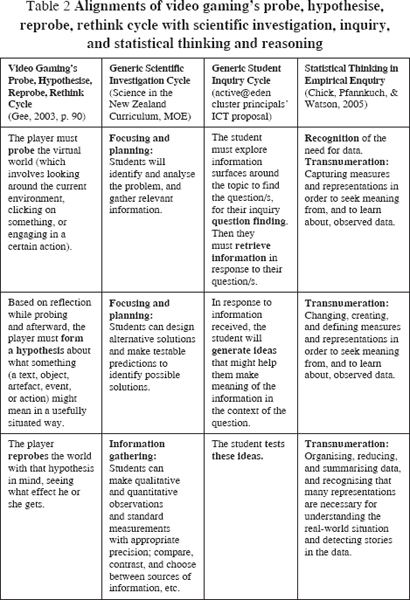
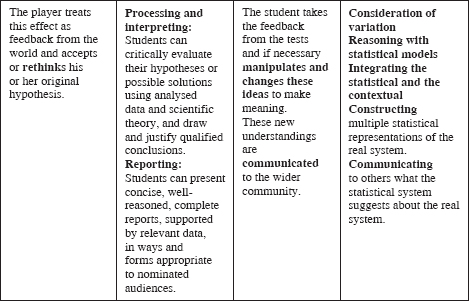
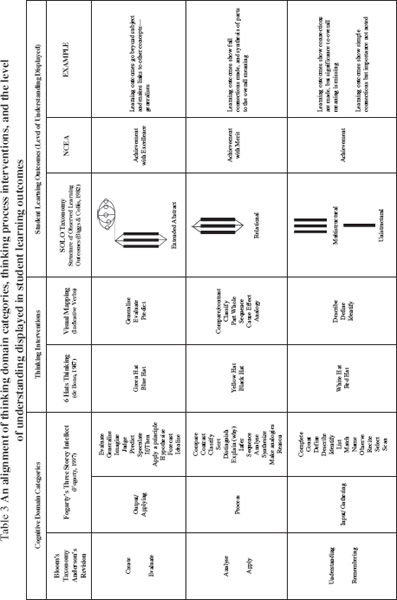
Developing a thinking toolbox curriculum based around a common language for talking about thinking processes in learning is made easier when schools, teachers, and, more significantly, students, adopt a learning process approach to developing a thinking curriculum. The framework shown in Table 3 identifies World 2 thinking strategies that align with the differing complexities of thinking in the learning process, rather than strategies that align with creative, critical, and caring thinking, referred to in Figure 1. This alignment of thinking processes in learning allows schools and students to develop a common language for assessing thinking processes, and their learning context, against student learning outcomes in the Structure of Observed Learning Outcome (SOLO) model (Hattie & Purdie, 1998) and the National Certificate of Educational Achievement (NCEA). It also enables both teachers and students to identify the thinking strategy that is the most appropriate intervention, and to use this to clearly target support for the appropriate student learning outcome, as suggested in Table 3.
What should students know, understand, and be able to do in thinking? (curricula concerns)
What are the worthy/essential elements/components of thinking? What are the “knowledge, skills, attitudes, and values” of thinking?
I turn now to the second of Wiske's questions. An analysis of common components of World 2 thinking toolbox approaches follows, and considers critical, creative, and metacognitive thinking, in turn.
Critical thinking
Critical thinking has multiple representations. It is difficult to teach and evaluate the processes of critical thinking, when there is confusion in schools about the explicit nature of the thinking required. For example, one representation defines critical thinking as “skilled and active interpretation and evaluation of observations and communications, information and argumentation” (Fisher & Scriven, 1997, p. 21). Another emphasises dynamic interaction through the “application” of nine intellectual standards (clarity, accuracy, precision, depth, relevance, logicalness, significance, breadth, and fairness), “applied” to universal structures of thought (elements of reasoning) to develop intellectual traits of “fairmindedness” (Paul & Elder, 2002, p. 66). A third isolates the constituent skills for thinking, generating, clarifying, analysing, inferring, evaluating, and judging ideas, and for developing a common visual–verbal language of critical thinking (Hyerle, 2004). Others, like Swartz and Parks (1994), have lists of critical skills and processes designed for infusion into content instruction, aligned with visual thinking diagrams, or have teased out critical thinking abilities and skills needed for greater thoughtfulness (Fisher, 2003; Norris & Ennis, 1989).
Creative thinking
The cognitive characteristics of “creative thinking”, the creative act, have been characterised by Koestler (1970, p. 98) as an “act of liberation … the defeat of habit by originality”. New Zealand schools valuing creativity are influenced by Torrance (1962); indeed, “fluency, flexibility, originality, and elaboration” have become default criteria for what constitutes creativity in many schools. This mantra misrepresents infrequency as a form of originality, and overvalues elaboration and fluency in the creative process. If we are genuine in valuing the “no. 8 gauge fencing wire” thinking in our culture, we need to explore wider understandings of creative thinking.
Our approach to teaching creativity in schools seems to imply the understanding that teaching the creative process will necessarily lead to creative outcome that is marked by originality. For example, the British National Curriculum in Action Project—Creativity, Culture, and Education—describes the characteristics of creativity in the context of schools:
•&;&;thinking or behaving imaginatively;
•&;&;imaginative activity [that] is purposeful;
•&;&;creative processes must generate something original; and
•&;&;creative outcome must be of value in relation to the objective.
(Department for Education and Skills, 1999, p. 30)
This understanding hinges on our interpretation of originality and innovation, for to recognise innovation requires that some things remain the same. The telling question is, “How will we recognise innovation if every student is thinking innovatively, in an original way?”
Koestler (1970) argues that creative activity, be it in humour, discovery, or art, is the result of a bisociative act. These are acts that juxtapose two ideas that normally do not get thought of together. Bisociation demands flexibility, and establishes an unstable equilibrium that leads to creative originality. Understanding Koestler's argument would lead educators to rich frameworks for building creative endeavour, such as the bisociation involved in Fraser's (2000) work with young New Zealanders on building creativity through metaphor.
It is worth noting that novel and innovative thought does not sit comfortably within institutions. The curious mind, the question, and the questioner, are not necessarily valued or encouraged in society, let alone in staffrooms and classrooms. Moltzen (2004), describing the early educational experiences of highly-achieving creative New Zealand adults, uses the descriptors “fraught and miserable”.
Self-regulation and metacognition
Lifelong learners have self-regulatory and metacognitive strategies for thinking about their learning, thinking about themselves as learners, and thinking about thinking as an idea (World 3 thinking).
Integral to understanding student learning and performance in thinking are three phases of metacognition: forethought; performance; and self-reflection. Student success, their proactive and reactive insight, is correlated with the quality, frequency, and flexible use of an extensive range of self-regulatory strategies (Zimmerman & Martinez-Pons, 2004, p. 18). Self-regulatory processes for thinking are complex, and are understood through rehearsal, elaboration, organisation, and metacognition. Self-regulatory processes frame motivation through self-efficacy, self-rewards, interest enhancement, increased utility value, and control of anxiety. They frame behaviour through time and effort management; and frame context through study environment control and adaptive help-seeking (Rhee & Pintrich, 2004, p.32).
Hattie, Biggs, and Purdie (1996, p. 128) note that the most effective thinking interventions are those aligned to enhancing metacognition. World 2 approaches that teach explicit metacognitive strategies for planning, monitoring, and regulating learning are intended to help students become proficient thinkers. However, schools can misrepresent the complexity of “self-regulation and metacognition” through oversimplification; and can misunderstand the potential of self-regulation and metacognition by focusing on content at the expense of other pertinent aspects of self-regulation such as motivation. Although richer metacognitive frameworks exist, the awareness students have of their own thinking, and of their ability to evaluate and regulate their own thinking through school-based thinking interventions, is too often limited to metacognitive strategies useful for simply planning, monitoring, and evaluation. Schools can strengthen the metacognitive toolbox of thinking interventions, currently used to enhance lifelong learning, by introducing metacognitive and self-regulatory strategies that interweave motivation, behaviour, context, and cognition. Even better, they would strengthen students' understanding of their own thinking if they saw thinking for metacognition as more than the passing on of useful skills, and developed World 3 approaches to a curriculum for thinking, immersing students in metacognitive and self-regulatory learning environments.
A thinking curriculum requires a common thinking language, and generic, or content-specific, strategies and skills. However, there are alternative ways of classifying the components of a school-wide common thinking language toolbox. Schools like Hauraki Plains College in Ngatea are developing a school-wide common thinking language, Pukeko Words, by analysing the “language of instruction” in departmental learning experiences and national student assessment, and linking this to common thinking language strategies and visual thinking templates as outlined in Table 3.
Arguments for the explicit teaching of transferable “thinking skills” are based on the premiss that not only will students develop strategies for better thinking, but that in time they will develop an automaticy in use (moving through tacit, aware, strategic, and reflective use of the thinking strategy) that will free working memory to deal with more complex characteristics of the learning task. We act as if it is plausible that providing students with a World 2 toolbox of potentially transferable skills and strategies will develop habitual thinking strategies that will, in turn, allow a cognitive parsimony that liberates thinking and enhances student learning outcomes. However, without effort and explicit scaffolding, the transfer of thinking strategies and dispositions to other learning will not occur.
How can we enhance understanding in thinking? (pedagogical concerns)
Understanding thinking, and thinking processes, involves the ability to think about thinking. In the context of schools, it represents thinking about the strengths and weaknesses of our World 2 thinking about the ideas in the curriculum documents. Student understanding of thinking is significantly different from student knowing of the many thinking strategies used to think (about the ideas in the curriculum documents). I will address the pedagogical concerns in understanding thinking by describing instructional design and/or environments that build understanding in thinking.
What methods of instructional design and/or environments are most effective in enhancing the understanding of thinking?
Learning through the passing on of useful skills
Initially, instruction in transferable thinking was framed around the passing on of useful “skills”—Harpaz's (n.d.) “socialization” utilitarian ethic. This “value in usefulness” approach to learning through the pattern of imitation has played an important role in early attempts to develop thinking in schools in New Zealand. Despite appearing to reinforce the antithesis of thinking, through its didactic instructional delivery, teachers were comfortable with this method of instruction through imitation. Teachers passed on useful “skills” from their “thinking toolbox”, and taught students de Bono's (1973) Plus, Minus, Interesting, and 6 Hat thinking; Mrs Potter's Questions; and Venn diagrams. However, teaching through a framework of routine skills of thinking meant that students too often experienced isolated moments of learning with no connectivity, no relevance, and no transfer.
This improved when students in thinking classrooms received explicit instruction in both the thinking task and the thinking vocabulary. Students:
•&;&;observed their teachers modelling the thinking strategy;
•&;&;attempted the thinking task in a scaffolded way;
•&;&;received formative feedback on their efforts;
•&;&;reiterated the task in another context;
•&;&;were provided with opportunities for reflection and metacognitive discussion with peers and their teachers; and then
•&;&;had opportunities to use the skills required to solve problems in another area.
In short, students were taught thinking in a learning environment that allowed for an explicit thinking vocabulary, modelling, feedback and feedforward, scaffolding, reiteration, reflection, and transfer.
However, instruction based upon the passing on of useful skills comes adrift when students know the thinking skills, but do not understand and adopt their value. Disquiet over the effectiveness of delivery, when a thinking curriculum is based solely on the individual's acquisition of skills, is well-expressed by Lipman (1988) who emphasises that the explicit teaching of thinking skills is unlikely to make an impact on students' thinking, unless effort is made to develop dispositions for thinking.
Skills alone are not enough. Paul was one of the first to emphasise thinking dispositions alongside thinking skills, elaborating on the “virtues” required to develop strong sense fairmindedness thinking (Paul & Elder, 2002). Similarly, Claxton and Lucas (2004) describe dispositions or habits of mind required for successful creative thinking: the ability to tolerate uncertainty; being open-minded; risk taking; questioning; being patient; deferring judgement; being resilient; and showing empathy.
Learning through enculturation
Acculturation of metacognitive reflection—through learning experiences designed to force a student to adopt the norms of thinking about thinking—differs from enculturation approaches, where students are allowed to form and negotiate the norms and meanings of thinking about thinking in a learning community.
When an instructional approach framed upon “acculturation” of attitudes and values of thinking is favoured, few students become strategic or reflective users of thinking skills. McGuinness (1999) claims that teaching through explicit instruction of metacognitive skills in isolation is a limiting pedagogy:
Developing better thinking and reasoning skills may have as much to do with creating dispositions for 'good thinking' as it has for acquiring specific skills and strategies. For this reason classrooms need to have open-minded attitudes about the nature of knowledge and thinking and to create an educational atmosphere where talking about thinking—questioning, predicting, contradicting, doubting—is not only tolerated but actively pursued. (p. 2)
Schools might attempt enculturation by enhancing classroom environments that encourage the key competencies of managing self, participating, and contributing, or the dispositions of intellectual risk-taking, sustained intellectual curiosity, clarity, strategic planning, intellectual rigour, metacognitive reflection, and valuing the student question (Claxton & Lucas, 2004; Costa & Kallick, 2000; Marzano, 1992; Paul & Elder, 2002).
New Zealand schools have approached thinking about thinking through acculturation and enculturation: Habits of Mind (Costa & Kallick, 2000); valuing student questions; “Ignorance Logging”—the tracking and evaluating of students' “known unknown questions” (Witte, 2002, p. 2); Philosophy for Children, and by creating contexts for moral education through a community of enquiry (Fisher, 2003). Future Problem Solving and Community Problem Solving have provided an enculturation milieu of thinking for able students (Rogalla, 2003). However, regardless of the nature of the intervention (cognitive thinking skills and/or affective dispositions), when interventions attempt to acculturate thinking in a separate programme, their success has only “limited hard independent evidence” of their effectiveness in enhancing student thinking processes (Wegerif, 2002, p. 17).
The challenge with learning through enculturation is ensuring that “moulding” environments are available to all students, and that environments allow the free establishment of thinking values and dispositions, rather than the imposition of values and disposition. Enculturation too easily becomes indoctrination—the antithesis of thinking. Fraser (2004) articulates a similar concern over values education programmes, claiming that “long term benefits of such programmes are not conclusive and the short term gains are equally elusive/unclear” (p. 261).
Learning through metacognitive environments
If thinking can creatively improve ideas, then rather than teaching from World 2 toolbox lists of thinking skills and dispositions, perhaps we should create World 3 learning environments, where students “think about thinking”. Well-documented approaches to this are the “Community of Thinking” (Harpaz, 2005), “Knowledge Building” (Bereiter & Scardamalia, 1996), and the Activating Children's Thinking Skills project (ACTS) (McGuinness, 2000). For example, ACTS encouraged teachers to create environments “to give students time to think and used discussion and reflection on thinking strategies as a way to increase competence” (McGuinness, 2000, p. 9). Arguments for developing a common thinking language were supported when researchers reported that the “children's main difficulty was the absence of an adequate language for talking about thinking” (McGuinness, 2000, p. 12).
An untapped resource environment for enculturation of student thinking dispositions lies in student gamer conversations. The role of gaming, be it Magic: The Gathering trading cards,1 or massively multiplayer online role-playing games (MMORPG), represents an opportunity to connect to the authentic student-learning conversations, about game-related thinking dispositions, occurring every day, in school, and out of school. When students are interacting with others in a quest to accomplish complex goals, some of which may well conflict with their own goals, these World 3 conversations do not stop at 3.10 pm—they are ongoing.
Perhaps the telling question, when designing a thinking curriculum to enhance student thinking, is to ask about the counter examples. Do the methods of instructional design, and/or environments proposed, reinforce conformity, imprinting, uncritical acceptance, and indoctrination? Do the methods proposed reinforce the antithesis of thinking?
How can we determine what students understand in thinking?
How we can assess student understanding of thinking, throughout the learning process, is far from obvious. How we can assess student understanding of thinking at the end of a unit of work, or as the result of a thinking programme, is likewise difficult. If, as we claim, we are determined to develop more effective teaching and learning approaches for developing the key competency called thinking, then we need clarity over what the evidence is for shifts in student understanding of thinking. This evidence must not be indifferent to the learning process.
Do students who are taught thinking have an understanding of thinking that is deeper, more integrated, more coherent, and at a higher level of abstraction than that of other students? The evidence is limited. There is limited research evidence for a causal connection between a curriculum and pedagogy for thinking (be it World 2-type interventions or World 3 environments), and enhanced student learning outcomes in ordinary classroom environments.
Support for changing student learning outcomes, through the explicit teaching of thinking, comes from anecdotal reporting or research-driven interventions with high levels of professional support. Evidence for the effectiveness of thinking skills, on enhancing students' learning and understanding, can be seen in the Cognitive Acceleration through Science Education (CASE) project (Shayer & Adey, 2002), and in specific approaches to infusing thinking skills used at the Thinking Skills Research Centre at Newcastle University (Duncan, McNiven, & Savory, 2004; Fisher, 2002; Higgins, 2001; Leat, 1998).
We need both researcher and teacher evaluation into the effect of thinking interventions on student learning outcomes. We look for evidence of changes in student learning outcomes to inform our practice, and the introduction of a thinking curriculum should be no different. It goes without saying that the evaluation of the influence of school-based thinking programmes on student learning outcomes should be considered before their introduction. Schools need help from researchers in developing reliable assessment items that align with the specific nature of the thinking intervention proposed. To ensure the validity of the assessment, we need to use a test instrument suitable for measuring the specific thinking processes taught in the intervention. There are general problems of validation within existing tests of thinking (Fisher & Scriven, 1997, p. 142). Even if a test can be shown to be reliable, it does not follow that what is being tested is what the test purports to measure.
The Ministry of Education frames thinking as a performance-based competency: “integrated, holistic and complex”, including consideration of “knowledge, skills, attitudes and values” (Rutherford, 2004). The challenge is whether we can assess student understanding of thinking through performance. When we view “performance” through Mansilla and Gardner's (1998) knowledge, methods, purposes, and forms of thinking, we create an intriguing overview of possibilities for thinking performance, through the following questions: To what degree do student performances show that concepts in thinking have transformed students' intuitive beliefs about thinking? To what degree do students display a healthy scepticism towards their own beliefs about thinking, and towards knowledge about thinking from other sources? To what degree do students recognise a variety of possible uses of what they learn about thinking?
How might teachers use performance to assess student understanding of thinking, when inference must be made from the performance? I could argue that this is impossible, and at best we might ask schools to describe the learning experiences and learning environments they provide that favour the development of the “key competency” thinking. However, it is likely that any development of objective criteria for understanding thinking will attempt to measure “surface” and “deep” understanding (Marton & Saljo, 1976) of thinking in different educational contexts.
The SOLO Taxonomy (Biggs & Collis, 1982), provides a measure of cognitive learning outcomes or understanding of thinking, that, in my experience, teachers have felt comfortable adopting. This hierarchical model is comprehensive, supported by objective criteria, and used across different subjects and on differing types of assignments (Hattie & Purdie, 1998). Teachers enjoy the way that SOLO represents student learning of quite diverse material in stages of ascending structural complexity, and that these stages display a similar sequence across tasks. Furthermore, surface or deep levels of understanding can be planned for and assessed by coding a student's thinking performance against unistructural, multistructural, relational, or extended abstract categories, as shown in Table 1. Using visual symbols to represent levels of understanding in SOLO means that coding for complexity of thinking can be undertaken by both student and teacher, allowing “where should we go next?” decisions and thinking interventions to more accurately target student learning needs.
Conclusion
Without an educationally-sound curriculum map and pedagogical framework for thinking, New Zealand schools remain vulnerable to initiatives and interventions based upon the rhetoric of international invitees to the “thinking road show”, rather than upon sound research. Interventions are too often the result of a “selection whimsy”, an unsophisticated plundering from the latest expert's proprietary thinking resources.
There are many lists of thinking strategies for a thought-filled thinking curriculum, including the involvement of ICT as a mind tool for enhancing both student thinking and “knowledge building”. Unless we know why we want students to be more proficient in thinking, we will be uncertain, or even conflicted, in our instructional ideology. Rather than creating rich metacognitive World 3 thinking environments for students, we will continue futile attempts to develop student thinking through the explicit teaching of skills and dispositions, through imitation. Until we determine how to teach for the “understanding of thinking”, rather than the “knowing of thinking”, we will struggle to develop an effective thinking curriculum. Furthermore, unless we develop a better understanding of a thinking curriculum, the assessment of thinking-based interventions in schools will be reliant upon anecdotes about engagement, and Rimmer-like “write bigger” answers.
With a curriculum map of “thinking”, a developmental learning focus, and assessment items to evaluate thinking, we will avoid creating teachers and students who understand thinking only as a series of dislocated and episodic moments of learning—with no connectivity, no relevance, and no transfer.
We need ongoing research and professional learning to help educators develop a better understanding of thinking processes in the context of the four questions explored in this article: What is worthy of understanding in thinking? What should students know, understand, and be able to do in thinking? How can we enhance understanding in thinking? How can we determine what students understand in thinking?
Once we think more challengingly about our own thinking about “thinking curricula and pedagogies in schools”, there is a greater likelihood that students like Rimmer may have other responses than “I am a fish, I am a fish, I am a fish.”
References
Bereiter, C., & Scardamalia, M. (1996). Rethinking learning. In D. R. Olson & N. Torrance (Eds.), The handbook of education and human development: New models of learning, teaching and schooling (pp. 485–513). Cambridge, MA: Basil Blackwell.
Biggs, J. B., & Collis K. F. (1982). Evaluating the quality of learning: The SOLO taxonomy. New York: Academic Press.
Chick, H. L., Pfannkuch, M. P., & Watson, J. M. (2005). Transnumerative thinking: Finding and telling stories within data. Curriculum Matters, 1, 86–108.
Claxton, G., & Lucas, B. (2004). Be creative. Essential steps to revitalize your work and life. London: BBC Books.
Costa, A. L., & Kallick, B. (2000). Habits of mind. Discovering and exploring. Alexandria, VA: Association for Supervision and Curriculum Development.
de Bono, E. (1973). CoRT thinking program, workcards and teachers' notes. Sydney: Direct Education Services.
Department for Education and Skills: National Advisory Committee on Creative and Cultural Education. (1999). All our futures: Creativity, culture and education. Report: May 1999. Retrieved 10 November 2004, from http://www.dfes.gov.uk/naccce/028_043.pdf
Duncan, S., McNiven, D., & Savory, C. (2004). Thinking skills through science. Cambridge: Chris Kington.
Fisher, A., & Scriven, M. (1997). Critical thinking: Its definition and assessment. Point Reyes, CA: Edgepress; Norwich: University of East Anglia, Centre for Research in Critical Thinking.
Fisher, P. (Ed.). (2002). Thinking through history. Cambridge: Chris Kington.
Fisher, R. (2003). Teaching thinking (2nd ed.). London: Continuum.
Fraser, D. (2000, 4–7 December). Sin, hope and optimism in children's metaphors. Paper presented at the Australian Association for Research in Education conference, Sydney. Retrieved 4 November 2004, from http://www.aare.edu.au/00pap/fra00393.htm
Fraser, D. (2004). Some educational implications for spiritual giftedness. Gifted Education International, 18(3), 255–265.
Gee, J. P. (2003). What video games have to teach us about learning and literacy. New York: Palgrave Macmillan.
Harpaz, Y. (n.d.). Conflicting logics in education to critical thinking. Mandel School. Retrieved 6 January 2005, from http://www.learningtolearn.sa.edu.au/colleagues/
files/links/conflicting_logics_in_Educ.rtf
Harpaz, Y. (2005). Teaching and learning in a community of thinking. Journal of Curriculum and Supervision, 20(2), 136–157.
Hattie, J. A., Biggs, J., & Purdie, N. (1996). Effects of learning skills intervention on student learning: A meta-analysis. Review of Research in Education, 66, 99–136.
Hattie, J., & Purdie, N. (1998). The SOLO model: Addressing fundamental measurement issues. In B. Dart & G. M. Boulton-Lewis (Eds.), Teaching and learning in higher education. Camberwell: Australian Council for Educational Research.
Higgins, S. (2001). Thinking through primary teaching. Cambridge: Chris Kington.
Hyerle, H. (Ed.). (2004). Student successes with thinking maps. Thousand Oaks, CA: Corwin Press/Sage Publications.
Koestler, A. (1970). The act of creation (revised Danube edition). London: Pan Books.
Leat, D. (1998). Thinking through geography. Cambridge: Chris Kington.
Lipman, M. (1988). Philosophy goes to school. Philadelphia: Temple University Press.
Lipman, M. (1994). All our futures: Creativity, culture and education. Paper presented at the 6th International Conference on Thinking, Boston.
Mansilla, V. B., & Gardner, H. (1998). What are the qualities of understanding? In M. S. Wiske (Ed.), Teaching for understanding. Linking research with practice (pp. 161–196). San Francisco: Jossey-Bass/Wiley.
Marton, F., & Saljo, R. (1976). On qualitative differences in learning—I: Outcome and process. British Journal of Educational Psychology, 46, 4–11.
Marzano, R. J. (1992). A different kind of classroom: Teaching with dimensions of learning. Alexandria, VA: Association for Supervision and Curriculum Development.
McGuinness, C. (1999). From thinking skills to thinking classrooms: A review and evaluation of approaches for developing pupils' thinking (Research Report RR115). London: Department for Education and Employment.
McGuinness, C. (2000). ACTS: A methodology for enhancing thinking skills across-the-curriculum [Electronic version]. Teaching Thinking, 2, 1–12. Retrieved 10 January 2004, from http://www.sustainablethinkingclassrooms.qub.ac.uk/ACTS_for_Teach_Think.pdf
Moltzen, R. I. M. (2004). Gifted adult New Zealanders. Keynote address to the Talent Development Initiative Gifted Edge Workshop. Auckland: The Gifted Kids Programme.
Norris, S., & Ennis, R. (1989). Evaluating critical thinking. Pacific Grove, CA: Critical Thinking Press and Software/Prentice-Hall.
Paul, R. W., & Elder, L. (2002). Critical thinking. Upper Saddle River, NJ: Prentice Hall.
Rhee, C. R., & Pintrich, P. R. (2004). Teaching to facilitate self-regulated learning. In J. Ee, A. Chang, & O. Tan (Eds.), Thinking about thinking. What educators need to know (pp. 31–47). Singapore: McGraw Hill Education (Asia).
Rogalla, M. (2003, Spring). Future problem solving program. The National Research Centre on Gifted and Talented Newsletter, 8–13. Retrieved 4 January 2004, from http://www.gifted.uconn.edu/nrcgt/newslttr.html#Spring2003
Rutherford, J. (2004). Key competencies in the New Zealand curriculum: A snapshot of consultation, December 2004. Retrieved 12 April 2005, from http://www.tki.org.nz/r/nzcurriculum/docs/consult-snapshot.doc
Rychen, D. S. (2002, 10–11 October). Key competencies for the knowledge society: A contribution from the OECD Project Definition and Selection of Competencies (DeSeCo). Paper presented at the Education—Lifelong Learning and the Knowledge Economy conference, Stuttgart.
Shayer, M., & Adey, P. (2002). Learning intelligence. Buckingham: Open University Press.
Swartz, R. J., & Parks, S. (1994). Infusing the teaching of critical and creative thinking into content instruction. Pacific Grove, CA: Critical Thinking Books and Software/Prentice-Hall.
Torrance, E. P. (1962). Guiding creative talent. Englewood Cliffs, NJ: Prentice-Hall.
Victorian Curriculum and Assessment Authority. (2005). Victorian Essential Learning Standards. Retrieved 15 April 2005, from http://vels.vcaa.vic.edu.au/about/index.html#2
Wegerif, R. (2002). Literature review in thinking skills, technology and learning. A report for NESTA Futurelab. Retrieved 6 April 2005, from http://www.nestafuturelab.org/research/reviews/ts01.htm
Wiske, M. S. (1998). What is teaching for understanding? In M. S. Wiske (Ed.), Teaching for understanding. Linking research with practice (pp. 61–86). San Francisco: Jossey-Bass.
Witte, M. (2002, Winter/Spring). The programs Questions, Questioning and Questioners, 1(1). Retrieved 6 January 2005, from http://www.medicine.arizona.edu/ignorance/index.html
Zimmerman, B. J., & Martinez-Pons, M. (2004). Pursuing academic self-regulation: A twenty year methodological quest. In J. Ee, A. Chang, & O. Tan (Eds.), Thinking about thinking. What educators need to know (pp. 3–30). Singapore: McGraw Hill Education (Asia).
Notes
1.&;&;Magic: The Gathering is a collectible card game. Magic has an estimated six million players in over 70 countries worldwide. The game is a strategy contest which includes an element of chance.
The author
Pam Hook is an education and learning consultant (www.hooked-on-thinking.com), and project director for two New Zealand Ministry of Education ICT_pd clusters. She is interested in the development of students' thinking, and in exploring the conditions by which the involvement of ICT might improve learning outcomes. Pam is involved in staff development in teaching and learning in New Zealand schools, and has presented on thinking and ICT at national and international conferences.
Email: pam@hooked-on-thinking.com