The spectre of the literary curriculum
Jim Neyland
Abstract
The literary curriculum is not the literacy curriculum. The literary curriculum encompasses aspects of the taught curriculum, the assessed curriculum, and the processes of curriculum development and adjustment. The literary curriculum is named as such because it results from the systematic drive to make curriculum space legible, readable, and enumerable in ever-increasing detail. The aim is to display this space as ordered, predictable, and regulable. Unfortunately, the literary curriculum produces the opposite of its aim. It leaves teachers illiterate and disoriented. Instead of order, it produces a manufactured disorder.
Introduction
There are experts and there are pretenders. How can we tell the difference? Charlie Parker showed us. In jazz culture an up-and-coming musician sometimes requests the privilege of sitting in—for a couple of pieces— with an established combo. Commonly these requests are refused because any failure to uphold the band’s standards is resented. Charlie Parker, arguably the jazz idiom’s greatest player, saw things differently. He received such requests with enthusiasm. Why? Because he liked to learn from the newcomers’ ideas. He overlooked their weaknesses, encouraged them, engaged with them and, as a consequence, enriched both his and their music (Berliner, 1994). That is the distinguishing test. The genuine expert feels deeply her equality with the rest of us; the fake is acutely conscious that only she knows best. Parker’s approach to leadership is simple, but, by the standards of contemporary education, most peculiar.
* * *
In education there are three kinds of expert. I’m referring to archetypes, not actual individuals. They are each genuinely a cut above the rest of us because they have some heightened level of understanding about education.
But they differ in their willingness to listen and respond to others as equals. The flame of democracy burns differently within them. The first type of expert, although blessed with great insight and wisdom—born of years of experience and thoughtful reading of history’s outstanding thinkers—is eager to learn from the ideas of the novice. The second type is not really wise and insightful, but scholarly. The works of esteemed thinkers are read and chewed over; usually somewhat deferentially, in a conversation among almost equals. But the teacher next door has nothing of interest to say. These experts bend the knee to the departed while turning their back on their neighbour. The third is neither wise nor scholarly. They are superior because they have command of a method. Their democratic spirit, anaemic at best, disregards both the human experience of contemporaries and the wisdom bequeathed by scholarly tradition. They know how to collect and interpret data, and they hear the data’s disembodied voice speak to them of facts. So, the first kind of expert extends the education conversation to both the living and the dead; the second, only to the dead; and the third, to neither the living nor the dead.
In our day the third kind of expert speaks loudest, and with a newly authorised language. The new grammar and vocabulary make it easier to ask questions like: Are our schools effective? How can we obtain better information? and Are our policies being implemented? In time such expressions become so familiar they slip off the tongue. When this happens we know that the forensic metaphor is likely to be guiding educational thought (Neyland, 2003). When the forensic metaphor guides, we can be sure of the weakening of those narratives and larger visions that uniquely express and shape our deeper commitment to those we teach. These practice-enriching stories and ideals are the essential “gods” of education—gods with a small “g”. When these essential gods of education are silenced there arises a new deism, expertocracy, and a new oracle, information. This, more or less, is the current state of things.
Is there a credible alternative to the forensic metaphor, expertocracy, and the worship of data? I have argued that there is. It is the improvisation metaphor (Humphreys & Hyland, 2002; Neyland, 2004a, b, c). This metaphor frames education as: (i) organised but without centralised control;1 (ii) structured but in a way that is both minimal and fit for purpose; (iii) supportive of learning and creativity in the service of structure-forming activity; (iv) needing questioning and sometimes the dissolution of established structures; (v) guided by larger narratives and ideals (not usually fully explicable or harmonious); and (vi) needing protocols and information-led theories, but only in the service of the direct educational encounter between teachers and learners.2
The literary curriculum
Few educators will dispute the proposition that today the design, funding, and development of the curriculum depend heavily on the provision of information. In a speech in 2006, the Secretary for Education in New Zealand celebrated the drive, under his management, for more and more detailed information. I have heard many school principals lament the extent to which data gathering encroaches on their real work. They know too well that the education machine demands daily a feed of fact and detail. The trouble is the machine is not merely hungry; it is gluttonous. Inevitably the mining of information to aid scientific decision making leads to more questions and a burgeoning demand for data. We are swamped by data, yet the machine is ever more rapacious.
Why this insatiable drive for facts? The short answer: this is required by the mode of reason in vogue today, instrumental rationality (Neyland, 2005). Instrumental rationality has its virtues. It enables funding to be well directed. It leads to the critical examination of dubious creeds and the destruction of worn-out narratives. Unfortunately, in the way that antibacterial soap kills both harmful and helpful germs, instrumental rationality also destroys the narratives that sustain educational life. Facts ought to ratify or challenge our visions, not make them redundant. But visions and personal commitments—essential for a living education—are being eroded.
This information rapaciousness is an aspect of what I call the literary curriculum (Neyland, 2007a). This should not be confused with the literacy curriculum. The literary curriculum is one that can be recounted entirely in written detail. It is fully legible, ordered, and transparent, except where it is not yet completely so. Importantly, such a lack of completeness is considered only a temporary anomaly, easily remedied. The literary curriculum is, if not yet compact in its detail, at least potentially so. The education landscape can and will be depicted, delineated, and enumerated in fine detail. Nothing escapes representation. Nothing is illegible, ineffable, or ambiguous. The search for the not-yet-explicit is viewed as an extension of the already manifest, as if all can in principle be brought within the analytical, scientific gaze. Information is either in the foreground or the background, and the latter can, in principle, be made the foreground (Neyland, 2006).
This state of mind is perilous for educators. Over time, the humility of the dispassionate investigator who meekly follows where the data direct becomes a misplaced confidence, a hubristic self-assurance. It is born of familiarity with the approved method, and buoyed by the ability to weed out anachronistic creeds and make education more efficient. Efficiency is taken as more or less equivalent to effectiveness. The neutral investigator even becomes a little proud of her scientific humility. Conscious of her strength, she begins to spell truth with a capital T, and so she becomes weaker. How does this state of affairs come about?
The information-rich literary curriculum, focused as it is on the production of new facts, cannot easily interrogate its own deeply embedded assumptions. In recounting curriculum space in written detail, it cannot “un-write” itself. This is what Heidegger meant when he wrote that “science calculates but does not think” (Levinas, 1984, p. 58). Such self-examination, should it be attempted, is equivalent to attempting to knock down the walls in order to find out what is holding up the ceiling; or, to put it another way, in any attempt to bring the background to the fore, the original foreground becomes unravelled and neither background nor foreground is revealed. But the situation is more precarious. Husserl observed that, in transcending the living, dynamic, unrepresentable, self-directing, ambiguous lifeworld—in this case of education—science also conceals the lifeworld without explicitly noticing the fact (Kocklemans, 1970).
Two illustrations
What Heidegger and Husserl are saying is crucial for an understanding of the argument I am presenting here: that we are blissfully unaware of the hidden consequences of the literary curriculum, and that the literary curriculum seems to us to be the right and proper course of action, because we are blinded to its larger impact. Let me pause here to illustrate something of what they are saying, starting with the notion of an education lifeworld that is concealed by the literary curriculum. Husserl—as are others writing in the same vein—is referring here to what for us are the lived human existences of teachers and students as they encounter each other in the educational setting. The education lifeworld is at a deeper level than that penetrated by standard analyses of education subcultures. The notion of lifeworld refers to something more fundamental, something prior to, more primordial than, the world of minisocieties. It is a state of being that comes before the being-with of societal relationships; it is a being-for the other person in a direct relationship of responsibility, unmediated by facts, categories, or protocols. The being-for the other person is part freedom, part responsibility for the other person.
The “freedom” part of this notion is illustrated in one of Sydney Harris’s anecdotes. Harris was walking with a friend down an American city street. They went to the friend’s regular newsstand to buy a paper. Harris’s friend greeted the salesman cordially. The latter replied in a surly manner and rudely exchanged the money for a paper. The friend warmly thanked the salesman and wished him a pleasant day. “Does he always treat you like that?” enquired Harris. “Yes, I’m afraid he does.” “Are you always so friendly in return?” “Yes, I am.” “Why?” “I don’t want him to determine how I am going to act.” In that situation Harris’s friend exercised his beingness as a free human existing person. He could not change how he was treated, but he could maintain his freedom to respond as he chose. A similar sentiment was expressed by Blaise Pascal when he wrote:
Man is only a reed, the feeblest reed in nature; but he is a thinking [conscious] reed. There is no need for the entire universe to arm itself in order to annihilate him; a vapour, a drop of water, suffices to kill him. But were the universe to crush him, man would yet be more noble than that which slays him, because man knows that he dies, and the advantage that the universe has over him; of this the universe knows nothing. Thus all our dignity lies in thought [consciousness]. (May, 1967, p. 57)
In these two illustrations I am drawing attention to a quality of human experience attested to by many scholars, a quality that is at once a freedom and a responsibility, which can provide a richness to the education encounter that cannot be attained by a data-driven protocol or the command of an expert anonymously ruling through a curriculum statement or authorised pedagogical technique.
I will turn now to illustrating the difficulty of uncovering the deep assumptions of the literary curriculum, and the tendency for the very presence of such foundations to be concealed. I will, in the first instance, use a simple experiment from perceptual psychology. Please follow these instructions. Hold the page containing Figure 1 in your right hand, cover your left eye with your left hand, and fix your gaze on the diamond.
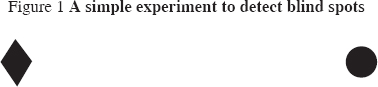
Move the page towards and away from you until the circle disappears—it will, no exceptions. It is now possible, provided you continue to stare fixedly at the diamond, to move the page from side to side and the circle will remain invisible.
This little experiment illustrates two phenomena. First, there are blind spots in our perceptual field. But this is equally true in other fields: memory, personal knowledge, research knowledge, and education theory, for instance. When we frame our knowledge, as we must, some aspects of reality—sometimes important ones—are made invisible. Second, and more importantly, I draw your attention to this question: When the circle disappeared, what replaced it? Did you see a snippet of an adjoining page in the journal through a hole recently vacated by the black circle? Did the white page appear misty grey where the circle once was? No. When the circle disappeared, you saw clear white paper. Had the journal been printed in pink, you would have seen pink. Why? This is how our brains work. During perception our brains pay attention, as it were, to a small number of pieces of perceptual data, and then fill in the rest to form a perceptual whole, a complete field of vision. When the circle disappeared it did so without trace. It was as if there had never been a circle. The brain unconsciously floods the blind spot with other data—the colour of the page—leaving us not just blinded but deluded.
This automatic spilling over of neighbouring information to flood and conceal blind spots is also illustrated by another experiment. People who have lost a hand in an accident or operation report that they can still feel the hand; and they can. Neurophysiologists refer to this as their “phantom” hand. In this experiment the subject—who has lost a hand— has a cube of ice placed against her cheek. She reports, “That’s amazing, my phantom thumb has gone cold!” The cube is moved to another place on her cheek. “My phantom index finger is now cold!” What has happened here? Within the brain the representations of the hand and the face are more or less adjacent. The missing hand leaves a part of the brain without sensation. Accordingly, the sensation-seeking brain spills over sensation from nearby—in this case the face region of the brain—to provide the sought data.
So, to return to the topic of this paper, our educational knowledge and theory not only leave us blinded; they leave us with the impression that we know a great deal more than we do, but this fact is concealed from our awareness. The literary curriculum appears sufficient in itself. Where it is known to be incomplete it is believed to be completable. Its delusional qualities go unrecognised.
The systematic pursuit of transparency
If you have followed the argument so far you will be questioning whether what I am saying is true. Am I guilty of exaggeration? Is the literary curriculum real? And if it is, surely it is a good thing; we ought not to be working in an information vacuum. Is it true that teachers and learners are reduced to a kind of self-diminishing conformity, and that an expertocracy deprives us of education-affirming narratives and ideals? After all, we value empowered learners, diversity, and localised autonomy, don’t we? In what follows I will argue that the literary curriculum is real.
Of course there are counter instances and attempts to resist, and we can be grateful for this. What I am talking about is a trend; one that has built up a momentum, is coextensive with a supportive grammar and vocabulary, and produces a particular disposition of thought. If we are to maintain a healthy self-identity and a vibrant education system we need to develop a level of awareness about this, and heed the warnings of Heidegger and Husserl: the literary curriculum and the technical rationality that accompanies it present and perpetuate a distortion of the lived educational encounter between teacher and student, and in doing so conceal that fact from us. Importantly, the literary curriculum is not a good thing by anyone’s standards, because it does not even achieve its own aims. It achieves the opposite of what is intended and, in particular, through the corrosion of narratives, teachers and students are left illiterate. It is true that we value empowered learners, diversity, and localised autonomy, but what we are getting is compliance, uniformity, and centralised control.
The first point that needs to be stressed is this. What is new is not the attempt, through the literary curriculum, to make curriculum space transparent. An element of transparency has been, will be, and ought always to be sought. What is new is the systematic pursuit of this transparency; the view that it is unthinkable to do otherwise. This notion had its inception around the turn of the 18th century during the enlightenment when diversity became the focus of unprecedented attention. Prior to this, diversity went unremarked. During the enlightenment things changed. Diversity came to be seen as, to a considerable degree, the product of educational activity—a radically new idea. This was the birth of the horticultural metaphor in education. Human nature came to be seen as the consequence of cultivation and, therefore, able to be shaped by human control through education. Differences were newly seen as malleable, and diversity as able to be bridled. This notion was then welded to another enlightenment idea: nature is a single all-encompassing system of discoverable laws that determine events; and, once identified, it is in everyone’s best interest to fit in with them. What resulted? Differences came to be seen as things that not only could be changed but should be changed. Who had the privileged knowledge of the laws of human nature and, accordingly, the blueprint according to which people should be moulded? The legislative expert.
Because nature, by these lights, is law like. One sign that educational cultivation is on track is the ability to predict human behaviour and educational outcomes. In fact, unpredictability, the bitter enemy of the blueprint, is a sign of systemic failure. Have things changed since these early enlightenment times? Not as much as we would like to think. Since the 1980s in the United States, and more recently elsewhere,3 education is widely managed scientifically. The scientific management of education entails thinking of education as a technical system (Neyland, 2007a). A group of experts legislate the mandatory outcomes of education, backed by an audit agency that ensures compliance, and a data gathering arm that monitors the system’s overall functioning. Such a system necessarily produces both conformity and uniformity. But because the scientific management of education has been given an imprimatur by the globals, and is—perhaps inadvertently—supported by the international comparisons movement, the embedding of organisational compliance and sameness is solidified and globalised.
The scientific management of education and the international comparisons movement—the first backed by the power of the state, the second a high-stakes event in international relations—lead inevitably not only to the desire to make curriculum space transparent, but also to the systematic drive for transparency. Why do I say a “systematic” drive? First, because the scientific management of education and the international comparisons movement appear to be merely neutral, co-ordinated, data-gathering mechanisms, and therefore unremarkable. Second, because, as I outlined earlier, one can never have enough data. Third, because recalcitrant teachers and students still do unpredictable and therefore antisystemic things. Why do the scientific management of education and the international comparisons movement appear “neutral”? The answer has been given, but is worth repeating. They transcend the education lifeworld—where localised communal practices, narratives, and direct one-to-one encounters prevail, where freely motivated responsibility for others is the rule that requires no rule—and, in so doing, they both misrepresent it and conceal that fact.4
The artificially designed, élite-ruled, and privatised curriculum
The literary curriculum is mistakenly presented as being a map of curriculum space. The idea is this. If we can chart curriculum space in meticulous detail we will come to know that space. This in turn will allow us to rule over it with understanding and kindly intent. This is an understandable but tragic error. It is equivalent to attempting to surgically remove a person’s immune system—can anyone say where in the body the immune system is?—in an attempt to fix it and make her well. The literary curriculum is not a map; it is, as has been intimated above, a blueprint. It does not chart the territory; it attempts to fabricate it. The literary curriculum, then, is not a faithful representation of the education lifeworld, an exposé of human endeavour and interpersonal responsibility; it is an artificially-designed and imposed blueprint.
To understand what is happening here one needs to be reminded of how the office of mapping becomes the office of blueprinting. Once upon a time maps were fashioned—one could say by the hand of an artisan—to conform to the territory they aimed to represent. Later, for the purposes of taxation and so on, it became necessary to categorise, standardise, and otherwise impose a calculable uniformity upon territories. Over time a larger domesticating and administrative impetus, backed by state powers of coercion, led to the territories being forced to conform to the standardised categories and the processes of bureaucratic “normalisation”. In short, the map became a blueprint. The same process is occurring in education. Maps of curriculum space are being transformed. In the interest of readability, local variety must be bridled and the curriculum routinised. For the larger purposes of comparison making, resource allocation, standardisation, and accountability enforcing, curriculum space is being made to conform to the map, which has, in the process, now become a blueprint.
Let me illustrate this with an example. Is it true that, in today’s education system, lesson planning is considered so normal that its practice cannot be questioned? Most would agree it is. To suggest that lesson planning— the specification of “learning intentions”, the methods of fulfilling them, and so on—could be harmful is mostly unthinkable. To question these practices, assiduously taught in preservice education, is to express an unimaginable sentiment. Yet, the practice of lesson planning is a good example of what I have been talking about. There are two crucial steps in the movement from the map to the blueprint. The first is to normalise the practice of mapping. The second is to seize control of the mapping office and turn the maps, the absence of which is by now considered unthinkable, into blueprints. In education today this revolution, achievable in one double movement, is almost complete. First, one ensures that planning of the sort outlined above is normalised. Done. Second, one takes control of the plans, and prescribes centrally what the learning intentions and pedagogical methods will be. Also done. From the legislative expert’s point of view, this is the best of all revolutions. Curriculum space has been colonised and made amenable to centralised administration, and those subjected barely noticed that their autonomy, by sleight of hand, has been stolen from them. Who saw the need to occupy the mapping office? The legislative expert; the person who hears the disembodied voice of data, and who, accordingly, knows best. The legislative curriculum, then, is not only artificially designed; it is élite ruled.
But what if the locals are alert to the sleight of hand, the coerced diminution in their self-identity as educators? In another paper I have outlined what happens (Neyland, unpublished). The locals, no longer able to act communally and purposefully, cease to feel the force of the direct face-to-face encounter; instead, they follow instructions. They are immobilised by, among other things, the requirement to test frequently, record continuously, make themselves available for external surveillance by audit agencies and, through “best evidence syntheses”, approved pedagogical schemes, and the like, to subject themselves to identity-corroding self-surveillance and compliance. The teacher, once a creative and responsive actor—or at least potentially so—is now a reactor; made to conform to an artificially designed, élite-ruled curriculum. She is anaesthetised. The gentle hand of the faceless expert guides her and coaxes her—with well-meaning kindness, there is not the slightest doubt—through what is required. The “best evidence synthesis” movement, for instance, is motivated by laudable ideals. But, rather than liberate teachers, it subjects them. This point is insightfully made by McDowall (2005, p. 5):
If being competent is synonymous with adhering to the norm there is no room for independence of thought or action. The ‘best evidence synthesis’ movement relieves teachers of the need to make judgments about what constitutes best practice. … because the thinking has been done for them. Worse it constructs their own judgments, if different from the evidence-legitimated norms, to be deviant. … This process subjects teachers. It makes them docile and obedient. … This is how norms close down the space for alternative thought and action.
The upshot of all this is that the literary curriculum becomes a privatised curriculum. What does this mean? A privatised curriculum is the opposite of a public curriculum. I am using the term public in the way Sennett (1977) did in his book The Fall of Public Man. An example of public space is—or I should say, ideally would be—the syndicate in the primary school, or the subject department or association in the secondary sector. Public curriculum space is where open-ended education conversations occur, where norms are created and illustrated, where creeds are dissolved and others newly crystallised, where social bonds are strengthened, where ideals are articulated, where dilemmas are restlessly, agonistically, contemplated, and where shared narratives unfold and are told and retold. Within public curriculum space the departure point for professional development is the localised concrete situation. Larger principles remain meaningful because they are, in this way, embodied and contextualised. In public curriculum space the three crucial elements of professional practice—the ethical intention, thought, and action—are one and the same; there is no separation. This is what Varela (1999) calls “ethical know-how”.
What has happened to public curriculum space? It has been razed to the ground, and what remains has been government subsidised and privatised. When public space is destroyed under the rule of the expert we are left with privatised curriculum space. This is characterised by an imitation of the features of public curriculum space. In private curriculum space norms and ideals do not emerge from communal interaction and localised contexts. They are administered centrally through authorised protocols, procedures, and pedagogical methods. As such, they cease to function as norms and ideals. What results is what Whyte (1957) called the new “organisation” person, she who trades her education identity for a conformist, compliant submission to the larger education system which rules gently with a “benign tyranny”. Not only are teachers controlled and privatised; the same happens to students. The story I have told above can be told again, but this time from the perspective of the student.5
The fatal paradox of the literary curriculum
Let me turn now to the tragic irony of the literary curriculum. The literary curriculum, in its attempt to be kind, is cruel. It is so well thought out it is incompetent. Its humanistic intentions are dehumanising. In one of the illustrations in an earlier section I tried to give meaning to the notion of an education lifeworld and, in particular, to the notion of existential freedom. If you think about the anecdote I used as an illustration, I hope it is evident that existential freedom and predictable human behaviour are never going to be mutually harmonious. I have already pointed out that the unpredictability of human behaviour is anathema to the legislative expert and the blueprint. If the education system is to be well governed, the expert must rule. Transparency is a critical device in the struggle for sovereignty over curriculum space. Curriculum space must be made readable, standardised, and pacified so that authorised technique-focused pedagogical practices can be implemented and comparisons can be made. Accordingly, those who recount and enumerate the literary curriculum need to domesticate and override localised communal practices and unmediated—not codified—encounters.
This, of course, is all done with the best of intentions. But the expert’s imposed order backfires because, in privatising curriculum space, in codifying practice and domesticating the education domain, the locals are deprived of their established modes of orientation. Localised and personalised narratives evaporate and situational, communally designed protective nets disintegrate. In the drive for uniformity, predictability, and order, teachers and students are left disoriented, wrong footed. Their former localised literacy is eroded. They become, paradoxically, illiterate. The legislative experts aim for order, but inadvertently achieve disorder. Thus, what is constructed is a manufactured disorder. This sense of disorientation and illiteracy was well expressed, and for the same reasons, by Tolstoy when he wrote:
So I wandered in the wood of human knowledge, amid the gleams of mathematical and experimental science which showed me clear horizons but in the direction where there could be no home, and also amid the darkness of the abstract sciences where I was immersed in deeper gloom the further I went, and where I finally convinced myself that there was, and could be, no exit. (Edwards, 1982, p. 63)
Conclusion
I have outlined the rise and rise of the technical expert, who has control of a method, hears the data speak, and attempts to render curriculum space readable. The literary curriculum—that which is fully, or not-yet-fully readable and legible—transforms and distorts the education domain and eventually dominates it. But this goes largely unnoticed. I have hinted at what I believe the alternative should be. First, a different sort of expert. This is one who is wise and scholarly, but who would shrink from telling others how they should be teaching and, instead, would use the novice’s ideas as a springboard for an educational improvisation. Second, a different sort of curriculum: the improvisation curriculum. The stories of the improvising expert and the improvisation curriculum will need to be told in another paper.
References
Berliner, P. (1994). Thinking in jazz: The infinite art of improvisation. Chicago: University of Chicago Press.
Davis, B., Sumara, D., & Luce-Kapler, R. (2000). Engaging minds: Learning and teaching in a complex world. Mahwah, NJ: Lawrence Erlbaum Associates.
Edwards, J. (1982). Ethics without philosophy: Wittgenstein and the moral life. Tampa: University Presses of Florida.
Humphreys, M., & Hyland, T. (2002). Theory, practice and performance in teaching: Professionalism, intuition, and jazz. Education Studies, 28(1), 5–15.
Kocklemans, J. (1970). The mathematization of nature in Husserl’s last publication, Krisis. In J. Kocklemans & T. Kisiel, Phenomenology and the natural sciences (pp. 45–67). Evanston: Northwestern University Press.
Levinas, E. (1984). Dialogue with Emmanuel Levinas. In R. Kearney (Ed.), Dialogues with contemporary continental thinkers (pp. 47–70). Manchester: Manchester University Press.
McDowall, S. (2005). Toward an alternative to the best evidence synthesis movement. (unpublished).
May, R. (1967). Existentialist psychotherapy. Toronto: Canadian Broadcasting Corporation.
Neyland, J. (2003). Re-visioning curriculum: Shifting the metaphor from science to jazz. In L. Bragg, C. Campbell, G. Herbert, & J. Mousley (Eds.), Mathematics education research: Innovation, networking, opportunities—Proceedings of the 26th annual conference of the Mathematics Education Research Group of Australasia (pp. 547–554). Geelong: Mathematics Education Research Group of Australasia.
Neyland, J. (2004a). Effortless mastery and the jazz metaphor. In I. Putt, R. Faragher, & M. McLean (Eds.), Mathematics education for the third millennium: Towards 2010—Proceedings of the 27th annual conference of the Mathematics Education Research Group of Australasia (pp. 390–397). Sydney: Mathematics Education Research Group of Australasia.
Neyland, J. (2004b). Playing outside: An introduction to the jazz metaphor in mathematics education. Australian Senior Mathematics Journal, 18(2), 8–16.
Neyland, J. (2004c). Social justice and the jazz metaphor. In I. Putt, R. Faragher, & M. McLean (Eds.), Mathematics education for the third millennium: Towards 2010—Proceedings of the 27th annual conference of the Mathematics Education Research Group of Australasia (pp. 398–405). Sydney: Mathematics Education Research Group of Australasia.
Neyland, J. (2005). Towards an ethically-oriented curriculum: Resisting the growth of instrumentalism. Curriculum Matters, 2, 109–129.
Neyland, J. (2006). The literary curriculum and the denial of backgrounds. Curriculum Matters, 2, 63–80.
Neyland, J. (2007a). Globalisation, ethics and mathematics education. In B. Atweh, A. Barton, M. Borba, N. Gough, C. Keitel, C. Vistro-Yu, & R. Vithal (Eds.), Internationalisation and globalisation in mathematics and science education pp. 113–128). Dordrecht: Springer.
Neyland, J. (2007b). The hidden injuries of the literary curriculum. (unpublished)
Ricoeur, P. (1992). Oneself as another (translated by K. Blamey). Chicago: University of Chicago Press.
Sennett, R. (1977). The fall of public man. New York: Knopf.
Sudnow, D. (1978). Ways of the hand: The organisation of improvised conduct. Cambridge: MIT Press.
Varela, F. (1999). Ethical know-how: Action, wisdom, and cognition. Stanford: Stanford University Press.
Whyte, W. H. (1957). Organisational man. London: Jonathan Cape.
Notes
1&;&;&;Another name for this is complexity. See Davis, Sumara, and Luce-Kapler (2000), for a readable introduction to complexity in education.
2&;&;&;For more on this, see Varela (1999), and Sudnow (1978).
3&;&;&;In the 1990s in New Zealand and Australia.
4&;&;&;I do not want to be misunderstood here. I am not saying that there is no place for protocols and so on. I am saying, following Ricoeur (1992), that the code should always be secondary to the direct face-to-face encounter. When this order of priority is reversed, as it is with the literary curriculum, the lifeworld is harmed. Neyland (unpublished) has more on the harm caused.
5&;&;&;I have done so in Neyland (2007a).
The author
Jim Neyland has been a classroom teacher and a preservice and ongoing teacher educator. He has worked in curriculum development at the national level. He is currently a senior lecturer in the School of Education Studies, Faculty of Education, Victoria University, Wellington.
Email: jim.neyland@vuw.ac.nz