The literary curriculum and the denial of backgrounds
Jim Neyland
Abstract
The “literary curriculum” seeks to make curriculum space legible. This requires denying that knowledge has backgrounds that cannot be made legible. Worse still, the attempt to make knowledge legible undermines that which can reasonably be described, and leaves it, if not unusable, then deficient. The difficulty facing those who are concerned with preserving an emphasis on “backgrounds that cannot be made foreground” is that the notion of background evades easy discussion. There are several reasons for this. One is the fact that we—in particular, speakers of English—feel the force of a disposition that urges us to name things and attribute a kind of ownership to them.
Prologue
In an essay on Christmas during wintertime, Chesterton observed that the boy who enjoys all seasons enjoys no season. Please take a moment to think about this statement. Does it have a ring of truth for you? If it does, if you have a feeling for why it is true, then you have a feeling for what this paper is about. One could express the same sort of truth by saying: the school that makes every teacher a principal has no principal; or, the university that appoints every lecturer a professor, has no professors. To apprehend the truth of these statements is to be aware of a background that attends each; a background that is at first imperceptible, but that is nonetheless vital. To “enjoy” involves more than “to take a delight in”, which is what appears in my dictionary. If one enjoys too many things, one ceases to enjoy. There is a necessary component of distinction that accompanies the word “enjoy” as a kind of atmosphere; but it is difficult to put one's finger on quite what this distinction is. The dictionary does not give the full story. There is a connecting background that the dictionary writers either did not notice, or, if they did, felt it beyond their capacity to make it legible in the way required.1
Unless a teacher has been reading Harry Potter to a class, it is highly unlikely she would ever consider the possibility that the students might suddenly become large, spherical, inflated beings, rise to the ceiling, and hover there like Chinese paper lanterns. Now, does the teacher—whose imagination has not been stimulated in this way—hold a belief, or an expectation, or an assumption, that this will not happen? No. She holds no view whatever on the matter, not even an unconscious belief. However, if such an event were to happen, she would be surprised. How can this be? These sorts of states of mind—I cannot call them beliefs, or any other name that I know of—are what Searle (1983, p. 142) calls “'fishy' because they are too fundamental to qualify as beliefs, even as unconscious beliefs”.
Does an experienced teacher follow rules which guide her professional practice? Experienced people know they do not; and independent investigation confirms this (Dreyfus & Dreyfus, 1986). How does she know what to do, then? Does she perhaps follow unconscious rules; that is, formerly conscious rules that have now become unconscious? No. The reason is: experienced teachers are working in a highly complex environment that constantly requires dealing with novel situations. Accordingly, if they used rules, they would also need a new set of rules to tell them which of the rules to apply in a novel situation. This leads to an infinite regress. “How do we ever interpret a rule?” writes the scientist and philosopher Polanyi (1946, p. 44), “By another rule? There can be only a finite number of tiers of rules so that such a regression would soon be exhausted.” So, how do they perform so competently in so many novel situations? Such teachers use what I call “improvisational gestalts”. “When exercising a skill,” Polanyi (1969, p. 160) argues, “we literally dwell in the innumerable muscular acts.” Furthermore, he argues that something similar occurs in all tacit knowing, which he sees as a part of all knowing: “since all understanding is tacit knowing, all understanding is achieved by indwelling” (p. 160).2 In effect, Polanyi is drawing attention to the nature of knowledge as embodied3—we dwell in our knowledge—tacit, and non-codified. Our knowing for the most part cannot be made explicit. It entails backgrounds that cannot be made foreground.
Does simple perception involve backgrounds of this sort? Polanyi (1969, p. 126) argues that it does. “A peculiar combination of skilful doing and knowing is present in the working of our sense organs.” We actively adjust our pupils and lenses, and the convergence of our eyes to form two images. Our eyes usually don't see entire objects. As I write this, there is a box of tissues on the table I am working at. I can see only three of the six faces. I can never see all six faces at once. I nonetheless “see” an entire object. But much of what I “see” is not in the foreground; and even though I could reach over and turn this particular box, this is not true of most of the objects I “see”. I perceive a part, but somehow I “see” a whole. Our perception is also co-determined by muscles which keep the head in the correct position, and, by messages from the inner ear. In addition, there are neural processes that adjust for distance, and that combine the two retinal images into one perceptual image. There are more than 30 “visual” areas of the brain. Some of these are located in the older pre-mammalian parts of the brain—in the brain stem—and account for the fact that some blind people can, in what neuro-physiologists call “blindsight”, identify by pointing, objects they cannot see in the normal sense of the word. In fact, those of us who are not blind can do this too, but we don't realise it because we can also identify the objects by normal vision. This primeval capacity probably accounts for our ability to duck away from objects propelled towards our heads, before we have properly seen them in the usual sense of the word. What I have just outlined is only a tiny portion of the story of simple perception. Our capacity to see, then, is a highly complex, holistic phenomenon. Seeing cannot be reduced to component parts. The same is true of other forms of sensory awareness; and importantly it also is true of knowing more generally.
Introduction
In a previous paper (Neyland, 2005), I identified five characteristics of an ethically-oriented curriculum. The second of these included the notion that knowledge involves “backgrounds that cannot be made foreground”. This idea was only very briefly dealt with there. In this paper, I will say more. But, for the usual reason—lack of space—much will need to remain unsaid. But first, why does this notion deserve attention now? There are two reasons. Firstly, without recognition of backgrounds, knowledge is degraded. Why? If we deny backgrounds, we, by way of compensation, attribute too much to foregrounds. But this leads, in the words of Dreyfus and Dreyfus (1986, p. 17) to “a severe degradation of performance [in which you fall] victim to 'knowing that' as it interrupted and replaced your 'knowing-how'”. Secondly, there is about us a potent force in education that denies the presence of backgrounds. The potent force is the literary curriculum—which should not be confused with the literacy curriculum.
The literary curriculum
What is the literary curriculum? In a word, it is the opposite of the notion of “backgrounds that cannot be made foreground”; i.e., it is the antithesis of the idea that knowledge entails a background that cannot be made explicit. The literary curriculum is based on the notion that curriculum space can, and should, be made fully readable, legible, and enumerable; curriculum space can and should be recounted in writing. The literary curriculum is aimed at colonising curriculum space; it is the information-processing mentality institutionalised in education. At present, it is a tidal wave that threatens to overwhelm us. The early wash is evident in the current privileging of (i) “scientific management” as a form of education organisation, (ii) instrumental rationality as the dominant mode of reasoning in authorised education theory, (iii) obsessive data gathering as an aid to instrumental decision making, and (iv) the “international comparisons” movement as a means of benchmarking. Associated with this are (v) the “best evidence synthesis” movement,4 and (vi) the emerging notion of “evidence-based learning”. I have argued, in three unpublished papers on the literary curriculum, that it was invented about a quarter of a century ago; it results in a curriculum that is “artificially-designed”, “elite-ruled”, and “privatised”; it leaves teachers damaged; and it has a “fatal paradox” at its heart because in reality it achieves the opposite of its aim; it leaves teachers, not as competent readers and writers of curriculum space, but wrong-footed, disoriented, and, paradoxically, illiterate. Among the things that are threatened by the literary curriculum are the facets of knowledge that cannot be made categorical in the way intended—the tacit knowledge that teachers have, for instance. So, my aim here is to put a bit of flesh on the bones of the notion of background. The discussion of backgrounds in Neyland (2005) proved difficult for some readers. I sympathise with them. It was difficult for two reasons. Firstly, it was necessarily brief. Secondly, and more importantly, it is by its nature a difficult topic to think and write about. More on this later.
Gestalts as backgrounds
“Background” theorists often refer, directly or indirectly, to gestalt psychology, and, in particular, to gestalt perceptual psychology. Our brains, gestalt psychologists have shown, have a natural tendency to form conceptual wholes. Here is a simple example.
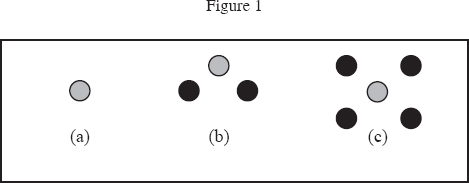
Figure 1(a) shows a shaded circle. In Figure 1(b), two more circles have been added, and, as a result, the meaning of the shaded circle has changed. It is no longer just a shaded circle, it is also the top vertex of a triangle. The brain forms a gestalt, a meaningful whole, and the three circles take on a larger meaning: a whole that is more than the component parts. In Figure 1(c), two more circles are added, and the meaning changes again. The gestalt is now of a “five” shape—for a die, for instance. The shaded circle is the centre of this shape. Try and think of Figure 1(b) as not being a triangle. It is difficult. Such is the force of our brain's capacity to form gestalts. This capacity to make wholes no doubt has an evolutionary explanation—it enabled us to make meaning from fragments of sensory data. A great deal more could be said about gestalts. For the moment, it is sufficient to say that other forms of knowing use gestalts in much the same way; they, too, are wholes that are greater than the parts they include. The larger meaning involves a background that is not part of the simple perception, or knowledge item. Wittgenstein (1953) pointed out that a drawing that could be either a duck or a rabbit,5 depending on how you look at it, will be seen as a duck if it is placed among other drawings of ducks, and a rabbit if placed among rabbits. The meaning of the drawing comes in part from a background that is not part of the drawing.
Gestalts are also important for understanding know-how; i.e., competent practice. Polanyi (1958) discusses the know-how involved in riding a bike. Searle (1983) discusses learning to ski. Dreyfus and Dreyfus (1986) discuss chess playing, driving, and nursing. Their analyses can easily be applied to the know-how of teaching, and the know-how of what is taught in schools. First, though, how does the literary curriculum approach know-how? The disposition, discussed above, which directs the literary curriculum, conceives know-how as rule-directed behaviour; as instances of rule-following; as codified. That is why there is such an emphasis on telling teachers—through output statement, guides, standards, protocols, and so on—how and what to teach. There is some sense to this, but mostly it is wrong-headed. Much know-how is initially learnt by following rules. In the case of skiing: “always face down hill”, “lean on the inside edges”, “lean forward”, and so on. In addition, sometimes know-how can be described in terms of rules. In the case of riding a bike around a corner at speed, for instance, a physicist can use the rules—usually called laws—of gravity, and centrifugal forces, to explain exactly why the cyclist leans at a particular angle. The critical question is this: When the know-how is performed (competently) does the performer use rules, perhaps even unconscious rules? The answer most theorists give—information-processing theorists, of course, beg to differ—is no, not even unconscious rules. It is a common error to believe that the rules used while learning become habits of thought and practice that reside in the unconscious, and that they direct things from there without the performer's awareness. If not rules, then what? The know-how “indwells” in bodily gestalts. Rule-following is not involved at all. In fact, to use my terminology, the know-how is embodied in improvisational gestalts. This is because the competent skier, for example, can traverse with grace and poise even unfamiliar terrains. The skier is not using rules, and not reproducing habitual behaviour. The skier is able to handle new situations beyond the scope of habitual behaviour. The skier spontaneously shows know-how for the unpractised slope; just as an improviser does in novel situations. To summarise this section: there are perceptual, knowledge, and know-how gestalts that involve a background dimension of meaning that cannot be made explicit as perceptual data, knowledge facts, or rules.
Why it is difficult to write about backgrounds
Backgrounds are fascinating, because thinking and writing about them involves running against the grain of our language conventions. One has sometimes to resort to the sort of device I used at the beginning of this paper: to using a kind of paradox to allude to what I am saying, because appropriate words are not readily available. Our grammar and vocabulary—like the literary curriculum—are predisposed towards the denial of backgrounds. The reason is simple: our language practices are aimed at making distinctions, being precise, being categorical, and generally making vague things explicit. When I use the word “chair”, for instance, I have a fairly clear intention in mind about what I am referring to. The word “chair” is about something—this notion of “aboutness” is important here. Even if I am referring to a generalised chair—“Are there any chairs in the room?”—I am still using the word to refer to something. If I say, “I am excited”, mostly it is because I am excited about something; a new book that has arrived, or the imminent visit of a friend, perhaps. There are some kinds of mental activity that do not have this quality. I might feel a vague undirected anxiousness, for example. This last feeling does not have the quality of “aboutness”. There are other states that lack this quality of aboutness, and these form part of the background for other states that do have this quality. This paper is about these non-aboutness states that form the necessary background for aboutness states, and it is about other tacit dimensions of knowing.
Searle (1983, p. 156) points out that the difficulty in writing about backgrounds explains why writers end up using vague terms such as “'practices', 'capacities', and 'stances' or … suggestively but misleadingly of 'assumptions' and 'presuppositions'”. Of these, Searle finds that “capacities” and “practices” are the best of a bad lot, as a means of talking about backgrounds. They avoid being caught too much in the compulsion present in ordinary language, to precisely represent actual states of affairs. However, “assumptions” and “presuppositions”, he finds, do not sufficiently escape the gravitational pull of a language vocabulary designed principally to represent things. In fact, Searle argues, mind, like language, also has, as a major function, the representation of things; mind is typically geared to and directed towards an “aboutness”. But the backgrounds that attend our representations are, as indicated above, non-representational—they are not about anything—so thinking about backgrounds also requires us to, as it were, paddle against the current.
Language, Searle (1983) argues:
is not well designed to talk about itself … the mind is not well designed to reflect on itself. … Our second-order investigations into the first-order phenomena quite naturally use the first-order vocabulary so we can be said … to reflect about reflection or have beliefs about believing or even to presuppose about presupposing. But when it comes to examining the conditions of the possibility of the functioning of the mind, we simply have very little vocabulary to hand except the vocabulary of first-order [intentional or 'aboutness'] states. (pp. 156–157, emphasis in original)
Backgrounds, because they cannot be identified, must instead be revealed. They are often revealed when they are “breached” (Garfinkel, 1967). If, as I have, I present to a mathematically-competent audience what appears to be a completely watertight “proof” of a mathematical result, but do so in a way that uses none of the usual conventions for mathematical proof, this breaches a commonly-held but ineffable background understanding of what a mathematical proof is; and it causes a discomfort—sometimes ironic laughter, sometimes annoyance. In the breaching, a background is revealed, but it evades discussion. In fact, Garfinkel's work on breaching led him to conclude that we try to avoid being confronted by the presence of our backgrounds. Searle discusses a more mundane example that has similarities to breaching. I lift my mug of beer to take a sip, and find it is lighter than expected. Why? It turns out that the mug is plastic, not glass. How do I explain my surprise? I say that I believed that the mug was glass. But, Searle points out, I say this only because “believe” is the best word for the situation. But it is the wrong word, and there is no right word. In reality, I had no beliefs whatsoever about the mug. I simply picked it up and drank. This is much the same as what Wittgenstein (1977) argues when he says that it is erroneous to talk of a “belief” or an “assumption” that the world started more than five minutes ago. I don't normally establish a belief on such a matter, because I am too busy relying on it while I form beliefs about other things. My need to offer an explanation in terms of beliefs shows the paucity of language—the English language at least—when it comes to discussing backgrounds.
A similar argument, I suggest, is valid for providing a partial explanation for the wide acceptance of the literary curriculum. Mind and language function to make things explicit; and they give the appearance of making explicit some things which really cannot be made explicit, thereby creating the impression that backgrounds do not exist as such, but exist instead as definable entities. The same can be said of the literary curriculum. The literary curriculum functions to make curriculum space readable, to recount it in writing. When regions of background are encountered, the tendency is to make them amenable to explanation and explication—just as I did in the example of the plastic beer mug. This leads to the pretence that backgrounds do not exist.
Why it is important to write about backgrounds
This topic—backgrounds—is not only fascinating, it is important. Why? To put it bluntly, I am concerned that the literary curriculum will ruin education. To put it less bluntly, the error of using first-order constructs (definitions, categories, rules, codes, and so on) to frame second-order investigations (into background capacities, and tacit and ethical knowing), I have just indicated, is a “natural” disposition for thinking, talking, and theorising. Accordingly, the literary curriculum is more or less a default setting for curriculum theorising, in particular for those who control the purse strings. Such people are typically motivated by a requirement to fully justify where every dollar is spent, and, therefore, are eager to pin things down and make them calculable. But we have at the moment more than this. This default setting is backed by state apparatuses of power. It is a default setting that is foisted on everyone because it is made mandatory through legislation. Governments require the literary curriculum to dominate curriculum space. Making curriculum space readable is more than a disposition, it is a project that is being systematically pursued, but with the very best intentions.
What happens when it is forgotten, or denied, that there are backgrounds that cannot be made foreground? To put it differently, what happens when the literary curriculum dominates? Let's look at the special case of the specified curriculum, that which outlines what must be taught. The more that the specified curriculum is made explicit, the less that is left unspecified. This leads to the predominance of the view that all that is important can be specified, and that that which is unspecified is unimportant. Add into the mix the accountability procedures that accompany the literary curriculum, and the problem increases. If a teacher cannot demonstrate that her students are making progress, then her professional competence is questioned. The ability to demonstrate progress naturally becomes a high-stakes issue. But it is hard to demonstrate progress in the development of tacit knowledge, improvisational gestalts, ethical know-how,6 larger orientations in line with a subject's areas of deeper significance, and so on. Accordingly, little by little, these things are neglected, and the more easily-specified facets become objects that assessment is focused upon. Then, little by little, the teaching programme becomes aimed at students demonstrating these easily assessable competencies. Before long, the more important backgrounds are forgotten.
Can I remind the reader of a crucial factor here. It is not that the neglect of backgrounds is a regrettable oversight, and that much good is obtained from teaching to foregrounds. The theorists of backgrounds point out time and again that foreground knowledge is degraded if backgrounds are ignored. One cannot say, “Yes, I neglected backgrounds, but at least I taught the foreground well.” If the background is neglected, the foreground cannot have been properly taught. Here is a simple example. Self-identity is shaped and strengthened by narratives that give meaning to our lives. Creative writing is one means of encouraging students to construct narratives of meaning and vitality for themselves. It is easy to see that these students dwell in their written expression. There is a co-dependence between lived experience, identity formation, meaning making, and narrative forming, at work here. How does one demonstrate progress in complex situations like this? I have to admit that, even in formulating that sentence, I have tangibly breached my own education values. It feels in a way an offence to ask this question, even hypothetically; I'm despoiling the sacred ground of human dignity. The words stick in my throat, as it were, because they come from somewhere foreign to my deeper education sensibilities; they come from the literary curriculum, not from the curriculum that nourishes my teaching. But I can easily demonstrate progress in spelling: for example, Sarah made seven errors on Monday, five on Friday, and four the following Thursday.
I will mention, in passing, another reason why it is important to write about backgrounds. Dreyfus and Dreyfus (1986) say they have personal experience of the big money interests that back the information-processing industry seeking to limit public exposure of their criticisms of that industry's denial of backgrounds. The information-processing industry has a great deal invested in ensuring that many software products under development get to market—products that are designed on the premise that backgrounds can be made foreground—and want for this reason to ensure that contrary views are not widely disseminated. Now, obviously there is no such equivalent in education. But there is, in education, considerable cultural capital, subsidised by government funding, invested in the systems and processes that support the literary curriculum. I don't believe this is a significant point. But it is nonetheless a factor that is influencing events.
Further reasons why backgrounds are difficult to discuss
In an earlier section, I indicated why it is difficult to think and write about backgrounds. I will say more on this topic now.
In addition to what was outlined above, we also have a tendency to retrospectively explain instances of tacit knowing and ethical know-how as if these resulted from particular cognitive choices. Perhaps I should mention here that, by “we”, I mean those who are significantly influenced by the cultural traditions that tend to neglect anything other than deliberative, rationality-based modes of explanation. Dreyfus and Dreyfus (1992, p. 122) draw attention to this regrettable tendency. They argue that, even if our “everyday intuitive ethical experience [is] recognised”, our understanding and explanation of this tend to become “distorted by reading back into it the mental content found in deliberation”. But, one might wonder, how much of knowing is in fact tacit or “ethical”? Most of it, argue Dreyfus and Dreyfus (1986, p. 29): This is “the sort of ability we all use all the time as we go about our everyday tasks”. Polanyi (1969, p. 195) says: “All knowledge falls into one of … two classes: it is either tacit or rooted in tacit knowledge.” Murdoch (1997): All knowing has as a background a “sovereign” good. Taylor (1989, p. 3ff): Knowing entails “inescapable frameworks”. Taylor (1991, p. 31ff): All knowing involves “inescapable horizons” of “distinction” and “significance”.
So, the topic of this paper cannot be dismissed as of only sectional applicability. But there is another reason why we struggle in this area of investigation. Here the reader will need to forgive me, while I briefly summarise, in two paragraphs only, some of the deeper issues that attend an analysis of this topic. I will return to more familiar territory shortly.
We—and here I mean, in particular, speakers of English7—are uncomfortable with the notion that our knowing, to a very significant degree, is embodied (Dreyfus, 1992; Johnson, 1987; Lakoff, 1987; Lakoff & Johnson, 1980; Merleau-Ponty, 1962; Polanyi, 1958, 1967; Sudnow, 1978; Varela, Thompson, & Rosch, 1991; Wittgenstein, 1953). Merleau-Ponty's (1962) work in the phenomenology of embodied perception did much to lay the groundwork for later theorising about the ubiquity of embodied knowing. But even Merleau-Ponty occasionally resorted to “I can” language—in Merleau-Ponty (1969, p. 255), for instance—to explain the authorship of embodied knowing. However, Sudnow's (1978, 2001) detailed study of embodied knowing—which Dreyfus (2001, p. xii) believes carries “forward and beyond Merleau-Ponty's phenomenology of the active body”—indicates that it is not the “I” that directs, but the body that acts. Dreyfus (2001, p. x), in his foreword to Sudnow's rewritten account, elaborates on Sudnow's findings: “After much experience … a novice progresses to the stage where he finds himself able to reach for gestalts [leading to the situation where] now there is a strategy without a strategist … there is no longer an I that plans, not even a mind that aims ahead [italics added]”. What I am saying here is this. We—in particular, speakers of English—have a disposition, reinforced by our language conventions, that urges us to attribute ownership to knowledge, and authorship to action. But Sudnow's work on embodied knowing indicates that in most situations we just act. This, I should quickly mention, is not a threat to the idea of free will, it is a threat to the dominant idea of disembodied cognition typical of the information-processing and literary curriculum mentality. The teacher, for instance, just does the right thing in the classroom most of the time. She does it spontaneously. She does not apply a rule, or consult a standard or protocol; not even unconsciously. This leaves us with a double difficulty. Firstly, we feel the urge to explain and articulate what “good” know-how entails—in standards and protocols, in “best evidence syntheses”, and so on. Secondly, we want to attribute a rational decision and an I-directing authorship to our actions. But the literature on tacit and embodied knowing suggests that our seeking these forms of explanation is misplaced. So, what does that leave us with in terms of writing about these backgrounds, that attend our knowing? Not much I'm afraid. Do we fret about this? Yes. Should we? Wittgenstein says no. I am not arguing that discussions about priorities, distinctions, and so on, are unimportant. They are crucial. But they need to be conducted against a framework that is radically different from that established by the literary curriculum. A topic for another paper perhaps.
Before I move on to more familiar ideas, I will briefly mention one more thing that is linked to what I just wrote about Wittgenstein. Wittgenstein (1953) suggested yet deeper reasons for why we avoid facing up to the presence of backgrounds that cannot be made foreground. My thinking on this is based to a considerable degree on Edwards' (1982, 1990) discussion of Wittgenstein's thought. I consider Wittgenstein's ideas on this topic to be of utmost importance. Disappointingly, they are rarely discussed. I'll leave this as a topic for a future paper.
Epilogue
That completes a short discussion of backgrounds. I am left aware that I have only managed to scratch the surface of this topic here. In addition, the field is still developing. Among the things I have left out is a discussion of ethical backgrounds that cannot be made foreground. This is closely related to the notions of ideals in education, and aesthetics. Educators seem to have formed themselves into two camps on these issues: the “there is no such thing as ethics and ideals” camp; and the “it is inconceivable that nothing can be accorded significance” camp. I sympathise with both. The way out of the impasse seems to me to entail a transcendence of the problematic as it now stands. The notion of “pursuing ideals” seems to me to be one possible way forward. Why? “Pursuing ideals” is ambiguous. It is not clear whether the ideals are pursuing or being pursued.8 Anyway, that is just one of more than a dozen areas that, in my view, need further discussion. I am aware that I have hardly mentioned the issues upon which the “background” scholars differ with each other. There are several. But their areas of agreement far outweigh those of disagreement; and the latter in many cases seem to me to boil down to differences of understanding of the meaning of other terms. For example, Johnson differs with Searle on one point concerning whether or not backgrounds are part of meaning. But the heart of the matter is really a slight difference between the two over their understandings of the notion of truth. Mostly, these writers openly acknowledge their mutual indebtedness. Where they do not, it is usually because they didn't know of each other's work—Wittgenstein and Heidegger, for instance.
Conclusion
Now to round off the paper. The orthodox educator believes that if things cannot be made explicit, they cannot be explained; things that cannot be made explicit—assuming they reluctantly agree there are such things—are therefore mysteries. Others take a different view, one that does not need to entail resorting to mysteries. Some things can be explained—perhaps with difficulty—but they cannot be made explicit. The reason for this is that, knowledge, like beauty, is more than skin-deep. Knowledge, like beauty, is full-bodied; it is embodied. It cannot be identified forensically as “evidence” in a “best evidence synthesis”, or in “evidence-based learning”. Knowledge has a background—a living, breathing background—that cannot be observed or itemised as if it were on the surface of things, in the foreground. In fact, to try to do so has a deleterious effect on the knowledge in question. But the background cannot be ignored either. Backgrounds are part of knowing—in particular, they are part of tacit knowing. To ignore them is to neglect them, and to weaken capacities to know. To deny them courts disaster.
Teachers and students use tools, both physical and conceptual—the long multiplication algorithm, for instance, is a tool. Tools are not mere objects. The tool is “ready-to-hand”, whereas the object is simply “at-hand”. Our tools are not separate from us; we live in our tools—we “indwell” them—our tools are part of us.9 This way of thinking about the knowledge and artefacts that surround us is a deeply human one. The artefacts I have made to assist me in my teaching, the techniques I have refined, the orientations toward education I adopt, these reflect my—not someone else's—purposes and intentions as a teacher, and to the degree that I am at home with them, they are extensions of my body. They are, in fact, part of my body. This is a deeply human way of understanding our living in the world, and our work in education. By these lights it is ridiculous to think of a tool without thinking of the purpose for which it was made. Larger purposes cannot be separated from other dimensions of knowing; knowing what is beautiful and sound; a feeling for what is “good”. These things cannot be made categorical. The literary curriculum urges that everything be made categorical. It results in the disappearance of that which cannot. The result is not good for education.
References
Dreyfus, H. (1992). What computers still can't do: A critique of artificial reason. Cambridge, MA: MIT Press.
Dreyfus, H. (2001). Foreword. In Sudnow, D. (2001). Ways of the hand: A rewritten account (pp. ix-xiii). Cambridge, MA: MIT Press.
Dreyfus, H., & Dreyfus, S. (1992). What is moral maturity? Towards a phenomenology of ethical expertise. In J. Ogilvy (Ed.), Revisioning philosophy (pp. 111–131). New York: SUNY Press.
Dreyfus, H., & Dreyfus, S. (with Athanasiou, T.). (1986). Mind over machine: The power of human intuition and expertise in the era of the computer. New York: The Free Press.
Eco, U. (1984). Semiotics and the philosophy of language. London: Macmillan.
Edwards, J. (1982). Ethics without philosophy: Wittgenstein and the moral life. Tampa: University Presses of Florida.
Edwards, J. (1990). The authority of language: Heidegger, Wittgenstein, and the threat of philosophical nihilism. Tampa: University of South Florida Press.
Garfinkel, H. (1967). Studies in ethnomethodology. Englewood Cliffs: Prentice-Hall.
Heidegger, M. (1962). Being and time (J. Macquarrie & E. Robinson, Trans.). New York: Harper and Row.
Johnson, M. (1987). The body in the mind: The bodily basis of meaning, imagination, and reason. Chicago: University of Chicago Press.
Lakoff, G. (1987). Women, fire and dangerous things: What categories reveal about the mind. Chicago: University of Chicago Press.
Lakoff, G., & Johnson, M. (1980). Metaphors we live by. Chicago: University of Chicago Press.
Llewelyn, J. (1991). The middle voice of ecological conscience: A chiasmic reading of responsibility in the neighbourhood of Levinas, Heidegger and others. London: Macmillan.
Merleau-Ponty, M. (1962). The phenomenology of perception. London: Routledge & Kegan Paul.
Merleau-Ponty, M. (1969). Eye and mind. In A. Fisher (Ed.), The essential writings of Merleau-Ponty (pp. 252–286). New York: Harcourt, Brace & World.
Murdoch, I. (1997). The sovereignty of good over other concepts. In I. Murdoch, Existentialists and mystics: Writings on philosophy and literature (R. Conrandi, Ed., pp. 363–385). New York: Penguin Books.
Neyland, J. (2005). Towards an ethically-oriented curriculum: Resisting the growth of instrumentalism. Curriculum Matters, 1, 109–129.
Polanyi, M. (1946). Science, faith and society. London: Oxford University Press.
Polanyi, M. (1958). Personal knowledge: Towards a post-critical philosophy. London: Routledge & Kegan Paul.
Polanyi, M. (1967). The tacit dimension. London: Routledge & Kegan Paul.
Polanyi, M. (1969). Knowing and being. London: Routledge & Kegan Paul.
Searle, J. (1983). Intensionality: An essay in the philosophy of mind. Cambridge: Cambridge University Press.
Sudnow, D. (1978). Ways of the hand: The organisation of improvised conduct. Cambridge, MA: MIT Press.
Sudnow, D. (2001). Ways of the hand: A rewritten account. Cambridge, MA: MIT Press.
Taylor, C. (1989). Sources of the self. Cambridge: Harvard University Press.
Taylor, C. (1991). The ethics of authenticity. Cambridge: Harvard University Press.
Varela, F. (1992). Making it concrete: Before, during and after breakdowns. In J. Ogilvy (Ed.), Revisioning philosophy (pp. 97–109). New York: SUNY Press.
Varela, F. (1999). Ethical know-how: Action, wisdom, and cognition. Stanford: Stanford University Press.
Varela, F., Thompson, E., & Rosch, E. (1991). The embodied mind. Cambridge, MA: MIT Press.
Wittgenstein, L. (1953). Philosophical investigations. Oxford: Blackwell.
Wittgenstein, L. (1977). On certainty. Oxford: Blackwell.
Notes
1&;&;See Eco (1984) for more on the limitations of dictionary definitions.
2&;&;This notion of “indwelling” is much like Heidegger's (1962) notion that certain things—such as tools, both physical and conceptual—are “ready-to-hand” rather than merely “at-hand”.
3&;&;Varela (1992, p. 102) explains that “embodied” refers to the notion: “(1) that cognition depends upon the kinds of experience that come from having a body with various sensory-motor capacities; and (2) that these individual sensory-motor capacities are themselves embedded in a more encompassing biological and cultural context.”
4&;&;There is more on the “best evidence synthesis” movement in my submitted paper, The Hidden Injuries of the Literary Curriculum.
5&;&;The drawing is in sec. xi.
6&;&;Varela's (1999) term.
7&;&;John Jameison and I are in the process of preparing a paper based on John's analysis of the subtle differences between English and other languages. The paper argues that English speakers are more naturally comfortable with modes of thought that emphasise the “I” as the owner of knowledge and the author of know-how.
8&;&;I am suggesting here that the ambiguous quality allows the expression to be seen as falling in the “interspace”—Taylor's (1989) term—between an anthropocentric or subjectivist orientation on the one hand, and Heidegger's “language speaks” (Edwards, 1990) orientation on the other. In plainer language, this distinction can be thought of as that between an heroic separated individual (“I can”) on the one hand, and a “cultural dope” (Garfinkel, 1967) on the other. This device (the use of this sort of ambiguity), I suggest, has affinities with Taylor's (1989, 1991) notion of “subtler languages”, and Llewelyn's (1991) concept of a “middle voice” between the active and the passive voices—in this case roughly equivalent to “I pursue ideals”, and “ideals pursue me”, respectively. There are affinities here with Merleau-Ponty's (1962) discussion of Klee, and Edwards' (1990) discussion of the difference between the later Heidegger and the later Wittgenstein. I think Wittgenstein, too, was approaching something like this interspatial language, or medial voice, orientation, but in a different way. Wittgenstein's notion of “Pathos”—meaning roughly “the impressiveness of things”—seems to me to be his attempt at getting at the same idea. For instance, he wrote: “'Language (or thought) is something unique'—this proves to be a superstition (not a mistake!), itself produced by grammatical illusions. And now the impressiveness [of the world] (Pathos) retreats to these illusions, to the problem” (Wittgenstein, 1953, sec. 110). These “subtler”, “interspatial”, “medial voiced” notions can in turn be linked with what one could call an “ecological” orientation (Taylor, 1991), or an “ecological consciousness” (Llewelyn, 1991). These, it seems to me, could be developed as an expression of an ecological orientation in curriculum. Such an orientation is radically different from the literary curriculum. Taylor (1991, p. 90) writes this, for instance: “It would greatly help to stave off ecological disaster if we could recover a sense of the demand that our natural surroundings and wilderness make on us. The subjectivist bias that both instrumental reason and the ideologies of self-centred fulfilment make dominant in our time renders it almost impossible to state the case here.” I hope the reader can see the spectre of the literary curriculum hovering in the background of what Taylor is saying here.
9&;&;Of course, what is a tool for one, need not necessarily be a tool for another. Many things that ought to become ready-to-hand remain at-hand. This is true of any teachers or students who have not yet established the right sort of relationship with this knowledge.
The author
Jim Neyland has been a classroom teacher, a teacher educator, and has worked in curriculum development at the national level. He is currently a senior lecturer in the School of Educational Studies at Victoria University of Wellington.
Email: jim.neyland@vuw.ac.nz