Reading comprehension benefits from being taught to write: The secondary students’ perspective
Meiyang Hong and Gavin T. L. Brown
https://doi.org/10.18296/cm.0216
Abstract
Drawing data (N = 625) from the 2004 Assessment Tools for Teaching and Learning Version 4 database, this article explores how New Zealand Years 11–12 secondary students perceived the importance of learning to read and write in English and how those perceptions related to their reading attitudes and performance. More positive student perceptions of learning reading comprehension supported greater interest while more positive perceptions of learning to write supported self-efficacy. Increased performance was positively enhanced by greater self-efficacy more than greater interest. This study emphasises the importance of learning to write as a support for greater reading comprehension.
Introduction
Reading comprehension is an essential skill, not only for achievement in almost all subjects but also for lifelong social participation (Medina & McGregor, 2019). Results in reading comprehension are positively associated with positive attitudes toward reading. Self-efficacy beliefs (Zimmerman, 2000) and interest in a subject (Hattie, 2008; Marsh et al., 2006) contribute to academic achievement in reading comprehension. Reading and writing in a language have shared knowledge, shared functions, and shared rhetorical relations (Fitzgerald & Shanahan, 2000; Shanahan, 2006). However, empirical evidence that links learning to write to greater performance in reading comprehension is scant. Considering the strong bond between reading and writing, it is likely that students who are taught to write would also have good reading achievement. However, this assumption is not well validated.
In this study, a cross-section of senior secondary school students’ perceptions of the importance of learning to read and write were linked to their self-reported self-efficacy and interest in reading, and subsequently their performance on a reading comprehension test. This study generates evidence that student perceptions of what they have been taught in terms of writing in English classes especially contributes to greater self-efficacy and greater performance on standardised reading comprehension tests.
Literature review
Reading and writing relations
According to the shared-function view of reading and writing, when students write about a reading text, they need to select the most important ideas from the text, organise those ideas with specific connections, make decisions about the content to put in writing, use their own words to express the ideas, and be ready to reflect on their own writing (Devine & Kania, 2003; Fitzgerald & Shanahan, 2000; Ministry of Education, 1997; Shanahan, 2006; Tierney & Shanahan, 1991). Meta-analytic evidence exists that writing about a reading text will improve comprehension of the texts for compulsory school students (Graham & Hebert, 2010, 2011).
Writing assists learning because students are more likely to explore and respond to the ideas in reading texts when they need to express their opinions and feelings about the texts (Vacca, 2002). Active information searching within the text to support writing will increase students’ reading comprehension (Devine & Kania, 2003). Even when students are only writing for themselves rather than writing for teachers’ assignments, the act of writing plays a part in improving understanding. Writing personal summaries has a bigger effect on assisting students’ learning than reading summaries written by teachers and others (Devine & Kania, 2003). When students learn to write, they simultaneously learn the knowledge and skills of reading comprehension.
Student perceptions of being taught to read and write
Students value the importance of close reading. For example, Beck et al. (2015) reported that 76% of students thought learning and using reading strategies were significant in social studies. Specifically, they noticed that knowing how to find the main idea was indispensable to understanding texts and learning new content. Because students regarded reading more as a required skill to succeed in daily life and financial wellbeing than as a way to get pleasure, they were aware of the significance of learning effective reading strategies and the values reading brought to build their vocabulary and knowledge (Fletcher & Nicholas, 2016). Perhaps this is why Beck et al. (2015) found that students prefer informative books.
While students recognised the value of close reading, they also noticed the effort and energy required by close reading. Fisher and Frey (2014) reported that students felt exhausted, drained, or tired after a close-reading session. Close reading was cognitively demanding, and some students could not focus their attention for very long, even when they thought the texts were interesting.
Attitudes toward writing is a separable construct from attitudes toward reading (Graham et al., 2012). Studies indicate that students’ attitudes toward writing, their writing self-efficacy, and performance are positively interrelated (Ekholm et al., 2018; Graham et al., 2007; Klassen, 2002; Villalón et al., 2015). Students reported being able to express ideas and creativity (positive feeling about writing) and struggling with the difficulty and complexity of writing (negative feeling) (Hall & Axelrod, 2014). Students’ attitudes toward writing appear to decline in higher grade levels (Ekholm et al., 2018; Hall & Axelrod, 2014).
However, beliefs about the value or importance of writing, a set of motivational constructs identified by Graham (2018), was less researched based on a systematic review by Camacho et al. (2021). There is also a gap in linking student perceptions of writing importance with reading self-efficacy and reading performance. Hence, a detailed examination of student perceptions of close reading and writing and student self-efficacy and interest beliefs (Schunk & Zimmerman, 2006) could shed light on how the teaching of writing and close reading interact from the learners’ perspective.
Self-efficacy in reading
Self-efficacy is an individual’s belief in his or her ability to achieve specific goals (Bandura, 1997), such as the ability to read a particular novel, rather than more general decisions of being able to read, which is better understood as self-concept (Hattie, 1992). Previous studies have suggested that there is a significant positive relation between self-efficacy beliefs and academic performance, including reading achievement (Guthrie et al., 2013; Moulton et al., 1991). Solheim (2011) found that only reading self-efficacy, rather than reading task value, significantly predicted reading performance. In New Zealand, ‘Otunuku and Brown (2007) found that self-efficacy had weak, yet statistically significant, positive relations to reading achievement, but only for Asian and Pākehā students. Given the reciprocal relationship of self-efficacy and actual competence, it is not surprising that more capable students will have greater self-efficacy, while weaker students will have lower self-efficacy (Chin & Kameoka, 2002; Talsma et al., 2018).
Interest in reading
Interest is an essential feature of intrinsic motivation (Ryan & Deci, 2000; Wigfield & Cambria, 2010; Wigfield & Eccles, 2000). However, the effect of reading interest on reading performance is inconsistent. Taboada et al. (2008) found that interest in reading predicted students’ reading achievement progress when students’ previous reading achievement was controlled. Across 41 countries, Chiu and Chow (2010) found that students with higher reading interests had higher reading scores than other students. However, Retelsdorf et al. (2011) found that interest in reading was not statistically significantly linked to initial reading achievement but was a statistically significant predictor of achievement growth. Generally, as students age through the school system, their interest in reading declines (Wigfield et al., 1997).
Context: Reading comprehension in New Zealand English teaching and learning
At the time when the data in this study were collected, New Zealand students’ reading performance at age 15 was significantly above the Organisation for Economic Cooperation and Development (OECD) average, according to the PISA system (Marshall et al., 2007; Ministry of Education, 2009). However, the reports also highlighted a wider gap between secondary students with high and low achievement in New Zealand than in most other OECD countries.
In New Zealand, reading and writing are taught together in a course called English. At the time of this study, English teaching and learning in New Zealand was under the guidance of a national curriculum statement that divided English into three strands—Oral (listening and speaking), Written (reading and writing), and Visual Language (viewing and presenting) (Brown, 1998; Ministry of Education, 1994). The same teacher is responsible for teaching all facets of the curriculum. Although New Zealand updated the curriculum in 2007 (Ministry of Education, 2007), our reading of the two documents suggests that the revision did not change the substantive core skills, knowledge, or abilities of reading comprehension and writing. Instead, the revision made structural changes to the overarching classification and organisation of the curricular content. This indicates that data linked to the 1994 curriculum at the level of achievement objectives has currency for the 2007 curriculum. In other words, regardless of the labels, the substance of reading comprehension and writing is not different despite terminological changes. The focus and purpose of the English curriculum have been summarised as:
English is not to be primarily a content subject; it is to be about the processes used by an individual to construct a response to a text or to initiate a text. Responses and texts express ideas, emotions, thoughts, personal experiences, aesthetic, moral or philosophic values, and so on. The processes of expression are taught rather than the content of the individual student’s expression. The meaning and power of a text lies in its language. (Brown, 1998, p. 66)
The reading strand had two functions (personal reading and close reading), with the latter assessed in end-of-year qualification examinations only in the final 3 years of secondary schooling (Crooks, 2002). Close reading was defined as “reading to develop detailed understanding, involving the identification of distinctive language features such as vocabulary, imagery, and structure, and how these contribute to meanings, implications, and effects” (Ministry of Education, 1994, p. 139). Instead of just extracting surface-level meanings, students are supposed to study texts for further and deeper ideas. In contrast, personal reading speaks to the importance of reading widely for personal pleasure and interest and was generally not assessed.
New Zealand’s teaching of writing focuses more on the writing process, which requires teachers to help students perceive their purposes as writers and the expectations of their readers at the same time (Emmitt et al., 1996). The curriculum identified three classes of writing: poetic, expressive, and transactional. At high school ages and stages of instruction, writing became a composition of transactional rhetoric aligned to seven socio-communicative purposes, creating texts that differ in form and features according to purpose. The common purposes in high school English writing include: Persuade, Instruct, Narrate, Describe, Explain, Recount, and Analyse (Brown et al., 2003; Hattie & Brown, 2004). In the writing tasks for the Analyse purpose, students will develop skills in understanding a text they have already read more deeply and completely (Brown et al., 2003). It is worth noting that, at the time of this study, high school students were found to perform best in narrative and descriptive writing, in part because the National Certificates of Educational Achievement (NCEA) at Level 1 (Year 11 of the school system) had an achievement standard entitled Produce Creative Writing (Satherley, 2006).
It is worth noting that the long-planned curriculum refresh that focused on understand, know, and do (Ministry of Education, 2023), has been overturned by a recently elected government following advice to adopt two strands of English Language and Literature (Ministerial Advisory Group, 2024). Consequently, it is difficult to predict how these data may map onto the new curriculum. Nevertheless, the information in these student surveys focuses on skills in reading (e.g., understand main ideas and details in a range of texts; know about rules and conventions of language use; and recognise, understand, and evaluate inaccuracies and inconsistencies in and between texts) and writing (e.g., write effectively to persuade or influence readers; write effectively and artistically to entertain; and write accurately with correct grammar, punctuation, and spelling) that appear to constitute reasonably universal and perpetual characteristics of senior secondary school English language skills and knowledge. We suggest that, notwithstanding changes to the official documentation, the student perceptions provide powerful insights into important aspects of English reading comprehension and writing instruction.
Research goal
This study aimed to understand how secondary school students perceived the importance of learning to read and write and how those perceptions were related to their self-efficacy for, interest in, and performance in reading comprehension. We assumed that there would be a relationship among student self-efficacy and interest beliefs, perceptions of learning, and performance. One question guided this study:
How do student perceptions of the importance of learning to read and write affect students’ reading attitudes and performance in secondary school?
Method
The data
Little research exists on reading comprehension of New Zealand students ages 16 to 17 that is tightly aligned to classroom practices, curriculum objectives, and levels. The Progressive Achievement Tests only go up to Year 10 and the National Monitoring Study of Student Achievement surveys Years 4 and 8. In contrast, NCEA (e.g., AS 90851: Show understanding of significant aspects of unfamiliar written texts through close reading, using supporting evidence) does cover this age range but its purpose is not to reflect classroom practices. Instead, it is a summative, high-stakes qualification assessment, which raises concerns about the validity of NCEA data to examine classroom practices. The OECD PISA focuses on age 15 and is not closely aligned to the detailed achievement objectives of The New Zealand Curriculum (Ministry of Education, 2007; Te Tāhuhu o te Mātauranga Ministry of Education, 2025), in part to establish international comparisons. Consequently, we have drawn on the normative data collected from the Assessment Tools for Teaching and Learning Version 4 (asTTle V4) test system (Hattie et al., 2004). The norming tests were administered as zero-stakes events intended to evaluate the quality of test questions and tasks; hence, they had no impact on student grades or qualifications, nor did they have any consequence for participating schools or teachers.
The asTTle system generated data about the academic performance of students in Years 4–12 in reading, writing, and mathematics as well as attitudes to and within those subjects. Test items for reading comprehension and writing were aligned against the objectives of curriculum levels 2–6 (Brown et al., 2003; Nicholls, 2003). As part of the norming process, students completed research questions about learning and attitudes (i.e., self-efficacy and interest) after they had taken a 40-minute asTTle test. This study only included performance, perception, and attitude data from Years 11 and 12 reading comprehension tests.
The asTTle project data were collected with permission from the University of Auckland Human Participants Ethics Committee (HPEC Reference 2000/296). All participants gave consent by completing the test and submitting it to the asTTle team. The data were anonymised for further research, and access was given by the second author, who was the senior project manager for the asTTle R&D team.
Participants
A total of 704 Years 11–12 (nominally aged 16–17) students completed the questionnaires. Participants with more than 10% missing data for items contributing to latent variables were deleted from the sample, resulting in 625 participants (Table 1). Given the upper end of the test system was curriculum level 6, there were more Year 11 students than Year 12 students: approximately three to two. The participants were almost equally divided by gender, with a small advantage to boys. All students self-reported their ethnicities, and the sample was in correspondence with the proportion of ethnicities in New Zealand’s population for the 2006 Census data and the latest 2018 Census data (Stats NZ, 2020). Participants’ socioeconomic status was inferred from the school decile rating, which refers to the percentages of students in a school living in lowest (1) to highest (10) social-economic communities (Ministry of Education, n.d.). In this study, school deciles 1–3 were grouped into low decile, deciles 4–7 into medium deciles, and deciles 8–10 into high deciles. The proportions of participants from medium- and high-decile schools were similar and more than twice that of those from low-decile schools.
Table 1. Demographic information of participants
| Demographic characteristic | Participants |
|---|
| N | 625 |
| Student year | N (%) |
| 11 | 352 (56.3) |
| 12 | 273 (43.7) |
| Student gender | |
| Male | 327 (52.3) |
| Female | 298 (47.7) |
| Student ethnicity | |
| Pākehā / NZ European | 352 (56.3) |
| Māori | 67 (10.7) |
| Pacific Islander | 78 (12.5) |
| Other | 58 (9.3) |
| Asian | 70 (11.2) |
| School decile | |
| Low | 103 (16.5) |
| Medium | 262 (41.9) |
| High | 260 (41.6) |
Instruments
Three instruments were used to measure student perceptions of learning to read and write, attitudes toward reading, and performance in close reading.
Perceptions of learning English
The inventory was adapted from Irving’s (2004) instrument for student evaluation of highly accomplished teaching of mathematics. Irving’s study found that student survey items could classify with 65% accuracy whether the evaluated teachers had won the National Board for Professional Teaching Standards Highly Accomplished Teacher status. Fourteen items that most strongly predicted high-quality teaching in mathematics were adapted to the teaching of English. Two scales were constructed, one each for learning reading and writing. Participants indicated how important they thought learning to read (e.g., understand main ideas and details in range of texts) and write (e.g., write effectively to persuade or influence readers) was, using a 5-point ordinal rating scale (1 = not important, 2 = of little importance, 3 = of some importance, 4 = of considerable importance, 5 = of critical importance).
Attitudes toward the reading subject
The questionnaire on attitudes to the reading subject contained six items retrieved from the National Education Monitoring Project (NEMP) (Hattie et al., 2004). The items consisted of two intercorrelated scales: self-efficacy (e.g., How good do you think you are at reading?) and interest (e.g., How much do you like doing reading in your own time (not at school)?). Students indicated their responses by choosing one of four “smiley” faces (1 = very sad face, 2 = sad face, 3 = happy face, 4 = very happy face).
Reading performance
Students’ reading performance was obtained through single-parameter item response theory (IRT) scoring so that students who answered more difficult questions correctly had higher scores (Hattie et al., 2004). The scale had a mean of 769 (SD = 100) for Year 11 students and 775 for Year 12 students. The IRT-scoring method allows students to be compared across schools, year groups, and time. Items were categorised as surface or deep according to the Structure of Observed Learning Outcomes (SOLO) cognitive processing taxonomy (Hattie & Brown, 2004). While the system provides a single value score, we used the two SOLO sub-scores to model total reading as a latent construct predicting these two features of comprehension.
Analysis
Data were first analysed with confirmatory factor analysis (CFA) using Jamovi Version 1.6.3 (The Jamovi Project, 2020) to evaluate the fit between the observed data and the hypothesised measurement models. Despite being cross-sectional data, we evaluated in structural equation modelling (SEM) the hypothesis that student perceptions of having been taught reading and writing skills explained their self-efficacy and interest beliefs and performance. To evaluate that model, we tested alternative competing models (Revelle & Rocklin, 2010); six alternative path models were tested:
•M0: A baseline all factors intercorrelated.
•M1 (the hypothesised model): Student perceptions of the importance of learning to read and write as predictors of self-efficacy, interest, and performance in the subject, with mediating paths through self-efficacy and interest to performance.
•M2: Reversed direction of M1 with test performance predicting all psychological constructs.
•M3: Perceptions of learning to read as the source of all other constructs.
•M4: Perceptions of learning to write as the source of all other constructs.
•M5: Self-efficacy as the source of all other constructs.
•M6: Interest as the source of all other constructs.
The six structural equation models were evaluated with the lavaan package version 0.6–7 (Rosseel, 2012) in R version 4.0.3 (R Core Team, 2020). The difference in Akaike information criterion (AIC) (∆i) between the lowest scoring model and all other comparison models was used, with a ∆i > 10 suggesting substantial evidence for the lowest value model as the best model (Burnham & Anderson, 2004).
Results
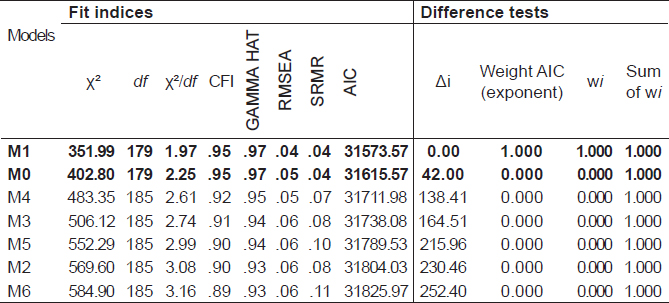
After removing item EL1 (i.e., appreciate, understand, and analyse qualities of literature such as plot, setting, theme or character), a 5-factor intercorrelated model (Model M0) had good fit (χ² = 402.80; df = 179; χ²/df = 2.25, p = .13; CFI = .95; TLI = .94; SRMR = .04; RMSEA = .04; 90% CI = .04–.05; AIC = 31615.57). Appendix A shows that model fits range from marginal (M5, M2, and M6), to acceptable (M4 and M3), to good (M1 and M0). Model M1 had the best fit to the data, supporting the idea that student perceptions of the importance of learning to read and write influenced their self-efficacy, interest, and performance in a reading comprehension test, with interest and self-efficacy as mediators between student perceptions of learning and performance. Table 2 provides the standardised beta factor loadings of Model M1.
Table 2. Factors, items, and loadings
| Factors/Items | Loadings |
|---|
| Reading (M = 3.47, SD = 0.67, ω = 0.85) | |
| EL11: Understand main ideas and details in range of texts. | .70 |
| EL 7: Know about rules and conventions of language use. | .67 |
| EL 10: Recognise, understand, and evaluate inaccuracies and inconsistencies in and between texts. | .66 |
| EL 2: Compare and contrast texts of different styles, purposes, or content. | .62 |
| EL 4: Infer the purpose, intent, and audience of the text. | .60 |
| EL 5: Interpret and evaluate the quality of language and meaning of texts. | .58 |
| EL 9: Make connections between visual and written parts of texts. | .56 |
| EL 8: Know about, use, understand, and think critically about information and communication technologies. | .53 |
| EL 3: Find and process information accurately and quickly. | .50 |
| EL 6: Know about and use poetic language techniques. | .50 |
| Writing (M = 3.89, SD = 0.84, ω = 0.74) | |
| EL 14: Write effectively to persuade or influence readers. | .76 |
| EL 13: Write effectively and artistically to entertain. | .70 |
| EL 12: Write accurately with correct grammar, punctuation, and spelling. | .63 |
| Self-efficacy (M = 3.07, SD = 0.62, ω = 0.82) | |
| Reading attitude 2: How good do you think you are at reading? | .84 |
Reading attitude 4: How good does your mom and dad think you are
at reading? | .80 |
| Reading attitude 3: How good does your teacher think you are at reading? | .69 |
| Interest (M = 2.73, SD = 0.80, ω = 0.81) | |
| Reading attitude 5: How much do you like doing reading in your own time (not at school)? | .86 |
| Reading attitude 6: How do you feel about going to a library to get something to read? | .73 |
| Reading attitude 1: How much do you like doing reading at school? | .70 |
| Performance (M = 781.61, SD = 61.62, ω = 0.67) | |
| SOLO Surface Processes in Reading | .75 |
| SOLO Deep Processes in Reading | .68 |
Note. EL = English learning; SOLO = Structure of Observed Learning Outcomes.
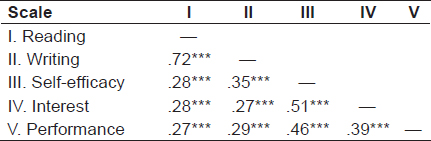
The factor intercorrelations of Model M1 (Table 3) were all statistically significant but were largely modest (.25 < r < .55), except for between the importance of reading to writing (r = .72).
Table 3. Factor intercorrelations
Note. *** = p < .001.
Scale
I
II
III
IV
V
I. Reading
—
II. Writing
.72***
—
III. Self-efficacy
.28***
.35***
—
IV. Interest
.28***
.27***
.51***
—
V. Performance
.27***
.29***
.46***
.39***
—
-->
According to Model M1 (Figure 1), learning to read and write did not support student reading performance directly. Instead, the importance of reading contributed to students’ interest, whereas the importance of writing contributed to students’ self-efficacy. Together, students’ interest and self-efficacy fully mediated the relationship of importance beliefs to student performance. Note that, consistent with the research literature, self-efficacy had twice the effect on performance than interest. In total, these importance beliefs account for 26% of the variance, a large proportion, in the performance score, via mediation by interest and self-efficacy.
Figure 1. Schematic mediated path diagram of student perceptions of the importance of reading and writing, interest, self-efficacy, and performance in reading
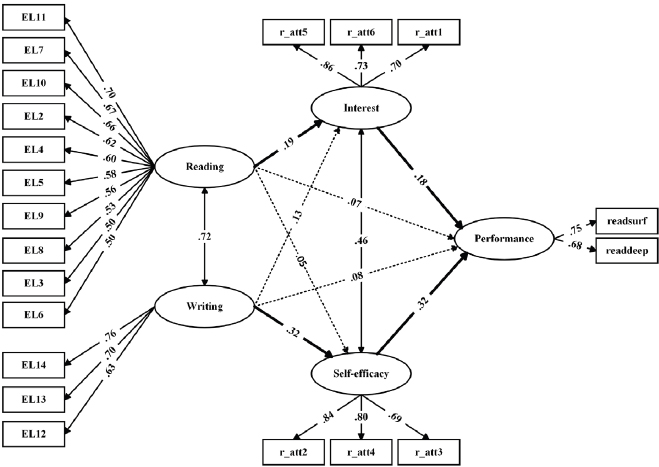
Note. All values are standardised. Solid lines denote statistically significant paths, while dotted lines denote non-statistically significant paths. All residual errors removed for simplicity. EL = English learning; r_att = Reading attitude; readsurf = SOLO Surf Processes in Reading; readdeep = SOLO Deep Processes in Reading.
Discussion
The importance of integrating reading and writing
This correlational study identifies a potential causal pathway from student perceptions of the importance of reading and writing to their tested performance in reading through their interest and self-efficacy in reading. Surprisingly, perceptions of the importance of learning to read and write were not directly related to performance. Instead, the model showed that student perceptions of the importance of learning to read or write were mediated by interest and self-efficacy, respectively.
Fisher and Frey’s (2014) and Beck et al.’s (2015) research may provide some insight into this result. Most texts in close reading are informational texts (Reutzel et al., 2016), which have been found to be interesting to students (Beck et al., 2015). As Fisher and Frey (2014) have found, although students felt that the texts in close-reading classes were difficult to understand, they found them interesting. Interest becomes a mediating role between student perceptions and performance. Therefore, it is likely that students, when noticing the importance of learning to read, were prompted to read interesting, albeit challenging, texts. This contributed to greater interest in or liking of reading and produced better performance in reading.
However, the perceptions of importance of learning to read did not have a statistically significant relation with self-efficacy. This may be understandable because students in other studies have felt that close reading was demanding in cognition, energy, and effort (Fisher & Frey, 2014). The difficulty involved in reading challenging but interesting texts may result in reduced confidence in close reading. Therefore, student perceptions of the importance of learning to read improve reading interest but not reading self-efficacy.
Interestingly, the model showed that student perceptions of the importance of learning to write indirectly improved reading performance via greater self-efficacy in reading. This result is consistent with the shared-knowledge, shared-function, and shared-rhetoric views of reading and writing relations (Fitzgerald & Shanahan, 2000; Shanahan, 2006; Tierney & Shanahan, 1991). The correlation between importance of reading and writing factors (r = .72; 52% shared variance) seems consistent with the context of New Zealand English classrooms, where reading and writing are taught by the same teacher in the same subject. Consequently, from the student perspective, reading and writing are intertwined to a high degree. Previous studies have shown that learning how to write enhanced students’ reading comprehension (Graham & Hebert, 2010, 2011; Tierney & Shanahan, 1991). It seems that being taught to write well supports confidence in being able to read well. The results emphasise the importance of integrating learning to write with learning to read, as researchers have proposed (Elbow, 1997; Horning & Kraemer, 2013; Vacca, 2002).
Effects on performance
In accordance with previous research (Shell et al., 1989; Solheim, 2011), self-efficacy in reading comprehension was found to be the stronger predictor of reading performance in this study. The result supports the theory that domain-specific self-efficacy is a good predictor of performance in that domain. Furthermore, the loading of self-efficacy on performance here is consistent with international large-scale assessment results for 15 year olds (Marsh et al., 2006). It is pleasing to realise that student self-efficacy in reading can be enhanced by the classroom practice of better quality teaching of writing. The items measuring learning to write identify what students think that teachers can do to improve their self-efficacy (e.g., instruction in writing accurately and teaching how to write effectively to persuade readers). Perhaps the logic is that, if the learner understands how to express their own ideas in writing better, they will be able to understand how other authors have written and thus be able to comprehend what they are reading better.
This study found that interest in reading was positively related to reading performance. While this result aligns with some previous research (Hattie, 2008; Marsh et al., 2006; Taboada et al., 2008; Wigfield & Cambria, 2010), it is inconsistent with the zero relations of interest to performance that Retelsdorf et al. (2011) reported. It should be noted that interest was not tested as a single independent predictor (as in Retelsdorf et al.’s study) but was tested as a mediator of performance in the current study. Moreover, the effect of interest on performance was weaker than that of self-efficacy. This suggests that simply liking reading may not be a stable factor in good reading comprehension performance. More reliably, teachers inspire students’ interest in reading by helping them to enjoy and understand what they are reading or strengthen their self-efficacy in reading by teaching students how to write.
Implications
This study provides empirical evidence as to the relationship of influences among student perceptions of learning importance to academic performance in the subject of English. The study corroborates the importance of self-efficacy for academic performance because of its consistent, robust effects on performance. The study also reminds us that only teaching reading comprehension without reference to teaching writing is insufficient to improve reading performance because of its zero direct effects on performance and small impact on reading interest. To maximise reading performance in the context of senior secondary school, teachers need to integrate writing in reading classes; exactly what an English class can do. On the one hand, teaching students to write enhances students’ comprehension in reading, given the shared reading–writing relations. On the other hand, in teaching practice, teachers should focus more on fostering students’ warranted competency-based self-efficacy, which has more potent effects than interest in reading success. In other words, students need to grow in writing competency to have a justified self-efficacy in reading comprehension.
A concern many readers might have is the dated nature of the data. Our argument is that, despite formal changes in the curriculum statements, the survey items capture common and enduring instructional goals of senior secondary school English classrooms.
A limitation of this study is that the statistical causal model is based on cross-sectional data. Although causal conclusions are made, they still require longitudinal and experimental proof. However, this analysis suggests longitudinal or experimental studies that could test the conclusions reached here. Changing the focus of reading instruction to include explicit attention to the craft of writing to persuade or influence will most likely help learners read better.
It is critical to notice that the results obtained in this study represent students’ perceptions of the importance of learning reading and writing. It is not an objective report of what teachers teach about reading and writing in classrooms. It is possible that what students perceived as important about reading and writing was not the same as what teachers delivered in classroom practices. Future research could look at what teachers actually do when teaching reading and writing to establish the validity of student perceptions.
It will also be important, once the refreshed curriculum is implemented, to replicate this study to establish if there is an effect from the official framework on how students perceive classroom instruction in reading and writing.
Conclusion
This study adapted Irving’s (2004) scale in mathematics to the field of English language arts. It adds to our understanding of how Irving’s instrument can measure student perceptions of teaching quality in different subjects. An original contribution of this study is its identification that teaching writing increases student self-efficacy in reading comprehension; a matter that has had relatively little study. This model of reading–writing relations to performance provides further evidence for the integration of teaching reading and writing for better reading comprehension.
Declaration of Interest statement
The authors report that there are no competing interests to declare.
References
Bandura, A. (1997). Self-efficacy: The exercise of control. W. H. Freeman.
Beck, J. S., Buehl, M. M., & Barber, A. T. (2015). Students’ perceptions of reading and learning in social studies: A multimethod approach. Middle Grades Research Journal, 10(2), 1–16
Burnham, K. P., & Anderson, D. R. (2004). Multimodel inference: Understanding AIC and BIC in model selection. Sociological Methods & Research, 33(2), 261–304. https://doi.org/10.1177/0049124104268644
Brown, G. T. L. (1998). The New Zealand English curriculum. English in Aotearoa, 35, 64–70.
Brown, G. T. L., Pipe, D., & Higginson, R. (2003). Writing at levels 5–6 of the New Zealand English curriculum: Development of progress indicators and tasks (asTTle Technical Report #45). University of Auckland/Ministry of Education. https://bit.ly/3Lo05dZ
Camacho, A., Alves, R. A., & Boscolo, P. (2021). Writing motivation in school: A systematic review of empirical research in the early twenty-first century. Educational Psychology Review, 33(1), 213–248. https://doi.org/10.1007/s10648-020-09530-4
Chin, D., & Kameoka, V. A. (2002). Psychosocial and contextual predictors of educational and occupational self-efficacy among Hispanic inner-city adolescents. Hispanic Journal of Behavioral Sciences, 24(4), 448–464. https://doi.org/10.1177/0739986302238214
Chiu, M. M., & Chow, B. W. Y. (2010). Culture, motivation, and reading achievement: High school students in 41 countries. Learning and Individual Differences, 20(6), 579–592. https://doi.org/10.1016/j.lindif.2010.03.007
Crooks, T. J. (2002). Educational assessment in New Zealand schools. Assessment in Education: Principles, Policy & Practice, 9(2), 237–253. https://doi.org/10.1080/0969594022000001959
Devine, T. G., & Kania, J. S. (2003). Studying: Skills, strategies, and systems. In J. Flood, Diane Lapp, J. R. Squire, & J. M. Jensen (Eds.), Handbook of research on teaching the English language arts (pp. 942–954). Lawrence Erlbaum Associates.
Ekholm, E., Zumbrunn, S., & DeBusk-Lane, M. (2018). Clarifying an elusive construct: A systematic review of writing attitudes. Educational Psychology Review, 30(3), 827–856. https://doi.org/10.1007/s10648-017-9423-5
Elbow, P. (1997). High stakes and low stakes in assigning and responding to writing. New Directions for Teaching and Learning, 1997(69), 5–13. https://doi.org/10.1002/tl.6901
Emmitt, M., Pollock, J., & Limbrick, L. (1996). An introduction to language and learning (New Zealand ed.). Oxford University Press.
Fisher, D., & Frey, N. (2014). Student and teacher perspectives on a close reading protocol. Literacy Research & Instruction, 53(1), 25–49. https://doi.org/10.1080/19388071.2013.818175
Fitzgerald, J., & Shanahan, T. (2000). Reading and writing relations and their development. Educational Psychologist, 35(1), 39–50. https://doi.org/10.1207/S15326985EP3501_5
Fletcher, J., & Nicholas, K. (2016). What can we learn from young adolescents’ perceptions about the teaching of reading? Educational Review, 68(4), 481–496. https://doi.org/10.1080/00131911.2016.1144558
Graham, S. (2018). A revised writer(s)-within-community model of writing. Educational Psychologist, 53(4), 258–279. https://doi.org/10.1080/00461520.2018.1481406
Graham, S., Berninger, V., & Abbott, R. (2012). Are attitudes toward writing and reading separable constructs? A study with primary grade children. Reading & Writing Quarterly, 28(1), 51–69. https://doi.org/10.1080/10573569.2012.632732
Graham, S., Berninger, V., & Fan, W. (2007). The structural relationship between writing attitude and writing achievement in first and third grade students. Contemporary Educational Psychology, 32(3), 516–536. https://doi.org/10.1016/j.cedpsych.2007.01.002
Graham, S., & Hebert, M. (2010). Writing to read: Evidence for how writing can improve reading. (A Carnegie Corporation Time to Act Report; p. 74). Alliance for Excellence in Education.
Graham, S., & Hebert, M. (2011). Writing to read: A meta-analysis of the impact of writing and writing instruction on reading. Harvard Educational Review, 81(4), 710–744. https://doi.org/10.17763/haer.81.4.t2k0m13756113566
Guthrie, J. T., Klauda, S. L., & Ho, A. N. (2013). Modeling the relationships among reading instruction, motivation, engagement, and achievement for adolescents. Reading Research Quarterly, 48(1), 9–26. https://doi.org/10.1002/rrq.035
Hall, A. H., & Axelrod, Y. (2014). ‘I am kind of a good writer and kind of not’: Examining students’ writing attitudes. Journal of Research in Education, 24(2), 34–50.
Hattie, J. (1992). Self-concept. L. Earlbaum Associates.
Hattie, J. (2008). Some correlates of academic performance in New Zealand schools: The asTTle database. In C. M. Rubie-Davies & C. Rawlinson (Eds.), Challenging thinking about teaching and learning (pp. 75–96). Nova Science Publishers.
Hattie, J., & Brown, G. T. L. (2004). Cognitive processes in asTTle: The SOLO taxonomy (asTTle Technical Report 43). https://e-asttle.tki.org.nz/content/download/1499/6030/version/1/file/43.+The+SOLO+taxonomy+2004.pdf
Hattie, J., Brown, G. T. L., Keegan, P. J., MacKay, A. J., Irving, S. E., Cutforth, S., Campbell, A. R. T., Patel, P., Sussex, K., Sutherland, T., McCall, S., Mooyman, D., & Yu, J. (2004). Assessment Tools for Teaching and Learning (asTTle) manual (Version 4, 2005). University of Auckland/Ministry of Education/Learning Media. https://doi.org/10.17608/k6.auckland.14977503.v1
Horning, A. S., & Kraemer, E. W. (Eds.). (2013). Reconnecting reading and writing. Parlor Press.
Irving, S. E. (2004). The development and validation of a student evaluation instrument to identify highly accomplished mathematics teachers [Doctoral thesis, The University of Auckland]. https://researchspace.auckland.ac.nz/handle/2292/326
Klassen, R. (2002). Writing in early adolescence: A review of the role of self-efficacy beliefs. Educational Psychology Review, 14(2), 173–203. https://doi.org/10.1023/A:1014626805572
Marsh, H. W., Hau, K.-T., Artelt, C., Baumert, J., & Peschar, J. L. (2006). OECD’s brief self-report measure of educational psychology’s most useful affective constructs: Cross-cultural, psychometric comparisons across 25 countries. International Journal of Testing, 6(4), 311–360. https://doi.org/10.1207/s15327574ijt0604_1
Marshall, N., Caygill, R., & May, S. (2007). PISA-2006-reading-literacy-how-ready-are-our-15-year-olds-for-tomorrows-world.pdf. Ministry of Education. https://www.educationcounts.govt.nz/__data/assets/pdf_file/0008/29636/PISA-2006-Reading-Literacy-How-ready-are-our-15-year-olds-for-tomorrows-world.pdf
Medina, E., & McGregor, A. (2019). PISA 2018: Reading in New Zealand: Reading achievement & experiences of 15-year-olds. Ministry of Education. https://www.educationcounts.govt.nz/__data/assets/pdf_file/0003/196626/PISA-2018-Reading-in-New-Zealand.pdf
Ministerial Advisory Group. (2024). Redesigning the English and mathematics & statistics learning areas in the refreshed New Zealand curriculum for primary, intermediate and early secondary school students: Years 0 to 10. https://assets.education.govt.nz/public/Documents/Curriculum/Report-from-the-Ministerial-Advisory-Group-March-2024.pdf
Ministry of Education. (n.d.). School deciles. Author. https://www.education.govt.nz/school/funding-and-financials/resourcing/operational-funding/school-decile-ratings/
Ministry of Education. (1994). English in the New Zealand curriculum. Learning Media.
Ministry of Education. (1997). Planning and assessment in English. Learning Media.
Ministry of Education. (2007). The New Zealand curriculum. Learning Media.
Ministry of Education. (2009). PISA-2003-reading-skills-for-tomorrows-world.pdf. https://www.educationcounts.govt.nz/__data/assets/pdf_file/0004/63085/PISA-2003-Reading-skills-for-tomorrows-world.pdf
Ministry of Education. (2023). The refreshed New Zealand curriculum: The learning areas of Mātaiaho English. Curriculum Centre. https://curriculumrefresh-live-assetstorages3bucket-l5w0dsj7zmbm.s3.amazonaws.com/s3fs-public/2023-11/CO3101_MOE_English-A4.pdf?VersionId=XbBZE7uVxp0hDnKLgrEAswNp1nxDnY5p
Moulton, K. D., Brown, S. D., & Lent, R. W. (1991). Relation of self-efficacy beliefs to academic outcomes: A meta-analytic investigation. Journal of Counselling Psychology, 38, 30–38. https://doi.org/10.1037/0022-0167.38.1.30
Nicholls, H. (2003). English reading curriculum framework and map: Levels 2–6 (asTTle Technical Report #34). University of Auckland/Ministry of Education. https://bit.ly/3W5T0DF
‘Otunuku, M., & Brown, G. T. L. (2007). Tongan students’ attitudes towards their subjects in New Zealand relative to their academic achievement. Asia Pacific Education Review, 8(1), 117–128. https://doi.org/10.1007/BF03025838
R Core Team. (2020). R: A language and environment for statistical computing (4.0.3) [Computer software]. R Foundation for Statistical Computing. https://www.R-project.org/
Retelsdorf, J., Köller, O., & Möller, J. (2011). On the effects of motivation on reading performance growth in secondary school. Learning and Instruction, 21(4), 550–559. https://doi.org/10.1016/j.learninstruc.2010.11.001
Reutzel, D. R., Jones, C. D., Clark, S. K., & Kumar, T. (2016). The informational text structure survey (ITS2): An exploration of primary grade teachers’ sensitivity to text structure in young children’s informational texts. The Journal of Educational Research, 109(1), 81–98. https://doi.org/10.1080/00220671.2014.918927
Revelle, W., & Rocklin, T. (2010). Very simple structure: An alternative procedure for estimating the optimal number of interpretable factors. Multivariate Behavioral Research. https://doi.org/10.1207/s15327906mbr1404_2
Rosseel, Y. (2012). Lavaan: An R package for structural equation modeling. Journal of Statistical Software, 48(2), 1–36. https://doi.org/10.18637/jss.v048.i02
Ryan, R. M., & Deci, E. L. (2000). Self-determination theory and the facilitation of intrinsic motivation, social development, and well-being. American Psychologist, 55(1), 68. https://doi.org/10.1037/0003-066X.55.1.68
Satherley, P. (2006). Student outcome overview 2001–2005: Research findings on student achievement in reading, writing and mathematics in New Zealand schools. Ministry of Education, Research Division. https://www.educationcounts.govt.nz/publications/schooling2/learners/education-and-learning-outcomes/6858
Schunk, D. H., & Zimmerman, B. J. (2006). Competence and control beliefs: Distinguishing the means and ends. In P. A. Alexander & P. H. Winne (Eds.), Handbook of educational psychology (2nd ed., pp. 349–367). Erlbaum. https://doi.org/10.4324/9780203874790.ch16
Shanahan, T. (2006). Relations among oral language, reading, and writing development. In C. A. MacArthur, S. Graham, & J. Fitzgerald (Eds.), Handbook of writing research (paperback ed., 2. print, pp. 171–183). Guilford Press.
Shell, D. F., Murphy, C. C., & Bruning, R. H. (1989). Self-efficacy and outcome expectancy mechanisms in reading and writing achievement. Journal of Educational Psychology, 81(1), 91–100. https://doi.org/10.1037/0022-0663.81.1.91
Solheim, O. J. (2011). The impact of reading self-efficacy and task value on reading comprehension scores in different item formats. Reading Psychology, 32(1), 1–27. https://doi.org/10.1080/02702710903256601
Stats NZ. (2020, September 3). Ethnic group summaries reveal New Zealand’s multicultural make-up. https://www.stats.govt.nz/news/ethnic-group-summaries-reveal-new-zealands-multicultural-make-up
Taboada, A., Tonks, S. M., Wigfield, A., & Guthrie, J. T. (2008). Effects of motivational and cognitive variables on reading comprehension. Reading and Writing, 22(1), 85. https://doi.org/10.1007/s11145-008-9133-y
Talsma, K., Schüz, B., Schwarzer, R., & Norris, K. (2018). I believe, therefore I achieve (and vice versa): A meta-analytic cross-lagged panel analysis of self-efficacy and academic performance. Learning and Individual Differences, 61, 136–150. https://doi.org/10.1016/j.lindif.2017.11.015
Te Tāhuhu o te Mātauranga Ministry of Education. (2025). Tāhūrangi—New Zealand curriculum. Te Poutāhū Curriculum Centre. https://newzealandcurriculum.tahurangi.education.govt.nz/new-zealand-curriculum/5637175326.p
The Jamovi Project. (2020). Jamovi (1.6.3) [Computer software]. https://www.jamovi.org
Tierney, R. J., & Shanahan, T. (1991). Research on the reading–writing relationship: Interactions, transactions, and outcomes. In R. Barr, M. L. Kamil, P. Mosenthal, & P. D. Pearson (Eds.), The handbook of reading research (vol. 2, pp. 246–280). Longman.
Vacca, R. T. (2002). Making a difference in adolescents’ school lives: Visible and invisible aspects of content area reading. In A. E. Farstrup & S. J. Samuels (Eds.), What research has to say about reading instruction (3rd ed., pp. 184–204). International Reading Association. https://doi.org/10.1598/0872071774.9
Villalón, R., Mateos, M., & Cuevas, I. (2015). High school boys’ and girls’ writing conceptions and writing self-efficacy beliefs: What is their role in writing performance? Educational Psychology, 35(6), 653–674. https://doi.org/10.1080/01443410.2013.836157
Wigfield, A., & Cambria, J. (2010). Students’ achievement values, goal orientations, and interest: Definitions, development, and relations to achievement outcomes. Developmental Review, 30(1), 1–35. https://doi.org/10.1016/j.dr.2009.12.001
Wigfield, A., & Eccles, J. S. (2000). Expectancy–value theory of achievement motivation. Contemporary Educational Psychology, 25(1), 68–81. https://doi.org/10.1006/ceps.1999.1015
Wigfield, A., Eccles, J. S., Yoon, K. S., Harold, R. D., Arbreton, A. J. A., Freedman-Doan, C., & Blumenfeld, P. C. (1997). Change in children’s competence beliefs and subjective task values across the elementary school years: A 3-year study. Journal of Educational Psychology, 89(3), 451–469. https://doi.org/10.1037/0022-0663.89.3.451
Zimmerman, B. J. (2000). Self-efficacy: An essential motive to learn. Contemporary Educational Psychology, 25(1), 82–91. https://doi.org/10.1006/ceps.1999.1016
The authors
Meiyang Hong (corresponding author) is currently a doctoral candidate at Faculty of Arts and Education, The University of Auckland. Her research interests lie in educational psychology, developmental psychology, and English language arts. She mainly conducts quantitative research methods, such as confirmatory factor analysis, structural equation modelling, and invariance testing.
Email: meiyang.hong@auckland.ac.nz
Gavin T. L. Brown researches the effects of context and assessment qualities on teacher and student beliefs and subsequent effects on behaviour and achievement. His research makes extensive use of survey and test data analysed with confirmatory factor analysis, structural equation modelling, and item response theory techniques. He is currently the Director of the Quantitative Data Analysis and Research Unit at The University of Auckland Faculty of Education and Social Work.
Email: gt.brown@auckland.ac.nz
Appendix A. Fit indices and AIC difference tests for structural models
and intercorrelated measurement model
Note. CFI = comparative fit index; RMSEA = root mean square error of approximation; SRMR = standardised root mean residual; AIC = Akaike information criterion; Δi = AIC difference between the best model and the comparison model; wi = proportion of weight. Bolded numbers indicate good fit. M0 = intercorrelated measurement model; M1-6 = structural model 1-6.