Literacy and the achievement gap
Geraldine McDonald
Abstract
This paper challenges the belief that methods of teaching reading are the answer to raising age cohort standards of achievement, and that literacy, in the form of reading and writing, is based on spoken language. It is argued that documents, advising how to raise standards of literacy, have overlooked the way in which education systems work, and their relationship to large-scale testing, and have not considered methods which use real-life writing to establish literacy in young school children. The concept of a configuration of sites is presented as a way of understanding literacy in both its social and individual aspects, and for diverse population groups.
Introduction
This article is organised into three sections. In the first, I examine current beliefs about what literacy is, its relationship to reading and the so-called gap of achievement, and its supposed basis in spoken language. The second section adopts a broader definition of literacy: one arising from society's possession of a written script, the consequences of this for social institutions, and the claims for its effects on the constitution of minds. Developmental evidence is presented to show that children in literate societies take an early interest in the activity of writing. The third section draws conclusions from the broader definition of literacy, by illustrating the various social sites which incorporate written scripts. Individuals have access to differing configurations of these sites for literacy. The article concludes with brief reference to the “new literacy” and the use of writing to teach literacy in the early years.
Current beliefs about literacy
Literacy defined as reading
Definitions, of course, are only relevant to the interests they are constructed to serve and it would be fruitless to enter a definitional argument as to what 'literacy' really is.
(Street, 1984, p. 51)
English in the New Zealand Curriculum (Ministry of Education, 1994) broadens the scope of literacy, from the traditional reading and writing, by adding visual literacy. However, in New Zealand, literacy is generally restricted to reading. This is hardly new, and, as noted by Vygotsky (1997, p. 131), “the mechanics of reading is put forward so much that it shades written language”. There are many reading experts in New Zealand, but early writing lacks its advocates (however, see Hood, 2003).
One reason for the widespread emphasis on reading can be found in the history of schooling, and the origins of instruction in order to read the Bible, allied with a fear that writing would lead to political pamphleteering and deliver power into the hands of dissidents. Teaching today is likely to concentrate on areas of the curriculum that are assessed internationally, and there is greater difficulty in large-scale testing of writing than in testing for reading. For example, a report from the US on the reading of children aged 4–7 years, from 1998 to 2000, noted that:
It is not feasible to include a sampling of children's writings given the practical constraints associated with the cost of scoring their samples.
(National Center for Education Statistics, 2003, para. 5)
Can methods of teaching reading close the achievement gap?
The Government's goal, announced in October 1998, was that “by 2005, every child turning nine will be able to read, write and do maths for success”. The Literacy Taskforce and the Literacy Experts Group were established to advise on the achievement of this aim. The main focus of both groups' reports was on how to teach reading, leaving discussion of methods of teaching writing to Dancing with the Pen (Ministry of Education, 1992). The report of the Literacy Experts Group (Ministry of Education, 1999) concentrates on methods, particularly those associated with phonics and with reading for meaning.
International studies measure the performance of age or grade cohorts. New Zealand was one of 35 countries which took part in the International Association for the Evaluation of Educational Achievement (IEA) study: Progress in Reading Literacy Study (PIRLS). In 2001, Year 5 students were tested on their comprehension of two kinds of text: fiction and information. The consequence of such international testing has been one of alarm, because we have slipped in the ranking from our previous high position (Greaney, 2003), and we have a larger spread of scores than most other similar countries. A long tail, disproportionately made up of Māori and Pasifika students, and students whose home language is not English, creates the so-called “gap” between the best and worst readers. One convincing reason offered for this situation has been immigration, resulting in a changing demographic profile and greater ethnic diversity.
The Literacy Taskforce claimed that their strategy was about “closing the gap between the lowest and the highest achievers” (Ministry of Education, 1999, intro., para. 2). There is no doubt that the Government, the Literacy Experts, and the Literacy Taskforce all accepted that there was a link between methods of teaching and standards of reading. Greaney (2003) responded to the messages from international testing by suggesting ineffective instructional procedures and poor phonological skills as the causes and, in his newsletter of 17 November 2004, Bill English, Opposition Education spokesman, asked why, if Reading Recovery worked, we still have a large disparity in achievement.
Despite the faith in methods of teaching, “most children learn to read by any method”, and “many methods that have been promoted from time to time are little more than gimmicks” (Stubbs, 1980, p. 142). One method tried in the eighteenth century was making letters out of gingerbread. When the letters had been learnt, the pupil ate them. In an Indian madrassa, an Islamic school, children are still being taught successfully to read and write by spelling (McDonald, 2005).
Literacy is a valuable commodity, and the restriction of reading by requiring whole age cohorts to reach a certain level of competence is a way of gaining control over groups of people (Lankshear, 1985). Yet, even where barriers exist, people may overcome them. In sixteenth and seventeenth century England, for example, the populace was fundamentally literate (Laqueur, 1976). It was neither schools, which were rare, nor the demands of the workplace, which produced this phenomenon. There was a popular culture which considered that being able to read and write made men and women able to function more effectively. Improved artificial lighting, and newspapers in coffee shops, also helped.
The Literacy Experts considered that Reading Recovery, with some amendments, could contribute to raising standards of reading achievement. However, 10 years after its introduction in the United States, Hiebert (1994) examined the evidence for one-on-one instruction at Grade 1, and concluded that the data available “produce an unconvincing scenario of the effects of RR on an age cohort” (p. 23). She also pointed out that a longitudinal study had shown that, by Grade 4, 42.5 percent of the Reading Recovery-tutored students had not been promoted, compared with 3 percent for a comparison group not tutored. Pinnell, Lyons, and Jones (1996), in a response, stated categorically that Reading Recovery “is not designed to serve or directly affect the entire age cohort” (p. 23). In a rejoinder, Hiebert (1996) noted that it could be assumed that raising the achievement of the least able readers would be reflected in a rise in the age cohort reading achievement score. Although this is a very common assumption, it fails to take into account the structure of schooling, and the practice of retaining some children, particularly in the beginning classes. Students work to the level of schooling in which they are placed, and holding children back is likely to cancel any test gains within an age cohort.
In the 1980s, I became concerned about the disproportionate numbers of Māori students retained in the junior classes in New Zealand, while non-Māori were more likely to be promoted by age (McDonald, 1988). Officers of the Department of Education told me that the problem of non-promotion would be solved by Reading Recovery, which was then being implemented in stages. National implementation began in 1983. Therefore, I divided all schools into the following: those without a Reading Recovery programme; those which had had a Reading Recovery programme up to 1986; and those which did not have a Reading Recovery programme until 1987. There was no variation across the three school samples of a magnitude which would point to Reading Recovery having had any effect on national promotion rates in any year, and certainly not at age 8 where one might have expected to see change. The cohort size was about 50,000, and the net gain in promotion between 1985 and 1987 was of 126 more children being promoted from the junior school to Year 3. Māori children had gained 147 more places than they would have at 1985 rates, whilst the non-Māori promoted group decreased by 21. The additional promotion amounted to 0.3 percent, and since the rate had been gradually increasing over the years, it is doubtful whether this can be attributed to Reading Recovery (McDonald, 1989).
This result says nothing about the value of Reading Recovery for individual students. Rather, it points to the inflexibility of a promotion system which operates on children's exit from the junior school (McDonald, 2000).1 Today, the education statistics still show more overage boys than girls, and, since non-promotion affects Pasifika and Māori children disproportionately, it can be expected that this situation remains. It is unfortunate that the Ministry of Education no longer publishes information about the age and year levels of Māori and Pasifika students, to allow us to assess the present situation.
The individual versus the cohort
The thinking that supports teaching methods as cause or cure of reading test results fails to distinguish success with individual students, and success of cohorts. Phonological awareness may, for example, be particularly helpful to beginning writers. Reading for meaning may improve comprehension. Thousands of children have benefited from the one-to-one attention of Reading Recovery. However, the achievement of age or grade cohorts is also influenced by the management of schooling, policies on promotion and retention, the amount of “space in the next room”, organisation of progress within classrooms, and the level at which the testing is carried out.
When students are in their fifth year of schooling, and the testing is for comprehension, links between the mechanics of reading and cohort outcomes may be tenuous. Then there is the somewhat intractable influence of the characteristics of populations to take into account. Because a test gap is a measure of the ranking of students' achievement, and not a direct measure of whether or not those in the tail can read, it is possible for all students to be able to read at least to some extent while the gap remains as large as ever. Influences beyond the school, a popular topic in the sociology of education, continue throughout schooling, and not just when learning to read and write.
Despite a lack of evidence on teaching methods as the answer to raising cohort standards of reading, teaching in general undoubtedly makes a difference to achievement. The amount of teaching, whether measured as length of schooling, regularity of attendance of pupils, or time given to the use of literacy, and whether or not reading instruction is delayed for particular groups of students, all need to be taken into consideration.
Spoken language and literacy
Confusion between written and spoken language is widespread.
(Stubbs, 1980, p. 22)
The New Zealand Curriculum Framework refers to “the importance of language and literacy learning” and it is claimed that “language development is essential to intellectual growth” (Ministry of Education, 1993, p. 10). The construction of mind is a keenly-contested area, and there is more than one theory as to the origin of that capacity for thought, which distinguishes us from animals.2 When language is linked to literacy, it generally means spoken language. The Literacy Experts Group, for example, argued that literacy is based on oral language, and furthermore that:
In general, successful reading for children at age nine means comprehending in print much of what they are expected to comprehend when listening to spoken language. Successful writing means expressing in print much of what they are expected to express when speaking.
(Ministry of Education, 1999, p. 2)
The authors of Dancing with the Pen: The Learner as Writer, agreed that “talk is central to learning. It provides the foundation on which we learn to read and write” (Ministry of Education, 1992, p. 10). The Literacy Experts Group's advice was to “use oral language as the basis” (Literacy Taskforce, 1999, p. 5). However, when the Experts Group gave examples of the relationship between speech and reading, they pointed out that reading leads to increase in vocabulary items—a fact which undermines the argument of spoken language as the basis of reading.
The sociolinguist Stubbs (1980, pp. 21–42) provides a different view of the relationship between spoken and written language. He points out that it is an error to consider oral language as the primary system—with written language as the secondary. Language is an abstract system, and speech and writing are realisations of this in different media. Stubbs (1980) certainly does not say that spoken language and written language are unconnected, but rather that their relationship is not complementary:
It is true that a writing system represents units of the spoken language, and that anything which is written down can be read aloud, but written language does not directly represent spoken language. (p. 41)
The outcomes of a written script
The social consequences
The appropriateness of speech versus writing differs according to culture. In the 1960s, Jack Goody, a Cambridge anthropologist, began to publish his ideas about what happened when traditional societies, dependent on oral communication, developed or acquired a system of writing. Goody saw writing as a technology with two aspects. A written script, he argued, made possible social institutions such as religion, law, bureaucracy, and the state. He also believed that writing enabled the development of logical thought. Sylvia Scribner, Michael Cole, Alexander Romanovich Luria, and others, however, have demonstrated that it is the uses of writing as taught in school, rather than the technology itself, that enables people to reason logically.
The idea that writing transforms or creates social institutions is on firmer ground, a position illustrated by Madhur Jaffrey (2005), who tells the following legend: After Brahma had created the caste system, he realised that a further one was needed. “Brahma went into a trance. When he opened his eyes he saw before him a glorious figure of a man holding a pen in one hand, an ink-pot in another and a sword tied around his waist” (p. 7). His progeny were to be known as the Kayasthas, and their work was to record the deeds of man, both good and evil, and to dispense justice. In other words, the ink-pot would make them both historians and legal officers.
Debray (2004) argues that the invention of writing led to the belief in a single god, because the text representing a god could be carried around from place to place with its owners. This weakened the claim that there were numerous gods residing in a variety of locations.
The use of writing in legal systems created a new set of meanings associated with literate practices, and Don McKenzie wrote that the Treaty of Waitangi offers:
a prime example of European assumptions about the comprehension, status and binding power of written statements and written consent on the one hand as against the flexible accommodations of oral consensus on the other.
(McKenzie, 1985, p. 9)
The developmental consequence
According to Holt (2000, p. 9), “NZ children have been writing with and without adult approval since the written word was first taught in the Bay of Islands in 1836.” Although this probably refers to older children, the remark is equally true of the efforts of the very young.
Brought up in an environment in which writing is used, children as young as two may try to reproduce the action. Taylor (1983, p. 57) managed to capture on film a “fleeting moment” when a little girl aged 2 years and 4 months tried her hand at writing. I once observed another small girl aged two, in a bank, “filling in” a deposit slip, and a boy aged two-and-a-bit in his home, scuttling over to a piece of paper and a ballpoint pen lying on the floor, and then making marks as he had earlier observed his older brother doing. Quite young children can also “read” logos and the first letters of their names.
This evidence contradicts Manguel (1997), who, based on a sample of one, wrote that reading comes before writing. He was taught to read by his nurse, and could read by the age of four, but did not learn to write until he was seven. However, children in a literate environment learn about the uses of written language at the same time as they learn spoken language. Language development occurs in strands of form, content, and use, and only gradually do these become connected (Bloom & Lahey, 1978). It is the same pattern for reading and writing.
Vygotsky (1997) viewed writing as arising from drawing, and others have made the same claim. However, when Joan Brockett's students, who were studying early writing in what was called the Writing Acquisition Project (see McDonald, 2005), asked 4-year-olds in kindergarten to “write something”, the children knew whether or not they could write, and could certainly distinguish drawing from writing—one child, for example, saying, “I can't write. I can just draw.” Such early attempts are not dependent on spoken language, and they show that a child's interest comes first from observation of the social uses of writing, although children soon learn components of content and form as well.3
Since anthropological, sociolinguistic, and developmental evidence all show that reading and writing are not based on spoken language, and that speech is different from written record, it is surprising that, as part of the PIRLS study, parents were asked how frequently they, or someone else, told stories or sang songs to their child before they began primary school. In oral societies, storytelling is generally developed into a high art, but this does not lead to writing. Telling stories and singing are as likely to develop a capacity for memory, as they are to encourage written record. It was the need to record things such as debts, ownership of cattle, who won the battles, and who were the kings, which gave rise to the technology of writing. This is not an argument for stopping singing with, and telling stories to, young children. It is a challenge to the logic of their inclusion in an international test of literacy. Spoken language serves many useful functions for teaching literacy, but this seems to have become muddled up with beliefs about its development.
The belief that speech is the basis for reading and writing is not harmless. It may delay formal instruction, because of judgements about the quality of a child's speech. The Literacy Taskforce (1999), for example:
considered that the stage at which Reading Recovery is delivered could be more flexible … [Some children] might take longer than this first year to develop their oral language skills to a point where they can make maximum gains from the programme. (p. 15)
Spoken language and intellectual development
The belief that spoken language determines intellectual development (Ministry of Education, 1993, p. 3), can be compared with the largely discredited Sapir-Whorf hypothesis that words determine thought. At one stage, Vygotsky, as explained by Minick (1987), believed that words were the carriers of meaning established intermentally, and that they mediated transfer of social meaning into the intramental plane. A further step in this direction is the claim that quality of thinking is determined by quality of speech, and that some forms of spoken language are better than others. An example can be found in Basil Bernstein's theory of the effect on thinking of elaborated and restricted codes—the former being the explanatory speaking style of the middle classes, and the latter the style of the working classes—an analysis criticised by Hasan (1992).
An excellent antidote to single cause explanations for school failure, including the charge that the school fails the children, can be found in a study by Li (2003). Li tells the story of a Chinese family in Canada, whose children do not conform to the stereotype that Chinese children always do well at school. As her ethnographic account unfolds, Li reveals circumstances within the family, the school, and the neighbourhood, which go well beyond single cause explanations.
Street (1984, 2005), and others such as Luke and Barton, have been promoting “new literacy” (see Limbrick & Aikman, 2005) which contrasts an autonomous skill learnt in classrooms with the way in which literacy is used in social life. Literacy meanings and practices are always situated in a particular world-view, and Street calls this literacy “ideological”, because it incorporates attitudes, values, and beliefs.
Despite Street's advice to not define literacy, ethnographic and socio-linguistic approaches allow us to view it as a cultural property owned by societies which possess a written script. The script can take varied forms, based on different principles of representation. Ours happens to be alphabetic.
Explanation and use
Sites for literacy
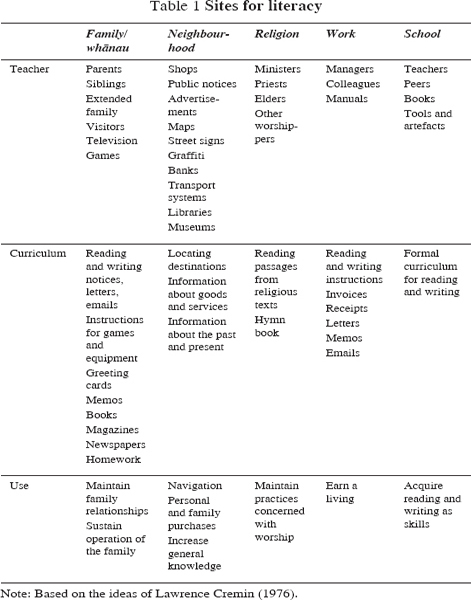
The historian Lawrence Cremin has shown how, in colonial America, “the [educational] configuration taught, in different combinations for different orders of the society, the values of piety, civility and learning” (Cremin, 1976, p. 12). Table 1 adopts Cremin's concept of sites and educational configurations, and applies them to literacy.
Table 1 shows just one way of representing such a configuration. If we concentrate on the learner, in each literacy context there is a “curriculum” for reading and writing. There are also accompanying methods of assessment by others, such as older brothers and sisters, and there is self-assessment, as, for example, when a 4-year-old, asked, “Can you write?” replied, “I can just write my name.” The differing uses to which a written script is put determine the kinds of written material, and hence produces genres differing according to each site. Compare writing on a bus ticket, used in the neighbourhood site, with a letter from a grandparent in the family site.
In her study of what young school students know about maps before they had had any formal instruction, Holland (2005) discovered that they found out through participation in a combination of family and neighbourhood sites. They knew about route maps—having travelled with a parent to the homes of friends—and they had consulted maps in shopping malls and nature reserves, often in order to find a toilet.
Table 1 encourages us to ask about the configuration of sources of literacy for individuals and groups which differ in culture. Also, what are the literacy demands on workers, and do literacy activities arising from the workplace enter the home? The school's most direct written connection with the family is not the parent newsletter, but the homework done by a family member. In addition to the values associated with the sites, many material artefacts contribute to literacy (McDonald, Le, Higgins, & Podmore, 2005), and literacy tools include paintbrushes and spray cans.
In a sustained programme of work, Stuart McNaughton and his students have helped us to understand how the family helps literacy emerge as a skill. John Dickie (2003) has provided Samoan students at Year 8 with disposable cameras, and asked them to record examples of writing and its use in neighbourhood and home. Juliet Smith (2004), in her study of culturally diverse families, found differences in what parents sought in books for children. The mothers from New Zealand and Britain saw reading books to children as a source of entertainment and pleasure, while parents from India, Fiji, and Sri Lanka saw books as a source of moral values. A mother from one of the islands of the Pacific explained how the purpose of a child's reading of the Bible was to learn passages which could be recited in church in a public display of competence.
Literacy as social practice
Street (2005) has suggested that the “new literacy studies” could influence classroom practice in order to overcome the failure of traditional literacy programmes. Yet, if used with school beginners, achievement results would probably encounter the same systemic barriers of school organisation and testing that cause difficulties for the maintenance of gains through Reading Recovery. It is not at all certain that it is the methods which cause the failure.
There appear to be few published examples of an approach to literacy, other than a top-down or bottom-up method of teaching beginning readers. There is, however, an account of real-life uses of literacy in Wainuiomata kindergartens (Dickie, 2005), and a splendid description by Hall (1998) of a class of British 5-year-olds doing what “literacy really is”, by writing to get permission for constructing a garage, building a model, and corresponding with imaginary neighbours who had objected. This involved negotiation, writing, and reading. It was not a method of teaching writing, but an example of how to use writing to achieve literacy.
Conclusion
“Literacy: reading” has now become “reading literacy”; a shift from the dictionary definition of literacy, with reading as one of its defining features, to reading as just one form of literacy—even if considered the most important. This has allowed the invention of “oral literacy”, which is surely an oxymoron.
The documents reviewed in this account show, at best, a muddled understanding of literacy and, at worst, some errors. However, it is as well to remember that statements in official texts can be considered “instruments for coping with things rather than ways of representing their intrinsic nature” (Cobb, 1994, p. 18).
The “new literacy” has been around for quite some time, and since so much emphasis has been placed on methods, it deserved a mention in the reports that advised strategies. It may not be the answer to closing the achievement gap, but it may suit students having a struggle. It would make good use of writing, and younger children generally appreciate the power of a written message to make others do things.
The assumption that the answer to raising standards lies in methods of reading needs greater scrutiny. So, too, does faith in speech as the basis of reading and writing. There needs to be a greater knowledge of how education systems work, and of their relationship to cohort achievement as measured by large-scale tests. However, methods remain a matter of importance to individuals, as long as we realise that learning involves many more factors than methods or curriculum statements. Finally, there needs to be an understanding of literacy which goes beyond an individual skill acquired in classrooms.
Acknowledgement
I would like to thank John Dickie for many helpful discussions and recommendations for reading. He is not responsible, however, for the opinions expressed.
References
Bloom, L., & Lahey, M. (1978). Language development and language disorders. New York: John Wiley.
Cobb, P. (1994). Where is mind? Constructivist and sociocultural perspectives on mathematical development. Educational Researcher, 23(7), 13–20.
Cremin, L. A. (1976). Traditions of American education. New York: Basic Books.
Debray, R. (2004). God: An itinerary (J. Mehlman, Trans.). London: Verso.
Dickie, J. G. (2003, 29 November–3 December). Pasifika students in New Zealand schools: Some explanations for their literacy performance. Paper presented at the NZARE/AARE combined annual conference, Auckland.
Dickie, J. G. (2005). Transition from kindergarten to school: Sharing children's understandings about literacy. Report prepared for Wainuiomata Education Literacy Development (carried out with financial support from the JEDI Trust). Wellington: Victoria University of Wellington College of Education.
Donaldson, M. (1978). Children's minds. Glasgow: William Collins.
Greaney, K. (2003, 29 November–3 December). First to fourth to thirteenth and (in all probability) still dropping? New Zealand's international literacy results: Some personal thoughts about the reasons for the “gap”. Paper presented at the NZARE/AARE combined annual conference, Auckland.
Hall, N. (1998). Real literacy in a school setting: Five-year-olds take on the world. The Reading Teacher, 52(1), 8–17.
Hasan, R. (1992). Speech genre, semiotic mediation and the development of higher mental functions. Language Sciences, 14(4), 489–528.
Hiebert, E. E. (1994). Reading Recovery in the United States: What difference does it make to an age cohort? Educational Researcher, 23(9), 15–25.
Hiebert, E. E. (1996). Revisiting the question: What difference does Reading Recovery make to an age cohort? Educational Researcher, 25(7), 26–28.
Holland, P. (2005). Young children learning about maps at school and in the neighbourhood. Unpublished MEd thesis, Victoria University of Wellington.
Holt, M. J. (2000). Children's writing in New Zealand newspapers 1930s and 1980s. Unpublished PhD thesis in English, University of Auckland.
Hood, H. (2003). “We don't write stories—we're in the big kids' room now.” Has the formal teaching of genre, and the advent of formal assessment, improved primary school writing programmes? Reading Forum NZ, 1, 21–29.
Jaffrey, M. (2005). Climbing the mango trees: A memoir of a childhood in India. London: Ebury Press.
Lankshear, C. (1985). Ideas of functional literacy: Critique and redefinition of an educational goal. New Zealand Journal of Educational Studies, 20(1), 5–19.
Laqueur, T. (1976). The cultural origins of popular literacy in England in 1500–1850. Oxford Review of Education, 2(3), 225–275.
Li, G. (2003). Literacy, culture, and politics of schooling: Counternarratives of a Chinese Canadian family. Anthropology and Education Quarterly, 32(2), 182–204.
Limbrick, L., & Aikman, M. (2005). New times: The place of literacies and English in the curriculum. Curriculum Matters, 1, 29–48.
Literacy Taskforce. (1999). Report of the Literacy Taskforce. Wellington: Ministry of Education.
Manguel, A. (1997). A history of reading. London: Flamingo.
McDonald, G. (1988). Promotion, retention and acceleration: How the school produces inequality in the face of good intentions. set: Research Information for Teachers, 2, item 3.
McDonald, G. (1989). Pupil progress, Reading Recovery, and the 1:20 teacher-pupil ratio policy in the junior school. In G. McDonald, V. N. Podmore, M. Renwick, L. Smith, J. Vize, & C. Wylie (Eds.), More teachers, fewer pupils: A study of the 1:20 teacher-pupil ratio policy in the Junior School (pp. 69–86). Wellington: New Zealand Council for Educational Research.
McDonald, G. (2000). Chronological age, intelligence and schooling. In W. Drewery & L. Bird (Eds.), Human development in Aotearoa: A journey through the lifespan (pp. 29–33). Auckland: McGraw-Hill.
McDonald, G. (2005). Forms, lists and messages: Young children writing. Early Childhood Folio, 9, 2–9.
McDonald, G., Le, H., Higgins, J., & Podmore, V. (2005). Artifacts, tools and classrooms. Mind, Culture and Activity, 12(2), 113–127.
McKenzie, D. F. (1985). Oral culture, literacy and print in early New Zealand: The Treaty of Waitangi. Wellington: Victoria University Press.
Minick, N. (1987). The development of Vygotsky's thought: An introduction. In L. S. Vygotsky (1997), The collected works of L. S. Vygotsky. Volume 1 (pp. 17–36). New York: Plenum Press.
Ministry of Education. (1992). Dancing with the pen: The learner as writer. Wellington: Learning Media.
Ministry of Education. (1993). The New Zealand curriculum framework. Wellington: Learning Media.
Ministry of Education. (1994). English in the New Zealand curriculum. Wellington: Learning Media.
Ministry of Education. (1999). Literacy Experts Group report to the Secretary for Education. Retrieved May 2006, from http://www.minedu.govt.nz
National Center for Education Statistics. (2003). The condition of education: Reading—young children's achievement and classroom experiences. Retrieved April 2006, from http://nces.ed.gov/programs/coe/2003/analysis/sa01.asp
Pinnell, G. S., Lyons, C., & Jones, N. (1996). Response to Hiebert: What difference does Reading Recovery make? Educational Researcher, 25(7), 23–25.
Smith, J. S. (2004). Situated literacy: A study of family literacy in Aotearoa/New Zealand. Unpublished MEd thesis, Wellington College of Education.
Street, B. V. (1984). Literacy in theory and practice. Cambridge: Cambridge University Press.
Street, B. V. (2005). Recent applications of new literacy studies in educational contexts. Research in the Teaching of English, 39(4), 417–423.
Stubbs, M. (1980). The sociolinguistics of reading and writing. London: Routledge & Kegan Paul.
Taylor, D. (1983). Family literacy: Young children learning to read and write. Exeter, NH: Heinemann Educational Books.
Vygotsky, L. S. (1997). The collected works of L. S. Vygotsky. Volume 4. New York: Plenum Press.
Notes
1&;&;Table 23 in The Education Statistics of New Zealand for 2004 provides information on the relationship between age and level of schooling as at 1 July. This shows 15 percent of students over-age at Year 7, a reduction from the 20 percent found in the study carried out in the 1980s (McDonald, 1988).
2&;&;We can compare the views of Piaget, who stressed a child's action on the environment, with Vygotsky, who emphasised speech as mediating agent, while others, such as Donaldson (1978, pp. 36–37), see mind's development involving understanding of the situation, and activity theorists stress participation in socially-patterned activities.
3&;&;A child whose writing was observed from the age of 4 years and 6 months knew that the content of writing is something you can say, that he could use it for play, and that it is assessed, because “people will laugh if your writing is not right”.
The author
Dr Geraldine McDonald is a research associate in the School of Education Studies, Victoria University of Wellington. She has long been interested in literacy and its uses, the relationship between the demography of schooling and testing, and philosophy of mind.
Email: geraldine.mcdonald@clear.net.nz