Curriculum integration in secondary schools
John Locke
Abstract
From its foundation in 2004, Alfriston College has sought to be a school for the 21st century. Extensive research and reflection by the foundation staff have resulted in a number of different approaches to secondary school teaching and learning. This article explains how the school introduced a low-impact reorganisation of the planning of learning to enable students to understand what they learn in a coherent, big-picture sense, and regularly suspends the timetable to foster transforming learning that is collaborative, creative, and problem solving—a type of learning that helps prepare students for their 21st century future.
Introduction
The curriculum and pedagogy that characterised 20th century schools were not significantly different from those of the preceding century. The same cannot be said of 21st century schools. Secondary schools, in particular, face two major challenges to their fundamental purpose. The first relates to the changing nature of what is valued as knowledge, and the second concerns the shift in emphasis from schools as organisations that rank and sort, to learning organisations that deliver a high-quality curriculum for all students.
This article begins with a brief description of the challenges listed above and then illustrates two ways in which one secondary school has responded to these opportunities by developing a curriculum and associated pedagogy that is focused on integrated learning and learning that involves problem solving that is closely connected to real-life circumstances.
The changing nature of knowledge
John Dewey’s (1897) view of education was that greater emphasis should be placed on the broadening of intellect and development of problem-solving and critical-thinking skills. He also believed in the incorporation of the student’s past experiences into the classroom. In this context, Dewey (1938, cited in Beane, 1997), commented:
Almost everyone has had occasion to look back upon his school days and wonder what has become of the knowledge he was supposed to have amassed during his years of schooling … but it was so segregated when it was acquired and hence is so disconnected from the rest of experience that it is not available under the actual conditions of life. (p. 6)
In 1969 Postman and Weingartner had the following to say about the organisation of knowledge in secondary schools:
English is not history and history is not science and science is not art and art is not music, and art and music are minor subjects and English, history and science major subjects, and a subject is something you ‘take’ and when you have taken it you have ‘had’ it, you are immune and need not take it again. (p. 21)
At the time these observations were made, schools were following the traditional concept of education, which held that knowledge is a known body of ideas, skills, and information to be transferred by an expert from one generation to the next. However, traditional Western education has now passed a point of historical change in the perception of valued knowledge at secondary school level.
Expert knowledge remains important in the 21st century, but it has been supplemented (or perhaps even supplanted) by new knowledge that results from collaboration, experience, and experimentation. It is dynamic, growing, evolving, and unknown. Expert knowledge is transmitted by teachers to students; new knowledge is continuously developed by students with teachers. Castells (2000, cited in Gilbert, 2005, p. 35), elaborates a little on what is termed “new knowledge”:
Knowledge is no longer thought of as a thing, developed and stored in experts, and able to be organized into disciplines. Instead people now see knowledge as a form of energy. People treat it as something dynamic or fluid, something that makes things happen.
Bolstad (2008) speculates about how a Year 13 student in 2030 might regard early 21st century secondary education. The imaginary Year 13 student writes (p. 23):
The learning environment in the late 20th and early 21st century was very different from how it is today. For example, in Years 11–13 our grandparents would choose about five or six ‘subjects’ to study each year. A typical day would involve going to four or five different classrooms sitting with about 30 other students and learning each ‘subject’ with a ‘subject teacher’—each subject seemingly unrelated to the next!
Everyday, real-world learning involves the ideas, knowledge, and skills taught in schools, but in secondary schools subjects are usually taught quite separately, and it is rare that they are joined together to create everyday learning solutions. Students learn better if they “see the point” of what they are learning. For this to happen, learning must be real and it must have personal relevance. From the perspective of current students, the secondary school classroom learning experience is not unlike that of the tennis player who benefits from specialised coaching in forehand, backhand, net play, service, and volley, but never gets the opportunity to play a real game. A good tennis player selects the stroke to suit the circumstances and builds a game plan around a sequence of strokes. In the traditional secondary school context no game or game-planning opportunity exists within a normal student’s timetable. There is little complementary learning or co-operation between specialist subject departments, and consequently there is little opportunity for big-picture learning. Subject disciplines tend to exist in isolation and students are often deprived of the chance to develop an understanding of both the unique contribution of each discipline and the insights offered by cross-referencing disciplines towards the understanding of complex problems and situations.
Organised as they are into subject disciplines, secondary schools are not well placed to deliver new knowledge that involves generating rather than storing knowledge, is primarily a group rather than an individual activity, and happens in a real-world problem-based context.
Learning for all
Bolstad and Gilbert (2008) explain the moral imperative of educational sustainability as follows:
Thus while, in general, a larger proportion of each year group is staying on the education production line for longer, Māori and Pasifika students are disproportionally represented among the system’s rejects (or looked at another way, those who have rejected the system). This has significant implications for New Zealand’s future, given that if current demographic projections are correct over the next 50 years we will become a nation of predominantly Māori and Pasifika people. If we do not find ways to address the cause of these groups’ lower rates of participation and achievement, our overall levels of educational attainment will drop, and as a country we will be ill equipped to participate in the globalised world of the 21st century. (pp. 24–25)
A lack of engagement in learning may be linked to an ineffective learning relationship between the student and the teacher. Bishop and Berryman (2006) have described the powerful effect on learning of student–teacher relationships. They have also devised an effective teaching profile and associated professional development programme (Te Kōtahitanga) to focus the attention of teachers on what types of pedagogies will increase the engagement of their students in learning. The integrated learning models proposed in this article are intended to be supported by the positive teacher– student relationships exemplified by the Te Kōtahitanga approach.
The journey towards the 2030 learning experience described earlier by Bolstad (2008) begins in the early years of the 21st century with secondary schools reflecting deeply about the relevance and accessibility of a curriculum that subdivides knowledge into parcels. The New Zealand Curriculum (Ministry of Education, 2007) provides permission for secondary schools to enter the territory of 21st century educational change. The most interesting and liberating sections of the publication are the key competencies (pp. 12–13) and effective pedagogies (pp. 34–35). This is where the idea of a changed view of knowledge is tackled, and it is where the greatest opportunities and challenges for secondary educators lie.
Embarking on a period of transition is fraught with a plethora of genuine obstacles that provide compelling arguments to stand still. This article tries to provide some signposts and maps for those eager to explore new, worthwhile, and rewarding territory.
Models of integrated learning
Many New Zealand secondary schools have included integrated learning in their Years 9 and 10 programmes; a brief trip to Google reveals that Nelson College for Girls, Riccarton High School, Kuranui College, and Whangaparoa College all advertise integrated programmes on their websites. What follows are two case studies of integrated learning programmes operating since 2004 at Alfriston College (roll 1200), a state coeducational secondary school in Manurewa, a suburb in the South Auckland region.
Background
Four aspects or meanings of curriculum integration identified by Beane (1997) and by Pigdon and Woolley (1995), and cited by CI FAQs (n.d.), are:
1.&;&;Integration of experience
New experience becomes part of our existing knowledge and ways of seeing things. We use past experiences to help us understand and solve new problems.
2.&;&;Social integration
Here, learners apply the ideas and understandings they have developed to their daily lives and to the lives of others, and they learn by interacting with others.
3.&;&;The integration of knowledge (and skills)
When students begin to see knowledge, skills, and values are connected, they also begin to see the “big picture” of learning. They can then more easily and readily make new connections and apply their knowledge.
4.&;&;Integration as curriculum design
Integration in this sense encourages students and teachers alike to explore, gather, process, refine, and present information about the topics they want or need to investigate, not being constrained by the boundaries of subjects.
Aspects 3 and 4 are most strongly represented in the Alfriston models. Jane Gilbert (2005, pp. 206–209) provides a checklist of what teachers can do to meet the challenges of new knowledge and encourage the engagement of all students:
•&;&;They can think of new ways to timetable student activities.
•&;&;They can develop skills for helping students work in small groups.
•&;&;They can foreground students’ real-world research projects.
•&;&;They can focus on developing a systems-level understanding of their subject.
These recommendations have also had a significant impact on the development of the Alfriston models.
Year 9 collaboratively planned integrated programme
This was one of a group of initiatives designed prior to the opening of the school, intended to encourage the active engagement in learning of students at Years 9 and 10. Surveys of foundation students revealed that “important ideas” were of high-level interest to Year 9 students. These ideas were framed around the deep reflection and questioning that students of this age carry out as they begin to mature into adult responsibilities. Questions about rules, the meaning of community, and global environmental and resource issues are all high-stakes concepts that Year 9 students said were important to them.
A programme was developed in which the delivery of the knowledge, skills, and ideas associated with individual subjects was integrated. This provided Year 9 students with a coherent and engaging explanation of how school subjects could collectively illuminate the understanding of a specific issue of significance to them.
Secondary teachers describe themselves by their subject specialty. Teaching jobs are advertised as being for teachers of social science, or technology, or mathematics. This specialisation is a fundamental characteristic of the secondary sector. Specialisation also nurtures the inspirational, enthusiastic, expert, subject teacher who is such a source of positive influence at secondary level. Consequently, any proposed change must build upon rather than confront or ignore this reality. Thus when pondering about how to foster integrated learning, the quandary for the secondary school is how to get the breadth and reality of seeing-the-point or big-picture learning but retain the rigour that results from specialist delivery; or, to put it a slightly different way: How does a secondary school engage in crosscurricular delivery without compromising the integrity and value of subject disciplines?
Integration in this model happens at the front end of the exercise; it is achieved by whole-staff collaborative planning. The objective is that students gain a deeper understanding of an important concept as a result of the coherence of the planned, interwoven delivery by specialist teachers.
The Year 9 curriculum is collaboratively planned one term at a time by all teaching staff. A planning cycle begins with heads of learning early in the preceding term. The planning focus is a “big question” such as “Why am I well fed when millions are hungry?”, or exploring a major concept such as “Order and chaos—why do we have rules?” These questions and concepts were co-constructed with students. The learning is then planned for delivery by specialists in a co-ordinated way. During a term devoted to “order and chaos”, it might be that:
•&;&;mathematics examines the ideas of prediction, probability, and statistical analysis
•&;&;science explores the particle nature of matter and systems of classification
•&;&;social science develops an understanding of how societies organise or disorganise themselves
•&;&;languages have the opportunity to explore creativity, express concepts, and underline the usefulness of grammar and punctuation
•&;&;physical education develops an understanding of rules and the role of the umpire or referee
•&;&;technology underlines safety and the usefulness of units and measurement and the power of a planned design process
•&;&;the visual and performing arts explore ways in which concepts of order or chaos might be illustrated, performed, or described.
The end result is that students are more likely to see the point of what they are learning because they understand the bigger picture. They also begin to appreciate the differences between subjects and the unique way in which each discipline contributes to knowledge and understanding.
The collaborative planning process has five operational phases.
Step 1.&;Heads of learning meet six to eight weeks before delivery to confirm the concept and scope the contribution of their learning area and any possible alignment with other learning areas.
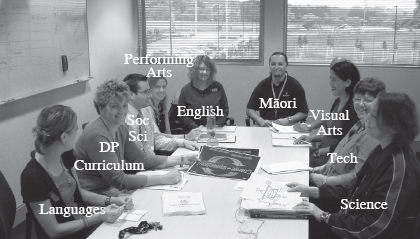
Step 2.&;Learning areas meet to plan the detail of delivery, activities, assignments, sequence content, skills, and assessment meetings.
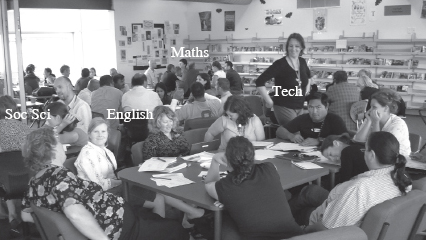
Step 3.&;All teachers attend small cluster groups to share plans and familiarise themselves with the activities of other learning areas.
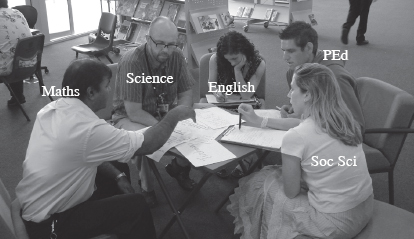
Step 4.&;Heads of learning meet once again to finalise the plan for the next term’s learning.
Step 5.&;Immersion day. A high-interest, whole-day, off-timetable engagement activity begins the new term for all Year 9 students. As the term unfolds, each learning area makes its unique contribution towards each student’s understanding of the concept.
Additional benefits
This exercise has a number of benefits in addition to exposing students to integrated thinking and learning:
•&;&;Heads-of-learning planning sessions have the added advantage that, for the first time, all subject leaders gain insight into exactly what goes on in maths or technology or dance at Year 9. The process also identifies opportunities to avoid overlap and build on complementary content and skills.
•&;&;This understanding across curricula also extends to subject teachers. The process of school-wide focused planning nurtures a culture of collaboration and mutual understanding. Opportunities are identified and capitalised upon to share activities or assignments. Sequentially unfolding curricula can also sometimes be aligned in time and across disciplines.
In this way, a sense of purpose, collaboration, and coherence pervades the everyday life of the school and makes a substantial contribution to a healthy learning culture. Dean Fink and Louise Stoll (2005, pp. 14–15) list six processes that define and operationalise what they term a “learning community”:
•&;&;thinking together
•&;&;self-evaluation
•&;&;team learning
•&;&;making connections (the big picture)
•&;&;creativity
•&;&;reculturing (changing the way we do things).
The collaborative planning of an integrated curriculum acts as a very effective catalyst for all of these processes.
Shortcomings of the collaborative planning approach
This integrated planning and specialist delivery approach is relatively easy to overlay onto an existing secondary school timetable and staffing structure. The approach improves the coherence of the delivery of existing knowledge, knowledge that is selected by the teacher rather than the student. However, it does not provide rich opportunities for discovering new knowledge or for problem solving.
Rose Hipkins (2008a) describes this as the difference between improving learning and transforming learning. She has carried out research with Alfriston College on the impact of longer periods of learning, comparing 50-minute, 100-minute, and three-day periods. She states that:
The research initially focused on whether the longer (100-minute) lessons really did make a difference but we soon found that the really different learning conditions arose in the three-day learning episodes. (Hipkins, 2008a, p. 42)
In a transformative paradigm all practices and assumptions will be revisited as the school embarks on a journey to think differently about learning and the ways we organise it. There are indications in the results presented here that the learning processes are more likely to be transformed (as opposed to improved) during three-day learning episodes. (Hipkins, 2008b, p. 48)
These observations confirmed the school’s earlier belief that a “deeper” form of integration would be necessary if students were to experience the type of learning required for the 21st century. The three-day episode was designed to create an opportunity for an integrated and sustained focus on solving real-life problems.
The structural changes required by this programme are not very far removed from those practised by many schools already, in a slightly different way, when they timetable a sports day or an open day, or engage in the wide variety of extension activities and camps at the end of the school year.
The three-day episode
This learning event was designed in response to the recognition that the front-end-planned Year 9 programme was unlikely to deliver the kind of learning that is really required by the 21st century; the kind of learning that involves the creation of new knowledge resulting from the cross-fertilisation of disciplines. The three-day episode is a more comprehensive response to Jane Gilbert’s suggestions about what teachers can do (see page 74) than the Year 9 collaboratively planned approach.
The shape of a three-day-episode programme has remained almost unchanged since its inception in 2004:
•&;&;It occurs once per term.
•&;&;The whole school is involved.
•&;&;The duration is for three school days (sometimes this can be spread across a weekend; for example, Friday, Monday, Tuesday).
•&;&;Students self-select learning activities.
•&;&;During a three-day programme the timetable is suspended—no normal timetabled classes operate.
•&;&;A theme or topic is determined for each term’s three-day programme. Staff are notified of these themes/topics and the proposed dates at the beginning of the year.
•&;&;Staff plan and deliver programmes that fit within the theme/topic.
•&;&;Students and staff in specific programmes stay together for the three days.
•&;&;All three-day programmes run consecutively.
•&;&;Students select programmes based on interest or need.
•&;&;Students operate in multilevel learning groups.
•&;&;Programmes conclude with a “celebration of learning”, an opportunity for students to share their learning.
•&;&;Programmes are either whānau-based (that is, staff and students from the whānau, or school-within-a-school, work together within the programme theme/topic), or interest-based, or match the interest and skills of the staff members/students.
In 2008, Alfriston College developed a set of design principles to guide the future development of the event:
1.&;&;Nature of Learning
The planned learning should provide opportunities to strengthen learners’ capabilities, including “learning to learn” dimensions and provide for engaging, interactive learning experiences.
2.&;&;Ownership
The planned learning should foster autonomy, providing learners with choice and flexibility within a scaffolded learning environment.
3.&;&;Connectedness, Authenticity, Relevance
The planned learning should help learners make authentic and relevant connections between their learning experiences and the world they live in, in ways that expand their horizons.
4.&;&;Outcomes
The planned learning should conclude with an evaluation of the episode, using learner-derived indicators of successful learning, so that achievements can be celebrated.
These principles are closely aligned to the principles, values, key competencies, and effective pedagogies of The New Zealand Curriculum (Ministry of Education, 2007).
A typical three-day episode involves between 30 and 40 courses. Each course is led by one or more teachers, who are sometimes supported by adults or senior students. Courses often take place off site. The three-day episode is also an opportunity for students to complete an appropriate NCEA (National Certificate of Educational Achievement) unit that requires intensive immersed learning extending for up to 15 hours. Some of the episodes are organised around a topical theme such as the Olympics or elections. Some episodes are more focused on meeting individual needs or learning interest. All the courses tend to be devoted to transforming learning that involves collaboration, experience, or experiment, and result in the creation of new knowledge. Some examples are listed below, accompanied by comments (published in the school newsletter, Alfriston College Update, Alfriston College, 2008, p. 2) from participating students about what they learnt as a result of the course:
Flight—Past, Present and Future:
“I am thinking more differently about my life and how to live it. I’m going to get out there and try new things.”
Let’s Have a Ball:
“I learnt about body image and how the media influences people’s image of a healthy person.”
The AC 12-Hour Film Fest:
“I learnt that doing things out of your comfort zone can be fun.”
Knit for the New and Needy:
“I made beanies and booties for premature babies. This made me think differently as it’s such a great cause to be helping and I want to help others with knitting. Also I just want to volunteer for other causes because it made me feel good to be helping someone else.”
Indy Music:
“I learnt how hard it is to discipline yourself and stick to something and the need to take and give constructive criticism.”
Workplace First Aid:
“I learnt that I am capable of helping and making a difference. I am also confident about helping.”
Mask Making:
“I learnt how to approach situations differently—have a more open mind.”
Mission to Mars:
“I wonder whether we should spend money on space travel rather than helping the poor.”
West Coast Adventure:
“I learnt that I am more of a leader and can take control of different situations.”
Mucking in the AC Way:
“I’m thinking about starting to help out in the community and people in need.”
These comments support the suggestions that the type of learning experienced by students was transforming in one or all of the following ways:
•&;&;The learner was “seeing the world with new eyes”.
•&;&;The episode had produced a dispositional change.
•&;&;The learner was “seeing themselves with new eyes”.
Conclusion
Learning in the world beyond school always involves the interwoven knowledge, skills, and ideas from a multiplicity of disciplines. For over 150 years secondary schools have chosen to teach “subjects” and “disciplines” in a way that isolates them from each other. A major challenge for the 21st century secondary school is to find ways in which learning can be integrated, yet retain the rigour associated with specialist expertise.
Alfriston College has developed two ways of meeting this requirement: one focuses on the collaborative planning of a year-group curriculum, and the other on a school-wide timetable-suspended transforming learning activity. The Year 9 programme requires little structural change to implement, but is limited in its capacity to meet new learning needs. The three-day episode has the capability to transform learning, but it also requires significant structural (timetable) and pedagogical changes. The activity is dependent on whole-staff involvement and the support of the school community. It is learning that is exciting and fulfilling for both teachers and students.
References
Alfriston College. (2008). Alfriston College Update, 17(June), 2.
Beane, J. (1997). Curriculum integration: Designing the core of democratic education. New York: Teachers College Press.
Bishop, R., & Berryman, M. (2006). Culture speaks: Cultural relationships and classroom learning. Wellington: Huia Publishing.
Bolstad, R. A. (2008). A possible future? Senior secondary education in the year 2030. set: Research Information for Teachers, 1, 23–24.
Bolstad, R. A., & Gilbert, J. (2008). Disciplining and drafting, or 21st century learning? Wellington: NZCER Press.
CI FAQs. (n.d.). Retrieved 18 August 2008, from http://www.tki.org.nz/r/integration/interact/communicate/faqs/faqs_e.php
Dewey, J. (1897). My pedagogic creed. School Journal, 14(3), 77–80.
Fink, D., & Stoll, L. (2005). Leadership for mortals. London: Corwin Press.
Gilbert, J. (2005). Catching the knowledge wave? The knowledge wave and the future of education. Wellington: NZCER Press.
Hipkins, R. (2008a). Longer learning periods for the secondary school day: What does research say? set: Research Information for Teachers, 1, 40–43.
Hipkins, R. (with Shanks, L., & Denny, M.). (2008b). Early experiences of longer learning periods at Alfriston College. set: Research Information for Teachers, 1, 44–49.
Ministry of Education. (2007). The New Zealand curriculum. Wellington: Learning Media.
Pigdon, K., & Woolley, M. (Eds). (1995). The big picture: Integrating children’s learning. Portsmouth, NH: Heinemann.
Postman, N., & Weingartner, C. (1969). Teaching as a subversive activity. Harmondsworth, UK: Penguin.
The author
John Locke is the director of the First-time Principals Programme at The University of Auckland. He has been the principal of three secondary schools, including Alfriston College, where he was foundation principal.
Email: j.locke@auckland.ac.nz