Generative AI and narrative assessment practice in early childhood education
What professional and ethical issues
must we discuss?
Alex Gunn, Sonya Gaches, and Jenna-Lee Pfeifer
The uses of generative artificial intelligence (GenAI) and large language models (LLMs) is of increasing interest in early childhood education (ECE). However, a recent step-change in the uptake of such technologies is giving rise to ever-more questions of the ethics and professional consequences of using all kinds of technologies in ECE. Furthermore, new possibilities and implications for teachers’ work are emerging, including in assessment. This article poses questions about the uses of GenAI technologies in the context of narrative assessment as learning stories in Aotearoa New Zealand ECE. We prompt and analyse a LLM-generated learning story to think about the utility of such tools if they are used for assessment purposes in the context of Te Whāriki.
Introduction
Artificial intelligence seems to have become a part of our everyday lives. Generative artificial intelligence (GenAI)1 and large language models (LLMs) are an increasingly hot topic in schools, universities, workplaces, and homes as they are evermore proposed as ways to save time, increase efficiency, and decrease cognitive load (Khan & Suhluli, 2025). Within the profession of teaching in Aotearoa, Coblentz et al. (2025) surveyed students and early-adopter teachers in primary settings about their GenAI use. Findings from this study suggest that surveyed teachers felt “cautious optimism about using AI to support their work” (p. 2) with most relying on free GenAI tools for support with planning, assessment, curriculum materials, and personalised learning support. Much published research on GenAI uses by early childhood education (ECE) kaiako in Aotearoa is yet to emerge, although Purdue et al. (2025) have argued for its use within ECE initial teacher education and by disabled kaiako. While these New Zealand papers are generally supportive of teachers’ uses of GenAI and LLMs and many authors assert that the benefits of use outweigh the risks, there is also a longstanding body of work raising concerns about if and how best to use GenAI.
For example, European-based research suggests that uncritical and instrumental uses of tools may foster cognitive offloading with negative effects and encourage AI individualism (Brandtzaeg et al., 2025). An erosion of critical thinking skills along with the loss of professional autonomy and ethical decision making are other perceived issues (Gerlich, 2025). As far back as 2021 UNESCO had noted that GenAI systems are infused with the values and beliefs of those that create the technologies, and we recognise that beliefs and values aren’t necessarily universally shared.
While global debates about digital professionalism and ethical AI uses circulate, we, as researchers and teacher educators working with kaiako in ECE, have become increasingly aware in these past two years of teachers taking up such tools. In their efforts to lessen perceived time burdens of administrative and paperwork tasks, kaiako are already using GenAIs, including in relation to assessment, planning, and the writing of learning stories (Lee et al., 2024; White & Chase, 2024). While our firsthand experiences of this are mostly anecdotal, we are seeing some evidence of GenAI and LLM use by student teachers when learning to write learning stories. For us there are ethical and professional questions and concerns to be considered if kaiako are to use such tools, and this article is a means of promoting discussion and awareness as we work to build our own and others’ critical digital literacy in the context of GenAI.
The scope of this article
In the face of the kinds of GenAI usage we had experienced and learnt of, we wondered what it might mean for assessment practice if free GenAI tools were used uncritically by kaiako to help them write learning stories. What kind of information might a GenAI provide in response to basic prompts? Would LLM responses look like what we would expect in terms of assessment in the context of our curriculum framework? What kinds of planning might an LLM suggest? And what could such outputs mean for student and teacher learning about and practices of assessment within ECE? In response to our questions, we decided to ask an LLM to write a learning story for a fictional child (Casey) and then we reflected upon the outcomes and related ethical and professional questions this raised. Thus, this article is intended to provoke discussion and to increase consciousness about the potential consequences of using GenAI in assessment and planning.
In what follows, we will first describe some key tenets of quality assessment in Aotearoa New Zealand ECE before locating narrative assessments as learning stories in this context. Then, we briefly address what research tells us about how GenAI tools are being used in teaching before stepping into a role play of sorts, bringing an LLM together with assessment and planning questions to see what kinds of responses are generated after our basic request about writing a learning story. As we describe the LLM responses, we point out questions about the utility of the responses for assessment and planning. Again, the purpose of this article is to provoke discussion and to raise consciousness about potential unintended consequences of using LLMs uncritically in these ways.
Tenets of quality assessment in early childhood in Aotearoa New Zealand
Any assessment information that a teacher generates should be credible (valid), trustworthy (reliable), and manageable to implement (Sutton, 1992), to ensure the information helps teachers and learners understand and plan for intended and valued learning. Furthermore, if assessment is to improve learning, as our curriculum framework Te Whāriki (Ministry of Education, 2017) (hereafter, Te Whāriki) expects, then assessment practices should reflect sociocultural teaching and learning approaches and serve principally formative purposes (Carr & Lee, 2012, 2019, Ministry of Education, 2004/9, 2017). A key purpose of formative assessment in the context of Te Whāriki is to help children understand their learning dispositions and working theories, all the while positively shaping children’s identities as learners (Carr 2001, Carr & Lee, 2012, Sands & McChesney, 2023). The right feedback, provided in a timely manner, can grow children’s understanding of their learning power and processes as it motivates further learning (Black et al, 2003, Carr et al., 2015). Narrative forms of assessment information provide a uniquely situated view of what kaiako have noticed, recognised, and responded to as they engage with tamariki (Carr, 2008; Ministry of Education, 2004/9). Narrative assessment as learning stories provide insights into real relationships, unique histories, and the collaborations of children and others (human and more than human), as they have learnt, lived, and played together in ECE over time.
We are of the view that the narratives which kaiako write to children about their learning become part of a rich tapestry of education and life stories that attest to the child’s belonging and worldly contributions. In the face of the emerging GenAI or LLM use noted at the beginning of this article, we wonder what will it mean in years to come when older children and youth begin to realise that what’s been written about them was not this view of their identity construction and learning, but rather the product of software engaging in, as Noam Chomksy puts it, “high-tech plagiarism” (2023, 4:28mins). There seems to be a lot to consider if and when a teacher hands over assessment responsibilities and relatedly planning, to GenAI technologies and tools.
About narrative assessment as learning stories in Aotearoa New Zealand.
As has been well documented (Carr, 1998a, 1998b), learning stories are a narrative approach to assessment that emerged from research into the early implementation of Te Whāriki (Ministry of Education, 1993). That research explored observable outcomes for children in the context of Te Whāriki and fit-for-purpose approaches to assessment.
Learning stories were born at the time of the narrative revolution in human psychology (Engel, 2000). As a cultural tool, narrative is also fueled by feminist and indigenous perspectives and worldviews (Hatherly & Sands, 2002). The narrative turn recognised that people use stories to make meaning—they act to organise thoughts, memory, intentions and identities (Bruner, 1991). As Te Whāriki is concerned with the development of learner identities over time, and in how teachers, in partnership with whānau and children can design relevant early childhood learning environments, learning stories provide a means of illustrating how specific learning dispositions, working theories, and evolving capabilities are supported in practice. Within the writing or speaking of narratives, kaiako make visible the networks of relationships that give rise to shared experiences and meaning. In ECE, learning stories illuminate the people, places, and things that are contingent with the valued learning being prioritised. Why does this matter? Because if kaiako can understand the context within which capabilities, theories, and identities are flourishing, that information can be used for planning and evaluation.
In light of Te Whāriki as an Indigenous framework for conceiving of the child, the child’s learning, and the child’s empowerment, learning stories are a fit-for-purpose form of narrative assessment that can attest to and achieve the multiple means we describe earlier. To be clear, learning stories are not the only form of assessment that might be undertaken within an ECE setting. Yet, as a way of producing useful formative assessment information aligned with Te Whāriki expectations, we think that the appropriateness of narrative assessment as learning stories is clear.
As we learnt about teachers’ and student teachers’ use of LLMs to produce assessment and planning information in ECE, we became perplexed about the utility of an LLM for this work. These wonderings led us to two specific questions to guide this inquiry: (1) How are GenAI tools already being used in ECE? and (2) How might an LLM address children as it also describes how they are learning to learn?
How are GenAI tools being used already in ECE?
We are principally interested in how teachers’ work might be being mediated by GenAIs rather than how GenAI tools might be being used by children. Furthermore, while there still seems to be a healthy skepticism about whether and how to use GenAI and LLMs in teaching (Dickleman & Greenberg, 2024, Luo et al. 2024), and ongoing questions about the safe and ethical uses of the technologies (Crescenzi-Lanna, 2023; Kurian, 2023, Luo et al. 2024, UNESCO 2021), we know that the discourse of easing teachers’ work-burden and saving time are persuasive motivators for using GenAIs for some (Coblentz et al., 2025; Purdue et al. 2025). Emerging research is already indicating that in ECE teachers are using the tools for assessment and planning in Aotearoa New Zealand and overseas (Lee et al., 2024; White & Chase, 2024), and researchers have been able to map out a landscape of teachers’ uses of GenAI tools for a range of purposes (Kanders et al., 2024), namely for the design of culturally relevant teaching, for administrative tasks, and the development of teaching content. Some of these kinds of uses were also noted in Coblentz et al.’s (2025) recent Aotearoa New Zealand study. Zhang et al. (2026) note that within research based in the USA and China, GenAIs are used for the benefit of ECE when actively mediated by adults. Uses of technologies within assessment-related work has also been shown by Nuttal et.al. (2023) to have produced new kinds of work activity and expectations.
Generating a learning story with a LLM
We decided to generate a learning story in an LLM (using the free version of the widely internationally available tool ChatGPT) for a fictional child named Casey. We then wanted to analyse the story with a view to how it was able to reflect some expectations of narrative assessment as learning stories (Carr, 2001; Carr & Lee, 2012, 2019; Hatherly & Sands, 2002; Hedges, 2022; Ministry of Education, 2004/9, 2017). Specifically, we were thinking about the sociocultural nature of the assessment and asking how the LLM’s responses would meet the fundamental assessment purpose of addressing children about how they are learning to learn. Of the LLM’s responses we asked:
•Who is the audience (the child or some other person)?
•How is the context for the learning visible (the contingent people, place, and things)?
•What is the valued learning being documented (learning dispositions and working theories)?
•What can be said about the formative nature of the learning story (mana-enhancing feedback to the child about their learning power and strengths)?
•How are planning suggestions directed (towards learning dispositions, working theories, and/or something else)?
Our readings of the generated responses provided an opportunity to think through our question of utility. Did the LLM produce responses of the kind warranted by Te Whāriki?
In the next section of our article, we share the results of our LLM enquiries. Our purpose was not to help the LLM improve or learn, nor was it to encourage teachers to begin using LLMs more. Rather, we used the tool so that we might better understand and be able to discuss with others any potential consequences for assessment practice and ECE professionalism.
“Help me write a learning story…”
We asked the LLM to “help me write a learning story about Casey” (see. Figure 1).2 Inadvertently we’d undermined our own assessment tenets with this very instruction, it was a reminder of how easy it is to erode the underpinnings of quality assessment in the context of Te Whāriki. We should have input instead, “help me write a learning story for Casey”—after all, the primary audience of formative assessment information must be the learner. To test the effect of our error, we asked the LLM to write a second learning story, about a different child, using the proper instruction. It didn’t seem to make a difference to the output, however—the same kinds of features we discuss in the Casey story were observed.
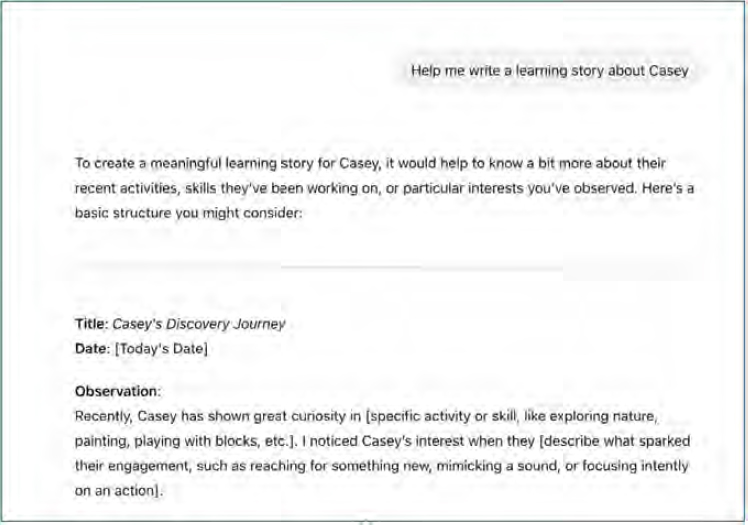
Figure 1. LLM story initial instruction
The LLM’s response continued beyond what is shown here to suggest we continue to structure our learning story using headings of “learning and development” and then a “reflection”. Neither of these are features of a learning story that we recognise. We gave the LLM more information: “Over these last 8 months I have noticed Casey using their voice in different ways. Casey is 16 months old.” Figures 2 and 3 give the LLM’s response, a story about Casey’s “vocal exploration”. Once the LLM generated its response, we began to appreciate the limitations of a predictive algorithm, devoid of much assistance from its user, to understand the nuances of the prompt. For us, the noticing of Casey’s use of voice, in the context of Te Whāriki, is a reflection of the child’s increasing capacity to confidently express points of view, feelings, and ideas, and, relatedly, to speak into the social milieu. This is not what the LLM prioritised as valued learning in its reply (see Figures 2 and 3).
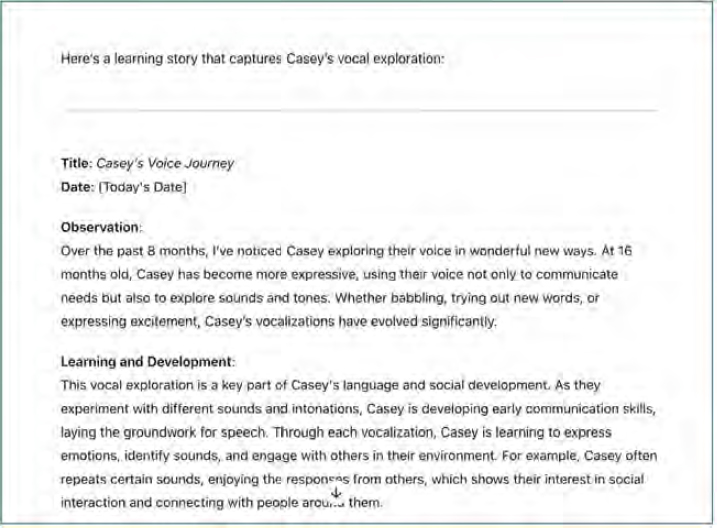
Figure 2. LLM Story (part a)
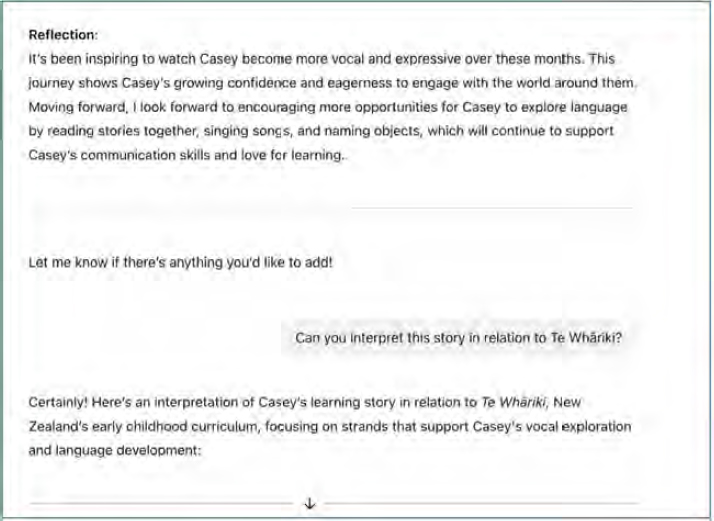
Figure 3. LLM Story (part b)
The LLM asked us if there was anything we wanted to add. But, before exploring that, we pause to describe some of things we were starting to notice about the LLM’s responses. First, in relation to our question of “audience”, the LLM’s response was to write about Casey, rather than to them as the principal audience for the assessment information. Therefore, the “formative purpose” of the learning story as a tool to help Casey understand their learning power was undermined. The LLM’s output was not informing Casey about their learning strengths, nor helping them understand how to become better at learning (i.e., how they were strengthening their learning dispositions and working theories). Nor could it, due to the absence of information from us, describe anything that Casey’s teachers or others might have been contributing to the valued learning of “using their voice”. There was no sense of the contingent people, places, and things that contributed to the learning that we were wanting to document about (Casey’s use of voice as they confidently express points of view, feelings, and ideas, contributing to the social milieu). As noted, we didn’t give any prompts about this, but the point is that Casey’s capabilities, as described by the LLM, are almost entirely self-referential, apart from some hallucinated3 comments about Casey repeating sounds, enjoying responses from others, and enjoying social interactions and connections. Thus, the expectation of sociocultural assessment output is displaced by a more individualistic developmental psychology one. The LLM was writing about development, not learning, specifically “vocal development”—quite a different focus to our notion of “voice” given in our first prompts. “Voice” is a much broader conceptual and practical construct, related to children’s empowerment, rights, and agency—such conceptions were absent in the LLM’s construction.
The LLM response was narrowly focused on developmental outcomes: Casey’s vocal, and relatedly social development. The response compared Casey’s capabilities to a normative developmental trajectory (babbling laying the groundwork for speech) and gave no recognition to any distributed agency involved with Casey’s capabilities. The story did not tell us about the things we expected it to, such as how Casey’s use of voice reflects their emerging capacity to speak into, contribute within, and belong within a place. As such, the response was quite removed from the curriculum context of Te Whāriki (Ministry of Education, 2017) and focusing our attention not on the empowered child’s learner identities but on developmental trajectories instead.
The LLM response was more summative and diagnostic than formative in its purpose. It summed up Casey’s “vocal development” at a point in time and diagnosed where Casey was “at” along a predetermined and normative trajectory. In taking this approach, Casey is produced as partial, someone who has yet to arrive at an expected stage of development, and who needs support to get there. The developmentalism within the response abounds.
We began to seriously question the utility of the GenAI response for assisting with a teacher’s assessment workload and saving time. Not only was the LLMs story questionable in terms of credibility in relation to Te Whāriki, it also struggled to produce features of a learning story that we would expect to see: the story wasn’t formative, it wasn’t about Casey’s learning dispositions or even a working theory about “voice”. So, we pointed the LLM to the curriculum framework and asked it if it could help us “interpret the story in relation to Te Whāriki”.
Interpreting a story in relation to Te Whāriki
In response to our question about “interpreting”, the LLM suggested possible “Te Whāriki links” to the response it had created.4 These can best be described as surface-level readings of the English texts of curriculum strands, even though some domains of mana (i.e., Mana reo and Mana aotūroa) are mentioned, construed again within a dominant discourse of developmentalism (see Figures 4 and 5).
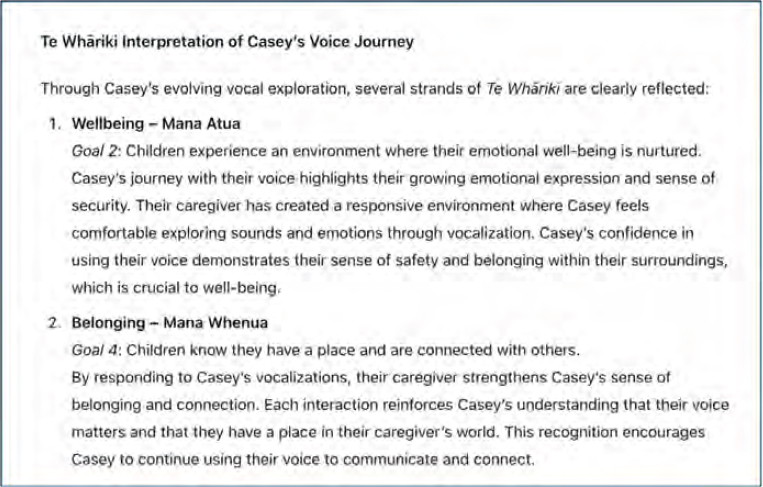
Figure 4. LLM interpretation of a story in relation to Te Whāriki (part a)
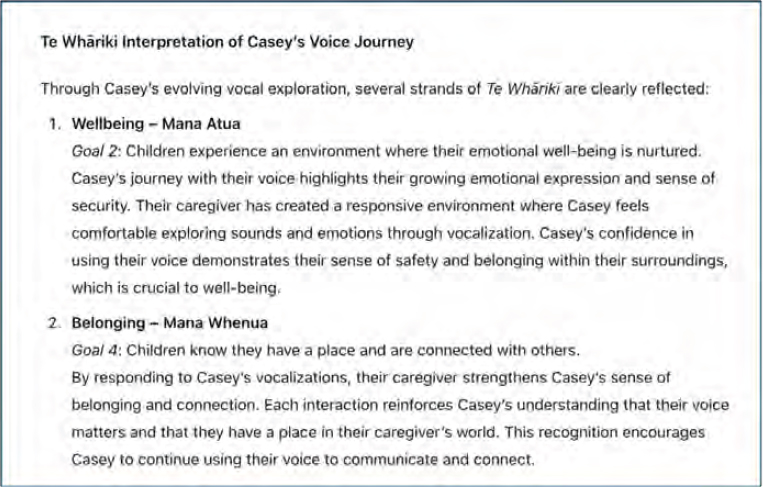
Figure 5. LLM interpretation of a story in relation to Te Whāriki (part b)
Here the goals of Te Whāriki are used to explain, in the past tense, Casey’s development. This is a fundamental misappropriation of the goals of the framework which are to guide kaiako in their design of learning environments that afford the particular learning the framework intends (one that prioritises mana, learning dispositions, working theories). Our concern here is that, if these kinds of interpretations and misuses of Te Whāriki were to go unnoticed by people using an LLM like this, it would seriously undermine the framework and curriculum implementation. Finally, we decided to ask the LLM for suggestions about planning.
What would a LLM suggest a teacher plan for?
A list of suggested activities was produced alongside comments about how these aligned with Te Whāriki and would support specific developmental outcomes if these were actioned (see Figure 6).
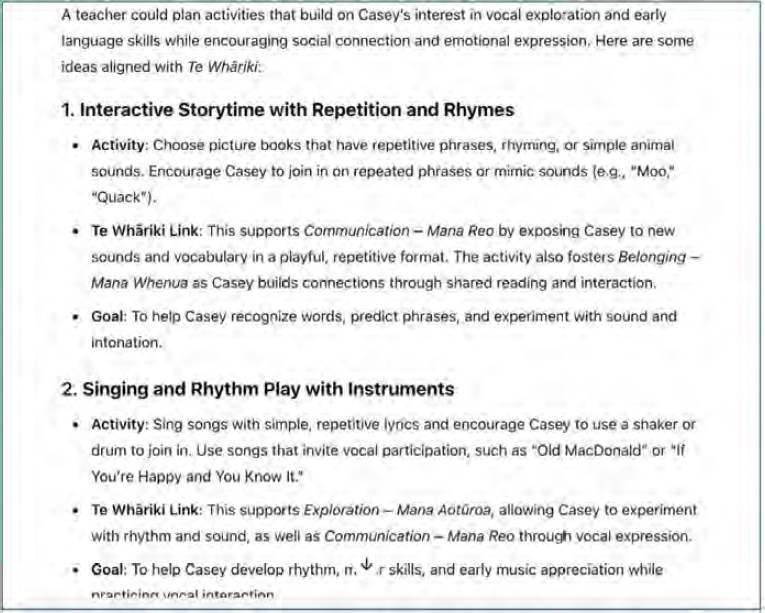
Figure 6. LLM’s suggested planning
The internal coherency of the response, from the point of view of the LLM, was apt—in its responses to our basic prompts, it had prioritised aspects of a child’s development as the valued learning, interpreted these in relation to developmental trajectories, and suggested activities that would be considered so-called developmentally appropriate for a teacher to implement. However, that a teacher might take lists of activities like these and use them as planning in the context of Te Whāriki, is a significant problem of practice we think, if even for the simple reason that planning an activity is not the same as planning for learning. No intentions were evident in the response of planning for the child’s mana, any working theories, or learning dispositions.
Concluding thoughts and invitations
Returning to our initial statement of focus for this article, we continue to question the utility of the LLM-generated assessment information, especially now that we recognise the kinds of effort likely required to help the LLM produce a learning story recognisable to us working in the context of Te Whāriki. Our informal exploration raised questions about the credibility of the assessment information. Did the LLM responses address the learning of value within the curriculum (learning dispositions and/or working theories)? No. Instead, it defaulted to a developmental framing of a child’s vocal and social development and continued in that vein to suggest activities that could be planned to build on Casey’s “interest in vocal exploration and early language skills”. The LLM-generated responses privileged individualised Western notions of child development and failed to address learning in ways that consider Indigenous understandings of the child and the valued learning expressed within Te Whāriki.
Was the LLM response formative in nature? No, it didn’t speak to Casey about their learning (learning dispositions of confidently expressing points of view, feelings, or ideas, or of taking responsibility in the social milieu), nor did we consider its responses to be particularly empowering of Casey as a learner. Instead, the LLM took up a summative and diagnostic approach to the assessment information, pointing out Casey’s accomplishments relative to a developmental trajectory and suggesting activities to boost Casey’s vocal and social development. While the LLM was able to make some basic, summative evaluative remarks about two aspects of child development at one point in time, it failed to reflect the weaving of the child underpinned by Te Whāriki principles and strands. Within the LLM-generated story, Casey is a one-dimensional unit of analysis where their “voice” is limited to babbling and reproducing adult-prompted sounds. We were troubled by the fabrication of information within the LLM’s responses. Casey was reportedly: “becoming more expressive”, “babbling”, “trying new words”, “expressing excitement”, their capabilities having “evolved significantly”—none of which were part of any of our prompts.
Finally, the purpose of narrative assessments as learning stories is not only to notice and recognise children’s learning, but also to show how kaiako propose to respond. This requires kaiako to draw upon their professional relational knowledge and to work with the child and others in an empowering way. Planning relies on knowing who the child is, what their interests are, what motivates them, and what funds of knowledge they will likely draw from to make curriculum with others (Hedges et al., 2011). Weaving together these aspects of the child, with aspirations from whānau and the children themselves, means a localised curriculum based on Te Whāriki can emerge. The result should be planning that is personalised for that child, addressing their many dimensions, presented in such a manner that the learning story continues in its efforts to become part of that child’s identity building (Carr, 2001; Carr & Lee, 2012; Hedges, 2022). How can generic activity lists such as those produced in our LLM’s response suffice?
To conclude, we think it’s time to start talking more about teachers and student teachers’ potential uses of GenAIs and LLMs in ECE assessment and planning work. We understand that kaiako are already using these tools and our experiences indicate that some student teachers are using them too. We feel obligated to speak into this space lest these emerging practices begin to inadvertently undermine our curriculum framework and professional and ethical practices as teachers, ultimately with negative impacts on children. For now, we present this analysis and critique of GenAI use in assessment and planning in the hope that we may continue our conversations with others about this vital work of kaiako in ECE in Aotearoa New Zealand and beyond.
Notes
1We recognise that GenAIs and large language models LLMs are related kinds of technological tools but not exactly the same—and we do not profess to be expert in either. LLMs are used for language-based inquiries, tasks, and responses, whereas GenAIs can produce a range of other forms of content (e.g., music, images, and code). In our experience, “GenAI” is mostly used colloquially to refer to any tool that is creating novel content from its analysis of input. However, to achieve the task of “writing a learning story” it will likely have been an LLM tool that has produced the language-based response required. We use the terms interchangeably.
2Note, the figures we share here are made from screenshots of our GenAI interactions from which we have deleted identifying logos.
3Within the field of GenAI, hallucinations are a model’s fabricated responses which occur when its probability algorithm generates a plausible but possibly factually incorrect, fabricated or nonsensical idea.
4It may be noted by now that while we asked the LLM to help write a ‘learning story’ we are not referring to the LLM generated response as a ‘learning story’ because the response generated cannot in our view be accorded the status of learning story in the context of Te Whāriki and Aotearoa New Zealand ECE.
References
Black, P., Harrison, C., Lee, C., Marshall, B., & Wiliam, D. (2003). Assessment for learning: Putting it into practice. Open University Press.
Brandtzaeg, P. B., Følstad, A., & Skjuve, M. (2025). Emerging AI individualism: How young people integrate social AI into everyday life. Communication and Change, 1(11), 1–22. https://doi.org/10.1007/s44382-025-00011-2
Bruner, J. (1991). The narrative construction of reality. Critical Inquiry, 18(1), 1–21. https://doi.org/10.1086/448619
Carr, M. (1998a). Assessing children’s experiences in early childhood (Part 1). University of Waikato and Ministry of Education.
Carr, M. (1998b). Assessing children’s experiences in early childhood (Part 2). University of Waikato and Ministry of Education.
Carr, M. (2001). Assessment in early childhood settings: Learning stories. Sage.
Carr, M. (2008). Can assessment unlock and open the doors to resourcefulness and agency? In S. Swaffield (Ed.), Unlocking assessment: Understanding for reflection and application (pp. 36–54). Routledge.
Carr, M., Cowie, B., & Davis, K. (2015). Continuity of early learning: Learning progress and outcomes in the early years. Wilf Malcolm Institute of Educational Research, The University of Waikato.
Carr, M., & Lee, W. (2012). Learning stories: Constructing learner identities in early education. Sage. https://doi.org/10.4324/9780429030055-2
Carr, M., & Lee, W. (2019). Learning stories in practice. Sage.
Chomsky, N. (2023, January 1). Chomsky on ChatGPT, Education, Russia and the unvaccinated [video]. YouTube, EduKitchen. https://www.youtube.com/watch?v=IgxzcOugvEI&t=268s
Coblentz, D., Dong, J., & Gibbs, B. (2025). Generative artificial intelligence in Aotearoa New Zealand primary schools. Teacher and student survey findings. NZCER Press.
Crescenzi-Lanna, L. (2023). Literature review of the reciprocal value of artificial and human intelligence in early childhood education. Journal of Research on Technology in Education, 55(1), 21–33. https://doi.org/10.1080/15391523.2022.2128480
Dickleman, G. J., & Greenberg, J. D. (2024). AI in early learning and how it affects higher education and workplace learning. In D.Guralnick, M. E. Auer, & A. Poce (Eds), Creative approaches to technology-enhanced learning for the workplace and higher education: Proceedings of the Learning Ideas Conference, 2024, Vol. 1 (pp.124–148). Springer Nature. https://doi.org/10.1007/978-3-031-72430-5_12
Engel, S. (2000). The stories children tell: Making sense of the narratives of childhood. W. H. Freeman and Co.
Gerlich, M. (2025). AI tools in society: Impacts on cognitive offloading and the future of critical thinking. Societies, 15(6), 1–28. https://doi.org/10.3390/soc15010006
Hatherly, A., & Sands, L. (2002). So, what is different about learning stories? The First Years: Ngā Tau Tuatahi. NZ Journal of Infant and Toddler Education, 4(1), 8–12.
Hedges, H. (2022). Children’s interests, inquiries and identities: Curriculum, pedagogy, learning and outcomes in the early years. Routledge. https://doi.org/10.4324/9781003139881
Hedges, H., Cullen, J., & Jordan, B. (2011). Early years curriculum: Funds of knowledge as a conceptual framework for children’s interests. Journal of Curriculum Studies, 43(2), 185–205. https://doi.org/10.1080/00220272.2010.511275
Kanders, K., Stupple-Harris, L., Smith, L., & Gibson, J. L. (2024). Perspectives on the impact of generative AI on early-childhood development and education. Infant and Child Development, 33(4), e2514. https://doi.org/10.1002/icd.2514
Khan, S. M. F. A., & Suhluli, S. (2025). Generative AI and cognitive challenges in research: Balancing cognitive load, fatigue, and human resilience. Technologies, 13(11), 486. https://doi.org/10.3390/technologies13110486
Kurian, N. (2023). AI’s empathy gap: The risks and conversational artificial intelligence for young children’s well-being and key ethical considerations for early childhood education and care. Contemporary Issues in Early Childhood, OnlineFirst, 8. https://doi.org/10.1177/14639491231206004
Lee, W., Skeoch, R., & Sands, L. (2024). Exploring artificial intelligence in writing learning stories: Benefits, challenges, and ethical considerations. Paper presentation to European Early Childhood Research Association Conference, Brighton, UK, 3–6 September.
Luo, W., He, H., Liu, J., Berson, I. R., Berson, M. J., Zhou, Y., & Li, H. (2024). Aladdin’s genie or Pandora’s box for early childhood education? Experts chat on the roles, challenges, and developments of ChatGPT. Early Education and Development, 35(1), 96–113. https://doi.org/10.1080/10409289.2023.2214181
Ministry of Education. (1993). Te whāriki: Draft guidelines for developmentally appropriate programmes in early childhood services. Learning Media.
Ministry of Education. (2004). Kei tua o te pae—Assessment for learning ECE exemplars. Author.
Ministry of Education. (2017). Te whariki—He whāriki mātauranga mō ngā mokopuna o Aotearoa: Early childhood curriculum. Author. https://www.education.govt.nz/assets/Documents/Early-Childhood/ELS-Te-Whariki-Early-Childhood-Curriculum-ENG-Web.pdf
Nuttall, J., Rooney, T., Gunn, A. C., & White, E. J. (2023). The impact of digital documentation platforms on early childhood educators’ work in Australia and New Zealand. Technology, Pedagogy and Education. https://doi.org/10.1080/1475939X.2023.2177720
Purdue, K., Hohaia-Rollinson, F., Solomon, J., & Williamson-Garner, D. (2025). The benefits and challenges of using AI in learning and teaching for early childhood student kaiako and kaiako with learning disabilities. He Kupu, 8(3), 35–44.
Sands, L., & McChesney, K. (2023). How learning stories influence children’s learning identities. New Zealand Journal of Educational Studies, 58, 183–199. https://doi.org/10.1007/s40841-022-00273-0
Sutton, R. (1992). Assessment: A framework for teachers. Routledge.
UNESCO. (2021). Recommendation on the ethics of artificial intelligence. https://unesdoc.unesco.org/ark:/48223/pf0000380455
White, A., & Chase, L. (2024). Writing learning stories with artificial intelligence in higher education: Whose voices are elevated or silenced? Paper presentation to European Early Childhood Research Association Conference, Brighton, UK, 3–6 September.
Zhang, Y., Halili, S. H. B., & Zainuddin, Z. (2026). Applications of generative AI in early childhood education: A systematic review. Eurasia Journal of Mathematics, Science and Technology Education, 22(3), 1–22. https://doi.org/10.29333/ejmste/18068
Alexandra C. Gunn (Alex) (corresponding author) is a former early childhood teacher who now works as a professor of education at Te Kura Ākau Taitoka | Ōtākou Whakaihu Waka, The University of Otago.
Email: alex.gunn@otago.ac.nz
Sonya Gaches is pūkeka matua senior lecturer of education at Ōtākou Whakaihu Waka Te Kura Ākau Taitoka | University of Otago College of Education after spending over 25 years as an early childhood educator with younger people
Jenna-Lee Pfeifer is a former early childhood teacher, now a PhD student studying decolonisation at Te Kura Ākau Taitoka | Ōtākou Whakaihu Waka, The University of Otago.