The co-opting of hauora into curricula
Sharyn Heaton
Kāi Tahu, Muaüpoko, Rangitāne, Te Arawa
Abstract
Currently, the Māori word hauora is translated in New Zealand curricula as health and wellbeing or as health and physical education for Māori-medium education. “Hauora, wellbeing” is also an underlying concept within Health and Physical Education in the New Zealand Curriculum, where it is claimed that it offers a “Māori philosophy of health unique to New Zealand”. The use of Māori words and concepts in English-medium curricula is a source of tension, in as much as this usage involves a claim to represent a shared Māori perspective. Understandings of hauora need to go beyond their simplified interpretations within curricula.
Introduction
Tensions and contradictions are inevitable when epistemological concepts are imported from one language and cultural context into another with an expectation of developing a common meaning. These tensions have been overlooked when discussing hauora within health and physical education curricula, leading to a lack of appreciation of the unlimited ways in which hauora can be understood. Potential problems that have an impact on the Māori language, Māori philosophy and content knowledge in health and physical education curricula need to be examined from an in-depth Māori epistemological viewpoint if tensions are to be avoided. Etymological relevance and potential are underestimated and compromised in the translation and evolution of current understandings of hauora. This article briefly sets out to address this concern.
Background
The development of The New Zealand Curriculum Framework (Ministry of Education, 1993), and its literal translation, Te Anga Marautanga o Aotearoa (Te Tāhuhu o te Mātauranga, 1993), provided an opportunity to develop curricula in the English and the Māori languages. Within The New Zealand Curriculum Framework, subjects and disciplines were organised into seven “essential learning areas”. Health education, physical education and aspects of home economics were integrated and renamed Health and Physical Wellbeing, Hauora (Ministry of Education, 1993); in the Māori document this learning area was called Hauora, Health and Physical Wellbeing.
Subsequently these learning areas were developed into two national curricula: one for English-medium education and the other for Māori-medium1 schools in New Zealand. These curriculum policy documents were respectively called Health and Physical Education in the New Zealand Curriculum (HPENZC; Ministry of Education, 1999) and Hauora i Roto i te Marautanga o Aotearoa: He Tauira (Te Tāhuhu o te Mātauranga, 2000). HPENZC was mandated as an official curriculum policy document for New Zealand schools. The curriculum document Hauora i Roto i te Marautanga o Aotearoa: He Tauira remained in draft form and was never mandated as official curriculum policy (Goulton, 2004).
The opportunity for a second round of Māori-medium curriculum development was celebrated with the launch of Te Marautanga o Aotearoa2 (Te Tāhuhu o te Mātauranga, 2008). Te Marautanga o Aotearoa subsumed eight distinct stand-alone Māori-medium essential learning areas into one curriculum. Within Te Marautanga o Aotearoa, the official curriculum statement of policy for teaching and learning in Māori-medium education, Hauora was identified as the equivalent learning area to Health and Physical Education (Ministry of Education, 1999, 2007).
Hauora as the title of the essential learning area Health and Physical Wellbeing
The integration of Māori language, knowledge and culture into New Zealand curricula has involved an attempt to recognise the importance of valuing New Zealand’s bicultural heritage (Department of Education, 1984; Ministry of Education, 1993; Smith, 1997; Te Tāhuhu o te Mātauranga, 1993). Titles within The New Zealand Curriculum Framework and Te Anga Marautanga o Aotearoa were in English and Māori. The integration of Māori and English words, as in the titles of the essential learning areas Health and Physical Wellbeing, Hauora and Hauora, Health and Physical Wellbeing, was celebrated as an opportunity for biculturalism within curricula.
The translation of The New Zealand Curriculum Framework was contracted to Te Taura Whiri i te Reo (The Māori Language Commission) by the Ministry of Education, and thereafter to an independent contractor. “Contracting out” curricula policy was viewed as being enabling for Māori, as in the past the “Māori voice” had been absent from curriculum policy development (McMurchy-Pilkington, 2008). The contractor faced the challenge of capturing in the Māori language what was conveyed in The New Zealand Curriculum Framework. A standardised Māori term that was recognised as a locally accepted corpus of language for health and physical wellbeing was not readily available for the contractor to access. Yet it was the responsibility of the contractor to choose appropriate English-to-Māori translations without widespread Māori consultation (McMurchy-Pilkington, 2008).
A technical approach involving lexical definitions for capturing appropriate words for curriculum translation was used. A lexical definition explains how a word is actually used, in contrast to a stipulative definition, which proposes possible ways of using a word, which may or may not be commonly accepted. Hauora had been accepted within the health sector as meaning “a Māori perspective of health and wellbeing” (Health Research Council, 2004; Ministry of Health, 2000), and the word was transferred into curricula to define the essential learning area of Health and Physical Wellbeing. Just as the use of hauora created a space for a Māori voice within Māori health policy (Health Research Council, 2004; Ministry of Health, 2000), the use of hauora in curricula has made a space for a Māori voice within educational policy.
Literal or technical translations and definitions of words and concepts within curricula seem to have two competing and sometimes complementary goals: self-determination and assimilation. It is self-determining in that an opportunity was available for Māori to define what hauora meant. It is assimilatory in that such translations of concepts and words from an English world view into the Māori language have the potential to put the dominant culture and language at the centre, whereby the minority culture and language become co-opted into reproducing, in the Māori language (albeit unintentionally), their own assimilation (McKinley, 2005). According to McKinley, a world view in a language cannot be understood when the culture is separated from the language and when the language is used only as a technical tool of translation.
There are inherent difficulties when national curricula attempt to assimilate two distinct world views into one, with the intention that New Zealanders share a common understanding. As Durie writes, “Western thought with Māori words … will erode the essence of the Māori language” (1998, p. 6). Where language is used only to name, it does very little for the revitalisation of a language and perpetuates the separation of language from culture and knowledge. This leads to some confusion: is the emphasis placed on the revitalisation of Māori language through curricula, or is it through curricula that Māori language is revitalised and its survival maintained? Or are bilingual titles within curricula another example of an assimilatory practice? Possible answers to these questions are outside the scope of this paper, but warrant further consideration.
The identification of the essential learning area Health and Physical Wellbeing, Hauora provided the opportunity to develop Māori-medium curricula in the subject field. An illusion of possible change and an opportunity for Māori to assert their tino rangatiratanga (self-determination) was created, but in reality only subtle changes were made, resulting in the status quo. The curriculum Hauora i Roto i te Marautanga o Aotearoa displayed minimal deviation from its English counterpart. For example, of the 114 whāinga paetae (achievement objectives) within the hauora marautanga, 110 were translated purely from HPENZC (Goulton, 2004).
Māori as a collective identity should have been able to celebrate the opportunity to develop curricula in the Māori language as an expression of valuing Māori cultural identity, Māori language and Māori knowledge, but I question the place of the Māori language in translating a purely Western world view without careful consideration of the inclusion of Māori knowledge and “ways of knowing”. According to Metge (1967), within languages subtle and dramatic changes in word meaning are always in progress. Such changes may be unconsciously made or can be the deliberate result of the reapplication of a word to a new purpose. The hauora marautanga is just another site for assimilatory and hegemonic practices, instigated and sanctioned by Māori curriculum writers. There seems little difference between early missionaries translating the Bible into the Māori language in an attempt to colonise and civilise the heathens in order to move them away from their cultural practices (such as healing and spiritual consciousness), and confinement within the so-called “opportunity” to develop the Māori-medium curriculum Hauora i Roto i te Marautanga o Aotearoa.
A belief that New Zealanders can, and should, share a common understanding of Hauora, Health and Physical Wellbeing in curricula does not acknowledge the diverse realities of individuals, nor does it take cognisance of iwi (tribal) and hapü (sub-tribal) differences and scopes of knowing. Māori people are not a homogeneous pan-tribal identity (Durie, 1998; Smith, 1997). Attempts to provide a universal definition of hauora by translating it simplistically as health and physical wellbeing have the potential to undermine the autonomy and authority of iwi and hapü in favour of an all-encompassing assimilative construct. Political discourses such as national curricula need to take into account the complexities of Māori, iwi, hapü and whānau (family) identities and ways of knowing if curricula are to make any sense at a localised level (Goulton, 2004).
The naming of the essential learning area Health and Physical Wellbeing signalled a shift in popular discourse from a previously dominant “activity orientation” to one of “health orientation” (Culpan, 2005). The naming of the essential learning area Health and Physical Wellbeing as Hauora also seems to have been influenced by dominant health discourses. The discourses that feature Māori negatively in health-related statistics—such as the number presenting with diabetes, obesity and heart disease, and possibly even notions of healthism—may have influenced the choice of name for the essential learning area. Hauora implies a “health-related” focus, rather than a physical or “bodily focus”, and mirrors the not-so-hidden curriculum agenda of having a “health-related” focus in English-medium curriculum development. Just as dictionaries have the ability to impose meaning on words and concepts, so too do national curricula.
Ross (2001) has argued that rather than opening up an in-depth or diverse understanding of hauora to describe the complexity of human health, development and behaviour, and offering meanings that could be visionary for health and physical education practices in New Zealand, the weak English word wellbeing was substituted. The rich meanings that hauora could bring to HPENZC were undermined “by equating ‘hauora’ with well-being with its inevitable focus on individualism and new age pop psychology” (Ross, 2001, p. 8). Hauora has become divorced from its original context, and its meaning and function are almost alien to the very people it seeks to inform.
The stretching of the word hauora to encompass aspects of home economics, health and physical education has created a tension and confusion about the meaning of the word (Goulton, 2004). Various writers (Goulton, 2004; Heaton, 2006; Hokowhitu, 2001) have proposed that Hauora is an inappropriate title for the essential learning area Health and Physical Wellbeing. The hauora consultation report, He Whatu Korowai (Goulton, 2004), identified that there was a lack of clear definition of hauora and recommended that “the term Waiora be investigated further as an alternative name for the document” (Goulton, 2004, p. 15).
Within the Māori language there are many words that denote a sense of wellness, such as waiora (Best, 1976; Durie, 2003), whaiora, toiora (Best, 1976), koiora, mauriora (Durie, 2003), and oranga. Positive critical dialogue is needed in order to discuss the relevance of Māori words and concepts to enrich understanding for both Māori and Pākehā alike in the field of health and physical wellbeing, rather than accepting standardised and simplistic translations.
Translating hauora simplistically as health and physical wellbeing potentially debases metaphorical and etymological ways of knowing. For example, hauora is described as being the supernatural hau (breath) of ora (life) given to Hine-ahu-one (the first female form shaped from the earth) by Tāne-mahuta (Kohere, 2003). All forms of life have a hau. Hau has been described as the “wind of life” (Salmond, 1997, p. 176), “vital essence” (Best, 1976, p. 50) or “the breath or wind of spirit which was infused into the process to animate life” (Marsden, 1988, p. 9). The word hau has evolved and been manifested in the modern-day Māori lexicon within the word a-hau, meaning I, myself and me, acknowledging the life breath of a person (Hoskins, 2001). Epistemological and etymological understandings of hau-ora offer a depth of knowledge that is not accessible in literal, standardised definitions of Māori words currently found in health and physical education curricula.
Alternative understandings of hauora can be found within theological literature, such as in Māori creation stories and whakapapa (genealogy). Whakapapa provides a metaphysical understanding of historical descent, pattern and linkage, whereby animate and inanimate objects are interrelated and descend from an ancestral origin, called Io (Roberts & Wills, 1998; Salmond, 1985). Marsden and Henare (1992) describe whakapapa as a “paradigm3 of reality; of what is to be regarded as actual, probable, possible or impossible” (p. 12). The whakapapa below identifies hauora as life, in a time before the creation of the human form (Ka'ai, Moorfield, Reilly, & Mosley, 2004), and, I believe, as such, is an inappropriate name for a subject field of “health and physical wellbeing”. Hauora encompasses the animation of life itself, and seems more than what could be covered adequately within a curriculum area.
Figure 1 Creation genealogy
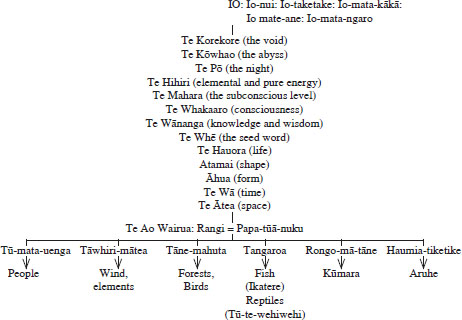
Hauora has become de-contextualised from its etymological origin and has been captured within health and physical wellbeing education curricula. The original intent of being inclusive of Māori knowledge in curricula seems well meaning and self-determining for Māori people, yet simplistic translations of hauora have the effect of subjugating Māori knowledge. It is subjugated in that alternative forms of Māori knowledge are “buried” under official or dominant discourses about hauora. Bourke has said of translation that:
Any claims for authenticity are disabled insofar as appeals to ancestry, metaphysics or agency are based upon terms that can only refer back to the discourse within which they [were] … framed. (Bourke, 1993, p. 28, as cited in McKinley, 2005)
Commonly used words are part of a complex system of language which evolves from history, beliefs, literature and customs. When new words are added, deliberately and in volume, they may lack referents back to their original meaning. Whakapapa can deepen understanding of hauora, yet the idea that various epistemological understandings of hauora have similar meaning and relevance for all seems to be problematic. Epistemological and etymological understandings of hauora may not have a place within the decontextualised vacuum of curricula for all New Zealanders. There is a need to reclaim Māori epistemologies, such as in-depth understanding of the conceptual nature of hauora within curricula. Deeper conceptual understanding of hauora could lead to alternative kinds of educational experiences and outcomes for students, which need to be documented.
Hauora is translated to mean health, wellbeing and health and physical education
The curriculum texts of The New Zealand Curriculum Framework, Te Anga Marautanga o Aotearoa and Hauora i Roto i te Marautanga o Aotearoa, distinguished between hauora as health on the one hand, and whakakaha tinana (physical wellbeing) or akoranga koiri (physical education) on the other. The dual terminology reflects the history and politics of the subject fields of health education and physical education. Health education is a field traditionally referring to the mental, emotional and social aspects of wellbeing, while physical education refers to the bodily and movement aspects of wellbeing (Culpan, 2005). The politics and history of English-medium curricula were transported directly into the Māori-medium curriculum when health was translated as hauora, physical wellbeing as whakakaha tinana and physical education as both akoranga koiri and koiri (Te Tāhuhu o te Mātauranga, 1993).
When these aspects of wellbeing are separated, a Māori notion of hauora as health is altered to be distinct from physical wellbeing. However, in a Māori context, hauora is multifaceted and incorporates the body. The body/mind dichotomy is only an illusion of separation. The body is the central space from which knowing is embedded. Our thinking body cannot be separated from the feeling mind (Shapiro, 1999). The effect of translation is that hauora becomes the health of the mind, emotional and social being, separated from the health of the body, as whakakaha tinana, physical wellbeing. Tensions and contradictions in understandings of hauora are inevitable when translations are fragmented and reinforce a Cartesian mind/body dualism.
Hauora as an underlying concept, “a Māori philosophy of health and wellbeing”
Within HPENZC and the Health and Physical Education essence statement in The New Zealand Curriculum (Ministry of Education, 1999, 2007) hauora is identified as one of the four interdependent underlying concepts. Hauora is:
a Māori philosophy of wellbeing that includes the dimensions of taha wairua, taha hinengaro, taha tinana, and taha whānau, each one influencing and supporting the other. (Ministry of Education, 2007, p. 22)
The dimensions of wellbeing are based on Durie’s Te Whare Tapa Whā model, comparing hauora to a four-sided house. Various writers have commented that the use of the Whare Tapa Whā explanation of human health using Māori terms for physical, mental, social and spiritual wellbeing fails to enrich notions of health and physical education because it does not tap into the unique meanings of the Māori concepts the words represent (Fitzpatrick, 2005; Hokowhitu, 2001; Ross, 2001; Salter, 2000).
Explanations of the Whare Tapa Whā are almost identical to the model of health proposed by Robert Lafaille in his book, Towards a New Science of Health (1993). Rochfield (2004) compares Lafaille’s model of health to the dimensions of the Whare Tapa Whā model, in terms of constituting four main paradigms:
1.biomedical—which equates with taha tinana
2.existential, anthropological or psychosocial—which equates with taha hinengaro
3.culturological or socioeconomic—which equates with taha whānau
4.systemic or environmental, seeing human health as part of the wider web of life, interconnected and interdependent—which equates with taha wairua (p. 47).
Māori cultural conceptualisations of dimensional wellbeing seem to be incongruently juxtaposed with non-Māori thought. Such an approach continues to be problematic in spite of the fact that many New Zealanders celebrated this relationship as an example of bicultural curricula for all New Zealanders (Hokowhitu, 2001; Salter, 2000; Stothart, 2002). The inclusion of Māori words and concepts was seen as a Māori ideal that Māori and Pākehā could embrace equally. However, according to Hokowhitu (2001):
Seizing a few words from Māori informants and/or decontextualising a Māori model so that it conforms to Western constructs, does not mean biculturalism! (p. 131)
Biculturalism can be viewed as the “valuing and learning of two cultures” and assumes that there has been a sharing of power (O’Sullivan, 2003). The relationship between the principal curriculum writers of HPENZC was one in which Māori were only junior partners (Hokowhitu, 2001, 2004). In the initial stages of the HPENZC writing process, Māori informants presented Māori perspectives of health and physical education to the principal writers. However, as the process advanced to the actual writing of a curriculum, Māori involvement ceased (Hokowhitu, 2001, 2004). Power is maintained through definitional control so that ideals cannot ultimately be met:
if we take the notion of control to involve the ‘imposition of meaning,’ when members construct definitions of situations in which the constraints are in part the definition of others then [there will be] discrepancies between ideals and actualities. (Young, 1971, p. 4)
Despite the good intentions of the HPENZC writers, HPENZC is another example of a dominant group defining, describing and essentially taking ownership of another’s culture (Hokowhitu, 2001; Salter, 1998). Under the guise of empowering rhetoric, tikanga Māori (Māori cultural practices) and understandings of hauora were diluted (Hokowhitu, 2001, 2004). The initial objective of producing a bicultural curriculum faded with the literal translations of Māori words, resulting in sanitised representations of Māori knowledge (Hokowhitu, 2001; Salter, 2000). Jones and Jenkins (2007) suggest we need to be informed by a “critical biculturalism”, which goes beyond homogenising impulses and soothing fantasies of unity and equality.
Rather than attempting to understand hauora from a Māori world view, and as a distinct body of knowledge, scholars and curriculum writers attempted to make understandings of hauora match existing academic categories of Eurocentric thought. According to Battiste and Youngblood Henderson (2000), Eurocentric thought demands a universal definition of indigenous knowledge, in contrast to indigenous writers, who do not share the same quest for precision in defining words and terms.
Attempts to be inclusive of Māori knowledge in curricula seem well meaning and self-determining for Māori, yet simplistically comparing hauora to a whare tapa whā model is hegemonic (van Meijl, 1993) and simultaneously subjugates Māori knowledge. It is subjugating in the sense that alternative forms of Māori knowledge are buried under official or dominant discourses about the whare tapa whā. “Structured silences” (Aronowitz & Giroux, 1993) have been created whereby alternative discourses about hauora seem irrelevant within the dominant health and physical education curricula.
On the one hand, the inclusion of conceptual and dimensional understandings of hauora is innovative for health and physical education curricula; on the other hand, it perpetuates the marginalisation of Māori knowledge. The inclusion of Māori words into New Zealand English could be enriching, but to prevent such an inclusion from being counterproductive, distortion of meaning through translation needs to be minimised (Metge, 2010). For example, taha hinengaro is usually translated as mental and emotional wellbeing (Ministry of Education, 1999, p. 31) and lacks a depth of understanding that a more in-depth Māori view could offer. According to Salmond:
All forms of knowledge were stored in the belly (puku), where the various organs of thought and emotion were located; the hinengaro or spleen, where thought, memory and emotions originated; the ngakau or entrails, where thought and feeling were given expression; and the manawa or bowels, where thought and feeling associated with the life force or manawa ora [originated]. (1985, p. 241)
Salmond’s discussion highlights that the physical bodily organs such as the hinengaro (the spleen) have intrinsic qualities, such as thoughts, feelings and emotions. The spleen is the seat of all emotions (Metge, 1985, 2010). This understanding of hinengaro supports the notion that there is no mind/body dualism in Māori ways of knowing; the physical manifests itself in the emotional and the emotional in the physical. The relevance of dimensional wellbeing as it relates to hauora needs to be explored further, and in-depth discussions are needed on how and if deeper understandings can be incorporated appropriately into national curricula.
The use of hauora in curricula inevitably involves a hegemonic struggle over how hauora is defined and whose voices are heard and whose are silenced. Hegemonic struggle involves a dualistic process, whereby groups competing for power attempt to attain cultural dominance: first, by having meanings and practices accepted as “obvious” and “given”, and second, by incorporating and/or marginalising opposing or alternative values and practices. The hegemonic practice of defining hauora as health and physical wellbeing has set a covert agenda with respect to what is culturally reasonable or normal.
The whare as a metaphor for hauora
Tony O’Connor (2007) suggests that the whare tapa whā was chosen as a metaphor for Māori health and wellbeing because the meeting house is an artefact of historical, cultural and social significance. The structure of the house provides an encoded and symbolic history of a hapü (sub-tribe) or iwi (tribe) and of tribal ancestors, as well as being the structure or otherwise symbolic and metaphorical representation of the human body:
Its ridgepole (tāhuhu) is his backbone, a carved representation of his face (koruru) covers the junction of the two barge-boards (maihi) which are his arms, the front window (mataaho) is his eye, and the visitor steps through the door into his poho (chest), enclosed by the rafters (heke) which are his ribs. The central pillar supporting the ridgepole is the poutokomanawa or heart-post. (Metge, 1967, p. 230)
People use metaphor to refer to one domain by using language expressions that are normally associated with another domain (Lakoff & Johnson, 2003). The poutokomanawa is represented within both the whare and the human person. Manawa is simplistically translated as the “heart, breath, emotion, bowels” (Ryan, 1997, p. 144); toko is used as both a prefix and a suffix in the words tautoko (support), tokotoko (a walking stick of support) and toko (the sun’s rays); the pou becomes the “support”, the “sustenance”, “the upright pole” (Ryan, 1997).
Just as the poutokomanawa is the main supporting pole of a whare, so too is my heart, my breath and my emotions. Within the whakataukï (proverbial saying) “He kokonga whare ka kitea, he kokonga ngākau e kore e kitea” (A corner of a house can be seen, not so the corners of the heart), the interrelationship between the whare and the human person is revealed. There is a need to move from viewing Māori language as a standardised technical tool of translation and co-option, to realising that language encompasses and embodies Māori knowledge and even human existence. Through metaphor, new aspects of the world and new ways of understanding reality can surface (Lakoff & Johnson, 2003).
The symbolism of the whare and the natural environment has been interpreted in Charles Royal’s article An Interpretation of the Pöwhiri (2001), where he discusses the Reverend Māori Marsden’s explanation of the whare tüpuna (ancestral meeting house) as a representation of the world. The significance of the whare with the world as a whole can be represented within iwi and hapü pepeha (proverbial sayings):
Ko te whare o Ngā Puhi e tū nei Ko Ranginui töna tuanui Ko Papatuanuku töna paparahi … Pïhanga Tohorā titiro ki Te Ramaroa. | This is the house of Ngā Puhi The sky is the roof And the land is the floor … Pïhanga Tohorā looks to Te Ramaroa. (Royal, 2001, p. 5) |
The image of the house of Ngā Puhi symbolically represents the landscape, with Ranginui (Sky) being the roof and Papa-tüā-nuku (the Earth) being its floor. Various writers have described the whare as the personification of the symbolic construction of the bodily form of our primeval parents, Ranginui and Papa-tüā-nuku, in their nuptial embrace (Ka'ai et al., 2004; Royal, 2001). The reciting of pepeha becomes an outward cultural expression of a view of the world that is contained within Māori creation traditions. The conclusion that Royal (2001) comes to is that in traditional Māori thinking the whare was used to symbolise the world and reality in general. Having come to a conclusion that a whare is analogous to the human person and to the world, it now seems necessary to decipher the key messages within the whare that can contribute to one’s health and wellbeing.
Conclusion
The majority of dominant “hauora” curriculum discourses have failed to examine the sociocultural environment in which the discourse has evolved. Hokowhitu’s analogy of “a chameleon mutating to suit every context” (2001, p. 16) sadly describes “hauora” curriculum policy discourse, which has moved through a series of dominant phases, from assimilation through to integration, to so-called self-determining for Māori-medium curricula. For example, hauora has been defined as health and physical wellbeing, health, wellbeing and health and physical education, and also as the name for the Māori-medium Health and Physical Education curriculum and learning area. By the sheer inclusion of translated Māori words and concepts in curricula, dominant and hegemonic “hauora” discourses are privileged and there is an ongoing failure to recognise a Māori view to any depth.
Lexical and stipulative definitions of Māori words and concepts need to be recaptured and reconceptualised within the contexts from which they have emanated, such as at a hapü, iwi and pan-tribal Māori level, in order to inform national curricula development. If words and concepts such as hauora are to be co-opted to fit within curricula, then there needs to be relevant research and scholarship to support their inclusion in education. De-contextualising and divorcing words from Māori culture and Māori ways of knowing needs to be considered seriously with regard to future Māori-language developments within curricula.
Western thought and frameworks need to be decentralised from outdated (and de-contextualised) meanings of hauora as wellbeing, health and health and physical education/wellbeing. Academic writing and research have the potential to produce counter-narratives to the dominant hegemonic discourse about hauora.
Māori epistemologies and Māori knowledge need to be coherently articulated within health and physical education curricula in order to support in-depth understandings of hauora. There is an assumption that Māori ways of understanding hauora as a concept and as a word can be shared by all New Zealanders, and that the only place for other conceptual understandings of hauora is that which equates to, or does not disrupt, the boundaries of understanding health, wellbeing and te whare tapa whā from a Eurocentric view. Such a sentiment requires a process of re-imaging the importance of localised Māori language and knowledge. By accepting only the knowledge that fits “health”, “wellbeing” and “health and physical wellbeing” discourses, the status quo never changes, power or authority is not contested and extra resources are not required for future so-called “hauora” development.
In this article I have shared understandings of hauora and the whare tapa whā/whare as a metaphor of hauora, yet I understand these views do not encompass all Māori thought. Rather, I have made a brief attempt at reclaiming a space for an otherwise “silenced voice” within curricula. A number of possibilities lie in “understanding what is and what is not—what is missing and what is desired” (Shapiro, 1999, p. 6). As an educator I realise the importance of critical reflection, analysis and refinement in practices and in education, moving beyond ideas to positive possibilities and visioning for schooling practices. Through positive reflection (Freire, 1970), ongoing critique and dialogue, possible tensions and contradictions of understanding hauora can be problematised with a view to finding solutions.
References
Aronowitz, S., & Giroux, H. (1993). Education still under siege. Westport, CT: Bergin & Garvey.
Battiste, M., & Youngblood Henderson, J. (2000). Protecting indigenous knowledge and heritage: A global challenge. Saskatoon, Canada: Purich Publishing.
Best, E. (1976). Māori religion and mythology. Wellington: Government Printer.
Culpan, I. (2005). Physical education: What is it all about? The muddled puzzle. Commissioned paper for the Ministry of Education. Retrieved from http://nzcurriculum.tki.org.nz/Archives/Curriculum-project-archives/Developing-the-draft/Health-and-physical-education/Background-reading
Department of Education. (1984). Review of core curriculum for schools. Wellington: Government Printer.
Durie, M. (1998). Whaiora: Māori health development. Auckland: Oxford University Press.
Durie, M. (2003). Ngā kāhui pou. Wellington: Huia.
Fitzpatrick, K. (2005). Hauora and physical education in New Zealand: Perspectives of Māori and Pasifika students. Waikato Journal of Education, 11(2), 37–48.
Freire, P. (1970). Pedagogy of the oppressed. New York: Seabury.
Goulton, F. (2004). He whatu korowai: Draft report detailing the draft hauora consultation programme and findings for Cathie Bull. Otaki: Horowai Associates.
Health Research Council. (2004). Ngā pou rangahau hauora kia whakapiki ake te hauora Māori. 2004–2008. Retrieved from Māori Development Research Centre: http://www.mdrc.co.nz/product_info.php?cPath=&products_id=374
Heaton, S. (2006). Nā te pupuke te hihiri: Wrestling with Māori and physical education. Unpublished master’s thesis, The University of Auckland.
Hokowhitu, B. (2001). Te mana Māori: Te tātari i ngā körero parau. Unpublished doctoral thesis, University of Otago.
Hokowhitu, B. (2004). Challenges to state physical education: Tikanga Māori physical education curricula, historical deconstruction inclusivism and decolonization. Waikato Journal of Education, 10, 71–84.
Hoskins, T. K. (2001). Kia whai kiko te körero: Constituting discourses at the edge. Unpublished master’s thesis, The University of Auckland.
Jones, A., & Jenkins, K. (2007). Cross-cultural pedagogy in higher education classrooms: Against dialogue. In D. Palfreyman & D. McBride (Eds.), Learning and teaching across cultures in higher education (pp. 133–152). New York: Palgrave Macmillan.
Ka'ai, T., Moorfield, J., Reilly, M., & Mosley, S. (2004). Ki te whaiao: An introduction to Māori culture and society. Auckland: Pearson Education.
Kohere, R. (2003). Te hauora. In B. Ross & L. Burrows (Eds.), It takes two feet: Teaching physical education and health in Aotearoa New Zealand (pp. 21–23). Palmerston North: Dunmore Press.
Lafaille, R. (1993). Towards the foundation of a new science of health: Possibilities, challenges and pitfalls. In R. Lafaille & S. Fulder (Eds.), Towards a new science of health (pp. 1–23). London: Routledge.
Lakoff, G., & Johnson, M. (2003). Metaphors we live by (2nd ed.). Chicago: University of Chicago Press.
Marsden, M. (1988). The natural world and natural resources: Māori value systems and perspectives. Resource Management Law Reform (Vol. 29a). Wellington: Ministry for the Environment.
Marsden, M., & Henare, T. A. (1992). Kaitiakitanga: A definitive introduction to the holistic world view of the Māori. Wellington: Ministry for the Environment.
McKinley, E. (2005). Locating the global: Culture, language and science education for indigenous students. International Journal of Science, 27(2), 227–241.
McMurchy-Pilkington, C. (2008). Indigenous people: Emancipatory possibilities in curriculum development. Canadian Journal of Education, 31(3), 614–638.
Metge, J. (1985). In and out of touch in cross-cultural context. Wellington: Victoria University Press.
Metge, J. (2010). Tuamaka: The challenge of difference in Aotearoa New Zealand. Auckland: Auckland University Press.
Metge, R. (1967). Rautahi: The Maoris of New Zealand. London: Routledge.
Ministry of Education. (1993). The New Zealand curriculum framework. Wellington: Learning Media.
Ministry of Education. (1999). Health and physical education in the New Zealand curriculum. Wellington: Learning Media.
Ministry of Education. (2007). The New Zealand curriculum. Wellington: Learning Media.
Ministry of Health. (2000). New Zealand health strategy. Wellington: Ministry of Health.
O’Connor, T. (2007). New Zealand’s biculturalism and the development of publicly funded rongoa (traditional Māori healing) services sites. Sites: A Journal of Social Anthropology and Cultural Studies, 4(1), 70–94.
O’Sullivan, D. (2003, October). Philosophical foundations of Māori–Crown relations in the twenty first century: Biculturalism or self-determination? Unpublished paper presented at the Australian Political Studies Association conference, Hobart.
Roberts, M., & Wills, P. (1998). Understanding Māori epistemology: A scientific perspective. In H. Wautischer (Ed.), Tribal epistemologies: Essays in the philosophy of anthropology. Aldershot, UK: Ashgate.
Rochfield, T. (2004). Whare tapa whā: A Māori model of a unified theory of health. Journal of Primary Prevention, 25(1), 41–57.
Ross, B. (2001). Visions and phantoms. Journal of Physical Education New Zealand, 34(1), 3–14.
Royal, C. (2001). An interpretation of the pöwhiri. Retrieved 31 October 2011, from http://www.charles-royal.com/assets/powhiri.pdf
Ryan, P. (1997). The Reed dictionary of modern Māori. Auckland: Reed Books.
Salmond, A. (1985). Māori epistemologies. In J. Overing (Ed.), Reason and morality (pp. 240–263). London: Tavistock.
Salmond, A. (1997). Between worlds: Early exchanges between Māori and Europeans 1773–1815. Auckland: Viking.
Salter, G. (1998). Me ako ki ngā tikanga Māori i roto i te reo kori. Journal of Physical Education New Zealand, 31(1), 18–21.
Salter, G. (2000). Marginalising indigenous knowledge in teaching physical education: The sanitising of hauora (wellbeing) in the new HPE curriculum. Journal of Physical Education New Zealand, 33(1), 5–13.
Shapiro, S. (1999). Pedagogy and the politics of the body: A critical praxis. New York: Garland.
Smith, G. (1997). The development of kaupapa Māori: Theory and praxis. Unpublished doctoral thesis, The University of Auckland.
Stothart, R. (2002). A quiet revolution: The story of te reo kori and te ao kori. New Zealand Education Review.
Te Tāhuhu o te Mātauranga. (1993). Te anga marautanga o Aotearoa. Wellington: Learning Media.
Te Tāhuhu o te Mātauranga. (2000). Hauora i roto i te Marautanga o Aotearoa. Wellington: Learning Media.
Te Tāhuhu o te Mātauranga. (2008). Te marautanga o Aotearoa. Wellington: Learning Media.
van Meijl, T. (1993). Maori perspective on health and its politicization. Medical Anthropology, 15(3), 283–297.
Young, M. (Ed.). (1971). Knowledge and control. London: Crowell, Collier, & Macmillan.
The author
Sharyn Heaton was a senior lecturer within Te Puna Wānanga, at the Faculty of Education, The University of Auckland at the time of writing this article. She is now a team leader at the Hamilton Ministry of Education office. She has been committed to Māori-medium education and health and physical education curriculum development for many years, being involved in the te reo kori movement (1987) and more recently in the development of the Hauora exemplars and Hauora professional development (2006). She was the principal investigator for the revision of the Hauora essence statement (2008) and believes that traditional Māori healing practices and Māori ways of knowing are our “gift of indigeneity” that should be shared within curricula.
Email: sharyn.heaton@minedu.govt.nz
Notes
1In the context of Te Marautanga o Aotearoa (Te Tāhuhu o te Mātauranga, 2008), “Māori-medium” refers to classes/kura where teaching occurs in te reo Māori more than 51 percent of the time (referred to as Level 1 and Level 2).
2A parallel document, The New Zealand Curriculum (Ministry of Education, 2007), provides the same function for English-medium schools.
3Paradigm as an “entire constellation of beliefs, values, techniques, and so shared by the members of a given community” (Kuhn, 1970, as cited in Marsden & Henare, 1992, p. 12).