Curriculum design at scale: How developers actually work
Susan McKenney, Jan van den Akker, Ryan Wakamiya, Andreas Beer, Yvonne Zijlstra, and Edlyn Chao
https://doi.org/10.18296/cm.0214
Abstract
Curriculum development is critically important to the educational enterprise, yet we lack insight into if and how ideal design and development practices are enacted in organisations that create curricular programmes and resources intended for large-scale implementation. This study identified essential elements of curriculum-development practices which, together, provide a framework for considering: When is the curriculum good (enough)? What is being made? How is it being made? Why is this important and for whom? The framework is valuable on its own and provided the foundation for a survey to inventory routines and clusters of designers oriented towards large-scale implementation.
Introduction
Curriculum design and development are critically important to the educational enterprise, in all subject matters at all levels. Around the world, large investments are spent on the creation of curriculum programmes and resources that must be able to function effectively in a broad range of circumstances. In part, this is because politicians, educationalists, and communities assume that curriculum quality can always be improved (Abbiss, 2017). Unfortunately, there is little research on how design and development practices are enacted in organisations that create curricular programmes and resources intended for large-scale (national or international) implementation. We do not see large-scale curriculum implementation as simply a matter of being used in more classrooms or schools. Our view of scale aligns well with that of Coburn (2003), who distinguishes the following dimensions: (1) Depth of change; (2) Sustainability of innovation; (3) Spread of reform-related norms and pedagogical principles; and (4) Shift in ownership to the educators who sustain, spread, and deepen reform principles themselves. This study seeks knowledge about characteristics of state-of-the-art strategies and sharper articulation of how designers, and the organisations in which they work, actually tackle the task of curriculum development for use at scale.
Theoretical framework
In this study, the notion of curriculum is treated from an inclusive perspective, with Taba’s (1962) broad definition (“plan for learning”) as a point of departure. In most cases, such plans address the aims, activity, and assessment of learning. Some plans address all of these in alignment with one another, while others specify individual components. As such, the curricula referred to in this study include various plans, ranging from frameworks, syllabi, and core content to (teacher) guides and (support, educative, instructional) materials. As this study focuses on curricula for use at scale, it narrows the discussion to plans created for use by others (e.g., as opposed to the plans that teachers create for themselves).
Curriculum planning takes place across the educational system, with attention to different details at the macro (system/society/nation/state), meso (school/institution), and micro (classroom/learner) levels. Within and across differing levels, the ideas bound together in a curriculum may be manifested through various representations, distinguished by Goodlad et al. (1979) and adapted by van den Akker (2003). The intended curriculum contains both the ideal curriculum (the vision or basic philosophy underlying a curriculum) and the formal/written curriculum (intentions as specified in curriculum documents and/or materials). The implemented curriculum contains both the perceived curriculum (interpretations by users, particularly teachers) and the operational curriculum (as enacted in the classroom). The attained curriculum is comprised of the experiential curriculum (learning experiences from pupil perspective) and the learnt curriculum (resulting learner outcomes).
High-quality curriculum development strives for alignment among curricular components (aims, activity, and assessment of learning), consistency across curriculum levels (micro, meso, macro), and harmony between curricular representations (intended, implemented, attained). Those individuals who undertake such work are referred to in this study as curriculum designers. Designers who focus on curriculum for use at scale are generally found in non-profit organisations, for-profit businesses, (semi-)government institutions, or associations. Non-profit organisations typically pursue the cause for educational improvement without being dictated by market demands. Often, monetary gains generated from the offered products and services can be fully reinvested in the educational cause by such organisations. Examples include Cambridge International, Maker ED, and Achieve. By contrast, for-profit businesses are dedicated to generating profits through their educational enterprises. The products and services that they offer set out to satisfy market demands and ensure customer satisfaction. Examples include Pearson, Kidaptive, and Twinkl. The (semi-) government institutions are either part of their respective national governments or have received the authority from their national governments to formally advise, oversee, and/or implement the executive tasks involved in shaping the nations’ education. For example, this category includes (inter-)national councils and institutes for curriculum development. Finally, associations are characterised by alliances that collaboratively pursue a shared goal towards curriculum improvement. The formed alliances can be on the level of individual members, educational institutions (such as schools), or across nations and governments. Examples include the Higher Learning Commission, the Association for Supervision and Curriculum Development, and the Consortium of Institutions for Development and Research in Education in Europe.
While many factors affect curriculum development, including national standards, assessment systems, and teacher education, two are particularly relevant to the development of curriculum for use at scale. First, the expertise of curriculum designers (and the shared knowledge of the teams in which they work) is crucial (McKenney & Schunn, 2018). This expertise enables them to yield the kinds of products that can influence sense making by teachers and other implementing agents (Aitken, 2006) and thus have lasting impact on teachers and learners (e.g., Pareja Roblin et al., 2018). Secondly, the organisational routines that shape designer (team) activity play powerful roles in enabling or hindering the quality of the work (Bopardikar et al., 2020; Barber, 2015). Organisational routines are repetitive, recognisable patterns of interdependent action, carried out by multiple actors (Feldman & Pentland, 2003). In this study, we note that quality is not only achieved through products alone, but also by the ways in which they are developed and introduced in practice. Differing organisations have their own ways of defining and measuring quality, as well as their own processes and approaches for design and implementation. Therefore, the study investigates naturally occurring conceptualisations and processes of quality assurance, referred to hereafter as robust curriculum development.
Across varied conceptualisations of robust curriculum development, three essential and enduring aspects were articulated in the classic work of Goodlad (1994), who described curriculum in terms of the substantive, technical-professional, and sociopolitical perspectives. For curriculum-development practices to succeed, individual designers and the organisational routines supporting them must attend to each of these perspectives, in light of what an organisation deems to be robust (see Figure 1). This stance forms the theoretical framing for the present study.
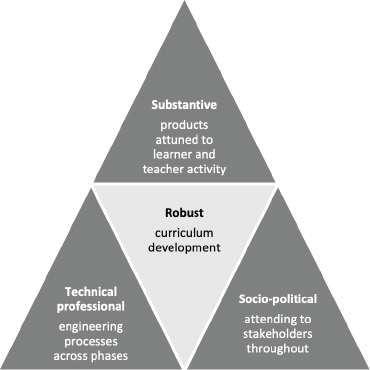
Figure 1. High-quality curriculum development attends to three perspectives
The substantive perspective addresses the major components or “commonplaces” of the curriculum itself such as goals, subject matter, learner activities, and resources for classroom use. It also includes the theory of action underlying a curriculum; for example, of its ability to foster classroom interactions that are emancipatory or contribute to developing new awarenesses (McLean & Hartnett, 2013). To develop these aspects, designers need insights from various disciplines related to the subject matter content at hand, pedagogy, learner perspectives, teacher support needs for implementation, school-leadership practices, and so on. Organisations must support designers by ensuring that design teams have (access to) the various kinds of expertise required to envision, create, and refine high-quality programmes and materials for teaching and learning.
The technical-professional perspective is concerned with methods of the development process itself. Typically starting with a “platform of ideas” (Walker, 1990), these evolve over phases, usually including: analysis; (re)design and development; implementation; evaluation; and monitoring. Designers require sound understanding of these processes to shape them in ways that are optimal for informing their substantive goals. Organisations must support designers by cultivating norms and routines that stimulate designers to adopt practices that help them focus on substantive concerns and mitigate bureaucratic hurdles.
Finally, the sociopolitical perspective refers to the influences exercised by various stakeholders (pupils, parents, teachers, school leaders, policy makers, administrators, etc.). In early stages, designers must be able to anticipate the concerns of stakeholders, test those assumptions, and derive corresponding criteria. For example, given that teachers’ educational beliefs affect the way they perceive and use curricula (Erdem, 2021), it is important for designers to anticipate multiple convictions and consider how to attune their materials accordingly. In later stages, designers must examine if and how (well) they have addressed stakeholder concerns. Throughout all phases of curriculum development, organisations must acknowledge that implementation is not an afterthought, but rather something that warrants consideration and action from the early stages. Robust organisations are able to recognise and help shape stakeholder involvement in ways that are beneficial to the work of the designers.
Aim of the study
This study has been initiated primarily with the goal of understanding state-of-the-art design practices as well as how organisations implement design practices and routines into their curriculum development process. As such, the technical-professional perspective is dominant. However, because they are crucial, we integrate the other two perspectives. From the substantive perspective, we look at the design processes and routines that shape the commonplaces of the curriculum. For example, this entails investigation of how and to what extent designers pay attention to individual components of curriculum, including aims, content, and assessment. Similarly, from the sociopolitical perspective, we look at the design processes and routines that influence (or are influenced by) various stakeholders. This includes aspects of designing for and monitoring implementation in schools, as well as sociopolitical dynamics within the organisations.
Educational researchers study many aspects of deployed curricula. However, few empirical studies have ever been conducted to understand the designer expertise and organisational routines that enable development of educational programmes and curricular resources intended for widespread use. Even more scarce are studies that explore how designers and the organisations in which they work attend to the substantive, technical-professional, and sociopolitical perspectives of curriculum design. As a result, the limited knowledge base of large-scale educational design practices is largely private, housed in the minds of individuals and the cultures of specific institutions; and based more on colloquial wisdom than on empirical findings.
In this study, we focus on the organisational routines and aspects of designer expertise that support curriculum development from each of the aforementioned perspectives, in ways that achieve the dimensions of scale described previously. The overarching goal of the study was to understand how curriculum designers attend to the substantive, technical-professional, and sociopolitical perspectives of curriculum development. To achieve that goal, two main research questions (RQs) were posed:
•RQ1: What are essential elements of curriculum-development practices when designing for use at scale?
•RQ2: How are the essential elements manifested in the work of curriculum developers?
Methods
To answer the research questions, two main data sources were used: literature review and a survey. The literature review aimed to answer RQ1 and provide a basis for understanding characteristics of curriculum development for use at scale. Three literature genres were chosen for this structured review: curriculum theory; curriculum models and principles; and empirical research on curriculum practices. For each of the four areas depicted in Figure 1, a core question was posed to the literature. Synthesis of the findings resulted in a unified framework, which is valuable in its own right, and also served as the basis for developing the survey, which was used to answer RQ2. Both framework and survey featured key elements of how designers define robustness and attend to the substantive, technical-professional, and sociopolitical perspectives.
The survey asked curriculum developers to describe their own practices in order to clarify how the essential elements are manifested in the state-of-the-art work of curriculum developers. After a few general questions about the participant’s experience and area of focus in curriculum development, the survey asked participants to “please consider your most recently completed project” and respond to specific items about development routines and practices undertaken in that work. All questions contained closed answer options, of which seven were multiple-choice and 10 were checkbox selection. Several also allowed unspecified input (i.e., “if other, please explain _____”). These questions examined if and how designers attend to each of the key elements identified from the substantive, technical-professional, and sociopolitical perspectives. The survey is available online at https://dx.doi.org/10.6084/m9.figshare.26799076
The survey was sent to 542 designers who were identified through an internet search, catalysed by the existing networks of the researchers, and snowballing from there. The internet search yielded (websites of) organisations that met the following criteria: (1) designing formal learning environment curricula; (2) for use at scale; (3) with information available in English. This yielded 71 organisations that create curriculum products targeting the micro, meso, or macro levels of which: 21 were non-profit organisations; 24 for-profit businesses; 17 (semi-)government institutions; and nine associations. The organisations are located in 18 different countries (Australia, Belgium, Canada, Finland, England, France, Germany, Hong Kong, India, Ireland, Japan, Netherlands, Norway, Scotland, Singapore, South Korea, United States, and Wales).
Multiple individuals at each organisation were invited to participate in the survey. Participation was voluntary and could be anonymous. Participants who chose to leave their email were sent a summary of the findings as well as a mini-toolkit for inventorying curriculum development practices. (The toolkit is available upon request and enables users to carry out their own focus group on this theme.) In total, 64 responses were received, yielding a response rate of 12%.
The respondents indicated that they had been professionally designing curriculum for an average of 18 years. Their professional activities were most frequently directed at the secondary level (80%), but also substantially at primary level (50%). Furthermore, their curricular products were largely targeted at teachers (86%), followed by learners (58%), and to some extent at educational leaders (28%). The scope of these curricular products mostly encompassed more than one unit/chapter (81%), sometimes single units/chapters (14%), and rarely less than one complete unit/chapter (5%). From the geographic perspective, the primary target group of the curriculum developers was mainly located in one specific country (73%), but it was also not uncommon for the target group to be located across specific countries (14%) or the whole world (13%).
The survey data and analyses were quantitative in nature. First, descriptive statistics were calculated on the items relating to each perspective. Thereafter, hierarchical cluster analysis using Ward’s method of minimised variance was performed to detect co-occurring answer patterns across respondents.
Results
RQ1: Essential elements of curriculum development at scale
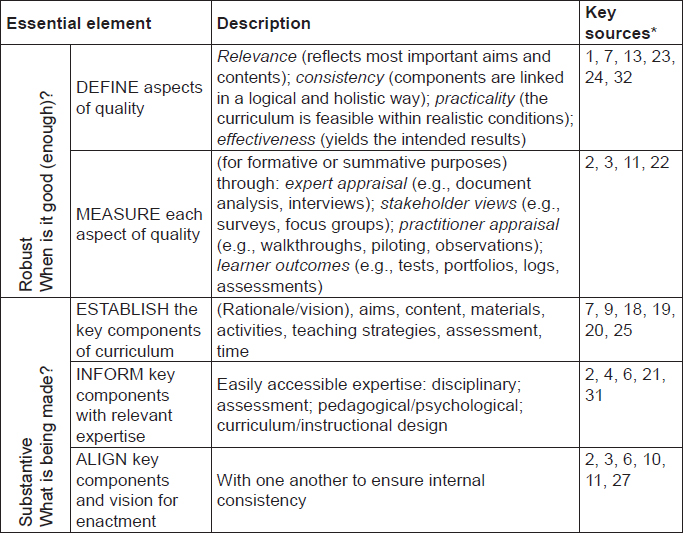
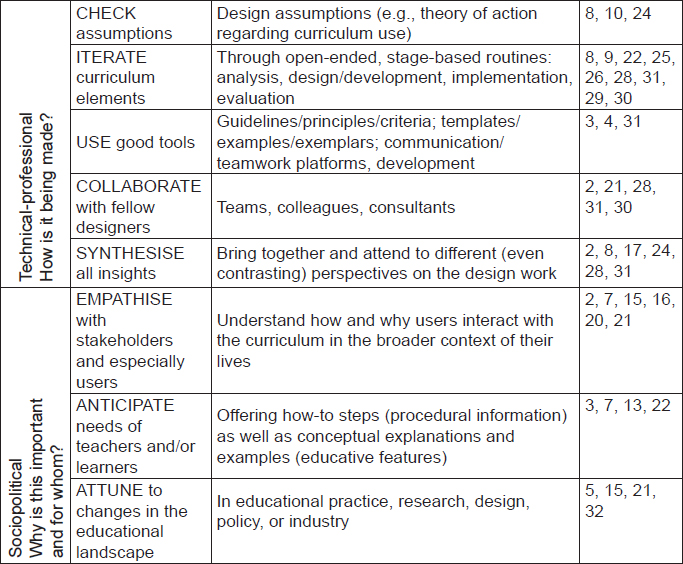
The detailed findings from the literature review have been reported elsewhere (McKenney et al., 2020) and are available upon request. Taken together, the results of the literature review were synthesised into a framework consisting of 13 essential elements. Each element represents actions curriculum designers attend to during the curriculum development process, such as how they “measure aspects of quality” or “collaborate with fellow designers”. Presented in Table 1 and described subsequently, the elements are categorised by the four areas depicted in Figure 1.
The core question for robust curriculum development was “When is it good (enough)?” This area is divided into two elements covering both the definition of aspects of quality and the measurement of aspects of quality. The aspects of quality can be defined in four ways: relevance; consistency; practicality; and effectiveness. Relevance describes the level to which the curriculum reflects the most important aims and contents for students. Consistency describes how the different components of the curriculum are linked together in a logical, coherent, and holistic way. Practicality describes the level to which the curriculum can be feasibly implemented in realistic conditions. Effectiveness describes the level to which the curriculum yields the intended results. Measurement of these aspects can be performed with either a formative or summative purpose and through four main methods. First, expert appraisal can be used especially to review components of the curriculum, through document analysis and interviews with stakeholders. Secondly, stakeholder views and perspectives can be generated through surveys and focus groups. Thirdly, practitioners can provide quality appraisals through pilots, walkthroughs, and observations. Finally, learner outcomes can be examined through testing, artefacts, logs, and other assessments.
From the substantive perspective, the core question is “What is being made?” This area focuses on the product and content of the curriculum. It includes three elements to which curriculum designers attend. In the first element, key components of the curriculum are established. The curriculum components are established at all levels from the macro (e.g., vision, rationale, and aims) to the micro (e.g., materials, activities, time, and assessment). Second, the key components are informed by expertise in areas such as pedagogical, subject matter, instructional design, and assessment. Third, designers align the key components with the established vision for enactment to ensure an internal consistency across the curriculum.
The technical-professional perspective asks the question of “How is it being made?” Five main elements of the technical process of curriculum development were identified. First, designers check their assumptions regarding the curriculum’s implementation and use throughout the design process. Secondly, they iterate upon their designs through open-ended stage-based routines often involving the analysis–design–implementation–evaluation cycle. Thirdly, they use good tools to support their development processes such as guidelines, templates, and communication or teamwork platforms. Fourthly, designers collaborate with fellow designers (e.g., within teams, between colleagues, or with external consultants). Finally, designers synthesise all of the insights from different (even contrasting) perspectives to broadly inform their design work.
The sociopolitical perspective focuses on stakeholders and asks the question “Why is this important and for whom?” From this perspective, designers take three general actions. First, they empathise with stakeholders and pay specific attention to understanding how and the why users interact with the curriculum. Secondly, designers anticipate the needs of teachers and learners to provide support in the form of procedural information or educative features. Thirdly, designers attune themselves to the changes in the educational landscape by maintaining connections to educational practice, research, design, and policy, as well as developments in industry.
Table 1. Essential elements of curriculum development (NB: numbers under key sources correspond to numbered citations listed below this table)
* Key sources in Table 1: 1Aamotsbakken & Knudsen, 2009; 2 Barber, 2015; 3 Bopardikar et al., 2020; 4 Bopardikar et al., 2021; 5 Connelly & Connelly, 2010; 6 Danish, 2014; 7 Davis et al., 2017; 8 Davis et al., 2014; 9 Eisner, 1979; 10 Goodlad et al., 1979; 11 Kanter 2010; 12 Klein, 1991; 13 Loper et al., 2017; 14 Marsh & Willis, 2007; 15 McKenney & Schunn, 2018; 16 Ornstein & Hunkins, 2017; 17 Pinar, 2013; 18 Posner, 2004; 19 Schubert et al., 2002; 20 Schwartz, 2006; 21 Severance at al., 2016; 22 Spronken-Smith et al., 2011; 23 Taba, 1962; 24 Thijs & Van den Akker, 2009; 25 Tyler, 1949; 26 Van den Akker, 2018; 27 Van den Akker, 2003; 28 Visscher-Voerman & Gustafson, 2004; 29 Walker, 1971; 30 Walker, 1982; 31 Walker, 1990; 32 Wong, 2013.
RQ2: How are the essential elements manifested in the work of curriculum developers?
Descriptive statistics
With regard to aspects of curricular quality, the respondents explicitly attended to relevance (91%), practicality (86%), consistency (80%), and effectiveness (75%). The measurement of those aspects was reported to have mostly occurred through expert appraisal (78%), closely followed by practitioner appraisal (73%), and, lastly, stakeholder views (63%) and learner outcomes (63%). These findings are illustrated in Figure 2.
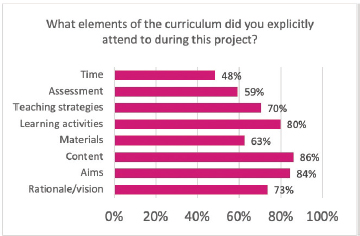
Figure 2. Responses to selected elements of robust curriculum development
Concerning substantive elements of the curriculum attended to, the respondents were able to choose from a list of components in the curriculum identified in the literature review. Content (86%) and aims (84%) were most frequently attended to. Rationale/vision (73%), learning activities (70%), and teaching strategies (70%) also received attention from the majority of respondents. Assessment (59%), materials (63%), and time (48%) were the least frequently attended to elements. Furthermore, the alignment between the components of curriculum was checked by nearly all respondents. While the greater part of respondents did so in a formal way (67%), a smaller proportion checked alignment in an informal way (30%). The remainder expected the alignment to occur naturally (3%). When asked about which sort of expertise was available, almost all respondents reported disciplinary/subject-matter expertise (94%). Curriculum/instructional design expertise (78%) and pedagogical/psychological expertise (75%) were also available for the greater bulk of respondents. In contrast, assessment expertise (48%) was only available for slightly more than half of the curriculum developers. A quarter of respondents reported availability of other expertise (25%), such as “technology integration”, “game design”, “students’ cultural background”, or “digital tool designers”. These frequencies are visualised in Figure 3.
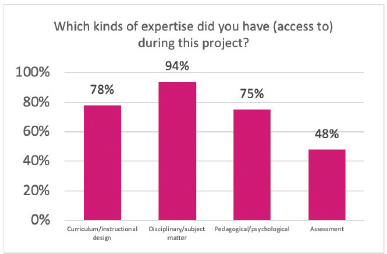
Figure 3. Selected substantive elements
From a technical-professional perspective, the survey first asked respondents if and how they check curriculum design assumptions. While the great majority of respondents either checked design assumptions in a formal way (45%) or in an informal way (43%), a smaller fraction expected this to occur naturally (9%). A few reported that checking assumptions was not their responsibility (3%). When asked how much the curriculum project was allowed to adapt during the design process, more than half answered lots (58%), less than half answered some (41%), and barely any respondent answered with minimally (2%). The most frequently reported tools used for design consisted of guidelines/principles/criteria (84%), followed by templates/examples/exemplars (72%), and communication/teamwork platforms (69%), and at last development/prototyping software (25%). For the additional option (“Other, namely …), 25% wrote in their own items. Examples of other tools included “organized cooperation between project groups”, “national standards from many sources”, “Geometizer” (a digital tool that transforms images into shapes), and “flow chart software”. With regards to collaborative activities, the majority of respondents reported to have mostly worked on a design team (75%), while a little more than a quarter reported to have worked mostly alone with access to additional expertise (22%). A very small remaining fraction worked just mostly alone (3%). Respondents addressed different, possibly contrasting, perspectives during their design work either in a formal (39%) or informal way (41%). Few respondents expected contrasting perspectives to be addressed naturally (13%), or that this task was not viewed to be their responsibility (8%). The pie charts in Figure 4 display the selected elements from this perspective.
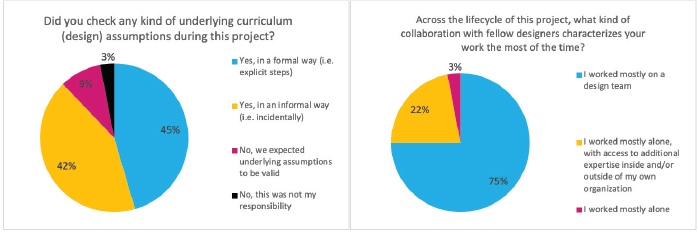
Figure 4. Selected technical-professional elements
Survey items related to the sociopolitical perspective asked about the steps taken to develop understanding of the primary users. The majority responded to have used formal data collection (72%) and/or informal face-to-face interactions (70%). About half of the respondents also relied on previous experience (48%) and/or articulation of user scenarios/profiles (45%). The user needs that were explicitly addressed mostly consisted of conceptual explanations or examples for teachers (75%) and how-to steps for teachers (61%). Respondents addressed learners less explicitly with conceptual explanations or examples for learners (61%), and how-to steps for learners (58%) being indicated slightly above half of the time. A smaller fraction noted other user needs (11%), such as “training, coaching, introducing new perspectives”, “integrating scaffolding into gameplay”, or “specific needs identified from formative assessment”. When questioned on which spheres influenced respondents’ understanding of curriculum design, practitioners/schools (91%) and research (88%) predominantly stood out in their frequency, compared to policy (50%), design (45%), and industry (23%). These findings are visualised in Figure 5.
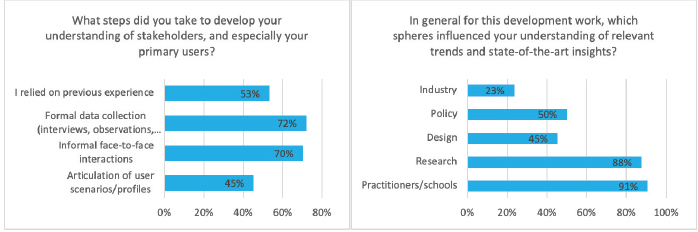
Figure 5. Selected sociopolitical elements
Cluster analysis
In addition to analysing the frequencies of the curriculum developer responses to the survey items, hierarchical cluster analysis was performed to detect co-occurring answer patterns across respondents. Cluster analysis groups answer items together that shared the most similar response patterns across designers; in this study, Ward’s method of minimised variance was used.
The cluster analysis revealed two main groups of respondents—one to which 12 respondents belonged, and one to which 45 respondents belonged. The first cluster (n = 12) could be referred to as the casual singleton. Respondents in this cluster did not indicate using formal methods for: checking alignment of curriculum components; checking assumptions; or addressing different perspectives on the design work. They work either fully alone or alone but with access to additional expertise. They characterised their openness to adaptation as either some or minimal, but not lots. They use development/prototyping software, as well as other kinds of tools. Further, this group of respondents indicated that industry was a sphere of influence for them.
The second cluster (n = 45) might be referred to as the systematic teammate. Respondents in this cluster indicated the use of formal or specific methods to measure quality, check alignment of curriculum components, check assumptions, address differing perspectives on the design work, and to develop understanding of stakeholders. They indicated that they work in teams. Generally, they attend explicitly to all four aspects of quality as well as all of the curriculum components. They allow their work on projects to adapt a lot, once it is started. They indicate having access to various forms of expertise during development and use support tools in the forms of guidelines/principles/criteria as well as templates/exemplars. These respondents tend to be comprehensive in addressing user needs, paying attention to teacher how-to steps and conceptual explanations for teachers, as well as how-to steps and conceptual explanations for learners. Figure 6 presents the clusters in light of specific survey items.
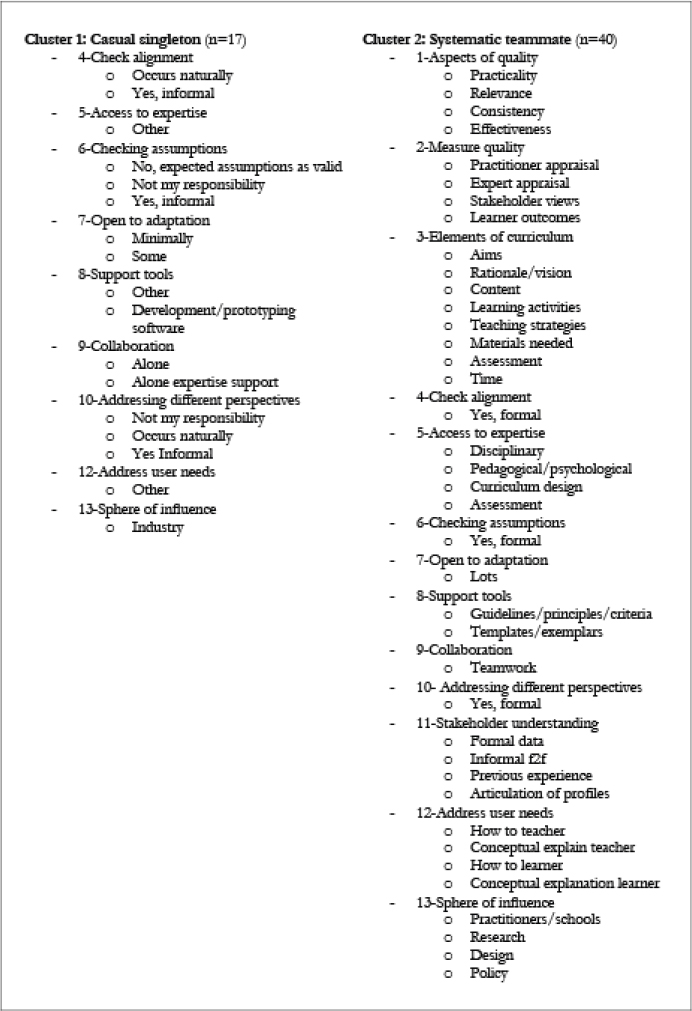
Figure 6. Cluster comparison (numbers correspond to questions on survey)
Conclusion
This study set out to identify essential elements of curriculum-development practices when designing for use at scale, and to investigate how those elements are manifested in the work of curriculum developers today. Literature review revealed 13 practices related to four domains: robustness (how quality is defined and how aspects of quality are measured); substance (how curriculum components were established, aligned, and what expertise was used during the process); technical-professional processes (how designers monitored, iterated, and collaborated with others while creating curricula); and sociopolitical considerations (how designers worked to understand the needs of their users and the wider context). Taken together, these findings formed the foundation for a survey, which was completed by 83 curriculum developers working at scale. Patterns in responses were identified, and hierarchical cluster analysis revealed two main groups of curriculum developers, one of which is described as the casual singleton and the other of which could be referred to as the systematic teammate.
Reflections and recommendations
The four areas of the framework resulting from this study can be compared to findings described previously (Samu, 2016), namely: time; relevance; structure; and innovation. For example, our sociopolitical considerations, together with the need to check assumptions (techno-professional), align with Samu’s sense of time. Both frameworks devote attention to relevance, including understanding how designers conceptualise and address diversity and difference. The substantive area aligns with Samu’s concept of structure, and anticipating and attuning to needs of teachers and learners (sociopolitical) is how the present framework supports innovation.
Results from the survey among curriculum designers revealed the reassuring finding that designers take their work seriously, as respondents reported explicitly attending to all aspects of quality (relevance, consistency, practicality, effectiveness) and using a healthy mix of ways to measure these, particularly expert and practitioner appraisal. However, with an average of 16 years of experience professionally designing curriculum among respondents, it raises the question to what extent this finding would be shared among designers with less experience. Future research could explore experience-based differences to possibly inform the onboarding of novice curriculum designers.
It was anticipated that designers would attend to curriculum components (substantive elements) such as content, aims, rationale/vision, and learning activities. However, the fact that only 48% reported explicitly attending to time seems surprising, especially given well-known concerns about mitigating curriculum overload for practitioners. Further, designer reports concerning access to assessment expertise seems comparatively low (48%), relative to access to other types of expertise (e.g., disciplinary/subject-matter, curriculum/instructional design, pedagogical/psychological). While non-disturbing explanations seem possible (e.g., that designers had access to various types of expertise but only if requested explicitly), this finding does give pause to consider if unavailability of assessment expertise could threaten curriculum alignment.
The majority of designers reported mostly working in design teams (75%). This is important because teamwork has shown to be crucial to the success of curriculum design teams, as contributions from one teammate shape the work of others, and thereby co-ordinating diverse inputs to yield coherent educative materials (Bopardikar et al., 2021). As this study did not inventory this aspect in greater detail, future research might investigate which forms of teamwork are the most productive in terms of contributing to curriculum designers’ (self-) efficacy. Further, results indicated that, to understand their stakeholders, designers used both formal (72%) and informal (70%) interactions frequently. Yet, surprisingly, user scenarios/profiles were not often employed (45%). This seems surprising, given the wealth of literature on the benefits of user-centred design. Further research is needed to understand why this is the case and if it is problematic.
Finally, cluster analysis of the survey results revealed two main groups of respondents, based on how designers typically develop curricula. The casual singleton elicits associations with the artistic rationality (Eisner, 1979) which was also observed as a pattern among educational designers two decades ago (Visscher-Voerman & Gustafson, 2004). By contrast, the systematic teammate aligns somewhat with rational (Tyler, 1949) and deliberative (Walker, 1990) approaches. While both groups emerged from the data, the latter was more than twice as prevalent. This could be explained by the fact that instrumental approaches have historically dominated the literature on curriculum and instructional design processes (Visscher-Voerman & Gustafson, 2004).
Significance of the study
Around the world, large sums of time, money, and energy are invested in curriculum development each year in the hope of yielding productive outcomes for educational practice. To a great extent, the degree to which these benefits are realised can be powerfully mediated by the designers who create them. Thus, strengthening and broadening the impact of curriculum development on educational practice inherently requires attending to the needs of curriculum designers. This study has identified characteristics of robust curriculum-development practices and routines of designers oriented towards large-scale implementation. Concretely, it yielded a framework that can be used by curriculum developers to reflect on their own processes. It also described the state of the art when it comes to authentic curriculum-development routines and practices of designers oriented towards large-scale implementation. Together, this study has taken modest but concrete steps towards peeling back the curtain of curriculum development to help understand how professional curriculum designers actually work. As such, these findings contribute to continued scholarship on how to support robust and successful curriculum-development practices at scale.
Acknowledgements
The work reported in this article was made possible with a grant from the International Baccalaureate Association. All activities were conducted with the ethical guidelines of the institution leading the study, the University of Twente.
References
Aamotsbakken, B., & Knudsen, S. V. (2009). The design of the reader in educational settings. Designs for Learning, 2(1), 22–35. https://doi.org/10.16993/dfl.17
Abbiss, J. (2017). Curriculum developments: Looking back, looking forward. Curriculum Matters, 13, 1–7. https://doi.org/10.18296/cm.0017
Aitken, G. (2006). Signalling shifts in meaning: The experience of social studies curriculum design. Curriculum Matters, 2(1), 6–25. https://doi.org/10.18296/cm.0078
Barber, J. (2015) How to design for breakthrough. Educational Designer, 2(8). http://www.educationaldesigner.org/ed/volume2/issue8/article29/
Bopardikar, A., Bernstein, D., Drayton, B., & McKenney, S. (2020). Work-based curriculum to broaden learners’ participation in science: Insights for designers. Research in Science Education, 50, 1251–1279. https://doi.org/10.1007/s11165-018-9731-x
Bopardikar, A., Bernstein, D., Drayton, B., & McKenney, S. (2021). Designing educative curriculum materials in interdisciplinary teams: Designer processes and contributions. Instructional Science, 49(2), 249–286. https://doi.org/10.1007/s11251-021-09538-5
Coburn, C. (2003). Rethinking scale: Moving beyond numbers to deep and lasting change. Educational Researcher, 32(6), 3–12. https://doi.org/10.3102/0013189X032006003
Connelly, F. M., & Connelly, G. (2010). Curriculum policy. In C. Kridel (Ed.), Encyclopedia of curriculum studies (pp. 224–227). SAGE Publications.
Danish, J. A. (2014). Applying an activity theory lens to designing instruction for learning about the structure, behavior, and function of a honeybee system. Journal of the Learning Sciences, 23(2), 100–148. https://doi.org/10.1080/10508406.2013.856794
Davis, E., Palincsar A. S., Arias, A. M., Bismack, A. S., Marulis, L., & Iwashyna, S. (2014). Designing educative curriculum materials: A theoretically and empirically driven process. Harvard Educational Review, 84(1), 24–52. https://doi.org/10.17763/haer.84.1.g48488u230616264
Davis, E. A., Palincsar, A. S., Smith, P. S., Arias, A. M., & Kademian, S. M. (2017). Educative curriculum materials: Uptake, impact, and implications for research and design. Educational Researcher, 46(6), 293–304. https://doi.org/10.3102/0013189X17727502
Eisner, E. (1979). The educational imagination. Macmillan.
Erdem, C. (2021). Testing the relationships between teachers’ curriculum design orientations and their underlying educational philosophies. Curriculum Matters, 17(1), 83–104. https://doi.org/10.18296/cm.0054
Feldman, M. S., & Pentland, B. T. (2003). Reconceptualizing organizational routines as a source of flexibility and change. Administrative Science Quarterly, 48(1), 94–118. https://doi.org/10.2307/3556620
Goodlad, J. (1994). Curriculum as a field of study. In T. Husén & T. Postlethwaite (Eds.), The international encyclopedia of education (pp. 1262–1267). Pergamon Press.
Goodlad, J., Klein, M., & Tye, K. (1979). The domains of curriculum and their study. In J. Goodlad & Associates (Eds.), Curriculum inquiry: The study of curriculum practice (pp. 43–76). McGraw-Hill.
Kanter, D. E. (2010). Doing the project and learning the content: Designing project-based science curricula for meaningful understanding. Science Education, 94, 525–551. https://doi.org/10.1002/sce.20381
Klein, F. (1991). A conceptual framework for curriculum decision making. In F. Klein (Ed.), The politics of curriculum decision making: Issues in centralizing the curriculum (pp. 24–41). State University of New York Press.
Loper, S., McNeill, K. L., & González-Howard, M. (2017). Multimedia educative curriculum materials (MECMs): Teachers’ choices in using MECMs designed to support scientific argumentation, Journal of Science Teacher Education, 28(1), 36–56. https://doi.org/10.1080/1046560X.2016.1277600
Marsh, C. J., & Willis, G. (2007). Curriculum: Alternative approaches, ongoing issues. Pearson.
McKenney, S., & Schunn, C. D. (2018). How can educational research support practice at scale? Attending to educational designer needs. British Educational Research Journal, 44(6), 1084–1100. https://doi.org/10.1002/berj.3480
McKenney, S., van den Akker, J., Wakamiya, R., Beer, A., Zijlstra, Y., & Chao, E. (2020). Curriculum development practices: Inventory, review & benchmarking. Final report to the International Baccalaureate Organisation. University of Twente.
McLean, M., & Hartnett, F. (2013). Challenging hegemonic understandings in compulsory risk management and rehabilitation of intellectually disabled offenders through curriculum design. Curriculum Matters, 9, 156–174. https://doi.org/10.18296/cm.0159
Ornstein, A. C., & Hunkins, F. P. (2017). Curriculum: Foundations, principles, and issues (7th ed.). Pearson Education.
Pareja Roblin, N., Schunn, C., & McKenney, S. (2018). What are critical features of science curriculum materials that impact student and teacher outcomes? Science Education, 102, 260–282. https://doi.org/10.1002/sce.21328
Pinar, W. F. (2013). International handbook of curriculum research (2nd ed.). Routledge. https://doi.org/10.4324/9780203831694
Posner, G. (2004). Analyzing the curriculum. McGraw-Hill.
Samu, T. (2016). Intrepid journeys in social studies curriculum development: Critical reflections and insights of a New Zealand educator. Curriculum Matters, 12, 132–153.
Schubert, W., Lopez Schubert, A., Thomas, T., & Carroll, W. (2002). Curriculum books: The first hundred years. Peter Lang.
Schwartz, M. (2006). For whom do we write the curriculum? Journal of Curriculum Studies, 38(4), 449–457. https://doi.org/10.1080/00220270500296606
Severance, S., Penuel, W. R., Sumner, T., & Leary, H. (2016). Organizing for teacher agency in curricular co-design. Journal of the Learning Sciences, 25(4), 531–564. https://doi.org/10.1080/10508406.2016.1207541
Spronken-Smith, R., Walker, R., Dickinson, K., Closs, G., Lord, J., & Harland, T. (2011). Redesigning a curriculum for inquiry: An ecology case study. Instructional Science, 39(5), 721–735. https://doi.org/10.1007/s11251-010-9150-5
Taba, H. (1962). Curriculum development: Theory and practice. Harcourt, Brace & World.
Thijs, A., & Van den Akker, J. (Eds.). (2009). Curriculum in development. Netherlands Institute for Curriculum Development (SLO).
Tyler, R. (1949). Basic principles of curriculum and instruction. University of Chicago Press.
van den Akker, J. (2003). Curriculum perspectives: An introduction. In J. van den Akker, U. Hameyer, & W. Kuiper (Eds.), Curriculum landscapes and trends (pp. 1–10). Kluwer Academic Publishers.
van den Akker, J. (2018). Developing curriculum frameworks: A comparative analysis. National Council for Curriculum and Assessment (NCAA).
Visscher-Voerman, I., & Gustafson, K. L. (2004). Paradigms in the theory and practice of education and training design. Educational Technology Research & Development, 52(2), 69–89.
Walker, D. (1971). A naturalistic model for curriculum development. The School Review, 80(1), 51–65.
Walker, D. (1982). Curriculum theory is many things to many people. Theory into Practice, 21(1), 62–65.
Walker, D. (1990). Fundamentals of curriculum. Harcourt, Brace, Jovanovich Publishers.
Wong, M. (2013). Developing integrated arts curriculum. Curriculum Inquiry, 43, 210–232. https://doi.org/10.1111/curi.12011
The authors
Susan McKenney (corresponding author) is professor of teacher professionalization, school development and educational technology at the University of Twente in the Netherlands.
Email: susan.mckenney@utwente.nl
Jan van den Akker is the director and owner of Curriculum Research and Consultancy in the Netherlands.
Email: jjhvda@gmail.com
Ryan Wakamiya is learner engagement coordinator at the University of Twente in the Netherlands.
Email: r.t.wakamiya@utwente.nl
Andreas Beer is an e-learning freelancer and former student of the Master of Science programme in Educational Science and Technology at the University of Twente in the Netherlands.
Email: a.beer2bn@googlemail.com
Yvonne Zijlstra is junior researcher at the Talent Development in Higher Education and Society research group at Hanze University of Applied Sciences.
Email: y.zijlstra@pl.hanze.nl
Edlyn Chao is senior curriculum manager at the International Baccalaureate Organisation.
Email: edlyn.chao@ibo.org