Disturbing history’s identity in the New Zealand curriculum to free up historical thinking
Philippa Hunter
Abstract
This paper conceives history in the New Zealand curriculum as a curriculum problem. In exposing this problem, history’s identity is thrown into question. I outline a motif of disturbance in light of my professional experiences of history curriculum and assessment policy shifts (1990s to 2010). From a critical pedagogy stance, I conceive the national curriculum’s events-based orientation to history as traditional and played out in pedagogy as exclusive cultural reproduction. From a critical pedagogy stance, I consider a counter approach to history curriculum that engages teacher agency and frees up possibilities for students’ historical thinking.
Introduction
This paper critiques the reclaiming of a traditional orientation of history in the New Zealand curriculum, and seeks to make sense of history’s curriculum identity for pedagogy in 2011. As a socially constructed curriculum subject, history’s identity reflects a cultural memory and prevailing discourses about what constitutes history in secondary schooling. In my view, a traditional history discourse has been reclaimed through two decades of educational reforms (1989–2011) and trickle-down policy mechanisms that embed social efficiency discourses. The language and controls of standards and compliances appear to have “re-regulated” (Ball, 2003) history teachers’ work and history’s curriculum identity. These values are embedded in curriculum and assessment standards and preferred knowledge and skills. They are also played out in pedagogy.
The notion of history’s identity is broadly conceived through the paper as: the representation of a curriculum construct; a focus for conceptual understanding; claims to knowledge and meaning making; and perceptions and expectations of history in a national curriculum. History’s curriculum identity need not be an abstract shaping that sits distanced from the society we live in. The history curriculum must be open to disturbance and critique of its nature and purpose for the education of young adults in New Zealand in 2011 and beyond.
The paper opens with glimpses of my engagement with history curriculum as a teacher educator and the professional disturbance that I negotiate in my history practitioner and research roles. I then locate my professional identities in contexts of history curriculum policy initiatives over two decades of New Zealand educational reforms, and reflect on an increasing sense of curriculum disturbance from a critical pedagogy stance. This supports a focus on identifying traditional/conservative and alternative/counter history orientations and unpacking “official history” in the revised New Zealand curriculum (The New Zealand Curriculum or NZC, Ministry of Education, 2007). History as cultural reproduction in the Social Sciences learning area in NZC curriculum policy is briefly discussed. The last section presents an alternative/counter orientation to history that opens up possibilities for historical thinking as a point of departure for professional conversations and pedagogy beyond prevailing curriculum conceptions of history’s identity.
Disturbance in the history curriculum
I call back voices from recent experiences of history curriculum contexts and conversations (2008–10) to reveal something of the personal and professional disturbance I mediate in my work as a teacher educator:
I just want it to be nice, Pip. I haven’t studied history like this ...!
—Sussi, a history graduate, expressing her dismay at engaging with concepts of racism. My history curriculum class was exploring how history students in Year 13 might interpret Parliamentary debates in the context of 19th century New Zealand immigration as representations of dominant cultural beliefs of racial superiority.
She lacks just about everything in her teaching. She doesn’t know anything about history!
—Mike, an associate teacher, casting judgement on his student, Jana, during a school practicum visit I made to evaluate Jana’s history pedagogy. Jana, a beginning history teacher, had a recent master’s degree in history and politics.
Come on, Pip, history’s an intellectual subject—family history is not!
—Sam, an experienced history teacher, was responding to my thoughts about ways students’ historical knowledge might be used in the wider society of which they are a part. The setting for this was a curriculum hui where history research findings were disseminated.
There’s no such thing as social history any more—that women’s health topic is not taught any longer in NCEA history … What was that all about?
And what’s the story with that identity standard? What does this identity **** have to do with history? It’s good to see that it is being removed from the proposed standards.
—Mel and Lindsay, as experienced heads of history departments, expressing forceful views at a consultation meeting on the revision of the National Certificate of Educational Achievement (NCEA) history achievement standards (New Zealand Qualifications Authority, n.d.).
Most people are put off Aotearoa/New Zealand history topics after doing it at school …
—A Year 13 student reflecting on history’s links to identity, culture and heritage.1
The voices I have recalled present insights into teachers’ and students’ conceptions of history, and history’s identity in the national curriculum. Sussi’s plea for history to be “nice” reflects an avoidance of controversial or contested aspects of history. This brings to mind the powerful processes of reproducing the culture of school history. Research findings in New Zealand (Hunter & Farthing, 2004) suggest that despite experiencing a variety of historical contexts and approaches at university, teachers readily assimilate into the culture, traditions and contextual preferences of school history. For many teachers, this means returning to familiar, fixed and uncontested history, maintained by curriculum documentation and history discourses (the way the language, values and practices of history are communicated). Mike, an associate history teacher, expressed his frustration with Jana’s lack of knowledge of the contexts in the history curriculum. Yet Jana had achieved a recent master’s degree in history. Mike’s certitude about Jana’s (lack of) historical knowledge came from his experience of the history curriculum, his knowledge of policy requirements and his professional validation as a school leader. However, his judgement left no room for trust or respect of the historical thinking of Jana as a beginning teacher.
Sam’s belief that family history is neither intellectual nor “real history” reflects a dominant traditional discourse that identifies history as an intellectual and elevated subject in the curriculum. This serves to maintain values around history’s supposed scholarly cultural capital in the New Zealand curriculum. Hence, customary contextual preferences tend to be reproduced. However, cracks are revealed in Sam’s argument when the idea of “intellectual” is applied only to “sacred” (Waters, 2007) and revered history contexts and substantive knowledge production, and not to the processes or representation of history. Contexts characterised as social history are often dismissed as threatening history’s integrity as a subject. This is evident in Mel and Lindsay’s dismissive comments about a social history, and the place of understandings about identity in a history curriculum. As heads of history departments in their schools’ social sciences faculties, their beliefs serve to marginalise alternative historical approaches. As a consequence, professional conversations are silenced. Teachers’ beliefs about history’s curriculum identity have powerful agency, and they inevitably shape how students receive history pedagogy and historical thinking. The Year 13 student’s disturbing impression of New Zealand history contexts indicates something of this agency.
Locating professional identities in the policy shaping of history curriculum
Next, I discuss my professional involvement with some of the educational policy that has shaped history’s identity in the New Zealand curriculum. This is because curriculum policy shifts have influenced history’s curriculum identity and in turn shaped my identity as a history teacher educator. In this sense I am signalling the curriculum as a socio-historical context in which I work. The 1989 Education Act and amendments, and related policy shifts, reshaped school history assessment and consumed my professional work and interest. Between 1994 and 1997, I was involved in the writing and development (Hunter & Keown, 2001; Mutch, 2003) of Social Studies in the New Zealand Curriculum (Ministry of Education, 1997). I was particularly interested in the ways historical thinking through all schooling years might complement and enhance the History Forms 5 to 7 Syllabus for Schools (Ministry of Education, 1989) and accompanying examination prescriptions (Department of Education, 1987, 1988). Between 1997 and 2006, I assumed the roles of Chief Examiner of the New Zealand Qualifications Authority’s (NZQA’s) penultimate University Entrance, Bursary and Scholarship history examinations (1997–2000) and Moderator of the final examinations (2001–3). Alongside these norm-referenced processes, I was a panel writer for NZQA’s developments of history assessment through Unit Standards (1994–9), NCEA Achievement Standards (1999–2003) and the New Zealand History Scholarship Standard (2002–3). Regional moderation of teachers’ history assessment decisions and teacher professional development of unit and achievement standards assessments involved leading history teachers in standards interpretation and programming.
Involvement in history assessment shifts proved helpful for my history work in teacher education. I view this intensive phase of professional work with national curriculum and assessment policy as performativity (Ball, 2003). This means I enthusiastically embraced shifts towards curriculum objectives and standards because of a sense of professional validation and the belief that the history curriculum might be enhanced by policy reform processes. In retrospect I was naïve in imagining that alternative approaches and contexts for historical thinking might be possible through national examinations and assessment initiatives. Stephen Ball has noted how educational change impacts on self-identity: “… the … reform … does not simply change what people, as educators, scholars and researchers do, it changes who they are” (Ball, 2003, as cited in Jesson, 2008, p. 70). This applies to my experiences of history and social sciences policy initiatives.
By 2004, I had become increasingly resistant to the ways history’s curriculum identity was being constructed. Working with preservice history teachers to make sense of disconnected curriculum and assessment policies had become a disheartening process. The absence of a researched position of history’s place or purpose in the New Zealand curriculum, and the seeming policy avoidance of developing a senior school history curriculum, proved disturbing. I became resistant to ways a narrow interpretation of the revised NCEA history achievement standards was shaping a peculiar form of school history. A default standards-based history curriculum sanctioned by policy-framing discourses of social efficiency had fused itself onto the flimsy infrastructure of the prescriptive remnants and contexts of the 1989 history syllabus. This operated to hold a traditional form of history curriculum captive.
Social efficiency curriculum discourses reflect outcomes-based educational cultures, systems of monitoring and surveillance, and “accountability regimes” (Codd, 1999). In social efficiency discourses, curriculum knowledge is envisioned as “capability for action” as sourced in normative objective reality (Schiro, 2008, pp. 176–177). Learning needs are converted into purposes and objectives (Schubert, 2003). This changes school management and professional practice, evidenced, for example, as teacher effectiveness initiatives.
History education scholars Kelly, Meuwissen and Vansledright (2007) have expressed alarm about the future of school history within their American systems of standards and accountability. They question discourses of social efficiency that frame history curriculum: “… how do existing history standards and formal curricula officialize certain orientations toward historical knowledge and traditions through which that knowledge is taught?” (p. 117). From a critical pedagogy stance, it is my view that this question must also be asked of New Zealand’s “official” history curriculum.
My critical pedagogy stance is a professional response of disturbance to discourses of social efficiency, curriculum and assessment alignment tensions, and the reclaiming of a traditional orientation to history in the revised NZC. I draw on postmodern and feminist perspectives to inform my thinking about social sciences and history in the national curriculum. This involves critiquing the power of culture, class and gender differences and their influence on educational outcomes. Critical pedagogy embraces a complexity of multiple competing perceptions of social reality and calls truth claims into question (Giroux, 1991, 1995; Hinchey, 2004; Janesick, 2003; Kincheloe, 2004; Lather, 1991). A critical pedagogy orientation acknowledges the political nature of curriculum. It questions ways power operates to produce “various representations, images, and signs, and the capacity to illustrate the complex ways … these images and signs affect individuals located at various race, class and gender coordinates in the web of social reality” (Kincheloe, 2004, p. 14). A critical pedagogy views knowledge as produced within particular conceptual frameworks such as a history curriculum. Whilst constructive, and valuing of the dignity of teachers and students, critical pedagogy asks teachers to understand their own assumptions and privilege. It demands we question why we do the things we do in our classrooms, and problematise the work we do. So, how might we identify history in the national secondary school curriculum?
History orientations and official history in the revised New Zealand curriculum
School history is a form of historical inquiry that maintains a distinct identity with a culture, traditions, values and discourses in practice. Neither professional nor popular history, its key distinction lies in its curriculum and pedagogic contexts, including assessment. When researching history teachers’ perceptions of history in the curriculum (Hunter & Farthing, 2004), the Welsh history educator Rob Phillips’ reflexive approach to history education (2002) influenced my understandings of history’s multiple identities. Phillips drew on the British historian Keith Jenkins’ postmodern assertion that there is no single conception of history, rather that a “cultural multiplicity and pluralism” of histories exists to offer democratic opportunities (Phillips, 2002, p. 142). Therefore, school history—also referred to as curriculum history—is just one of many contested histories that embed traditions, identities and values. The professional socialisation (Eisner, 2008) of policy makers, curriculum developers and teachers informs educational envisioning, values and beliefs about what should constitute a history curriculum for New Zealand’s young citizens. These conceptions become framed as curriculum and assessment policy—the intended history curriculum. In turn, policy conceptions of history are interpreted and co-constructed by teachers in light of their discourse positioning and claims to knowledge. This shapes historical consciousness, classroom pedagogy and students’ thinking. In seeking to understand New Zealand’s history curriculum identity in 2011, we need to ask questions about the nature and purpose of history in the school curriculum and whose history should count.
Next I juxtapose features of a traditional/conservative orientation to history curriculum with features of an alternative/counter orientation to history curriculum. In this paper, I conceive the intended and enacted national history curriculum as a traditional orientation. The alternative/counter orientation is one of possibility. This is informed by my recent PhD theorising of history, my resistance to reductive policy shaping of the history curriculum and professional work with preservice history teachers.
A traditional/conservative orientation to history curriculum focuses on, for example:
•identification of significant events
•cultural reproduction by policy sanction
•progress and development of powerful political systems
•seeking an objective verifiable truth
•attempting to reconstruct a certain past
•deterministic and teleological approaches (Amirell, 2009)
•narratives of “sacred” national identities (Waters, 2007)
•exclusive citizenship identity
•avoidance of gendered and cultural historical experiences “outside” dominant and powerful historical representations
•an uncontested purpose of history itself
•attempting a coherence of human historical experiences
•events that are distant from students’ lives and experiences of history.
An alternative/counter orientation to history curriculum might focus on, for example:
•constructed historical processes, rather than reconstructing a found past
•acknowledging history’s distinctive form of narrative
•historical consciousness and the social imagination
•human agency as lived experience of the past
•acknowledging history as a culturally pluralistic and diverse discipline
•engaging with ideas and multiple perspectives
•interdisciplinary ways of knowing and researching
•analyses of the nature of contingency
•problem solving and active learning
•orienting contextual decisions towards students’ interests and preferences
•critiquing a variety of modes of evidence and representation
•critiquing inequitable practices, dominant world views and practices.
By 2005, my voice for history education countered discourses about the history many teachers perceived as “their” curriculum (Hunter & Farthing, 2004). Despite this, I was optimistic about the Ministry of Education’s Curriculum Marautanga Project (2004). This project involved reframing and refocusing (Ministry of Education, 2004) of The New Zealand Curriculum Framework (Ministry of Education, 1993). Revision of the national curriculum took place over 2003–7. I saw this as a great opportunity for discussion and debate about the nature and purpose of a history curriculum for New Zealand students as 21st century thinkers and citizens. However, I was not prepared for the extensive reshaping of the national curriculum’s Social Sciences learning area as history’s location, and the fight to resurrect a traditional history identity within an ostensible social sciences learning area (Hunter, 2007). The revision of the New Zealand curriculum, the Curriculum Marautanga Project, was informed by a curriculum stocktake (Ministry of Education, 2001) and international critique of The New Zealand Curriculum Framework. In New Zealand, history is offered as a subject specialism that students choose to take as an option in Years 11, 12 and 13. But the stocktake did not extend to the curriculum and assessment guidelines of history in the three senior years of secondary school.
The Curriculum Marautanga Project’s consultation for the curriculum revision was an extensive process. Teacher professional subject groups were consulted, and they worked to conceptualise the “essence” of their curriculum learning areas. History is situated in the Social Sciences learning area alongside social studies, geography and economics. Following the development of a Social Sciences essence statement, the existing NZQA history achievement standards (2005–7) established a reference point for the development of a set of history curriculum achievement objectives. The Ministry of Education contracted a group representing history teachers to do this work. History achievement objectives span three senior curriculum levels: levels 6 to 8 of NZC. These levels correspond with the senior secondary curriculum in Years 11–13 and NZQA’s NCEA Levels 1–3 achievement standards.
NZC is both a vision of a desired national schooling curriculum and a regulatory outcomes-based policy. As a curriculum policy, it encapsulates the official direction for schooling’s subject possibilities. While NZC’s generic elements of values, principles and key competencies2 hold rich possibilities for reshaping pedagogy and promoting alternate history discourses, the achievement objectives in all learning areas frame contextual and assessment requirements. Teachers’ interpretations of achievement objectives drive the enacted secondary curriculum and pedagogy. I argue, therefore, that the wording and intent of the achievement objectives conveys the prevailing culture of subject constructions and discourses in practice. The shaping of the NZC history achievement objectives reveals a great deal about the visions and beliefs of policy makers and curriculum writers. Table 1 shows the NZC history achievement objectives across the three senior secondary years and curriculum levels. The six achievement objectives are generic, and open to teacher interpretation and choice of context. At first glance, this seems a positive feature. However, the achievement objectives reflect the NZQA NCEA Levels 1–3 history achievement standards that were firmly in place and implemented in history pedagogy by 2007, through customary contexts that could be assessed by examinations.
Table 1 NZC: History achievement objectives
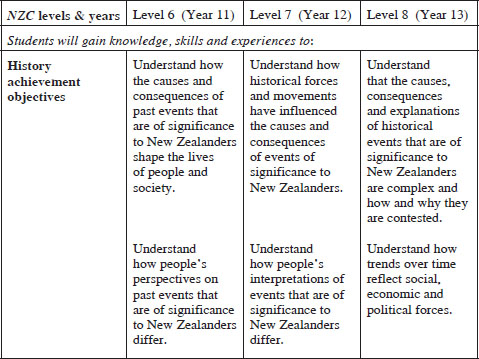
The history achievement objectives show a repetition of the earlier events-based contextual approaches to history that indicate traditional/conservative claims to knowledge. Incidentally, the concept of event did not appear in the earlier History Forms 5 to 7 Syllabus for Schools (Ministry of Education, 1989). The American National History Center cites the limitations of events-based history in the 21st century:
History stands out as the study of the past itself, an attempt to understand differences associated with temporality and to explain and conceptualize change over time based on evidence that survives. History is not, to cite the example given by the famous French historian Marc Bloch, simply the reporting of events (or phrased less felicitously but more famously by Henry Ford, ‘one dammed thing after another.’) (2009, p. 40).
The history achievement objectives’ wording of “significance to New Zealanders” (refer to Table 1) is not unpacked in NZC, nor satisfactorily explained in a recent online History Learning Guide for teachers (Ministry of Education, 2010). The notion of “significance” is problematic because it is not a neutral objective that can remain uncontested. On first reading the history objectives, I found the concept of “significance” in relation to events and New Zealanders deeply disturbing on both personal and professional levels. In the article “Guarding against collective amnesia? Making significance problematic: An exploration of issues”, researcher Anne Lloyd (2007) adopts a position that a criteria of significance “… will always reflect the directions and consciousness of society’s dominant groups, and that this will shape interpretations and narratives of the past” (p. 53). Similarly, the reference to New Zealanders indicates exclusive cultural and gendered identity in light of the legacy of political and conflict-based contexts of earlier history prescriptions. These contexts still dominate the enacted history curriculum (Hunter & Farthing, 2004, 2008, 2009). While I acknowledge that the NCEA 2011 Level 1 history standards contain explanatory notes for teachers’ thinking of “significance”, the notion of “significance” is tied back to an uncritical view of events (Ministry of Education, 2006; New Zealand Qualifications Authority, n.d.).
History as cultural reproduction in the national curriculum
The New Zealand history curriculum is a site of cultural reproduction with its own language, traditions, methods and assessment practices. While accessible to those who share dominant cultural values, curriculum history resists a multiplicity of historical experiences, expansive thinking about representation and critique of objectives. In working with preservice history teachers who experience practicum in a range of regional and national schools, anecdotal evidence reveals that the enacted New Zealand history curriculum reflects its traditional canon of topics emphasising theatres of war and discourses of sacrifice and nationhood. The comfort of a “progressive” approach to New Zealand history, wrapped up in conventional topics, means Māori histories, women’s historical agency and issues of the past as lived experience are subordinated in history pedagogy (Hunter & Farthing, 2004, 2008, 2009). Knowledge of New Zealand histories is generally shaped by externally examined customary contextual preferences. Hence school history perpetuates discourses that act to powerfully shape students’ world views.
Limitations of the NZC framing of history are evident in recent Ministry of Education and NZQA developments. These involve the alignment of the history curriculum achievement objectives with the NCEA history achievement standards (Ministry of Education, n.d.), and the complementary development of online learning guides for teachers. Each development reflects the difficulties faced when attempting to interpret and expand the scope of narrowly conceived history achievement objectives. There are problems in identifying the nature and purpose of historical thinking in curriculum and assessment for student-oriented pedagogy. The online History Learning Guide’s descriptive statement of what history involves is sweeping but tells us little: “History examines the past to understand the present” (Ministry of Education, 2010). The statement that connects history to the NZC Social Sciences learning area reads as follows: “[History] has its own achievement objectives in the New Zealand curriculum. The achievement objectives inform teaching, learning, assessment, and programme design—all contexts taught need to relate to them. There are no prescribed topics” (Ministry of Education, 2010). When attempting to apply Simpson and Halse’s (2007) dimensions of history (see next section) to NZC’s conception of history, it appears that a traditional identity and approach emphasises history as product (the history knowledge produced and reproduced). The dimensions of processes and purpose of historical inquiry are barely represented in the NZC conception of history.
In previous writing I reflected on the national curriculum’s Social Sciences learning area, in relation to the NZC reshaping of the Years 11–13 social studies curriculum (Hunter, 2006, 2007). The earlier New Zealand Curriculum Framework’s Social Sciences learning area (Ministry of Education, 1993) and its accompanying Years 1–13 Social Studies in the New Zealand Curriculum (Ministry of Education, 1997) were strongly informed by sociocultural and social constructivist thinking. These social discourses were bypassed a decade later by the developers of the history objectives for the NZC Social Sciences area. The dominance of traditionally conceived senior secondary subjects (history and economics in particular) certainly influenced the shape of NZC’s Social Sciences. Incidentally, NZC’s Social Sciences learning area is the only curriculum area that reinstated subject territories in its senior secondary levels’ achievement objectives. Consequently, history achievement objectives are not designed to integrate historical thinking with social, cultural, political, economics and geographic concepts and contexts through levels 6–8 (the senior Years 11–13). It also seems that a dismissive approach to historical thinking in the levels 1–5 junior social studies achievement objectives has diminished historical thinking for younger students. While this article does not have the space to discuss the nature of the Continuity and Change (historical) social studies objectives over Years 1–10, they also require critique in terms of their interpretation for younger students’ historical thinking within social inquiry.
NZC’s framing of history achievement objectives within the Social Sciences learning area has created a defensive and bounded subject construction. This rejects a conception of school history as an “inherently multidisciplinary field” (National History Center, 2009, p. 43). History educator Stefan Amirell (2009) recently queried ways constructions of school history have traditionally avoided social and ideological concerns. He reminds us, however, that history’s role in today’s society “is all but uncontroversial” (p. 441). Interrelationships between history in everyday social life, academia and the classroom are acknowledged in the writings of renowned history education scholars Lee (2004) and Seixas (2004). A history curriculum that is isolated within the Social Sciences learning area is rendered distant from social concerns and the history of the present. The constructivist and narrative nature of historical representation is diminished—albeit invisibly in the NZC history achievement objectives and their inherent processes. The dynamic body of international history education research literature might have assisted to widen the narrow conception of curriculum history. For example, useful scholarship focusing on understandings of historical constructivism, pedagogy and students’ historical thinking includes the scholarly writings of Ashby, Gordon and Lee (2005), Barton (2008), Vansledright (1996) and Wineberg (2000).
An alternative/counter history orientation
Australian researchers Ian Simpson and Christine Halse (2007) conducted a thematic analysis of history education literature to find out ways historians and scholars of history education conceptualise the identity of history. Subsequently, they theorised three dimensions of conceptualisation that I now apply to thinking about curriculum history. The dimensions are: history as product (the nature of historical knowledge), history as process (the doing of history) and history as purpose (the intent of history). Each dimension can embed conflicting knowledge or alternative positions and beliefs about what counts as history. Particular dimensions may be integrated or emphasised at the expense of others. Of course, the dimensions cannot be viewed in a vacuum, as they operate holistically. In Table 2 I outline ways the dimensions of product, process and purpose might be identified to support an alternative/counter orientation of curriculum history that would open up possibilities for historical thinking. This example is informed by my critical pedagogy stance and vision of possibilities for history in the schooling curriculum.
The ideas in Table 2 are offered as a starting point for curriculum decision makers, teachers and teacher educators to reflect on the nature and purpose of history in the national curriculum. The table is included in the paper as a catalyst for movement beyond the history curriculum’s uncritical approaches and reproduced knowledge preferences.
In opening up counter/alternative orientations to history curriculum, the fascinating area of research about students’ historical thinking deserves attention. Pomson and Hoz’s research into adolescents’ “ideal” historical conceptions (1998) found that students’ conceptions are unexpectedly sophisticated. Accordingly, they referred to students as “cognitive agents” in history pedagogy. The American National History Center (2009) conceives history as a “cognitive process” where students acquire historical thinking through active learning rather than “merely reproducing facts or descriptive formulae” (p. 44). Recent research into New Zealand students’ historical thinking (Hunter & Farthing, 2007, 2008, 2009) found students’ discourses articulate and informative about the received history curriculum, and their social and everyday orientation to history thinking. Years 11–13 students’ voices provided insights into aspects of history pedagogy that were minimised in programmes. Little student awareness was evident of “the constructed nature of history; empathy or imagination; the nature of official narratives; historical significance; or diversity of historical experience” (Hunter & Farthing, 2009, p. 57). Peter Seixas’ model for explicitly teaching students to think historically is often cited, and includes student engagement with historical significance, and human agency in history (as explained by Kelly et al., 2007). Our history students inhabit differing life-worlds to those experienced by their teachers. Mostly born in the mid-1990s, today’s students are savvy and able to use the interactive tools and processes of accessing history knowledge. They ask: Why are we doing this? Why does this matter? Students’ interest in history, and their choice of history as a subject option, deserves curriculum investment and innovation in approach.
Table 2 Dimensions of an alternative/counter orientation of curriculum history
| History as product | History as processes | History as purpose |
| Study of how societies are constituted (National History Center, 2009, p. 43) | “Analytic imperative to step outside oneself” (National History Center, 2009, p. 42) | Question the role of history and how it is used in contemporary society (Amirell, 2009) |
| Exploring history’s relevance for understanding contemporary society | Using active and experiential pedagogy | Using critical pedagogy that questions why we do things the way we do in history |
| Studying and representing the past as lived experience | Establishing a problem, or question or possibility within an historical context and setting/s | Engaging with civic cultures |
| Intellectually engaging with ideas and human experience | Accessing and critiquing modes of surviving evidence | Expanding social imagination and empathy |
| Acknowledging history as a culturally pluralistic discipline | Analysing and interpreting evidence | Developing historical consciousness, thinking and understandings |
| Acknowledging multiple perspectives and social contexts | Conceptualising change and continuity over time | Critiquing historical representation and practices of history—historical constructions, narratives, historians’ scholarship and interpretation |
| Acknowledging history as an open-ended interdisciplinary and multidisciplinary field | Synthesising patterns of evidence | Establishing links to life experiences and students’ experiences |
| Developing temporal and spatial consciousness in transnational and global fields | Constructing distinctive historical narrative | Developing counter-discourses; for example, gendered, cultural, indigenous historical experiences and world views |
| Acknowledging how identities are shaped | Identifying and critiquing representations of history | |
| Representing the history of the present | Deconstructing and un-layering historical narrative | |
In the article “History students voice their thinking: An opening for professional conversations” (Hunter & Farthing, 2009), we commented on research findings that teacher agency was a key motivation for students to choose history as a senior subject option. Students voiced trust and respect for their history teachers, and genuine enjoyment of the people they are. Similarly, in a recent New Zealand Listener article (“The best advice I ever got”, 2011), prominent New Zealanders reflected on the people who motivated them to make shifts in their lives. It is not surprising that teachers are mentioned, and in particular history teachers. Teacher agency may be positive or negative. Either way, a history teacher’s contextual approaches, pedagogy and vision of the purpose of a history curriculum rubs off on students. History teachers need to question the curriculum discourses and conception of history they are protectively suspended within. We need to understand that curriculum is never neutral and is open to contestation. The NZC and NZQA history developments between 2005 and 2011 have exposed dissonances and tensions (Hunter & Farthing, 2004; Sheehan, 2010) in history practitioner circles. Suspicion of colleagues’ motivations and thinking is evident in competing history discourses that delineate territories and perceptions of history’s curriculum identity. As educational thinkers, we have a responsibility to engage with contemporary thinking around history education and student-oriented pedagogies. This means we have to engage in dialogue to understand the work of history teachers, historians, curriculum developers and history educators when conceptualising history’s identity in the curriculum (Hunter & Farthing, 2004; Parkes, 2007). Australian history researcher Robert Parkes reflects that “restrictive understandings of each other’s role in the curriculum development process frequently results in history being represented as more fixed and certain than any party actually believes it is” (2007, p. 395).
Concluding comment
This paper has voiced my professional disturbance about ways curriculum history is conceptualised in professional contexts and sites that include curriculum policy, school history programmes and postgraduate teacher education. An involvement with continuous policy changes to New Zealand social sciences curriculum and assessment between the 1990s and 2005 has shaped my professional identities and thinking. This investment in curriculum and assessment initiatives meant I was complicit in policy processes that created a default kind of standards-based history curriculum. It is this narrow teacher-oriented identification of history that has remained largely uncontested in the national curriculum’s 2007 revision and its implementation in 2011. Accordingly, a shift to a critical pedagogy stance asks that we question and critique the things we do in our history classrooms and identify our conceptions of history. Curriculum history’s identity is problematised by offering alternate/counter possibilities to move beyond traditional and reproduced history approaches. By taking a critical pedagogy stance I have identified an alternative/counter, student-oriented approach to history, in an attempt to engage teachers and students in the active and agentive processes of the representation and purpose of history. The power and possibilities of students’ cognition, history teachers’ agency and professional dialogue must surely be activated for thinking historically in the contemporary curriculum.
References
Amirell, S. E. (2009). Descent from the ivory tower: A group assignment for studying the role of history in society. The History Teacher, 42(3), 441–457.
Ashby, R., Gordon, P., & Lee, P. (Eds.). (2005). International review of history education: Vol. 4. Understanding history: Recent research in history education. New York: Routledge Falmer.
Ball, S. (2003). The teacher’s soul and the terrors of performativity. Journal of Educational Policy, 18(2), 215–228.
Barton, K. (2008). Research on students’ ideas about history. In L. S. Levstik & C. A. Tyson (Eds.), Handbook of research in social studies education (pp. 239–259). New York: Routledge.
Codd, J. (1999). Education reform, accountability and the culture of distrust. New Zealand Journal of Educational Studies, 34(1), 45–53.
Department of Education. (1987). School certificate examination prescription: History. Wellington: Author.
Department of Education. (1988). University entrance, bursaries and scholarships History 229/230. Wellington: Author.
Eisner, E. W. (2008). Questionable assumptions about schooling. In B. Slater-Stern & M. L. Kysilka (Eds.), Contemporary readings in curriculum (pp. 11–19). London: Sage.
Giroux, H. (1991). Postmodernism, feminism, and cultural politics: Redrawing educational boundaries. Albany, NY: State University of New York.
Giroux, H. (1995). Border pedagogy and the politics of postmodernism. In P. McLaren (Ed.), Postmodernism, postcolonialism and pedagogy (pp. 3–37). Albert Park, VIC: James Nicholas.
Hinchey, P. (2004). Becoming a critical educator: Defining a classroom identity, designing a critical pedagogy. New York: Peter Lang.
Hunter, P. (2006). Framing a social sciences learning area in the New Zealand curriculum draft for consultation 2006. Teachers and Curriculum: Kaiako me te Marautanga, 9, 19–27.
Hunter, P. (2007). Social sciences in the New Zealand curriculum: A case of arrested development? Mediating challenges ahead. Teachers and Curriculum: Kaiako me te Marautanga, 10, 43–47.
Hunter, P. (in press). History in the New Zealand curriculum: Discourse shaping and key competencies possibilities. Teachers and Curriculum: Kaiako me te Marautanga.
Hunter, P., & Farthing, B. (2004). Talking history: Teachers’ perceptions of “their” curriculum in the context of history in the New Zealand curriculum 1980–2003. Hamilton: Wilf Malcolm Institute of Educational Research.
Hunter, P., & Farthing, B. (2007). Connecting learners with their pasts as a way into history. set: Research Information for Teachers, 1, 21–27.
Hunter, P., & Farthing, B. (2008). Students think history and teachers learn. set: Research Information for Teachers, 1, 15–22.
Hunter, P., & Farthing, B. (2009). History students voice their thinking: An opening for professional conversations. set: Research Information for Teachers, 3, 52–59.
Hunter, P., & Keown, P. (2001). The New Zealand social studies curriculum struggle 1993–1997: An “insider” analysis. Waikato Journal of Education, 7, 55–73.
Janesick, V. (2003). Curriculum trends: A reference handbook: Contemporary education issues. Santa Barbara: ABC-CLIO.
Jesson, J. (2008). Teachers’ work is curriculum. In V. Carpenter, J. Jesson, P. Roberts, & M. Stephenson, Ngā kaupapa here: Connections and contradictions in education (pp. 67–75). Melbourne: Cengage Learning.
Kelly, T., Meuwissen, K., & Vansledright, B. (2007). What of history? Historical knowledge within a system of standards and accountability. International Journal of Social Education, 22, 115–145.
Kincheloe, J. (2004). Critical pedagogy. New York: Peter Lang.
Lather, P. (1991). Getting smart: Feminist research and pedagogy within the postmodern. New York: Routledge.
Lee, P. (2004). Understanding history. In P. Seixas (Ed.), Theorizing historical consciousness (pp. 129–165). Toronto: University of Toronto Press.
Lloyd, A. (2007). Guarding against collective amnesia? Making significance problematic: An exploration of issues. Library Trends, 56(1), 53–65.
Mutch, C. (2003). Context, complexity, and construction: Developing social studies in the New Zealand curriculum. Unpublished doctoral thesis, Griffith University, Australia.
Ministry of Education. (n.d.). Alignment of standards. Retrieved 23 September 2010, from http://www.minedu.govt.nz/NZEducation/EducationPolicies/Schools/NCEA/NCEAAchievementStandards/AlignmentOfStandards.aspx
Ministry of Education. (1989). History forms 5 to 7 syllabus for schools. Wellington: Learning Media.
Ministry of Education. (1993). The New Zealand curriculum framework: Te anga marautanga o Aotearoa. Wellington: Learning Media.
Ministry of Education. (1997). Social studies in the New Zealand curriculum. Wellington: Learning Media.
Ministry of Education. (2001, 5 February). Curriculum stocktake. New Zealand Education Gazette, 1, 8.
Ministry of Education. (2004). The curriculum marautanga project. Issue 1. Wellington: Author.
Ministry of Education. (2006). New Zealand scholarship performance standard: History. Retrieved 19 October 2011, from http://www.minedu.govt.nz/NZEducation/EducationPolicies/Schools/NCEA/NCEAPolicy/NZScholarship/ScholarshipPerformanceStandards.aspx
Ministry of Education. (2007). The New Zealand curriculum. Wellington: Learning Media.
Ministry of Education. (2010). New Zealand curriculum guides: Senior secondary: History. Retrieved 23 September 2010, from http://seniorsecondary.tki.org.nz/Social-sciences/History
National History Center. (2009). The history major and liberal education. Liberal Education, 95(2), 40–47.
New Zealand Qualifications Authority. (n.d.). The National Certificate of Educational Achievement history levels 1–3 achievement standards. Available from http://www.nzqa.govt.nz/ncea/assessment/
Parkes, R. (2007). Reading history curriculum as postcolonial text: Towards a curricular response to the history wars in Australia and beyond. Curriculum and Inquiry, 37, 383–400.
Phillips, R. (2002). Reflective teaching of history 11–18. Continuum: London.
Pomson, A., & Hoz, R. (1998). Sought and found: Adolescents’ “ideal” historical conceptions as unveiled by concept mapping. Journal of Curriculum Studies, 30(3), 319–337.
Schiro, M. (2008). Curriculum theory: Conflicting visions and enduring concerns. London: Sage.
Schubert, W. (2003). The curriculum-curriculum: Experiences in teaching curriculum. Curriculum and Teaching Dialogue, 5(1), 9–21.
Seixas, P. (2004). Introduction. In P. Seixas (Ed.), Theorizing historical consciousness (pp. 3–24). Toronto: University of Toronto Press.
Sheehan, M. (2010). The place of ‘New Zealand’ in the New Zealand history curriculum. Journal of Curriculum Studies, 42(5), 671–691.
Simpson, I., & Halse, C. (2007, April). The fourth dimension: Constructions of the identity of history. Curriculum Perspectives, 27, 1–14.
The best advice I ever got. (2011, January 1–7). New Zealand Listener, 3686, 12–18.
Vansledright, B. (1996). Closing the gap between school and disciplinary history? Historian as high school history teacher. In J. Brophy (Ed.), Advances in research on teaching: Teaching and learning history (pp. 257–289). London: JAI Press.
Waters, T. (2007). The sacred and the profane in American history curriculum. The Social Studies, November /December, 246–260.
Wineberg, S. (2000). Making historical sense. In P. Stearns, P. Seixas, & S. Wineburg (Eds.), Knowing teaching & learning history: National and international perspectives (pp. 306–329). New York: New York University Press.
The author
Philippa Hunter is a senior lecturer in history and social sciences education, and curriculum studies, at the Faculty of Education, University of Waikato. She has been a primary and secondary teacher and has a background of extensive involvement with the Ministry of Education and NZQA’s social sciences curriculum and assessment policy initiatives. Philippa’s current curriculum research interests involve critical pedagogy in her teaching of history in initial teacher education, and narrative research of problematised history pedagogy.
Email: phunter@waikato.ac.nz
Notes
1For details of the fuller pedagogic context, refer to Hunter and Farthing’s history research (2009, p. 57).
2An explanation of NZC’s key competencies and ways they support alternative approaches for student-oriented history pedagogy can be found in Hunter and Farthing (2009). For an explanation of ways NZC’s values, principles, key competencies and learning areas other than Social Sciences support possibilities for history curriculum, refer to Hunter (in press).