Signalling shifts in meaning: the experience of social studies curriculum design
Graeme Aitken
Abstract
This article argues the view that curriculum policy is an educative resource for teachers, and that this view imposes certain design considerations on policy. Foremost among these is the need to signal shifts in meaning, in ways that enable teachers to better understand what the reform is requiring of them, and how this is different from existing practice. Past curriculum designs in New Zealand social studies are analysed, and patterns of signalling shifts in curriculum intention are illustrated. The article emphasises the importance of design that acknowledges existing understandings, that alerts teachers to possible misconceptions, and that shows how the reform builds on, and changes, past practice.
Introduction
A key feature of the recent New Zealand Curriculum Project work has been the development of essence statements that “encapsulate the fundamental ideas of each learning area … and … that clearly articulate important learning outcomes for students” (Ministry of Education, 2004). By redefining each learning area in terms of the unique and fundamental contribution it makes to the learning of young people in New Zealand, the essence statements are simultaneously a policy statement of student entitlement and a resource for teacher, and community, learning about the revised purposes and value of the learning area.
This article begins by examining the idea of curriculum policy as a resource for teacher learning, and considers the implications of this for curriculum policy design—especially the way in which design acknowledges and represents intended shifts in purpose and meaning. It then draws on examples from New Zealand social studies curriculum policy from 1942–1997, to illustrate past approaches to communicating such shifts, and, using insights from this analysis, suggests design features aimed at enhancing the communication of revised purposes and meanings in the proposed essence statement for the social sciences.
Curriculum policy design and teacher learning
“Curriculum policy” refers to formal written policy statements of learning intentions mandated by central government. “Curriculum policy design” refers to the way in which the elements of the policy are organised and expressed. This definition positions design at the national level as an outcome, and distinguishes it from curriculum development: the process of creating the design. This is not to deny the importance of process in influencing design. Design, in fact, as defined here, is an enduring artefact of process. The research literature on New Zealand social studies, however, has already paid considerable attention to the process of curriculum development, and to the influences on that process, particularly in relation to the development of the current curriculum (see, for example, Hunter & Keown, 2001; Mutch, 1998, 1998/1999, 2004; Openshaw, 1999, 2000). What this article offers, that is different from these, is a focus on curriculum design as an influence on subsequent sense making by teachers and other implementing agents. The prime focus here, therefore, is not on the already well-documented nature of the “contestation and struggle” (Openshaw, 2004, p. 12) that has characterised New Zealand social studies curriculum history, but on the impacts of this history on the detail of design, and on the educative potential of this design.
Curriculum policy is educative in the sense that it communicates, within the constraints of what the state is prepared to endorse, a representation of the content and purpose of the subject. This is especially the case in a less mature subject such as social studies, whose purposes may be poorly understood, and whose status attracts a lower priority from teachers faced with the competing demands of other subjects they prefer to teach—or that their school regards as being more important. As Hayward, Priestley, and Young (2004) have argued, external agencies have limited control over contextual factors that influence the understanding and acceptance of reform. They have to boost the strength, therefore, of the factors that are in their control. Design is one such factor. If its expression is ambiguous, contradictory, or unclear, it harms the integrity of the subject, and has the potential to compromise subsequent curriculum decision making by clouding sense making (Spillane, 2004; Spillane, Reiser, & Reimer, 2002).
This is not to naïvely suggest that there is a linear relationship between design and implementation, and that national policy can, or should, somehow be teacher-proofed to ensure fidelity of implementation. As Wenger (1998) has argued:
Learning cannot be designed. Ultimately, it belongs to the realm of experience and practice. It follows the negotiation of meaning; it moves on its own terms. It slips through the cracks; it creates its own cracks. Learning happens, design or no design. (p. 225)
This complexity does not, however, absolve the curriculum designer of all responsibility, because, as Wenger subsequently argues, “recognizing that communities of practice will generate their own response to design does not imply that they must be left to their own devices” (p. 234). The goal, as Davis and Krajcik (2005) explain, should be to produce a curriculum resource that communicates the essence of intention, and that promotes teachers' pedagogical design capacity so that they can “participate in the discourse and practice of teaching; rather than merely implementing a given set of curriculum materials” (p. 6). By enhancing the sense-making qualities of design, implementation decisions are better able to be based on deliberate and defensible adaptations that are “accurate” in the sense that they are coherent with intention, rather than inadvertent, “lethal mutations” (Brown & Campione, 1996). Therefore, design, while not a determinant of implementation, makes a significant contribution to that process (Ball & Cohen, 1996).
Sense making and the conservation of existing understandings
On the basis of seven years' observation and analysis of the implementation of mathematics and science curriculum standards in Michigan, Spillane et al. (2002) argue that what needs to be added to accounts of policy implementation is the role of the “process of human sense-making” (p. 419). Contrary to conventional accounts of implementation, Spillane and his colleagues claim that teachers actually have good intentions when it comes to implementation. They genuinely seek to work out how to put their interpretation of ideas into daily practice, by constructing messages from policy. In doing so, however, they may misconstrue, rather than deliberately undermine, policy intentions, and operate on misunderstandings or partial understandings of policy. This “unwitting and unknowing undermining” (Spillane, 2004, p. 169), whereby reform ideas are reconstructed, is a cognitive process in which implementing agents “first notice, then frame, interpret and construct meaning” (Spillane et al., 2002, p. 392) from policy. Inherent in this process is the conservation of existing understandings. New information is interpreted through the existing schema. The generalised and automatic nature of these schema means that, unless prompted to consider deeper meanings, we rely on “surface or superficial similarities between new knowledge about something and our existing scripts for that something” (Spillane, 2004, p. 78). New information, therefore, supplements, but does not supplant, existing knowledge and practice (Spillane et al., 2002).
There is an affective dimension to this as well, because the process of cognition is also influenced by values and emotions. This is especially significant in the case of policy, because reform often challenges core beliefs and behaviours about teaching and learning, and, therefore, about self-image as a teacher (Spillane et al., 2002). The form of reasoning applied by implementing agents, therefore, may be biased towards defending current practices as being consistent with the reform, not simply because they are making significant connections to existing schema, but because they are preserving their self-image. Implementing agents who are strongly motivated in this way may be selective in their reasoning, noticing the aspects of their current practice that are consistent with the reform, and claiming, therefore, that the reform is nothing new. Or, they may be biased towards discounting new ideas as being inconsistent with the realities of teaching as they know them (Spillane et al., 2002).
These findings have two significant implications for policy design. Firstly, Spillane (2004) has observed that implementing agents, influenced by the expectations of their existing schema, “often over-interpreted reform ideas as similar to some of their existing ideas” (p. 79). Secondly, he observed that the short-cutting process associated with the role of schema, and understanding, influenced what implementing agents noticed in the policy. Most often, they attended to the surface features of the policy, rather than the deeper structural or conceptual changes. Fernandez and Ritchie (2003) have made similar observations in the New Zealand context, noting that physics teachers viewed their new curriculum as similar to existing practices. They cite, for example, one teacher comment to the effect that “… whenever a new curriculum comes out, people do just what I have done. Look at it and say, 'Oh yeah, what I'm doing now fits with this, this and this' and so I am covering that by doing that and so nothing changes [italics added]” (p. 99).
The next section of this article examines these ideas in the context of the four official expressions of New Zealand social studies curriculum policy (1942, 1961, 1977, and 1997). It aims to identify the ways in which past designs have attempted to acknowledge and address the conservation of existing understandings that is built into the sense-making process.
Signalling shifts in meaning and purpose of New Zealand social studies: 1942–1997
The first national social studies curriculum, based on the recommendations of the 1942 Thomas Report (Department of Education, 1959), was developed for junior secondary school (Years 9 and 10). The first official social studies curriculum for primary schools was released in 1961 (Department of Education, 1961).1 In 1977, the curriculum developed by the Thomas Report was replaced by a greatly modified design (Department of Education, 1977). This design extended into the senior primary school (Years 7 and 8), but the 1961 syllabus remained in place for junior primary school. It was not until 1997 that the first curriculum covering all levels of schooling was developed (Ministry of Education, 1997).
It is to be expected that across such a time span the nature and purposes of a school subject will evolve (Goodson, 1995), especially a fledgling subject such as social studies. The design challenge that this evolution poses from a sense-making perspective is that of understanding the misconceptions that teachers may bring to a changed curriculum emphasis, from their previous experiences with the subject, and helping them understand the nature of, and reasons for, new directions. Analysis2 of the four curriculum designs reveals that there have been four general approaches to this challenge, although it is doubtful that these approaches were deliberate attempts to address the issue. They are evident through the lens of analysis used here; they may not have been evident to the curriculum writers of the time.
Approach one: criticism of previous practice
The 1942 curriculum replaced history and geography as stand-alone subjects in the junior secondary school. In so doing, the curriculum faced a significant challenge in communicating, to teachers familiar with history and geography, the purpose and meaning of the new subject. The curriculum statement approached this by naming history and geography as contributors to the new single subject, but argued that much of what was required to develop the new subject “is apt to fall between the fields of history and geography” (Department of Education, 1959, p. 28). Geography, it was claimed, “rarely goes much beyond the economic aspects of human activity”, whilst in history “social and cultural developments tend to be overshadowed by the political, and the pupil himself [sic] may be left to make the jump from the present to the past” (pp. 28–29). Whilst acknowledging that “the 'way of life' of any people is of course, inexplicable apart from a study of their history and geographical setting” (p. 29), it was nonetheless explained that “the facts and relationships that should be most strongly emphasised in a social studies course are precisely those that are apt to be neglected when history and geography are treated as separate subjects [italics added]” (p. 29). What the rationale for the new curriculum was claiming, therefore, was that the new integrated subject, through its focus on “ways of life” (p. 28), especially the social and cultural dimensions, would “help to create … individual interests of many kinds” (p. 27), and serve the purposes of citizenship education better than the more erudite economic and political studies that dominated history and geography.
From a curriculum design perspective, the approach to the development of this rationale is interesting, because it was, in part, based on a negative—the claim that history and geography lack relevance and appeal. While this may have been true, it is a dubious basis for winning over opinion. Spillane et al.'s (2002) explanation of the role that emotions play in cognition, whereby teachers seek to preserve their positive self-image, and resist attempts to tell them that what they have been doing previously is wrong, suggests that negative rationale may work against the desired change. This appears to have been the case for the 1942 curriculum.
In a strongly-worded defence of geography as a school subject, the first professor of geography at the University of Auckland agreed with the Thomas Report claim that there was dissatisfaction with the ways in which history and geography were being taught in schools, but he argued that the reason for this was that “the wrong kinds of history and geography were being taught” (Cumberland, 1950, p. 18). The solution, therefore, was not to “scrap … the defaulting subjects for another”, but to teach “the right kinds of history and geography”—i.e., those that helped students to “discover what places are like”, and to understand “period history” (p. 19).
There is also evidence that the Thomas Report rationale was not compelling for some secondary teachers either. Martin (1952) reported, some years after the introduction of the 1942 curriculum, that “a large number of teachers are still uncertain—some even hopelessly confused—about the meaning of social studies” (p. 148). He attributed this in part to confusion deriving from the curriculum in relation to the roles of history and geography. Like Cumberland, he could not see how history and geography did not contribute directly to the aims of social studies, and could not, therefore, understand their apparent rejection. Likewise, Evison (1963), writing as the head of a history department, confessed that, 15 years after beginning to teach the new curriculum, the “rationale … has eluded me. I find it too wide, too vague, and too superficial” (p. 23). While there was clearly much more operating here than the mere reaction to the justification of the social studies in a manner that was critical of history and geography, such a rationale for change was not helpful in winning over opinion.
Approach two: perfunctory acknowledgement
Subsequent curriculum designs have taken a much less explicit approach to the shift away from history and geography. Rather than attempting to explain the differences between history and geography and the new subject (social studies), these curricula have sought to establish a role for history and geography within social studies. The way in which this role has been expressed in curriculum design, however, has been somewhat problematic. Consider, for example, the reference to the contributing disciplines in each of the social studies curriculum statements (Figure 1).
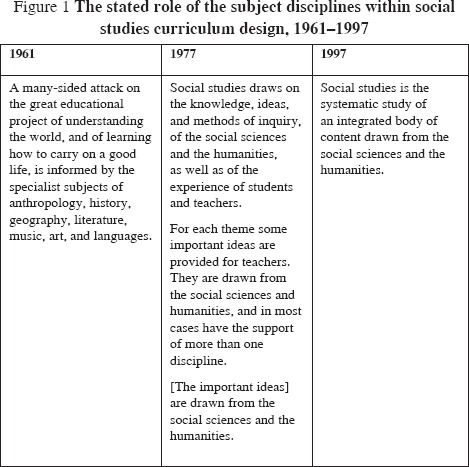
These are the only statements, in each of these curriculum documents, on the role of the subject disciplines in social studies. Aside from the 1961 statement, there is no specific reference to history and geography, and even within this statement, the role of these two subjects is diluted by the addition of four others, which for the most part are very different in nature from history and geography. Even more significantly, there is no reference, in any of the official supporting documents for these curricula, to any named social science or humanity (Department of Education, 1971, 1975, 1978, 1986; Ministry of Education, 1998)—this in spite of the fact that these documents provide guidance for teachers on such areas as sources of information, principles for planning, and content selection.
This is not to say that history and geography are not present in the curriculum documents, but rather that their role is not elaborated in any transparent sense. The 1977 curriculum was based around sets of important ideas at each of four levels. It was acknowledged that these ideas were drawn from the social sciences and humanities, and often from more than one discipline. Whilst many are recognisable as being ideas connected to history and geography, they are not always obviously so, and a significant proportion were also drawn from sociology and anthropology. The 1997 curriculum was organised around strands that alluded to the inclusion of history and geography, by adopting terms such as “place and environment” for geography, and “time, continuity and change” for history. It also continued the 1977 syllabus approach of positioning whatever recognition history and geography did have through these strands alongside strands that had connections with sociology, anthropology, and economics. The ideas of the 1977 curriculum, and the strands of the 1997 curriculum, broadened the disciplinary base for social studies in a manner consistent with the subject's aims, but their inclusion marked a new phase in which the distinctive points of view that Cumberland had claimed for history and geography became indistinguishable. History and geography did not exist in any sense as stand-alone bodies of knowledge and method. They had become, instead, sources of ideas that were not always easy to attribute to one or other subject, and that competed with ideas from an expanded range of social sciences.
This in itself may not have been a serious design issue if it had reflected the existing backgrounds of teachers, and their schema for social studies. This, however, was clearly not the case. Lewis (1980) claimed, in a review of the curriculum development process, that many secondary school teachers were frustrated by the new curriculum, and that Campbell's (1978, cited in Lewis, 1980) comment on the syllabus was an accurate reflection of their mood:
Take for example the Social Studies syllabus: this is supposed to be society in action, but it has been put together by sociologists with a particular line, and the majority of us have a background in history and geography. We have to move away from these studies and we have not had the training, we have not had the study. (p. 126)
Likewise, the National School Sampling Study on the implementation of the 1997 curriculum reported that of the 23 comments about the social studies, six requested the inclusion of more geography, and seven the inclusion of more history. As one teacher commented:
A geography component should be clearly identified and a history aspect for New Zealand. Geography is much neglected and only touched on incidentally. It needs to have a clear focus.
(cited in McGee et al., 2003, p. 248)
The 1977 and 1997 curriculum designs shifted the focus of social studies even further away from history and geography than had the Thomas Report, but failed to acknowledge and address the powerful schema for history and geography that were still prevalent among secondary teachers, and that were being reinforced externally by increasingly critical reports of the state of student knowledge of New Zealand history (for example, Barr, 1988; Low-Beer, 1986; Simon, 1992).
Approach three: non-acknowledgement
Non-acknowledgement is reflected in design that introduces new ideas without any explanation of their difference from current practice. The most significant example of this approach is the shift in the 1997 curriculum, from progression by topic to progression by pre-specified outcome. Prior to 1997, progression in social studies had been driven by two main ideas. The first, often referred to as the “expanding universe” idea, was that difficulty could be defined by context, based on increasing distance from children's immediate experience. The second was that progression of learning was defined by children's general progression through school. The curriculum statements were organised by level of schooling, and the consequent sequence of recommended topics was the surrogate for progression.
The 1997 curriculum marked a significant change in thinking about the nature of progression in social studies. Driven by the requirement of the national curriculum to define learning at eight different levels, progression was (in 1997) defined by pre-specified outcomes, organised, not by level of schooling, but by increasing conceptual complexity. In itself, this change may not have been a problem. The problem was that the new approach to progression in the 1997 curriculum did not acknowledge more than 30 years of teacher experience of progression by topic and context.
The introduction to the 1997 curriculum claimed that “the curriculum sets out a clear and structured progression of achievement objectives that spans all levels of schooling” (Ministry of Education, 1997, p. 7). There is no reference in this introduction, nor anywhere else in the 58 pages of the curriculum, nor the 104 pages of the supporting handbook (Ministry of Education, 1998), to this being a fundamental shift away from progression by topic. The assumption, reinforced by the inclusion of a diagram that had appeared in earlier national curriculum statements in other subject areas, was that teachers understood the new basis of progression that underpinned the national curriculum.
This was, however, a completely new concept for secondary teachers, and, in spite of the fact that primary teachers had implemented earlier statements in mathematics, science, and English, based on this premise, the very different manner of developing progression by achievement objectives within each of these documents challenges the assumption that there was a common understanding in this sector either. The social studies curriculum (Ministry of Education, 1997, p. 9) stated that “students learn at different rates, and, therefore, at any time, individual students or groups of students of the same age could be working towards achieving objectives at different levels within and across strands”. This complex wording was the only reference in the text to the fundamental point of difference from the earlier practice of progression by topic. It is not surprising, therefore, that the emerging evidence of practice suggests that teachers and resource writers are treating the achievement objectives as “topics” (albeit expressed differently), targeted at particular levels.
Of the 63 social studies units of work on the Ministry of Education Te Kete Ipurangi website in January 2005, 62 were primarily based on achievement objectives at one level of the curriculum. If the intention of the curriculum was being realised—i.e., students of the same age working towards achieving objectives at different levels—it would be expected that units should consistently be based on achievement objectives at more than one level. This same pattern is observed in other published resources. For example, a recent text on Years 9 and 10 social studies was based on the 10 Level 5 achievement objectives (Hunter, 2004). Likewise, a commonly-used textbook series, also based on Level 5, explains that the series is “accessible for students of every range of ability at level 5 [italics added]” (Naumann, 1999a, b, 2000, 2001a, b).
These data reveal a fundamental mismatch with the levelling intention of the 1997 curriculum—one that reflects teacher sense making being informed by their experiences with previous curriculum, and based on progression by topic rather than by pre-specified outcome. This is not to say that the method of progression by topic as implemented by teachers and resource writers was inappropriate. Elley (2004) has explained at length the difficulty of developing progression in subjects such as English and social studies, and the flaw of developing this progression independent of context. What is being argued here is that the design, by not acknowledging previous practice, and, more importantly, by not explaining how the new practice was different, did not adequately support the fundamental shift in thinking upon which the curriculum was based, and that, as a consequence, the intent of the reform, and of the national curriculum, was largely lost.
Approach four: explicit modification of practice
The 1961 curriculum design, and its support materials, encouraged the all encompassing and somewhat unfocused view that social studies was about “people”. By 1981, this had become of sufficient concern to the Department of Education that it gazetted a statement clarifying the intention of the 1961 curriculum (Department of Education, 1981). This statement, while not an official curriculum, aimed to shift teacher thinking about the purposes of social studies. It did so by explaining the need for change, and by recommending a strategy for making this change.
The statement expressed concern that social studies had focused too much on “countries and national groups” (Department of Education, 1981, p. 1), rather than on smaller groups of people closer to the experience of children; that too much emphasis was being placed on material culture—what people “did”—rather than why they did it; and that topics were often developed as “isolated studies” that inhibited the “deeper and broader understanding of human behaviour” (p. 1). To help shift understanding, the design suggested how the organising question, that had dominated the 1961 curriculum, could be slightly changed to capture the sense of reform required. The question of “How do people live and what do they aspire to?”, became “What can we learn about why people think, feel and act as they do?” A shift away from a narrow focus on material culture was therefore encouraged. This illustrates how design can be sensitive to current thinking and practice, by connecting to the familiar—in this case, the key curriculum question—but nonetheless aiming to shift thinking in a desired new direction.
The design used a different, but equally simple, device to encourage teachers to move studies closer to the experiences of children. A classification was introduced to guide teacher selection of “groups of people” for study, namely: people with whom children may participate; people who children may observe; people who are distant in time and place; and people who are in imaginary situations. The inclusion within this classification of two categories directly connected to children's experience, aimed to move teachers away from what the Department regarded as an overemphasis on “countries”. Teachers were also encouraged to sharpen the focus of their teaching by applying the new focusing question, not to all aspects of the lives of the people they were studying, but to particular areas of knowledge such as “relating to others”, and “interacting with the environment”. The impact of these design devices was weakened by their submergence amongst multiple messages to schools about what was “official” (Barr, 1989), but they illustrate an approach that was sensitive to existing schema, but that nonetheless attempted to shift practice in a new direction.
Design implications for future social studies curriculum
The proposed essence statement for social sciences has gone through many iterations. The most recent version (Ministry of Education, 2006) reveals the intention to communicate a number of new ideas.
Changes in purpose and meaning in the essence statement for the social sciences
The essence statement gives the idea of critical engagement with societal issues more prominence than was the case with the 1997 curriculum. Without further elaboration, however, this issues-centred shift could be interpreted as an example of social science study, rather than the focus the statement appears to intend. The statement also introduces the new term of “social inquiry”. This process is intended to integrate the three processes in the current curriculum—Inquiry, Values Exploration, and Social Decision-Making—but including the word “inquiry” in the description of the new process risks the misinterpretation that the Inquiry process, with which teachers are already familiar, has simply been elevated above the other two processes, and has, in effect, replaced them. The most significant shift in the statement is the proposed reorganisation of the curriculum into four, rather than five, strands (including the renaming of two strands), and the development of achievement objectives that integrate the content of the strands, rather than expressing the content within distinctive strands. Without a clear explanation of these changes, the significance of the strand renaming and reorganisation may well be lost—as teachers revert to the specific and familiar (the achievement objectives), and develop units of work with these as the sole curriculum referent.
Misconception alerts
On the basis of their observation and analysis of curriculum implementation, Spillane et al. (2002) have argued that design needs to attend to two principles if it is to effectively communicate the new intentions such as those outlined above. Firstly, it needs to be written in a way that communicates the rationale for the reform, therefore encouraging teachers and resource writers to go beyond the surface features, and to recognise the deeper conceptual understandings inherent in the reform. Secondly, the design needs to build on, and engage, implementing agents' prior knowledge. In other words, it needs to recognise existing schema, as well as misconceptions about the new policy that might arise from these schema.
There is, however, a difficult balance to be achieved here. If the policy creates too much dissonance from current practice, the desire to preserve self-image may mean that teacher sense making is severely compromised by strong resistant emotions. On the other hand, if the policy does not challenge existing schema in some way, implementing agents are likely to only attend to superficial aspects of the design. Spillane et al. (2002) are not specific about how this balance might be achieved, but Wiggins and McTighe (1998) illustrate an approach that is consistent with Spillane et al.'s recommendations. In their book, which advocates a change in the way that teachers should plan, they include throughout the text what they call “misconception alerts”. These statements are highlighted within the text, and anticipate possible misunderstandings that readers may associate with the content. Each misunderstanding is then briefly addressed. For example, Wiggins and McTighe (1998) address a common misconception, that “evidence of understanding” refers to end-of-teaching tests, by inserting into the text of their book the following boxed statement:
When we speak of evidence of understanding, we are referring to evidence gathered through a variety of formal and informal assessments during a unit of study or a course. We are not alluding only to end-of-teaching tests or culminating performance tasks. Rather, the collective evidence we seek may well include observation and dialogues, traditional quizzes and tests, performance tasks and projects, as well as students' self assessments gathered over time. (p. 13)
The possible misinterpretation is acknowledged (“we are not alluding only to end-of-teaching tests …”), and specific examples of alternatives are suggested (“observation and dialogues, traditional quizzes and tests, performance tasks and projects …”).
Although the adoption of such a strategy within curriculum design needs to be empirically tested with teachers, to evaluate its efficacy in enhancing sense making, it is consistent with Spillane et al.'s (2002) recommendation that policy needs to be written in a way that engages implementing agents' prior schema, and with the “explicit modification of practice” approach adopted in the 1981 Education Gazette revision of the 1961 curriculum. The sense-making potential of future iterations of the social sciences essence statement is likely to be enhanced by the application of such strategies, especially where they are used to support the changes in purpose and meaning that appear to be intended by the most recent version.3
Conclusions
This article has argued that effective design enhances the educative potential of curriculum policy, especially with respect to signalling the shifts in purpose and meaning that might otherwise go unnoticed. An examination of past curriculum policy statements in New Zealand social studies reveals that such shifts have received little acknowledgement, but that it is possible to build in more effective signals by showing how changes can build on current practice. In this way, the reform ideas have greater cognitive and affective potential to be more accessible and less damaging to teacher self-image, because they make more transparent the connection of the new ideas to existing schema. Showing, as the 1981 Education Gazette statement did, how a common practice such as using focusing questions can be adapted to shift intent, and how the introduction of a simple classification can broaden teacher content selection, is more likely to be understood and accepted than those approaches that fail to acknowledge past experience. The use of such devices, and of misconception alerts, has the potential to reduce the problems that arise from the cognitive and affective tendency to conserve existing understandings, whereby reform messages are unrecognised or misunderstood. This is not to ascribe an excessively prescriptive role to curriculum policy, nor to claim that design alone can improve the quality of implementation. What it can do, however, especially in relation to the issue of conservation of understanding addressed in this article, is reduce the pressure on the sense-making resources of the implementation communities, and, more significantly, by supporting reform from the outset with clear policy, increase teacher agency, and reduce reliance on accountability, inducement, and professional development.
References
Aitken, G. (2005). Curriculum design in New Zealand social studies: Learning from the past. Doctor of Education thesis, University of Auckland, Auckland.
Ball, D., & Cohen, D. (1996). Reform by the book: What is—or might be—the role of curriculum materials in teacher learning and instructional reform? Educational Researcher, 25(9), 6–14.
Barr, H. (1988). Welcome back Clio. The Social Studies Observer, 21(1), 3–4.
Barr, H. (1989). Social studies—where to now? The Social Studies Observer, 23(1), 5–7.
Barr, H., Graham, J., Hunter, P., Keown, P., & McGee, J. (1997). A position paper: Social studies in the New Zealand curriculum. Hamilton: School of Education, University of Waikato.
Brown, A., & Campione, J. (1996). Psychological theory and the design of innovative learning environments: On procedures, principles and systems. In L. Schauble & R. Glaser (Eds.), Innovations in learning: New environments for education (pp. 289–325). Mahwah, NJ: Lawrence Erlbaum Associates.
Cumberland, K. (1950). The geographer's point of view. Inaugural lecture delivered on 2 April 1946, Auckland University College. Auckland: Pelorus Press.
Davis, E., & Krajcik, J. (2005). Designing educative curriculum materials to promote teacher learning. Educational Researcher, 34(3), 3–14.
Department of Education. (1959). The post-primary school curriculum: Report of the committee appointed by the Minister of Education in November, 1942. Wellington: Government Printer.
Department of Education. (1961). Primary school syllabuses: Social studies in the primary school. Wellington: Author.
Department of Education. (1971). Suggestions for teaching social studies in the primary school: Parts I, II, III, IV. Wellington: Author.
Department of Education. (1975). Getting started: Social studies newsletter, No. 12. Wellington: Author.
Department of Education. (1977). Social studies syllabus guidelines. Wellington: Author.
Department of Education. (1978). Faces 4, primary social studies newsletter. Wellington: Department of Education Project Committee for Infants to Standard 4 Social Studies.
Department of Education. (1981, 17 March). Social studies in the primary school. Education Gazette, pp. 1–3.
Department of Education. (1986). Faces 7, primary social studies newsletter: Guidelines for planning social studies schemes. Wellington: Department of Education Project Committee for Infants to Standard 4 Social Studies.
Elley, W. (2004). Curriculum reform in retrospect: Was it forward or backward? In A.-M. O'Neill, J. Clark, & R. Openshaw (Eds.), Reshaping culture, knowledge and learning: Policy and content in the New Zealand curriculum framework (pp. 91–108). Palmerston North: Dunmore Press.
Evison, H. (1963). History or social studies? Difficulties of integration. New Zealand Post Primary Teachers Association Journal, June, 23–25.
Fernandez, T., & Ritchie, G. (2003). Analysing pedagogical change: Physics teachers' responses to a new curriculum. Waikato Journal of Education, 9, 91–111.
Goodson, I. (1995). Becoming a school subject. In The making of curriculum: Collected essays (pp. 160–183). London: Falmer Press.
Hayward, L., Priestley, M., & Young, M. (2004). Ruffling the calm of the ocean floor: Merging practice, policy and research in assessment in Scotland. Oxford Review of Education, 30(3), 397–415.
Hunter, P. (2004). Years 9 & 10 impact social studies. Hamilton: ABA Books.
Hunter, P., & Keown, P. (2001). The New Zealand social studies curriculum struggle 1993–1997: An “insider” analysis. Waikato Journal of Education, 7, 55–72.
Lewis, J. (1980). The form 1 to 4 social studies syllabus—planned or? In P. Ramsey (Ed.), Curriculum issues in New Zealand (pp. 111–155). Wellington: New Zealand Educational Institute.
Low-Beer, A. (1986). The eclipse of history in New Zealand schools. New Zealand Journal of Educational Studies, 21(2), 113–122.
Martin, J. (1952). Primary school geography. New Zealand Geographer, 8(2), 146–151.
McGee, C., Jones, A., Cowie, B., Hill, M., Miller, T., Harlow, A., & Mackenzie, K. (2003). Curriculum stocktake: National school sampling study—teachers' experience in curriculum implementation: English, languages, science and social studies. Hamilton: School of Education, University of Waikato.
Ministry of Education. (1997). Social studies in the New Zealand curriculum. Wellington: Learning Media.
Ministry of Education. (1998). Social studies in the New Zealand curriculum: Getting started. Wellington: Learning Media.
Ministry of Education. (2004). Curriculum/Marautanga project online. Retrieved from http://www.tki.org.nz/r/nzcurriculum/cp_online_e.php
Ministry of Education. (2006). Social studies draft essence statement—March 2006. Retrieved from http://centre4.interact.ac.nz/viewfile.php/users/49/1965008477/Soc_Sci_Mar_06.doc
Mutch, C. (1998). Current perceptions of the New Zealand social studies curriculum. Children's Social and Economics Education, 3(2), 65–80.
Mutch, C. (1998/1999). The long and winding road: The development of the new social studies curriculum. Christchurch College of Education Journal of Educational Research, 4(1), 69–85.
Mutch, C. (2004). Context, complexity and contestation in curriculum construction: Developing social studies in the New Zealand curriculum. Doctoral thesis, Griffiths University, Queensland. Retrieved from http://www.4.gu.edu.au:8080/adt-root/public/adt-QGU20040514.104836/
Naumann, R. (1999a). New Zealand social studies: A strands approach: Culture and heritage. Auckland: New House.
Naumann, R. (1999b). New Zealand social studies: A strands approach: Social organisation. Auckland: New House.
Naumann, R. (2000). New Zealand social studies: A strands approach: Place and environment. Auckland: New House.
Naumann, R. (2001a). New Zealand social studies: A strands approach: Time, continuity and change. Auckland: New House.
Naumann, R. (2001b). New Zealand social studies: A strands approach: Resources and economic activities. Auckland: New House.
Openshaw, R. (1999). Issues raised for social studies educators by the submissions to the draft statements for the new curriculum. In P. Benson & G. Hucker (Eds.), Social studies on Broadway (pp. 92–104). Palmerston North: Proceedings of the New Zealand Federation of Social Studies Associations Conference.
Openshaw, R. (2000). Culture wars in the antipodes: The social studies curriculum controversy in New Zealand. Theory and Research in Social Education, 28(1), 65–84.
Openshaw, R. (2004). How curriculum history can enhance teacher understanding, and why it may never get the opportunity to do so. Access, 23(1), 11–18.
Simon, J. (1992). Social studies: The cultivation of social amnesia? In G. McCulloch (Ed.), The school curriculum in New Zealand: History, theory, policy and practice (pp. 253–271). Palmerston North: Dunmore Press.
Spillane, J. P. (2004). Standards deviation: How schools misunderstand education policy. Cambridge, MA: Harvard University Press.
Spillane, J. P., Reiser, B., & Reimer, T. (2002). Policy implementation and cognition: Reframing and refocusing implementation research. Review of Educational Research, 72(3), 387–431.
Wenger, E. (1998). Communities of practice: Learning, meaning and identity. Cambridge, UK: Cambridge University Press.
Wiggins, G., & McTighe, J. (1998). Understanding by design. Upper Saddle River, NJ: Merrill Prentice Hall.
Notes
1&;&;In 1948 the syllabus for primary schools included reference to social studies but it was stated as “social studies in history and geography” and cannot, therefore, be regarded as the first official expression of a social studies curriculum in the primary school (Barr, Graham, Hunter, Keown, & McGee, 1997).
2&;&;For discussion of the method of analysis see Aitken (2005, Chapter 3).
3&;&;See Aitken (2005, pp. 213–215) for an application of this approach to his proposed essence statement for social studies.
The author
Graeme Aitken is a senior lecturer in the School of Social and Policy Studies, Faculty of Education, The University of Auckland. His recently completed doctoral research analysed the design of New Zealand social studies curriculum since 1942, and argued for a future design based on concepts and processes derived from citizenship education. He is currently working on the Best Evidence Synthesis in the social sciences subject domain.
Email: g.aitken@auckland.ac.nz