Who cares? Student’s values and the mathematics curriculum
Jude Ocean
Abstract
My aim in this article is to encourage educators to deeply consider the values of justice and care in curriculum design and delivery. To support this argument I describe interviews with 12 women who experienced a “separate knowing” (rules-based, abstract—Becker, 1996), high school mathematics education. Most rejected mathematics because they found it intolerant; they regarded it as unfair and unjust, or they felt uncared for. Their comments are described in detail. It is possible for curriculum design to incorporate issues of justice and care. Examples of mathematics programmes designed to attend to issues of care, incorporating group work and co-operation and paying particular attention to possibilities for friendship and care for other students, are given (Morrow, 1996; Rogers, 1995), as is an example of a mathematics programme designed to teach social justice (Gutstein, 2003).
Introduction
No matter how innovative the curriculum, implementation will fail if students’ values are not taken into account in curriculum design and delivery. Attention to values is based on a belief that disconnection of learning from values reproduces the traditional and harmful separation of the production of knowledge from the production of people (Rose, 1994). A curriculum model that attends to both cognitive and affective factors acknowledges that student–teacher relationships are integral to learning and holds learners to be as important as the knowledge they develop.
A recognition that attention needs to be paid to the morals and values base of the curriculum is seen in O’Neill, Clark, and Openshaw’s (2004) criticism of the New Zealand Curriculum Framework. Neyland’s (2004) analysis of the values base of the New Zealand mathematics curriculum addresses these issues within mathematics education. The intersection between social justice and mathematics education has been considered by a number of other researchers. Some have attended to the values of freedom and democracy (Apple & Beane, 1995; Noddings, 1992, 1993, 1994; Skovsmose, 2005; Walkerdine, 1998); of autonomy (Fennema & Peterson, 1985; Yackel & Cobb, 1995); and of equality (Boaler, 2002; Burton, 1990; Kaiser & Rogers, 1995; Keitel, 1998; National Council of Teachers of Mathematics, 2000; Noddings, 2001).
Less attention has been paid in the literature to the values of connection, care, support, and friendship. A model of mathematical education that considers the value of care as integral to mathematical learning, as proposed by Hackenberg (2005), is based on care and the concomitant notions of ethics of care developed by Noddings (2002) and Gilligan (1982). Hackenberg suggested that her model of mathematical caring may, with further articulation, respond to calls for models of both social interaction and ethics that are compatible with constructivist theories of knowing (von Glaserfeld, 2000). In this article, I consider the values of justice and care theorised by Gilligan (1982, 1995) and Gilligan, Lyons, and Hanmer (1990), and incorporate them into a consideration of the importance of values in curriculum design and delivery.
The study I describe here is my doctoral study, in which I found that students’ values were strongly implicated in their decisions to discontinue their mathematics education. The participants in this study had ceased to study mathematics because they found it intolerant; because they felt uncared for; and because they regarded mathematics education as unfair and unjust. These experiences caused them harm, and conflicted with their personal values to such an extent that they rejected the further study of mathematics.
Gilligan’s (1982, 1995) framework is the theoretical perspective through which the study results were analysed and interpreted. Gilligan (1982) suggested that individuals may have differential preferences for the kinds of knowledge that they value. Some people tend to value “connected” knowledge (which is characterised by intuition, creativity, and experience) while others tend to value “separate” knowledge (which is characterised by logic, rigour, and abstraction). Gilligan claimed that these different types of reasoning were associated respectively with two moral perspectives: (a) considerations of care and compassion, centred on the maintenance of relationships (the Care perspective); and (b) considerations of principles and individual rights, based on the moral priorities of freedom, equality, and autonomy (the Justice perspective). People with a Care perspective (who, Gilligan argued, are more likely to be women) focus on the relationship rather than the individual as primary. This perspective conceptualises the self as interdependent with others and constructs a moral problem as a failure of response to the needs of others. That is, a morally problematic situation is one in which a person does not respond to another’s genuine need. In contrast, individuals with a Justice moral perspective (more likely to be males) conceptualise the self as separate and autonomous, and construct a moral problem in terms of competing rights and fair resolution. Gilligan claimed gender differences in the North American populations that she studied: the proportion of women who demonstrated a dominant Justice or a dominant Care perspective were the same (about one-third), but virtually no men demonstrated a dominant Care perspective. The most striking result was the virtual absence of a Care-only perspective among the men (Gilligan, 1995). The claim for gender differences is contentious, but it is not a central point in this article. (See Flanagan and Jackson, 1998, and Martin, 1994, for a full discussion of the most important critiques and defences of Gilligan’s thesis.)
Gilligan’s thesis has attracted critique. There is a particular concern that her work might encourage a focus on Care at the expense of Justice (see Martin, 1994, for an excellent analysis of these critiques). Given the gains in legal rights achieved by women in recent decades by means of arguments based on equality, freedom, and autonomy, one might expect women to be especially aware of the importance of justice. While justice is considered necessary to a civil society, it is not considered sufficient for its existence by a number of moral philosophers (Baier, 1995; Hekman, 1995; Held, 1998; Kittay, 1998; Martin, 1994; Tronto, 1998). They argue for a consideration of care as well as justice; that is, questions of care are not to replace questions of justice, but are to be considered in addition to them. That is the position I take in this article.
One of the most common criticisms of Gilligan’s model is that it is simplistic and reductionist (see Flanagan & Jackson, 1998). Hekman (1995) also pointed out that some of the critique attracted by Gilligan’s early work was fuelled by her movement back and forth between positivist and narrative traditions. Since first publishing her ideas, Gilligan has adopted an alternative methodology that departs from the standard empiricism with which she began. She now takes an approach that is pluralistic and non-hierarchical and is located within a different paradigm from the positivist, scientific paradigm within which she began her career (Hekman, 1995). Hekman argued that the value of Gilligan’s work lies in that she in effect deconstructs the metanarrative of traditional moral theory, and claimed that what her approach entails is a new moral language altogether. In Moral Voices, Moral Selves (1995) Hekman argued for an exploration of the constitution of multiple moral voices, thus allowing consideration of culture, class, race, gender, and other factors. She and others such as Strike (1999) and Flanagan and Jackson (1998) accept the inclusion of the Care moral perspective in moral theory, but argue for a more complex model of morality than Gilligan has provided. They support models such as moral pluralism, where individual moral actors resolve conflicts between competing moral goods (Flanagan & Jackson, 1998; Strike, 1999), or a postmodern model that allows for a multiplicity of moral positions (Hekman, 1995). These approaches allow for the possibility of different moral discourses within and between cultures.
In this article I use mathematics as my case study, because that is my specialty, but many of the points I make relate to other disciplines as well. In reading the comments made by the participants in this study you may find points of familiarity within your own discipline area, whether it is English, Māori, science, art, or another subject. My aim is to encourage educators to deeply consider the values of justice and care when they are involved in curriculum design and delivery, be it at primary, secondary, or tertiary level.
Before we begin a discussion of the Justice and Care moral perspectives, it is important to note one point about the terminology used in this discussion. While this article is about values, I often use the term “morals” interchangeably with “values”. The term “moral” has acquired religious/sexual overtones in ordinary language, and is usually accompanied by suggestions of duty, obligation, and judgement (especially of sexual behaviour—Singer, 1994). However, in western philosophical discussion it is generally used without these connotations. In this article, I use “morals” and “values” interchangeably, and neither term refers to a personal standpoint on sexuality. Rather, I use “morality” to refer to the way we treat other people—specifically, the way we exercise power and care in our relations with others.
The Care and Justice moral perspectives
The Justice perspective is evidenced by an impersonal, abstracted, and logical approach to the solution of dilemmas, while a more personal and contextualised approach is characterised by the ethic of Care. In In a Different Voice (1982), Gilligan illustrated this difference by telling the story of two 11-year-olds, Amy and Jake, who were asked to solve the Heinz dilemma (Kohlberg, 1984). The Heinz dilemma goes as follows: A man, Heinz, had a wife who was dying from a cancer that only an extremely expensive drug could cure, but he did not have enough money. The druggist refused to sell it more cheaply, or to let him pay it by instalments. So Heinz broke into the druggist’s store and stole the drug. The question is, should Heinz have done that?
Jake’s answer focused on the law, and on punishment. He saw that Heinz had broken the law, but he said that the judge should give Heinz the lightest possible sentence. His attention was on what was right and what was wrong, on what the laws or rules were, on the chances of getting caught, and what the punishments might be. Fascinated by the power of logic, Jake located truth in mathematics, which he said is “the only thing that is totally logical” (Gilligan, 1982, p. 26). Seeing the Heinz problem “sort of like a math problem with humans” (p. 26), Jake saw it as an equation and produced a solution. Since he followed a logical process to arrive at the answer, he assumed that anyone else would arrive at the same answer; thus, the judge would also consider stealing, under these circumstances, to be the right thing to do.
Amy did not see the situation as a math problem with humans, as Jake had done. She saw instead the wife’s continuing need for her husband, and the husband’s continuing concern for his wife. She also sought to respond to the druggist in a way that sustained rather than severed connection; she recommended that Heinz continue to talk to him. She did not consider violence towards the druggist as a possibility, whether in the form of assault or robbery. In believing that “if somebody has something that would keep somebody alive, then it’s not right not to give it to them” (Gilligan, 1982, p. 28), she considered the main problem in the dilemma as the druggist’s refusal to lower the price of a drug that could save a life. In her view, the druggist failed to respond in a morally acceptable way to the wife. The problem arose not from the druggist’s assertion of (his own) rights, but from his failure of response (Gilligan, 1982).
Within the Justice perspective, as illustrated by Jake’s answers, the problem revolved around the law and whether to obey or break it. Within the Care perspective, as illustrated by Amy’s answers, the problem revolved around the druggist’s non-response to Heinz’s wife. These two children saw the need for a solution, but produced it in quite different ways: he impersonally, through systems of logic and law; she personally, through communication in relationship (Gilligan, 1982).
These two different definitions of what constitutes a problem distinguish the two moral perspectives. There are other important factors in distinguishing these two perspectives: different ideals, different prime values (or priorities), different views of maturity (and consequently different views of the necessary tasks of adolescence), and different foci on oneself and others. The ideal of the Justice perspective is that moral goods (such as democracy) as well as material goods are to be distributed fairly or equally among the members of a population. Autonomy, fairness, and equality are prime values of Justice. One of the aims of moral development within Justice is to increase one’s ability to apply the principles of justice and equality without being influenced by the values and opinions of others (Gilligan, 1982). Maturity is seen as the achievement of autonomy, and consequently adolescent development is measured in increasing degrees of separation from others. Adolescents are expected to increase separation by decreasing connection (Gilligan et al., 1990). Thus, development within the Justice perspective requires knowledge of principles and adherence to them, and maturity is evidenced by a particular version of trustworthiness, that of sticking to principles in the face of pressure. This requires a focus on oneself rather than on others, which is characteristic of the Justice perspective (Lyons, 1990). Importantly, this self-focus allows competition more easily than cooperation.
The priority of the Care moral perspective is to maintain connection to others through relationship. Connection is initiated and maintained through talk or discussion: thus, relationship is built through communication. One of the aims of moral development within the Care perspective is to increase one’s ability to respond to the needs and circumstances of others in their terms or as they understand it (Gilligan, 1982). Maturity is evidenced by the capacity to appropriately and effectively respond to others in terms of their needs and values, rather than one’s own, and it is measured in degrees of connection with significant others rather than degrees of separation from them. Interdependence (not independence in the sense of separation) is expected to increase as adolescents approach maturity (Gilligan et al., 1990). Non-violence is valued. From the Care perspective, moral development requires contact with others, a focus on the other (rather than on oneself), connection, and effective communication. Importantly, the other-focus (rather than self-focus) of the Care perspective (Lyons, 1990) allows co-operation more easily than competition.
In the next section I will describe my doctoral study, which investigated women’s responses to their high school mathematics education. As I indicated earlier, most of the women in this study ceased to study mathematics because they experienced intolerance, they felt unfairly treated, they felt ignored and abandoned, or they viewed mathematicians as unjust and did not want to join such a community. The discussion locates their rejections of mathematics education within the Care and Justice moral perspectives, to illustrate ways in which students’ values might lead them to reject an area of study on values-based grounds.
The students’ values in relation to mathematics study
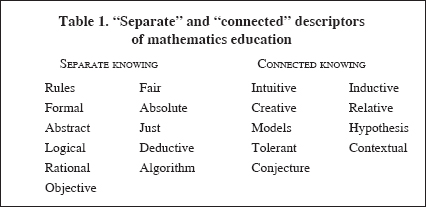
Gilligan (1982) claimed that some people tend to value “connected” knowledge (which is characterised by intuition, creativity, and experience) while others tend to value “separate” knowledge (which is characterised by logic, rigour, and abstraction). The study described here was undertaken as part of a doctoral dissertation in Melbourne, Australia, in 1997. The first stage of the study was to investigate links between students’ values and their rejection of a “separate” mathematics curriculum at high school. The distinction between “separate” and “connected” knowing in mathematics (see Table 1) draws on the work of Becker (1995, 1996), Boaler (1997a, 1997b, 1998), Buerk (1985), Erchick (1996), Koch (1996), Morrow (1996), and Morrow and Morrow (1995). The words fair, just, and tolerant were included in the study as descriptors of mathematics education because they are frequently used in descriptions of separate and connected knowing, but it is important to note that they are also moral descriptors. That is, they connote certain values to do with the ways in which people exercise power over one another—one can be said to exercise power fairly, justly, or tolerantly. Their inclusion as moral descriptors was not intentional. I did not appreciate the significance of these words in moral terms until I analysed participants’ responses to the interviews.
Sample
Twelve women were interviewed in this study. They were aged 23 to 53, with a median age of 24. They had a traditional, textbook-driven, silent, competitive mathematics education at high school. The first sample, comprising six women who were contacted through friends and colleagues, self-identified this. These women volunteered because of their strong dislike of mathematics at high school, which they described as “separate” rather than “connected” mathematics. Participants in the second sample were all under 25 years old, and were identified by a questionnaire that was designed for this study. The purpose of the questionnaire was to identify people who had had a “separate” mathematics education.
Of the 12 participants, all but two discontinued mathematics education between the ages of 14 and 16 because they disliked it, even though some of them achieved highly. These two (Laura and Susan), who had studied mathematics at university, had undertaken an engineering degree and a business degree respectively. Eight of the sample were tertiary students: Wendy (history); Laura (engineering); and six pre-service teachers (Josie, Christine, Andrea, Heather, Peta, and Susan). Four were employed: as a window-dresser (Louise), an editor (Linda), a nurse (Julie), and a university lecturer (Kelly). Their educational qualifications comprised high school graduation (six), a Bachelor’s degree (five), and a Master’s degree (one). English was the first language of all participants and of the researcher. This avoided the use of a colonising methodology (Tuhiwai Smith, 1999) in which the researcher assumes she may speak with an authoritative voice for cultures other than her own.
Method
Interviews were held individually and were semistructured, so that conversations with participants differed to some extent. In the course of the interviews, participants were asked to describe their high school mathematics education by selecting and/or discarding “separate” and “connected” descriptors of mathematics. The terms in Table 1 were written on cards, sorted randomly, and given to participants in an envelope. They were asked to look through them and choose and discuss up to five of the terms that were most representative of their high school mathematics education and two that were least representative. Participants were also asked to provide examples from that experience where possible. Their responses to the descriptors were audiotaped and transcribed and are presented in Table 2. It should be noted that participants conflated the concepts of mathematics, mathematics education, and mathematics teachers. In most cases, they moved from a discussion of one to the other without any recognition of the difference. For most high school students, mathematics as a concept is largely inseparable from mathematics education, because it is largely through their education that students come to know about mathematics. Similarly, mathematics education may be co-identified with mathematics teachers, especially for those students who seek to establish a personal relationship with the teacher (in particular, those students who have a Care moral perspective).
Results
Participants’ responses to the card-sorting exercise are given in Table 2.
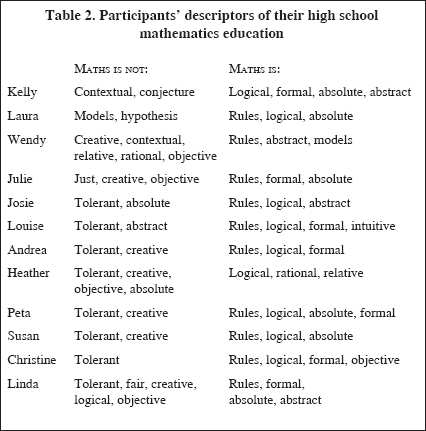
A surprising outcome of the study was that 8 of the 12 participants (including all six pre-service teachers in the sample) rejected tolerant as a descriptor of their high school mathematics education. One also rejected fair and one rejected just. The term tolerant was rejected immediately on sight by most participants. The rejection was usually accompanied by strongly-worded statements to the effect that the study of mathematics and the experience of tolerance are mutually exclusive events. If morality is taken to be concerned with the way in which people treat each other (that is, the way people exercise power in relations with others), then tolerant, fair, and just are moral descriptors. Given this definition, three-quarters of the participants in this study rejected their high school mathematics education on moral grounds, and one-third of all rejected descriptors were moral descriptors. The following discussion focuses on these moral objections.
The rejection of just
Julie was an intensive-care nurse who had completed high school 20 years earlier. She had a strong sense of social justice while at high school, hiding young men drafted to the war in Vietnam in her father’s house. She discontinued her study of mathematics after the third year of high school. During the card-sorting exercise (responding to the descriptors), Julie rejected just as a descriptor of mathematics education. Inflexibility and inequality stood out in her memory of her experience of mathematics education. She felt strongly that mathematicians (mathematics teachers) were unjust:
I don’t see maths, and I don’t see a lot of people who are mathematicians, as particularly just human beings. I just find them fairly rigid, inflexible people and they don’t have any justness about them, and if you can’t do it well they don’t understand and they don’t try to understand. They seem to be able to make a connection on that level (mathematics) but other than that, no … you’re just this poor little thing who’s missing out … They don’t recognise that you might have equal skills, but in other areas. If it’s not a maths area, well, there’s really no other area. Or maybe what you can do might be just the next rung down.
This is a strong response. Julie believed her mathematics teachers to be inegalitarian, with very restricted channels of connection to others. It was Julie’s identification of inequality (“they don’t recognise that you might have equal skills but in other areas”) and of hierarchy (“what you can do might be just the next rung down”) that formed part of her rejection of mathematics. Inequality and hierarchy do not sit well with the concept of equality. In showing a concern for equality Julie demonstrated a value of the Justice perspective (Gilligan, 1982).
Julie also observed that her mathematics teachers had little concern for the wellbeing of others. In commenting on a lack of care by her teachers (“if you can’t do it well … they don’t try to understand”), and of their restricted ability to connect with people (“they seem to be able to make a connection on that level (mathematics) but other than that, no”), her responses also reflect the Care perspective. Although she did not like the rule-driven, formulaic approach to learning mathematics that she had experienced at school, her strong objections to her mathematics education were moral objections based on both the Justice and Care perspectives (Gilligan, 1982). That her perceptions of the moral aspects of her mathematics education formed part of her decision to discontinue her study of mathematics is a possibility that must be considered.
The rejection of fair
Linda was one of the younger participants, working as an editor in a publishing house. In rejecting fair as a descriptor of mathematics education, she commented: “I’ve been unfairly treated by maths”. When asked for clarification, she explained that she achieved 89 percent in the mathematics exam in the penultimate year of high school, but this was at enormous cost to herself and to her other subjects. In preparing for her exams, she spent more time studying mathematics (5 to 6 hours per night) than she spent on all her other subjects combined. This time spent on rote learning was acceptable to her teacher and her parents, even though it was at the expense of her other subjects. However, Linda believed it was unfair to have to pay such a high price for her pass in mathematics. She spoke strongly about being unwilling to continue studying a subject that demanded so much from her and gave so little in return. In saying that mathematics took more than it returned, she noted her subjection to the discipline. It was not an equal relationship of give-and-take; it was a highly unequal relationship of demand-and-obey. Linda’s rejection of mathematics was partly a moral one, based on the value she placed on equality.
Julie and Linda rejected their mathematics education on the grounds of particular values they held. Their objections were to a lack of fairness and equality, values characteristic of the Justice perspective. Some of Julie’s objections were to a lack of connection to and concern for others, values characteristic of the Care perspective. Mathematics programmes of the kind designed and taught by Gutstein (2003), which focused on social justice in an urban Latino high school, might well have made a difference to Julie and Linda. In Gutstein’s courses, students learn to use mathematics to investigate issues such as racism in housing. For example, in one lesson students were asked to investigate inequality of wealth. Omar wrote: “Our family makes somewhere in the neighbourhood of $40,000. I heard that Michael Jordan makes about $1,000 for every minute he plays. So that means in 40 minutes he makes our whole family’s earnings. While my parents work year round for that money” (p. 50). One of Gutstein’s students evaluated the programme as follows: “With every single thing I learned about math came something else. Sometimes I learned more of other things instead of math. I learned to think of fairness, injustices, and so forth everywhere I see numbers distorted in the world” (p. 37). At the end of the course, one student wrote as part of her evaluation: “You could use math to defend your rights and realize injustices around you … it’s sort of like a pass you could use to try to make the world a better place” (p. 70). In attending to equality, fairness, and human rights in the design of this programme, Gutstein (2003) described a programme constructed from the perspective of Justice. Julie and Linda, whose values of equality and fairness would have been acknowledged and developed, may well have continued their study of mathematics in such a programme.
The rejection of tolerant
Josie, Heather, Peta, Christine, Andrea, and Susan were all pre-service teachers under the age of 26. Josie’s response was typical of the responses of most participants when they saw the card with the descriptor tolerant. She responded emphatically, describing mathematics education and tolerance as mutually exclusive: “I would not use this word [tolerant] when thinking about maths! I don’t think I can define it in a way that relates to maths!” Heather also saw the two as mutually exclusive, noting the formulaic rigidity of “separate” mathematics: “Tolerant, it [maths] can’t be … it won’t tolerate any little variation of it”. Peta rejected both tolerant and creative immediately and decisively: “These ones were definitely thrown out, from what I went through school with, tolerant, creative, definitely. Like that’s one of the first ones I’d throw out… our teachers weren’t very tolerant about different learning styles”. This was echoed by Christine, who said emphatically that “You have to do that work that they give you, they don’t tolerate something else”. Andrea also commented on the lack of attention to different learning styles: “Maths doesn’t really tolerate difference … in terms of the way that I was taught it, the different methods were never allowed, any kind of … this is the way it was done, you learnt the rules, and you did the maths.” Susan noted that what was missing in her classes was “time … and getting time to do it in a different way”.
In describing their high school mathematics education as intolerant, these women talked about a lack of variety and a lack of time to pursue alternative strategies. This description of mathematics education as unvaried, inflexible, and intolerant of alternatives fits more closely with a “separate” approach to mathematics than it does with a “connected” approach. But, although the description fits with a certain style of teaching and learning mathematics, these women read morality into their experience; they used a word that connotes a value, intolerant, to describe it. They described their dissatisfaction with their mathematics education in terms of their values. The rejection of the descriptor tolerant by eight of twelve women is a striking result, and indicates that the moral aspect of their mathematics education influenced their decision to discontinue the study of mathematics.
In her rejection of the word tolerant, Heather provided evidence that, for some students, attachment between teacher and student is critical for participation in mathematics education. The comments that she made demonstrate how some students connect to the study of mathematics through their relationship with the teacher. Heather did well in mathematics at primary school and in the first year or two of high school, but then began to fail. She attributed her failure to the lack of a caring relationship with a teacher. She indicates what little concern she felt the teachers had for her when she says, “I was very easily just brushed aside”. Heather believed that the lack of a teacher’s direct concern for her was partly the reason for her failure: “If I had been taken in hand by a teacher, and told … ‘I want you to do well’ … I probably would have done alright”. Using the metaphor “being taken in hand”, a phrase that conveys connection and partnership, Heather said she believed that it was personal involvement with a caring teacher that would have made the difference between success and failure to her. Heather’s comment provides support for the contention that a caring, trusting relationship with a teacher influences participation and achievement for some students.
Evidence that a caring relationship with a teacher may affect achievement is also found in Boaler (1997a), who analysed the experiences of high achievers in competitive settings in English schools. She observed that in one “top set” class in Britain, six girls sat together and “looked lost, confused and unhappy and got through hardly any work” (p. 172). On entry, two of them (Carly and Lorna) scored the highest marks in the school. However, these six girls attained lower grades in Year 10 than in Year 9, and in their GCSE exam Carly and Lorna scored Grade E (Boaler, 1997a). Boaler observed that the mathematics teacher used a high-pressure, sink-or-swim approach with this “top” class, leaving students behind if they couldn’t keep up. Rather than help students who fell behind (thus remaining attached to them), this teacher abandoned them, detaching herself from a relationship with the girls. Perhaps these girls had a similar experience to Heather’s; unable to form a relationship with mathematics because they were unable to form a relationship with the teacher.
Herzig (2004) provided evidence of this in her account of the experience of adult female doctoral students in mathematics. She interviewed six students in one mathematics department in the United States. The women described ways in which they felt ignored, the lack of mentors, advice, and guidance, and a general lack of moral support. These women reported that these experiences diminished their enthusiasm and care for mathematics.
Two women left the programme without completing their PhD due to the lack of care they perceived from faculty. Another two women described their deliberations about leaving, but were eventually persuaded to stay by an overt act of care on the part of a faculty member. Like Heather, attachment to and care from a teacher was significant to them.
The experiences of these girls and women reflect Gilligan’s (1982) thesis that relationships are of primary importance for some people: those with the values underlying a Care perspective. The Care perspective centres on the maintenance of relationships rather than the primacy of the individual. Teachers who seem distant or uncaring, unavailable for relationship, do not provide the connection that students with a Care perspective seek. These students then leave the class, physically or emotionally—as Heather did, as the girls in Boaler’s (1997a) study did, and as the women doctoral students in Herzig’s (2004) study did.
How could mathematics education be remedied to involve these students? Instances of curricula constructed to reflect a Care moral perspective can be found in Rogers (1990) and Morrow (1996). Both advocated a supportive classroom community, using words like community, support, friendship, nurturing, loving, caring, and trust in their descriptions of the “connected” mathematics lessons that they had taught or observed. Frankenstein (1989) published a mathematics book which included problems that required students to calculate the costs of disarmament and feeding people in the Third World. These are issues of central importance to many people; they focus on the minimisation of harm and the promotion of care. Other authors who have attended to the value of Care in mathematics education include Becker, (1995), Buerk (1985), Davis, Maher, and Noddings (1990), Lampert (1990), and Rogers (1995).
Conclusion
Attention to the values underlying curriculum choices is important. A recognition that attention needs to be paid to the morals and values base of the curriculum is seen in O’Neill et al.’s (2004) criticism of the New Zealand Curriculum Framework. Neyland’s (2004) analysis of the values base of the New Zealand mathematics curriculum addresses these issues within mathematics education. The intersection between social justice and mathematics education has also been considered by a number of other researchers (Apple & Beane, 1995; Boaler, 2002; Burton, 1990; Kaiser & Rogers, 1995; Keitel, 1998; National Council of Teachers of Mathematics, 2000; Noddings, 1992, 1993, 1994, 2001; Skovsmose, 2005; Walkerdine, 1998; Yackel & Cobb, 1995).
In the model here, issues of social justice such as equality, freedom, autonomy, and democracy are positioned within Gilligan’s (1982, 1995) construction of the Justice moral perspective. Gilligan described the Justice perspective as consideration of principles and individual rights, based on the moral priorities of freedom and autonomy. In In a Different Voice (1982) she identified a different moral voice from that of the Justice perspective, one that centred on considerations of care, compassion, and the maintenance of relationships. This she termed the Care moral perspective.
In this article I have discussed the findings of a study in which the participants’ moral perspectives of Justice and Care were strongly implicated in their decisions to discontinue a “traditional” high school mathematics education. The most surprising result of the study was that 8 of the 12 participants, who were interviewed individually, described their “separate” mathematics education at high school as intolerant. They noted the neglect of attention to different learning styles, the lack of time to solve mathematics in their own way, the lack of negotiation over learning goals, the high demand and low return of success, the dominance of a control–obedience classroom climate, and the inattention and lack of concern of mathematics teachers for students who did not succeed independently. They could have described the negative aspects of their mathematics education in words such as not intuitive, or not contextual (see Table 1), that indicated a rejection of learning styles only. Instead, they chose a moral phrase, not tolerant, to describe it. Their comments revealed a moral component of their decision to leave; they rejected the pursuit of mathematics because of values that they held to be important.
Julie, an intensive-care nurse who had, during high school, hidden young men evading conscription to the Vietnam War, described mathematics and mathematicians as unjust. She said her high school classes were characterised by a hierarchy—the “top” students were taught and the rest were abandoned. Julie objected to the acceptance (and even promotion) of inequality. A girl with a strong personal sense of social justice, she did not want to join such a community. Linda, another study participant, achieved a pass of 89 percent in 6th Form (Year 11) maths, surely a success by any standards. But she discontinued mathematics as soon as she could, not because she failed, but because she saw it as unfair. It demanded too much for the return it gave; she said it was not a “fair deal”. These two women discontinued the study of mathematics because of a conflict with their values of equality and fairness, values of the Justice perspective.
The need for a caring relationship with the teacher characterises the Care perspective. Heather, a young pre-service teacher, said she began to fail mathematics in early high school, but said, “If I had been taken in hand by a teacher, and told … ‘I want you to do well’ … I probably would have done alright”. Using the metaphor “being taken in hand”, a phrase that conveys connection and partnership, Heather indicated that personal involvement with a caring teacher would have encouraged her towards success. Connection with and trust in a teacher is important to students who have a Care perspective. Boaler (1997a) described a “top set” class in which the girls may have been unable to form a productive relationship with mathematics because they were unable to form a relationship with the teacher. In this “top set” class, six girls “sat together, and looked lost, confused, unhappy and got through hardly any work”. However, on entry to the school, two of these girls had been the highest achievers in the school. Boaler observed that the teacher had abandoned these girls, detaching herself from any relationship with them. I suggest that the lack of connection with the teacher was one reason that their participation and achievement had plummeted. That participation is deeply affected by uncaring relationships with teachers was reported by Herzig (2004). Four of six women PhD students in her study considered leaving their doctoral programme because of the lack of care they perceived from faculty, and two actually did leave without completing their doctorates. The other two stayed, after a caring intervention from a faculty member.
The field of mathematics education does not have an extensive knowledge base of the ways in which teachers mediate curriculum approaches: neither opponents nor proponents of reform curricula have paid much attention to the ways in which teachers manage such curricula (Boaler, 2002). A consideration of the values of justice and care can be incorporated in curriculum planning, and this would aid teachers in implementing the curriculum in ways that do not conflict with students’ values. Some examples of such programmes are described in the mathematics education literature. Gutstein (2003) has described a mathematics curriculum that attends to issues of social justice in an urban, Latino school in the United States. Rogers (1995) and Morrow (1996) described mathematics programmes designed to attend to issues of care, incorporating group work and co-operation, and paying particular attention to possibilities for friendship and care for other students.
Curriculum design and delivery cannot be disconnected from people and their values without consequences. If this division occurs, it privileges one group of people associated with abstract reasoning, usually those with considerable power, over another group associated with the provision of care and concern for others, usually those with less power (Hackenberg, 2005). Those who design the curriculum and those who teach it need to include a consideration of values if they are to succeed in their objectives for a more effective and more socially just pedagogy. The values framework presented in this paper, that of Gilligan (1982, 1995), offers one way in which to approach the task.
References
Apple, M., & Beane, J. (1995). Democratic schools. Alexandria, VA: Association for Supervision and Curriculum Development.
Baier, A. (1995). The need for more than justice. In V. Held (Ed.), Justice and care: Essential readings in feminist ethics (pp. 47–60). Boulder, CO: Westview Press.
Becker, J.R. (1995). Women’s ways of knowing in mathematics. In P. Rogers & G. Kaiser (Eds.), Equity in mathematics education: Influences of feminism and culture (pp. 163–173). London: The Falmer Press.
Becker, J.R. (1996). Research on gender and mathematics: One feminist perspective. Focus on Learning Problems in Mathematics, 18, 19–25.
Boaler, J. (1997a). Reclaiming school mathematics: The girls fight back. Gender and Education, 9(3), 285–305.
Boaler, J. (1997b). When even the winners are the losers: Evaluating the experience of “top set” students. Journal of Curriculum Studies, 29(2), 165–182.
Boaler, J. (1998). Alternative approaches to teaching, learning and assessing mathematics. Evaluation and Program Planning, 21, 129–141.
Boaler, J. (2002). Learning from teaching: Exploring the relationship between reform curriculum and equity. Journal for Research in Mathematics Education, 33(4), 239–258.
Buerk, D. (1985). The voices of women making meaning in mathematics. Journal of Education, 167, 59–70.
Davis, R.B., Maher, C.A., & Noddings, N. (1990). Suggestions for the improvement of mathematics education. In R. B. Davis, C. A. Maher & N. Noddings (Eds.), Constructivist views on the teaching and learning of mathematics (Journal for Research in Mathematics Education Monograph No. 4, pp. 187–191). Reston, VA: National Council of Teachers of Mathematics.
Erchick, D. (1996). Women’s voices and the experience of mathematics. Focus on Learning Problems in Mathematics, 18, 105–122.
Fennema, E., & Peterson, P. (1985). Autonomous learning behaviour: A possible explanation of gender-related differences in mathematics. In L. C. Wilkinson & C. B. Marrett (Eds.), Gender influences in classroom interaction (pp. 17–35). New York: Academic Press.
Flanagan, O., & Jackson, K. (1998). Justice, care and gender: The Kohlberg–Gilligan debate revisited. In M. Gatens (Ed.), Feminist ethics (pp. 121–136). Aldershot, England: Ashgate Publishers.
Frankenstein, M. (1989). Relearning mathematics: A different third R.—radical maths. London: Free Association Press.
Gilligan, C. (1982). In a different voice: Psychological theory and women’s development. Cambridge, MA: Harvard University Press.
Gilligan, C. (1995). Moral orientation and moral development. In V. Held (Ed.), Justice and care: Essential readings in feminist ethics (pp. 31–46). Boulder, CO: Westview Press.
Gilligan, C, Lyons, N.P., & Hanmer, T.J. (1990). Making connections: The relational worlds of adolescent girls at Emma Willard School. Cambridge, MA: Harvard University Press.
Gutstein, E. (2003). Teaching and learning mathematics for social justice in an urban Latino school. Journal for Research in Mathematics Education, 34(1), 37–73.
Hackenberg, A. (2005). A model of mathematical learning and caring relations. For the Learning of Mathematics, 25(1), 45–51.
Hekman, S.J. (1995). Moral voices, moral selves: Carol Gilligan and feminist moral theory. University Park: Pennsylvania State University Press.
Herzig, A.H. (2004). “Slaughtering this beautiful math”: Graduate women choosing and leaving mathematics. Gender and Education, 16(3), 379–395.
Kaiser, G., & Rogers, P. (Eds.). (1995). Equity in mathematics education: Influences of feminism and culture. London: Falmer Press.
Keitel, C. (Ed.). (1998). Social justice and mathematics education: Gender, class, ethnicity and the politics of schooling. Berlin: IOWME and Freie Universitāt Berlin.
Kittay, E.F. (1998). Human dependency and Rawlsian equality. In M. Gatens (Ed.), Feminist ethics (pp. 445–492). Aldershot, England: Ashgate Publishers.
Koch, L.C. (1996). The development of voice in the mathematics classroom. Focus on Learning Problems in Mathematics, 18, 164–75.
Kohlberg, L. (1984). The psychology of moral development: The nature and validity of moral stages. San Francisco: Harper & Row.
Lampert, M. (1990). When the problem is not the question and the solution is not the answer. American Educational Research Journal, 27, 29–63.
Lyons, N.P. (1990). Listening to voices we have not heard. In C. Gilligan, N. P. Lyons & T. J. Hanmer (Eds.), Making connections (pp. 30–72). Cambridge, MA: Harvard University Press.
Martin, J. R. (1994). Methodological essentialism: False difference and other dangerous traps. Signs: Journal of Women in Culture and Society, 19(3), 630–657.
Morrow, C.M. (1996). Women and mathematics: Avenues of connection. Focus on Learning Problems in Mathematics: Center for Teaching/Learning of Mathematics, 18, 4–18.
Morrow, C., & Morrow, J. (1995). Connecting women with mathematics. In P. Rogers & G. Kaiser (Eds.), Equity in mathematics education: Influences of feminism and culture (pp. 13–26). London: The Falmer Press.
National Council of Teachers of Mathematics. (2000). Principles and standards for school mathematics. Reston, VA: Author.
Neyland, J. (2004). An ethical critique of the paradigm case: The mathematics curriculum. In A.-M. O’Neill, J. Clark & R. Openshaw (Eds.), Reshaping culture, knowledge and learning: Policy and content in the New Zealand curriculum framework (pp. 143–160). Palmerston North: Dunmore Press.
Noddings, N. (1992). The challenge to care in schools: An alternative approach to education. New York: Teachers College Press.
Noddings, N. (1993). Constructivism and caring. In R. B. Davis & C. A. Maher (Eds.), Schools, mathematics and the world of reality (pp. 35–50). Boston: Allyn & Bacon.
Noddings, N. (1994). Does everybody count? Reflections on reforms in school mathematics. Journal of Mathematical Behaviour, 13, 89–104.
Noddings, N. (2001). The care tradition: Beyond “add women and stir”. Theory into Practice, 40(1), 29–34.
Noddings, N. (2002). Educating moral people: A caring alternative to character education. New York, NY: Teachers College Press.
O’Neill, A.M., Clark, J., & Openshaw, R. (Eds.). (2004). Reshaping culture, knowledge and learning: Policy and content in the New Zealand curriculum framework. Palmerston North: Dunmore Press.
Rogers, P. (1990). Thoughts on power and pedagogy. In L. Burton (Ed.), Gender and mathematics: An international experience (pp. 38–46). London: Cassell.
Rogers, P. (1995). Putting theory into practice. In P. Rogers & G. Kaiser (Eds.), Equity in mathematics education: Influences of feminism and culture (pp. 175–85). London: The Falmer Press.
Rose, H (1994). Thinking from caring: Feminism’s construction of a responsible rationality. In H. Rose (Ed.), Love, power and knowledge (pp. 28–50). Bloomington, IN: Indiana University Press.
Singer, P. (1994). Ethics. Oxford: Oxford University Press.
Skovsmose, O. (2005). Foregrounds and politics of learning obstacles. For the Learning of Mathematics, 25(1), 4–10.
Strike, K.A. (1999). Justice, caring, and universality: In defense of moral pluralism. In M. S. Katz, N. Noddings & K. A. Strike (Eds.), Justice and caring: The search for common ground in education (pp. 21–36). New York: Teachers College Press.
Tronto, J. (1998). Care as a basis for radical political judgments. In M. Gatens (Ed.), Feminist ethics (pp. 323–332). Aldershot, England: Ashgate Publishers.
Tuhiwai Smith, L. (1999). Decolonising methodologies: Research and indigenous peoples. Dunedin: University of Otago Press.
von Glaserfeld, E. (2000). Problems of constructivism. In L. Steffe & P. Thompson (Eds.), Radical constructivism in action (Studies in Mathematics Education Series No. 15, pp. 3–9). London: Routledge Falmer.
Walkerdine, V. (1998). Counting girls out: Girls and mathematics. London: The Falmer Press.
Yackel, E., & Cobb, P. (1995). Classroom sociomathematical norms and intellectual autonomy. In L. Meira & D. Carraher (Eds.), Proceedings of the 19th Conference on the Psychology of Mathematics Education, Brazil, 3-264–3-271.
The author
Jude Ocean is a lecturer at RMIT University in Melbourne, Australia. From 2004–2005 she worked in New York City, providing in-service education in mathematics to public school teachers. Immediately before that she spent three years at Monash University as a researcher and lecturer in education. She completed her PhD in 2002 at La Trobe University, on the influence of the care and justice moral perspectives on participation in mathematics education. Her MEd was completed at the University of Auckland in 1994.