An unexpected breakthrough for rapid reading improvement:
AVAILLL uses movies so students read it, see it and get it
FAYE PARKHILL and JILAINE JOHNSON
KEY POINTS
•&&&&The AVAILLL programme uses subtitled movies to engage students in practising reading.
•&&&&Students reading below their expected reading age improved by an average of 0.77 years in six weeks.
•&&&&Students responded enthusiastically to the programme and showed much greater engagement with reading.
•&&&&Improvements are greatest for Māori, Pasifika and other ethnic-minority students.
•&&&&Boys showed greater improvements than girls.
Audio Visual Achievement in Literacy, Language and Learning (AVAILLL), an innovative reading programme that supplements normal classroom literacy programmes, has proved to be extremely effective in classrooms within selected schools in Christchurch. Surprisingly, the AVAILLL programme uses popular movies to engage students with quality literature. Struggling readers from both the United States and New Zealand produce similar dramatic gains in this reading programme in just six weeks. Hollywood movies, often considered a threat to reading, have proved to be a profound ally.
Introduction
Traditional literacy approaches and interventions using print media are not always successful in motivating all students to engage in sufficient reading mileage to keep up with their peers. There is a strong link between high engagement and success in reading. For example, Pressley (2006) suggests that reading self-efficacy influences a student’s commitment to reading, and that motivation is connected to academic achievement in reading. Motivation to read is a direct predictor of reading amount, which in turn predicts achievement in reading comprehension (Guthrie, Wigfield, Metsala, & Cox, 1999).
Several international studies have indicated that many New Zealand students are high achievers in reading (Ministry of Education, 2001, 2002; Organisation for Economic Co-operation and Development, 2001; Telford & Caygill, 2007) and therefore can be assumed to be generally highly motivated to read for educational purposes as well as in their leisure time. On the other hand, low-achieving students are more likely to be unmotivated and disengaged from reading and characterise what has become known as the “long tail”. Of continued concern, however, are the mean performances of Māori and Pasifika students, with 30 percent of Pasifika and 25 percent of Māori not showing proficiency in reading above level one (Telford & Caygill, 2007). National assessment data from the National Education Monitoring Project (NEMP) (Crooks, Flockton, & White, 2007; Flockton & Crooks, 2005) continue to report similar findings on the performance of Māori and Pasifika students at Year 4 and Year 8 although this gap does appear to be decreasing (Crooks et al., 2007). These international and national reports indicate that some students have not responded to or “been well served” by the literacy practices in our schools (Ministry of Education, 2003, p. 12).
The continual challenge to motivate all students to read, and therefore achieve in reading, was the impetus behind the development of the AVAILLL trials in the United States. AVAILLL is based on the premise that using popular movies can motivate students to read books through the harmonious inputs of reading, viewing and listening simultaneously.
In 1992 Elley made an unexpected finding when he analysed the results of the International Association for the Evaluation of Educational Achievement (IEA) study of reading literacy. He discovered that prolonged television watching by students in five of the top-performing countries may have contributed to higher results. These students regularly watched television and films made in English with local-language subtitles. He suggested that further research was warranted in this area. Despite this recommendation 16 years ago, research focusing on subtitles to enhance reading achievement using popular film culture has been scarce, particularly in the last decade. Developer Dr Alice Killackey created the AVAILLL programme without being aware of Elley’s findings. However, research into the effectiveness of the programme helps address the need he identified.
What is the AVAILLL programme?
AVAILLL is an innovative programme developed and initially trialled in the United States.1 Students “ReadWatch” movies with subtitles and complete a range of games and activities designed to keep them on track with reading the subtitles. The programme also includes explicit literacy activities that interweave literacy skills with movies, subtitles and novels.
The developer, Dr Alice Killackey, a teacher educator in science, discovered upon returning to the classroom that many of her high school students did not have the reading skills to engage successfully in the study of science. What was apparent was their interest in, and deep comprehension of, visual media in science. This motivated her to develop a programme that would engage students in highly focused reading by using popular movies and subtitles. The initial results for these students were so encouraging that the following year the programme was replicated with almost identical results. These results inspired Dr Killackey to bring the programme to New Zealand, where she considered literacy programmes to have a worldwide reputation in research and practice.
The AVAILLL programme is a six-week unit and involves one hour of concentrated and focused reading per day. The programme involves an enjoyable variety of individual, pair, group and teamwork activities. To encourage student self-management, the more able readers (identified in the initial testing) may become student assistants to help manage the various activities at different stages of the programme.
The activities within AVAILLL are designed to target the key skill of reading comprehension. Reading fluency activities, vocabulary exploration using dictionaries, and using imagery (visualisation) are part of this process. Students are receiving the message in three ways. First through the print from the subtitles, second through the audio input and finally through the visual image. Therefore they “read it, see it and get it”. The AVAILLL activities also include an initial tape recording of each child reading aloud to check their oral fluency. This is repeated at the end of the programme for the child to “hear” their progress.
The AVAILLL activities have catchy titles such as:
•&&&&Surprising subtitles
•&&&&Next word hunt
•&&&&Take a dictionary to the movies
•&&&&AVAILLL and anaznaimg reading thing
•&&&&FUN—fluency, understanding and native-image
•&&&&Lip-synch for fluency
•&&&&Read it—see it
•&&&&Taking notes with AVAILLL-ability
•&&&&Sound effects—read, watch and don’t stop
The films used in this study were based upon students’ literature, documentaries suitable for a child audience and plays. The films were rated G or PG.
The films were:
•&&&&Hook (based on Peter Pan by J. M. Barrie)
•&&&&Holes (from the novel of the same name by Louis Sachar)
•&&&&Bridge to Terabithia (from the novel of the same name by Katherine Paterson)
•&&&&March of the Penguins (a nature documentary—narration from the documentary was used as the reading material)
•&&&&Hamlet—excerpts only (from a film version of the Shakespeare play).
Hamlet, although not aimed at children, was included as it was used in the United States trials.
Previous research
The programme was trialled in the United States with a sample of 400 students (14–18 years old), half of whom were an average of three years below their chronological age in reading levels. Forty-eight percent were students from ethnic minorities. The dramatic reading gains made by below-average students, and the significant reading gains by average readers, were so encouraging that it was decided to replicate the study in New Zealand.
The research question for the Christchurch study was:
How effective is the AVAILLL programme in increasing students’ reading comprehension in a sample of schools?
Method
While some secondary schools expressed an interest in the project, timetabling issues proved a barrier for an exact replication of the United States project. As the developer was keen to test the AVAILLL project with a younger age group, four lower decile primary schools in the Christchurch area were invited by her to participate in this quasiexperimental research project.
In each school, two classes were designated the experimental group and therefore received the AVAILLL programme for a total of six weeks. Two equivalent classes in each school were the control group and received the normal classroom instruction over the same period of time. The two groups were matched according to age level, ranging from Year 4 to Year 8.
One school, School D, had a Māori bilingual class (Years 7–8) who took part in the AVAILLL programme but had no other class to match as a control. The results from this class have been included as a separate finding.
Teachers and classes were chosen to participate in the study by standard random method. The developer, researchers and school administrators were present as observers.
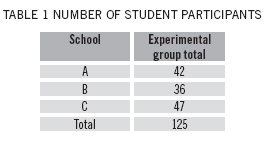
From the three schools (deciles 2–5), there was a total of 125 students in the experimental classes and 122 in the control classes (see Table 1). Forty percent of the students in the study were from ethnic-minority backgrounds, the majority of whom were from Māori or Pasifika cultural groups.
All students were administered a standardised reading comprehension test before and after the intervention. Only students who were present for both tests had their results analysed.
The test used was the Progressive Achievement Test in Reading Comprehension (PAT:Reading) published by the New Zealand Council for Educational Research (Reid & Elley, 1991). The raw scores were converted into level scores, which in turn were translated into reading ages using the Noun Frequency Readability Rating (see Reid & Elley, 1991, p. 21).
The same test was used before and after the intervention. Although there may have been some increase in scores due to repeat testing using the same version of the PAT comprehension test, this methodology was chosen to closely replicate the United States studies where only one version was available for use. The test used in the United States, the Group Reading Assessment and Diagnostic Evaluation (American Guidance Service, 2001), closely resembled the PAT format, but had audience-appropriate content and was normed for the United States school population.
A statistician from the University of Canterbury, using an analysis of variance (ANOVA), provided comparative information on changes in reading scores for the experimental and control groups, students from ethnic minorities, and both genders.
Qualitative data were collected through written evaluations from teacher and student participants at the end of the programme. The developer and teachers maintained email contact during the programme to provide formative feedback and to attend to any uncertainties.
Findings
Overall results
Figure 1 shows the overall results for both the control and experimental groups.
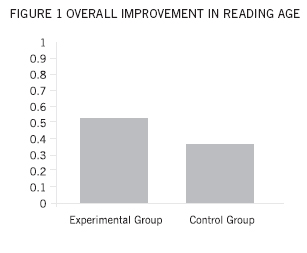
The average increase in reading age for the experimental group overall was 0.52 years, compared to the control group’s overall mean increase of 0.36 years.
Below-average readers
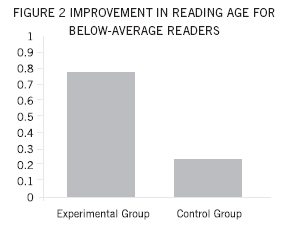
Results indicate that the AVAILLL programme has a noticeable impact for students reading at a lower level than expected and a positive impact for average or higher level readers. Teacher assessment data had identified those classified as below their expected reading level prior to the initial testing and the PAT results confirmed this status. These readers began the programme approximately one year below their expected reading level. After the six-week AVAILLL intervention their reading age increased by 0.77 of a year. The below-average readers in the control classes had a gain of 0.22 years. Differences between the experimental group and the control group for below-average readers are shown in Figure 2.
Ethnic-minority groups
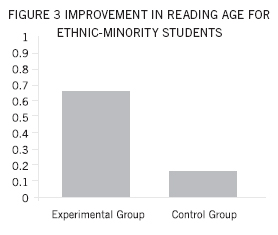
In our sample of schools, the mean reading gain of the ethnic-minority experimental group was 0.66 years. This compares with the ethnic-minority control group, whose mean gain over the same period was 0.17 years (see Figure 3).
In the control groups, only one teacher had students from ethnic minorities increase in reading age over the six-week period, but all but one group of Pākehā/New Zealand European students in the control classes increased in mean reading age.
The results for Māori, Pasifika, other ethnic-minority students and below-average readers confirm the trend noted by Dr Alice Killackey in the United States trials.
Bilingual class
School D had a bilingual English/te reo Māori class (Years 7–8) who took part in the AVAILLL programme but had no other class to match as a control. All but one of the 19 students in this class benefited from the programme (the remaining child showed no change). While the mean change in reading age was 1.5 years, the results for 11 students showed an increase in the range 1.65 to 3.1 years. For this bilingual class the programme engaged students; anecdotally, the teacher remarked on changed attitudes to reading and student involvement to the extent of humming tunes and mimicking words from the movies during ordinary class time. The bilingual class is keen to continue the programme using supplementary AVAILLL movies and literacy activities.
The marked success achieved by students in this bilingual class, where most of the students were Māori, indicates a direction for the AVAILLL programme both within New Zealand and internationally. AVAILLL could target schools in areas where there are significant ethnic minorities or low-progress readers, because it is these students that the data in both the United States and New Zealand trials indicate have made the most gains.
Gender differences
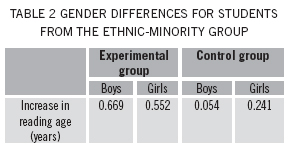
The attractiveness of the AVAILLL programme, the reading mileage generated and the explicit teaching of comprehension and other literacy skills outlined earlier made an impact upon students from ethnic minorities. The effect was especially strong for the boys. Table 2 shows the gains according to gender for the ethnic-minority students.
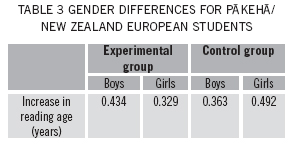
A comparison between the boys and girls in the Pākehā/New Zealand European group, however, did not show the same pattern. The boys only improved by around 0.1 year and the Pākehā/New Zealand European girls in fact scored higher in the control group than they did in the experimental group.
Age of greatest impact
Another interesting statistic was the age range where the AVAILLL programme had the greatest impact. The Years 7–8 students scored higher in relation to their pretest scores than the Years 4–6 students. This confirms the trend noted in the United States trials. Students in or approaching their early teens appear to be a target group who could benefit markedly from the intervention and the explicit teaching of literacy skills that the AVAILLL programme provides.
Student evaluations of AVAILLL
There was a very clear indication that students found the AVAILLL programme engaging and fun. They also acknowledged its potential to enhance reading and writing achievement. Common themes emerging from student evaluations included: their enjoyment; how it helped their reading; how it assisted other academic areas; how it renewed their interest in reading; and how it encouraged them to read subtitles in their leisure time.
These are some typical comments:
I didn’t even realise I was reading.
It was awesome and I’m sad that we have to do lame worksheets that don’t teach you anything [now].
I used to read one page in 2 minutes and now I am reading 10 pages in 2 minutes.
I can understand more difficult words.
If you watch movies with subtitles, you get the jokes. Without the subtitles the movie’s a bit boring.
AVAILLL—it was absolutely excellent. I am speechless! Made me spell faster, read faster and image about what you’re listening to.
If I did AVAILLL longer I’d have super high reading levels.
I think this programme should go worldwide.
AVAILLL can help millions.
It is the best reading that I have ever done.
I use much more complicated words in my reading now.
It helped me reading in ways I had never imagined.
That was the best reading activity in my life and I will never get more out of it. I think this programme should be worldwide.
My reading age has gone up just one year in six weeks.
Teacher evaluations
Five out of six teachers from the experimental group submitted an evaluation to one of the researchers. They all indicated positive engagement by students, gains in reading levels and the new practice reported by the students of using subtitles when watching movies at home. Two of the teachers identified specific gains for Māori, Pasifika and other ethnicities. Some teachers commented on how the students would dive into dictionaries, while others stated that students would voluntarily take dictionaries home over the weekend to practise on their own movies.
Many teachers reported positive feedback from parents who stated that their child now wanted to come to school to do reading. A chord that struck most teachers: their reluctant readers were happy to be reading!
Teachers said:
The programme changed my way of thinking as well as the students’. I agree that reading is just not reading, as it has many avenues to filter into, such as activities, listening, reading subtitles, communication, comprehension, concentration and extension. I have noticed changes in the students’ attitude towards reading, even though some may still not understand the overall concept, however I am very pleased with their participation. The students were so involved with all the activities and were so pleased when it came to watching the DVDs. There were times when the students would hum tunes and mimicked words during their ordinary class time.
Students … are not just aware of what a fluent reader sounds like, but know exactly what THEY need to do in order to become one themselves. This has been heartening, and also told me that the real benefits from the AVAILLL programme cannot be measured by a PAT 6 weeks after starting the programme, but rather months down the track once students have had more time to use subtitles in their own time and continue to practise fluency, using imagery while reading, and really having a true chance to independently reflect and focus on what was learnt.
I found that the students who increased their scores the most were actually my students whose native tongue is not English AND the students who were struggling with reading but were advanced enough to catch the subtitles as they popped up and who could barely complete the tasks.
The AVAILLL programme has been very successful in my classroom. The students have taken to it like ducks to water. I asked before we started who had watched DVDs with the subtitles on. 1 or 2 said they had tried it but the rest had not. Now 21 out of 25 students say they watch movies with the subtitles on and that they are even encouraging their parents to join them.
The students have expressed that the programme was fun, they were over the moon with the results and it was way better than ‘normal reading’ … I found the students that made the biggest shifts were New Zealand Māori students with lower than chronological reading ages and ESOL students who were originally reading well below their chronological reading age before going through the programme … Thank you so much for allowing us to be part of the inspirational AVAILLL programme.
Limitations
One of the teachers commented that she would be more interested in test results “months down the track”. This was valid as she expected results to continue to improve as students continued to access the subtitles when viewing films. However, this is a pilot study only and therefore sustainability of results was not investigated.
Implications of the research
The programme has real potential to engage more students in reading confidently and for pleasure. The attraction of popular films based on books of high literary quality engages students and offers them the potential to improve their reading mileage through the extensive reading of subtitles and extracts from novels. The exposure to critical literacy skills, strategies and understandings featuring in some of the activities potentially assists students to function more successfully in the modern world where being multiliterate is becoming a prerequisite. The AVAILLL programme encourages a strong connection between visual literacy (in this case the moving image) and print media. The captivating nature of the films disguises the skill development that is occurring in reading, particularly in the development of fluency.
This programme offers opportunities for students who have previously been unsuccessful in acquiring these skills and attitudes through traditional instruction and print media, to engage in activities that are highly motivating and relevant to their out-of-school activities. The collaborative nature of many of the activities aligns with current sociocultural and social constructivist views on teaching and learning (Tracey & Morrow, 2006). The engaging nature of the programme is exemplified by comments from students both during and after the programme. Many expressed their dismay when the six-week programme concluded and expressed a desire for more resources to be developed using other movies. Some critics may suggest that the “sanctity” of the book in reading programmes is at risk of being usurped or even destroyed by popular media, in this case film. However, the highly engaging nature of the activities, increase in reading mileage, connection with the book and the mental imagery that are supported by the programme’s techniques, actually assist to position books as valuable and essential resources for enjoyment and entertainment.
Furthermore, student participants could identify various aspects of reading where they knew they had improved their skills. The movies are a “pain-free” way “in” to reading for many Māori, Pasifika, other ethnic minorities and below-average readers; they become instantly involved with a media that they are not only familiar with but already view as positive and fun!
The AVAILLL programme holds great potential for assisting to break down the learning barriers that are preventing a significant percentage of students from becoming strongly literate. This is an international problem facing educators, not just a New Zealand one.
Further research is needed to ascertain the sustainability of the gains in achievement and engagement in reading that this pilot study demonstrated. A larger and more robust project is underway in 2009 to determine the sustainability of results.
Acknowledgements
We would like to acknowledge the contribution of the AVAILLL developer, Dr Alice Killackey, who passed away on 7 May 2009 while this article was in press.
References
American Guidance Service. (2001). Group Reading Assessment and Diagnostic Evaluation (GRADE). San Antonio, TX: Pearson Education.
Crooks, T., Flockton, L., & White, J. (2007). Writing: Assessment results 2006. Dunedin: Educational Assessment Research Unit, University of Otago.
Elley, W. (1992). How in the world do students read? Hamburg: International Reading Association.
Flockton, L., & Crooks, T. (2005). Reading and speaking: Assessment results 2004. Dunedin: Educational Assessment Research Unit, University of Otago.
Guthrie, J., Wigfield, A., Metsala, J., & Cox, K. (1999). Motivational and cognitive predictors of text comprehension and reading amount. Scientific Studies of Reading, 3, 231–256.
Ministry of Education. (2001). Progress in International Reading Literacy Study (PIRLS): A summary of New Zealand’s Year 5 student achievement 2001. Retrieved from Education Counts: http://educationcounts.govt.nz/publications/series/pirls/pirls_0506
Ministry of Education. (2002). PISA 2000: Overview of selected New Zealand findings. Retrieved from Education Counts: http://educationcounts.edcentre.govt.nz/publications/downloads/pisa.overview.2000.pdf
Ministry of Education. (2003). Effective literacy practice in Years 1 to 4. Wellington: Learning Media.
Organisation for Economic Co-operation and Development. (2001). Knowledge and skills for life: First results from PISA 2000. Paris: Author.
Pressley, M. (2006). Reading instruction that works: The case for balanced teaching (3rd ed.). New York: Guilford.
Reid, N. A., & Elley, W. B. (1991). Progressive Achievement Tests in Reading. Wellington: New Zealand Council for Educational Research.
Telford, M., & Caygill, R. (2007). PISA 2006: How ready are our 15 year olds for tomorrow’s world? Retrieved from Education Counts: http://educationcounts.govt.nz/publications/series/pisa/pisa_2006/16616
Tracey, D. H., & Morrow, L. M. (2006). lenses on reading: An introduction to theories and models. New York: Guilford Press.
Note
FAYE PARKHILL is a senior lecturer in the School of Literacies and Arts in Education at the University of Canterbury.
Email: faye.parkhill@canterbury.ac.nz
JILAINE JOHNSON is a senior lecturer in the School of Literacies and Arts in Education at the University of Canterbury.
Email: jilaine.johnson@canterbury.ac.nz