Conceptions of curriculum: A framework for understanding New Zealand's curriculum framework and teachers' opinions
Gavin T. L. Brown
Abstract
Five conceptions of curriculum (i.e., humanist, social reconstructionist, skills, technological, and academic) are described and used to analyse the New Zealand Curriculum Framework. It is argued that the framework contains aspects of all five conceptions, despite their apparent contradictory nature. The conceptions were used in a study of 235 primary school teachers' opinions as to the nature of curriculum. Teachers were found to be mostly in agreement with the humanist conception, while giving moderate agreement to the technological and academic conceptions. Nonetheless, they still gave slight agreement with the social reconstructionist conception. Use of the conceptions will enhance understanding of current curriculum debates and pressures.
The publishing of Curriculum Matters indicates that there is a growing interest in issues to do with curriculum. New Zealand embarked on a major and contested reform of its school curriculum in the early 1990s, and has recently undertaken a stocktake of those reforms. The stocktake has suggested somewhat minor revisions, while proposals to completely restructure the official curriculum are being floated (Rutherford, 2005). What appears missing in all the work to do with drafting, reviewing, publishing, implementing, and evaluating the official curriculum, is a framework by which the nature of curriculum can be understood. What I propose in this paper is to outline a framework by which curriculum can be understood, and report two studies that make use of that framework in analysing the curriculum and interpreting teachers' opinions of curriculum.
Most generally, curriculum has to do with the answers to such commonplace questions as “What can and should be taught to whom, when, and how?” (Eisner & Vallance, 1974). As Begg (2005, p. 6) puts it, curriculum is “all planning for the classroom”. There are several ways that curriculum can be understood: one approach interprets curriculum primarily in terms of political power (e.g., curriculum as a fact, as practice, or as social conflict, in Goodson, 1995), while a second analyses the nature of what is taught (e.g., curriculum as race, gender, aesthetic, institutionalised, or poststructuralist texts, in Pinar, Reynolds, Slattery, & Taubman, 1995). The approach I advocate examines the naïve or layperson notions that teachers—who are not curriculum specialists or theorists—have about what they think the stuff is that they are teaching.
Defining what should be in curriculum plans for the classroom requires answering two questions: (1) Who should determine what is taught?; and (2) What material should be taught? It would appear that there are a limited number of options available to curriculum developers in answering these questions. Who determines the curriculum can only be one or more of the following: (a) students' needs or wants; (b) teachers' knowledge and expertise; or (c) government's policies in response to society's problems or issues. The options for determining the substance of curriculum relates to either (a) important content, such as the chemical make-up of water, or (b) important processes, such as knowing how to learn.
Many studies have explored how teachers conceive of various subjects, including mathematics, English, reading, language, history, and social studies (Calderhead, 1996; Clark & Peterson, 1986; Thompson, 1992). These studies have shown that teachers develop a subject understanding that is “broad and deep, enabling them to facilitate the building of similar connections in the minds of others” (Calderhead, 1996, p. 716). They have also shown that the way teachers understand their subject affects the way they teach and assess. However, primary school teachers are generalists charged with responsibility for teaching all subjects—therefore, it is appropriate to examine how they conceive of curriculum, rather than just subjects. A second reason for looking at curriculum, rather than subjects, is that most teachers are not just delivery mechanisms or conduits for curriculum; but rather they are creators or makers of curriculum (Clandinin & Connelly, 1992). Thirdly, recent calls for school-based curriculum development in New Zealand (Bolstad, 2005) suggest that how teachers understand the nature of curriculum will become increasingly important.
Furthermore, where teachers are responsible for conducting curriculum-based assessment, as they are in the New Zealand, the orientation teachers have to curriculum may impact on what they believe about and how they use assessment. For example, in the field of mathematics, different major conceptions of the subject (i.e., relational understanding and instrumental understanding) are claimed to be “at the root of disagreements about what constitutes 'sound' approaches to the teaching of mathematics, and what constitutes 'sound' student assessment practices” (Thompson, 1992, p. 133). In particular, those who conceived of mathematics in relational terms appeared to emphasise authentic, problem-solving, process-focused forms of assessment, while those who conceived of mathematics in instrumental terms seemed to emphasise correct answer-focused forms of assessment.
Conceptions of curriculum
Five major orientations to curriculum have been described: (1) curriculum is about the development of processes or skills, especially in the cognitive domain, rather than just in life or social domains; (2) curriculum is about exploiting technology and technological approaches, to maximise outputs; (3) curriculum is about reforming or revolutionising society in order to bring about greater justice and benefits for all; (4) curriculum is about maximising the humanity of individuals by helping them develop their full potential; and (5) curriculum is about identifying and passing on valued academic knowledge and intellectual developments (Cheung, 2000; Eisner & Vallance, 1974). Cheung (2000) has argued that these orientations to curriculum (a) explain why teachers emphasise certain topics, (b) clarify the real meaning or intent of curriculum documents, and (c) influence both (teacher) professional and curriculum development. Inspection of curriculum practice is not guaranteed to expose teachers' true orientation to curriculum, as various contextual constraints may impose common curriculum practices on teachers with highly divergent views of curriculum (Cheung & Ng, 2000). Although teachers have interconnected conceptions of curriculum, drawing on several orientations simultaneously, there appear to be patterns in teacher conception of curriculum (Cheung, 2000).
Cheung (2000) operationalised four of the five curriculum conceptions into a teacher self-report instrument (i.e., humanist, social reconstructionist, technological, and academic). The humanist conception advocates that the student is the crucial source of all curriculum; the social reconstructionist perceives school as a vehicle for directing and assisting social reform or change; the technological orientation focuses on finding efficient means of reaching planned learning objectives through the use of modern technology; and the academic orientation aims at developing students' rational thinking and skills of inquiry. Cheung's (2000) research with Chinese-speaking, Hong Kong primary school teachers found that the highly intercorrelated technological and academic orientations most strongly explained teacher conceptions of curriculum, closely followed by a humanistic orientation. The social reconstructionist orientation was least prevalent, though still positively and moderately correlated with the three other curriculum orientations.
In a parallel study of teachers' conceptions of science curriculum, Cheung and Ng (2000) added a cognitive processes or skill orientation to the four previously identified major orientations. Their results, with a Likert self-report form, found that science teachers' orientations were predominantly cognitive-processes-oriented, though the other four orientations were not substantially weaker. This situation of many strongly-held orientations is described by Cheung and Ng (2000, p. 367) as “complementary pluralism”.
In this paper, I would like to use the five conceptions of curriculum framework to make sense of the New Zealand Curriculum Framework (Study 1), and report results from a survey of teachers' conceptions of curriculum (Study 2). I suggest that adoption of this framework would help us to better understand the messages being presented by the official curriculum, and how the official curriculum is being understood by teachers, as well as shedding some light on current curriculum debates and pressures.
Study 1: Analysis of the New Zealand Curriculum Framework in light of conceptions
The New Zealand Curriculum Framework (NZCF) is built around Principles, Essential Learning Areas, Essential Skills, Attitudes and Values, and an Assessment system (Figure 1) (Ministry of Education, 1993). I argue that the NZCF contains multiple competing and possibly incompatible conceptions within its pages. Elements of humanistic, social reform, technological, academic, and processes conceptions are available such that the NZCF means to all teachers fundamentally whatever they want it to mean.
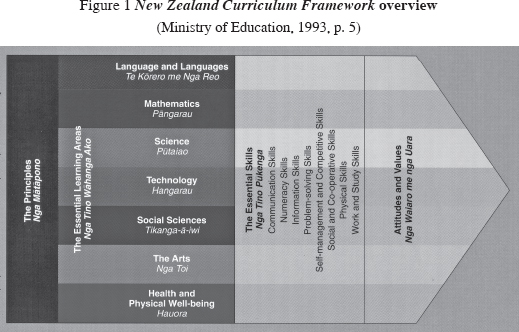
Nine principles were enunciated, that focused on the provision of a broad and balanced education that ensures achievement and success for all—through a coherent and seamless system of progress throughout schooling. The NZCF is meant to empower independent lifelong learning that is relevant to the wider world. At the same time, the NZCF is to provide flexibility for local needs while ensuring equality and inclusion for all students. A special emphasis is put, through the Treaty of Waitangi, on the needs and priorities of Māori students and communities. The framework is clearly child-centred, non-prescriptive, holistic, and integrated, while at the same time being managerial, with specified outcomes and objectives across multiple levels. The conceptions embedded in these principles are humanistic, technological, and social reforming, with a mention of skill development; the only conception not mentioned in the principles is the academic traditional-content-focused orientation.
The essential learning areas, in contrast, do provide a basis for orienting school content around the time-tested content of the academic disciplines. The most recent curriculum stocktake has extended the traditional content by adding an extra discipline: second-language learning. This part of the curriculum, which actually receives the most print space in the NZCF, and in all the supplementary curriculum statements, exhibits the traditional scholastic disciplines—English literature, mathematics, the sciences (physics, chemistry, and biology), the social sciences (history, geography, economics, sociology, etc.), the technologies (metal and woodworking, design, graphics, computers and electronics, soft materials, and cooking), the fine arts (painting, sculpture, music, dance, and drama), and health and physical education (nutrition, sexuality, sport, biomechanics, etc.). These are based fundamentally on the conception that curriculum should deliver, to young citizens, the important knowledge and content, brought down across the centuries, that are so valuable we wish all citizens to know them—herein lies the cultural canon of twenty-first century Western urban-industrial nations. The organisation of schools into essential learning faculties and departments further contributes to the discipline-based definition of what is so important that teachers should make students learn it.
In further contrast, the essential skills, by name alone, focus on the conception that curriculum is about developing important skills that will help the young person cope with a dynamic world in which important knowledge is not fixed, but rather fluid and unpredictable. The essential skills include communicative, cognitive, academic, interpersonal, intrapersonal, and vocational-oriented processes and abilities. These skills are considered to be identifiable and teachable, and their accomplishment will increase the life chances of the individual and society.
The inculcation of positive attitudes towards other people, learning opportunities, and learning materials, is a valued objective of the curriculum. I understand this to represent the humanist conception of developing as a holistic, well-rounded person. Schools are to provide activities and environments in which the positive child can be nurtured and grown. The school's curriculum responsibility also extends this humanist notion to one that is rather more socially reforming, through the provision of experiences that encourage the internalisation of such values as individual and collective responsibility, honesty, reliability, respect for others and the law, tolerance, fairness, caring or compassion, non-sexism, and non-racism. Schools are to reinforce the values of a democratic society, in which students become aware of their own values and beliefs, while exercising respect and sensitivity towards others with different values and beliefs. The humanist development of the child is extended to the development of children's ability and willingness to critically examine their own values and beliefs, as well as those of others. In my view, these values and attitudes express a conception that curriculum is about the development of the full human, and the reform of society, so that fewer social problems are perpetuated.
The assessment system advocated by the NZCF is intended to improve the quality of learning and teaching, assist in the communication of learning progress to parents and students, award qualifications, monitor standards, and target resources. It does this by measuring learning against defined outcomes that are ordered incrementally in eight levels. Assessment practices are meant to exhibit variety, fairness, and clarity, while providing school-based, diagnostic information. The indexing of learning to the eight levels, and the clear achievement objectives within each curriculum statement, bespeaks an approach to curriculum that is technological. The ordered specification of learning harks back to the days of instructional design and behavioural objectives. The application of technology to assessment can be seen in the many government-funded assessment resources available on the Internet—Assessment Resource Banks, National Exemplars, National Education Monitoring Project activities and reports, the provision of national qualifications models, and the reporting of student performance (School Entry Assessment and Numeracy Projects), and Assessment Tools for Teaching and Learning software. All express a conception of curriculum as not just something that can be organised in a technological manner, but that also requires technology itself in order to be delivered.
In summary then, the NZCF has multiple conceptions under-girding its priorities and emphases. There is not one systematic approach to deciding what should be taught, and this, I suggest, is the cause of curriculum conflict. The needs of the individual for personal development are authorised by the NZCF, which at the same time invokes a technological orientation to performing education. The contest over the place of the traditional canon of Western knowledge, versus the role to re-engineer society, is actually endorsed by the curriculum—both camps can find support for their views in the official framework. It seems to me that there is little doubt that much of the debate about the suitability of the NZCF arises from the multiple conceptions underlying the national policy. It is worth noting that many of the same insights into the NZCF were reported by Locke and Hill (2003)—I suggest that the conceptions framework provides a useful and accessible interpretive framework.
Study 2: New Zealand teachers' conceptions of curriculum
Having overviewed the multiple conceptions supported and expressed by the NZCF, I'd like to turn our attention to a study conducted some eight years after the curriculum framework's promulgation. This study was conducted as part of an extended investigation into teachers' conceptions of assessment (Brown, 2002), and sheds light on teachers' preferences for the different curriculum conceptions embedded in the NZCF.
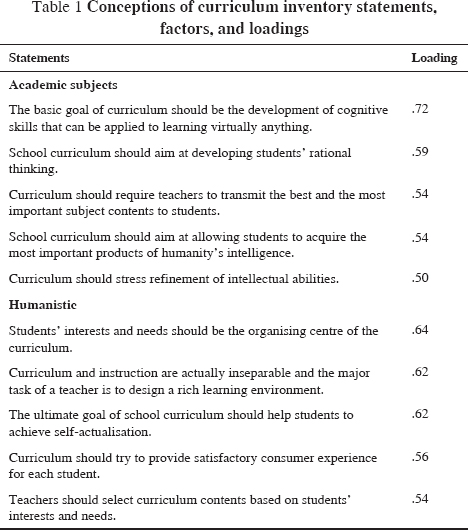
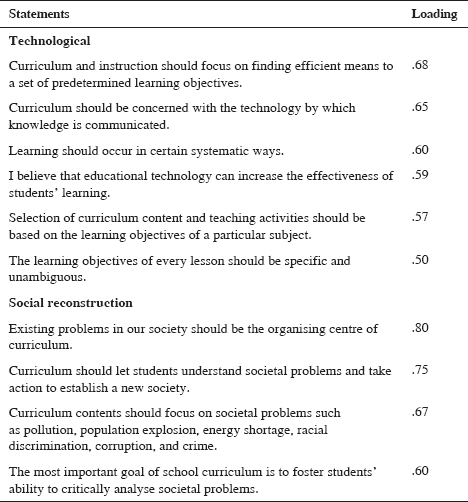
Cheung's (2000) curriculum orientations inventory consisted of 20 items which were grouped into four major conceptions (i.e., academic, humanistic, technological, and social reconstruction) (Table 1). The statements all had strong loadings on their respective factors, and scales had strong internal estimates of reliability (a range .73 to .79). The whole inventory had marginally-acceptable fit to the model in Cheung's (2000) research with teachers (CFI = .90; RMSEA = .086). A later revision to this inventory (Cheung & Wong, 2002) had a somewhat better fit (RMSEA = .073), but was unavailable at the time of this research. The inventory was adapted to New Zealand circumstances by making small wording changes. For example, the item about consummatory experience, a term introduced by Eisner and Vallance (1974), was rewritten as “Curriculum should try to provide satisfactory consumer experience for each student”.
Participants
A random, representative sample of 800 New Zealand primary schools was surveyed. In each school, the principal was asked to give a questionnaire to a teacher, and another to a leader/administrator of Years 5–7 students (i.e., ages 10 to 13). Given the low-stakes assessment regime and self-governing context of New Zealand schools, this distribution process was considered appropriate. An incentive to participants was that they were given confidential results for each questionnaire completed, relative to the New Zealand means, some nine months after completion. Of the 525 teachers who participated, approximately 235 completed the curriculum orientations inventory. This return rate was achieved without follow-up or any inducements.
The demographic characteristics of the individual teachers in this sample reasonably reflected those of the New Zealand teaching population (Table 2), as determined in the 1998 teacher census conducted for the Ministry of Education (Sturrock, 1999). The participants who completed the conceptions of curriculum inventory did not differ in any significant way from the population. Therefore, the participants in this study were from a relatively homogeneous sample of New Zealand primary school teachers, and sufficiently representative of the New Zealand population of primary school teachers on which to base generalisations (Brown, 2004).
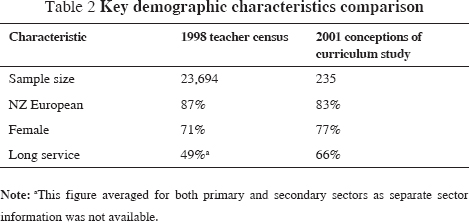
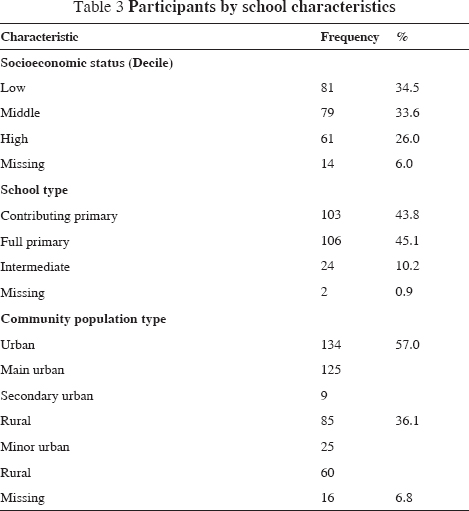
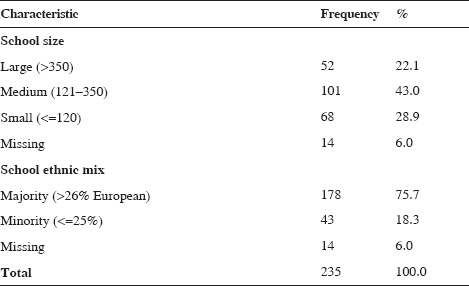
The 235 teachers were for the most part: (a) New Zealand European (83 percent); (b) female (77 percent); (c) highly experienced, with 10 or more years' teaching (66 percent); (d) reasonably well-trained with two or more years' training (82 percent); and (e) equally split between teachers (51 percent) and managers or senior teachers. As per design, the vast majority of the teachers were employed in contributing or full primary schools (89 percent) (Table 3). About one-third were employed in low socioeconomic status (SES) schools, while over a quarter worked in high SES schools. This distribution represented a very acceptable sampling of the distribution of teachers by school SES. Just over half of the teachers worked in large urban area schools, and just over 40 percent worked in medium-sized schools. Three-quarters of the teachers worked in schools whose students were predominantly of New Zealand European or Pākehā ethnicity (i.e., more than 75 percent of the roll—using a procedure described in Hattie, 2002). Therefore, data in this study were from a relatively homogeneous population of full and contributing primary school teachers, largely representative of the New Zealand population, except for an over-representation of teachers in small schools.
A two-level factor structure was tested, and it was found that the statements all had strong loadings on their four respective factors. But the whole inventory had poor fit to the model (X2 = 556.88; df = 185; TLI = .745; RMSEA = .092), and was inadmissible due to negative-error variance. As a consequence, re-analysis of the Cheung instrument resulted in dropping several items, and changing the higher order structure. The revised model had four first level factors that were correlated with each other (Figure 2), and had acceptable fit characteristics (X2 = 208.80; df = 84; TLI = .859; RMSEA = .080). The four conceptions identified were: humanistic; technological; academic; and social reconstructionist.
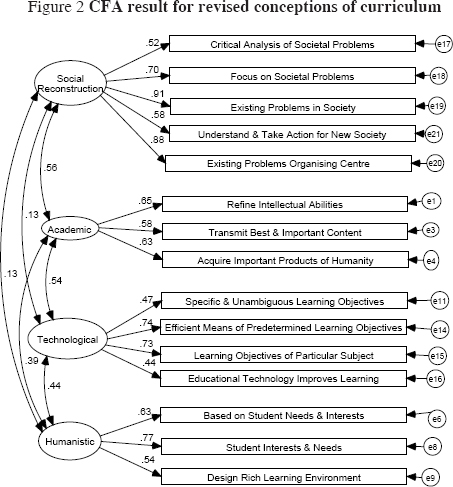
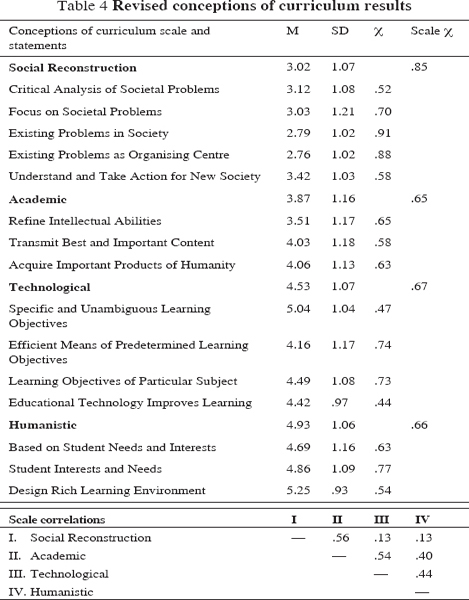
Table 4 shows the 15 statement means, standard deviations, and CFA scale loadings for the four scales, and the scale internal consistency estimates and scale intercorrelations. The Social Reconstruction scale (5 items) had good internal consistency (X = .85), an average score of 3.02 (or slightly agree), and very low correlations with the technological and humanistic scales. The Academic scale (3 items) had moderate internal consistency (X = .65), an average score of 3.87 (or nearly moderately agree), and moderate correlations with all three other scales. The Technological scale (4 items) had moderate internal consistency (X = .67), an average score of 4.53 (or half-way between moderate and mostly agree), and moderate correlations with the Academic and Humanistic scales. The Humanistic scale (3 items) had moderate internal consistency (X = .66), an average score of 4.93 (or mostly agree), and moderate correlations with the Academic and Technological scales. Therefore, four conceptions of curriculum were found, with teachers expressing most agreement with the humanistic conception, and least agreement with the social reconstruction conception. The moderate agreement with the academic conception of curriculum may be indicative of the lack of discipline-related degrees held by the participants (only 77 had three or more years of preservice training).
These data indicated that New Zealand primary school teachers held complementary plural views—they gave varying degrees of agreement to four fundamentally contradictory notions about how curriculum could be structured. They mostly agreed with the NZCF content that revolved around the primacy of the individual child, while giving moderate agreement to technological and academic aspects of the framework. In contrast, they only slightly agreed with the NZCF notions of reforming society's problems. While critics of the NZCF may have objected to the technological aspects, especially those around the assessment and levels systems (Duthie, 1994; Elley, 1996; Locke & Hill, 2003), it would appear that teachers in the classroom were not so antagonistic to these conceptions. It also suggests that assertions of support for the NZCF by teachers (Duthie, 1994; Lennox, 1996; Ministry of Education, 2002) are only partially true. Teachers supported the humanistic conceptions embedded in the curriculum, gave somewhat less support for the academic and technological notions, and came close to disagreeing with the social reforming conceptions. What this suggests is that teachers are able to recognise and discriminate between various conceptions of curriculum—their acceptance of the curriculum should not mean support for all conceptions.
Conclusion
Examining teachers' opinions about curriculum, and analysing curriculum statements, are greatly enhanced if the five conceptions outlined in this paper are used as an organising framework. These five conceptions help tease out the conflicting agendas at work in the official curriculum, and help us understand what teachers mean when they claim to support or oppose the curriculum. The pluralist tolerance of multiple perspectives, that may be mutually incompatible, can be clearly seen in both the curriculum and teachers' conceptions. I suggest that design of curriculum would be greatly enhanced if developers were able to express their plans for classroom activity in such easily grasped terms as these five conceptions. Indeed, I would go so far as to suggest that Bolstad's (2005, p. 205) concluding questions, “What should students learn at school? Why? And who decides?” can be answered at both the national and local level using the five conceptions described in this paper.
References
Begg, A. (2005). Why curriculum matters to me. Curriculum Matters, 1, 1–11.
Bolstad, R. (2005). School-based curriculum development: Is it coming back into fashion? Curriculum Matters, 1, 186–208.
Brown, G. T. L. (2002). Teachers' conceptions of assessment. Unpublished doctoral dissertation, University of Auckland, Auckland.
Brown, G. T. L. (2004). Teachers' conceptions of assessment: Implications for policy and professional development. Assessment in Education: Policy, Principles and Practice, 11(3), 305–322.
Calderhead, J. (1996). Teachers: Beliefs and knowledge. In D. C. Berliner & R. C. Calfee (Eds.), Handbook of educational psychology (pp. 709–725). New York: Simon & Schuster Macmillan.
Cheung, D. (2000). Measuring teachers' meta-orientations to curriculum: Application of hierarchical confirmatory analysis. Journal of Experimental Education, 68(2), 149–165.
Cheung, D., & Ng, P.-H. (2000). Science teachers' beliefs about curriculum design. Research in Science Education, 30(4), 357–375.
Cheung, D., & Wong, H.-W. (2002). Measuring teacher beliefs about alternative curriculum designs. The Curriculum Journal, 13(2), 225–248.
Clandinin, D. J., & Connelly, F. M. (1992). Teacher as curriculum maker. In P. F. Jackson (Ed.), Handbook of research on curriculum (pp. 363–401). New York: Macmillan.
Clark, C., & Peterson, P. (1986). Teachers' thought processes. In M. Wittrock (Ed.), Handbook of research on teaching (3rd ed., pp. 255–296). New York: Macmillan.
Duthie, V. (1994, July). Responses to the draft national curriculum statement English in the New Zealand curriculum. Unpublished report to the Ministry of Education. Wellington: Duthie Educational Consultancy.
Eisner, E. W., & Vallance, E. (1974). Conflicting conceptions of curriculum. Berkeley, CA: McCutchan.
Elley, W. B. (1996). Curriculum reform: Forwards or backwards? Delta: Policy and Practice in Education, 48(1), 11–18.
Goodson, I. (1995). The making of curriculum: Collected essays (2nd ed.). Washington, DC: Falmer Press.
Hattie, J. A. (2002). Schools like mine: Cluster analysis of New Zealand schools. (asTTle Tech. Rep. No. 14). Auckland: University of Auckland, Project asTTle.
Lennox, B. (1996). Comment: 'English in Aotearoa'. English in Aotearoa, 30, 18–20.
Locke, T., & Hill, M. (2003). The impact of changes in the nature of teachers' work on teacher professionalism. A collaborative project report. Hamilton: University of Waikato.
Ministry of Education. (1993). The New Zealand curriculum framework: Te anga marautanga o Aotearoa. Wellington: Learning Media.
Ministry of Education. (2002). Curriculum stocktake report. Wellington: Author.
Pinar, W. F., Reynolds, W. M., Slattery, P., & Taubman, P. M. (1995). Understanding curriculum. New York: Peter Lang.
Rutherford, J. (2005). Key competencies in the New Zealand curriculum development through consultation. Curriculum Matters, 1, 209–228.
Sturrock, F. (1999). Teacher census: Preliminary report. Wellington: Ministry of Education, Demographic and Statistical Analysis Unit.
Thompson, A. G. (1992). Teachers' beliefs and conceptions: A synthesis of the research. In D. A. Grouws (Ed.), Handbook of research on mathematics teaching and learning (pp. 127–146). New York: Macmillan.
Note
This paper includes research conducted as part of the author's 2002 PhD dissertation, Teachers' Conceptions of Assessment.
The author
Dr Gavin T. L. Brown, Senior Lecturer Research Methodology at The University of Auckland, has been conducting research on and teaching about teachers' and students' conceptions of assessment, teaching, learning, and curriculum, for the last five years. He has investigated teachers' and students' conceptions in New Zealand and Queensland. Previously, Gavin was the Senior Project Manager for the Assessment Tools for Teaching and Learning (asTTle), and an assessment researcher at the New Zealand Council for Educational Research. Currently, he is working on a book on conceptions of assessment, for Nova Science Publishers, New York.
Email: gt.brown@auckland.ac.nz