Learning additional languages in
New Zealand’s schools: The potential
and challenge of the new curriculum area
Martin East
Abstract
New Zealand’s new school curriculum, which will become mandatory from 2010, will require schools to offer a second-language programme as a curriculum “entitlement” for students in Years 7–10. This article considers the implementation of this new proposal in comparison with parallel developments in England, which include, from 2010, an entitlement to foreign-language courses for all students in Years 3–6, in addition to the well-established study of foreign languages in Years 7–11. A variety of published documents are used to build up a composite picture of the ways in which the two countries are addressing the issue of strengthening language learning in schools. It is argued that the contrasting evidence that emerges reveals the relative weakness of the New Zealand initiative. The article concludes by suggesting ways in which the New Zealand proposal could be made more effective.
Introduction
One significant development in New Zealand’s recently launched school curriculum is the establishment of a new learning area—Learning Languages. This new area will give the teaching and learning of second languages a higher profile and a greater status than it has thus far enjoyed in schools. This article considers the proposed implementation of the new curriculum area in comparison with parallel developments in England. The situation in England has been chosen for comparative purposes because both New Zealand and England are currently working towards improving the effectiveness of second-language learning in schools through new initiatives that will take full effect from 2010. The paper draws on and compares data from a variety of published documents from both countries. The contrasting evidence that emerges raises concerns about the potential impact of Learning Languages in New Zealand. The discussion is restricted to those languages identified in New Zealand as international languages other than English or Māori, or LOTEMs (Waite, 1992), and in England as modern foreign languages, or MFLs.1
The context of comparison
It might be suggested that a comparison between New Zealand and England in terms of foreign-language learning is meaningless. On the one hand, New Zealand’s geographical isolation (its closest large-scale neighbour is the largely English-speaking Australia) and its established trade links with other English-speaking nations place it into direct contrast with England, a member of the European Union, a nation on the doorstep of multilingual Europe, and a participant in the Council of Europe. It would seem on these bases that foreign-language learning is (or at least should be) considerably more of a priority for England than for New Zealand.
Participation in the Council of Europe undoubtedly brings with it a specific commitment to language teaching and learning, which is absent from New Zealand (Council of Europe, 2001; van Els, 2001). In addition, New Zealand can be clearly differentiated from England by virtue of its recognition of Māori as an official language, a differentiation that should arguably influence attitudes to language learning in New Zealand in a way that is absent from the English scene. New Zealand has moved well beyond its former colonial status (with implied close ties to “Mother England”), has situated itself firmly within the Asia–Pacific region, and has conferred equal status in law on the language of the tangata whenua. On these bases it should arguably be carving an independent niche for itself in terms of language teaching and learning, rather than maintaining the teaching of foreign languages on the basis of an historical link to a now distant past.
However, the reality (for New Zealand) is that the introduction of a new learning area comes on the back of international critique of the original curriculum, which led to the conclusion that, relative to other countries, New Zealand has very low levels of language learning, and the implication that New Zealand really ought to do something about this (Ministry of Education, 2002). Furthermore, New Zealand and England may legitimately be compared in three key respects: (1) the structure of the school system and the statutory nature of a national curriculum; (2) the range of foreign languages taught in schools; and, arguably most significantly, (3) attitudes towards foreign-language learning. These factors suggest that, notwithstanding the problems with comparison noted above, a comparison will serve to highlight issues of which New Zealand needs to be mindful.
Schooling and curriculum
For a start, the structure of compulsory schooling in the two countries is similar, with New Zealand having been influenced historically by the way education is structured in the United Kingdom. Figure 1 represents the most usual configuration.
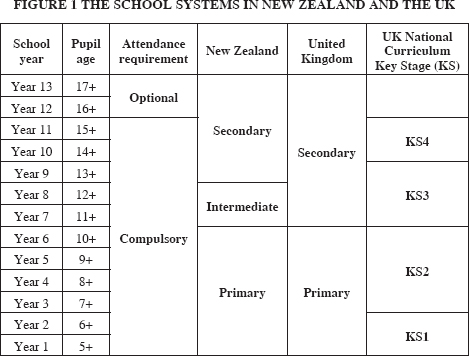
Both countries operate the school curriculum through statutory regulation. The UK’s national curriculum is divided into four “Key Stages” (KS, see Figure 1), with some differentiation in requirements across stages. At KS3, for example, subjects compulsory for all students are designated as “core” (English, mathematics, science) and “foundation” (nine subjects, including MFLs). Some students can be “disapplied” from an aspect or aspects of the main curriculum (that is, exempted from sections of it for a short or longer term) if, for example, those students are identified as having special educational needs. The new New Zealand curriculum applies to all years of schooling, from Years 1 to 13. It is not as subject specific or prescriptive as the UK curriculum, and is divided into eight “learning areas”, including the new Learning Languages.
Range of languages on offer
The MFLs taught in schools in England are broadly differentiated between “community” and “international”, although schools are legally required to offer one or more of the official languages of the European Union. In New Zealand, one early influential report (Waite, 1992) classified languages into several groups (Figure 2). The subgroup LOTEMs parallels the UK’s broad differentiation (although the range of languages on offer differs somewhat).
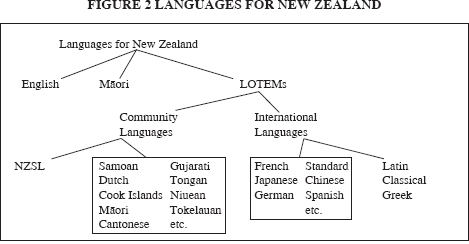
Notes: LOTEMs—languages other than English and Māori; NZSL—New Zealand Sign Language (an official language in New Zealand since April 2006).
Source: Waite, 1992
Entrenched monolingual attitudes
Arguably the most influential point of comparison with regard to foreign-language learning is a perceived entrenched “monolingual attitude”. Willis (2002) argues that over time monolingualism has become the norm for England: English has acquired an international and practical value for other nations, and has become the world’s main lingua franca. This in turn has influenced UK citizens’ need and willingness to learn other languages, and monolingualism has prevailed, despite compulsory study of an MFL at KS3. Willis (2003) notes that the UK’s monolingualism symbolises an expectation that others will reach out to the nation using English.2 This, she suggests, is perceived as a remnant of colonial attitudes.
Each of these arguments could well be applied to the situation in New Zealand, where similar monolingually minded attitudes have been identified in both the academic and professional literature (for example, Bell, Harlow, & Starks, 2005; East, 2000, 2003). Indeed, May (2005) notes one “clear reflection of the English monolingual bias” as being a “palpable lack of interest in language issues, among both policy makers and the wider public” in New Zealand (p. 3). There appears to have been a widely held belief that English is the only essentially important language, an assumption that has influenced policy decisions (Benton, 1996; May, 2002).
Given the similarities, both in educational structure and, more importantly, in attitude, comparisons of the situations in New Zealand and England with regard to foreign-language learning and the means of addressing the attendant problem of low status provide one way of evaluating the extent to which Learning Languages will make a difference to New Zealand’s language capabilities.
The English situation
The Nuffield Languages Inquiry was established in 1998 to “probe the assumption that ‘English is enough’” (McDonald & Boyd, 1998, p. 1), to take stock of the UK’s national capacity for languages, and to make recommendations for the future. Two years later its final report and recommendations were published (Nuffield Languages Inquiry, 2000). Building on this work, the UK government published a strategy document, Languages for All: Languages for Life—A Strategy for England (Department for Education and Skills, 2002). The context for the strategies suggested in this document is expressed in these words:
In the knowledge society of the 21st century, language competence and intercultural understanding are not optional extras, they are an essential part of being a citizen. For too long we have lagged behind as a nation in our capability to contribute fully as multi-lingual and culturally aware citizens. Likewise in the global economy too few employees have the necessary language skills to be able to engage fully in international business, and too few employers support their employees in gaining additional language skills as part of their job. (p. 5)
The foreword to the document spells out (p. 4) the vision for foreign-language learning the document sets. It is a vision to:
•&;&;provide an opportunity for early language learning
•&;&;provide high-quality teaching and learning opportunities
•&;&;transform the country’s capability in languages.
One of the lynchpins of the strategy is the progressive introduction of an “entitlement” to learning an MFL at KS2 (Years 3–7), such that by 2010 every student in KS2 will have the opportunity to learn at least one foreign language. In order to support the KS2 directive and to fulfil the key principle of “early language learning and high-quality teaching”, the UK government has put in place several initiatives (Department for Education and Skills, 2005). It has:
•&;&;published a pledge that by 2008 it will have invested £137 million (NZ$350m) in languages teaching
•&;&;funded 6,000 preservice teachers to follow a primary preservice course, which also develops their language skills
•&;&;provided access to in-service training for 18,000 primary teachers and funding for 9,000 teaching assistants.
Furthermore, preservice MFL teachers are currently eligible to apply for a £9,000 (NZ$22,500) training bursary and a £2,500 (NZ$6,250) “golden hello” payment (National Advisory Centre on Early Language Learning, 2007), strategies designed to add extra incentive to those considering training as foreign-languages specialists.
Despite this considerable financial commitment, the Languages for All document states:
The scale of the task must not be underestimated. Delivering an entitlement to language learning for pupils at Key Stage 2 will involve not only a huge cultural shift but also a challenge in terms of curriculum planning and a real effort in terms of training and mobilising a workforce that has the skills, expertise and confidence to deliver language learning in our primary schools. (Department for Education and Skills, 2002, p. 15)
Nevertheless, a recent government-initiated review of language provision (Dearing & King, 2007) is positive about the KS2 initiative, reporting that the take-up of languages in primary schools has gone very well, with around 70 percent of primary schools offering a language or being close to doing so. It appears that students across the ability range are enjoying languages, and there is no apparent lack of enthusiasm, interest, or willingness to learn them.
At the other end of the “compulsory schooling” spectrum (KS4—Years 10 and 11), however, the requirement that all students should have to study a foreign language to the level of the General Certificate of Secondary Education (GCSE, equivalent to NCEA Level 1) has been relaxed. From 2004 learning a language has ceased to be a mandatory part of the curriculum. Instead, it has also become an “entitlement”. It appears that governmental policy on language learning in England has given with one hand and taken away with the other. Willis (2002) points out the apparent inconsistency of this dual approach:
In an amazing feat of léger de main, the [UK government] could declare that ‘unless our children learn languages earlier we will fail them’ … whilst simultaneously downgrading their status to that of mere ‘statutory entitlement’ in Key Stage 4. Foreign languages would miraculously move from being a compulsory element of the secondary curriculum, to a ‘desirable’ subject in the primary sector and a requirement only in Key Stage 3. (p. 2)
There is certainly an apparent inconsistency here. These changes have given a conflicting message about the priority and status of foreign-language learning.
The situation in New Zealand
“We really must learn to speak other languages.” Thus argued Deputy Prime Minister Don McKinnon in 1992 in an address entitled “English is not enough”. He went on to argue that “The curricula in New Zealand schools and courses available in universities must equip young people with language and cultural skills … New Zealand’s ability to earn a living—our very future in fact—depends on young New Zealanders acquiring international language skills” (McKinnon, 1992, p. 1).
New Zealand’s 1993 curriculum framework document reinforced this message with the argument that “[a]ll students benefit from learning another language from the earliest practicable age” (Ministry of Education, 1993, p. 10). Nevertheless, the subsuming of foreign-language learning into a broader curriculum area (Language and Languages), which also included English and te reo Māori as first languages, along with its optional status, led in practice to frequent marginalisation.
The introduction of Learning Languages as a separate area signals a more positive and proactive approach to addressing the low take-up of languages. The new initiative appears to have been framed in the context of confronting the problem of monolingualism, which:
was specifically acknowledged by the Prime Minister … when she publicly supported the launch, in June 2003, of a Ministry of Education initiative to establish the teaching of languages other than English (i.e., second languages) in schools between Years 7–10. (May, 2005, p. 6)
May goes on to sound a warning note, however, when he observes that “there was an allied recognition that more resources, including the training of more language teachers, were urgently needed if this proposal was ever to be meaningfully implemented” (p. 6).
In New Zealand, therefore, language learning has also received attention with a government-supported focus on “entitlement” in Years 7–10. At the same time, problems around both financing and staffing the initiative have been identified as potential barriers to success.
Comparison of the New Zealand and English situations
If we compare the New Zealand initiatives to address monolingualism and the low take-up of foreign languages with those that are currently being implemented in England, there is a sense in which the New Zealand solutions may be “weighed in the balance and found wanting”. Figure 3 illustrates the differences in compulsory, entitlement, desirable, and optional language classes in these two contexts.
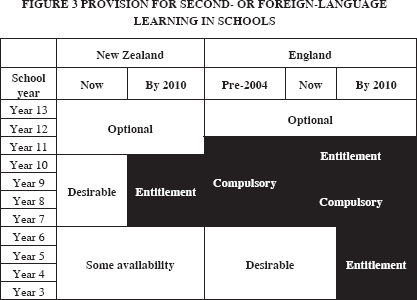
In terms of future direction, one major point of difference stands out: in England a compulsory core of teaching and learning a foreign language, found in Years 7–9 (KS3), is embedded within an entitlement to learning a foreign language from Years 3–11. In New Zealand, by contrast, there is no compulsory core, and entitlement will only be available to students in Years 7–10.
A second point of contrast relates to the numbers of students who currently study foreign languages in the two countries. A snapshot of subject enrolment statistics in the period 2001–2007 (Table 1), available each year from New Zealand’s Ministry of Education, reveals the trends for the take-up of international LOTEMs in the secondary schools sector, benchmarked in percentages against the numbers of students in Years 9–13.3
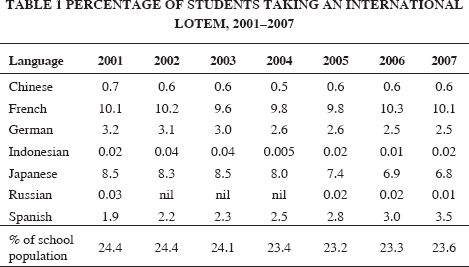
These data reveal that the number of students across the secondary range taking a foreign language has remained relatively consistent over this seven-year period at around one in four school students. Comparing these data to those recorded by East, Shackleford, and Spence (2007), who looked at the period 1991–2003, it is evident that the figures have remained fairly constant over the past 15 years, although the trend each year is slightly downwards. Furthermore, the commentary East et al. provide on the 1991–2003 data (p. 21) is equally applicable to the 2001–2007 data presented here: in practice, the take-up of languages is lower than the figures in Table 1 suggest because it is possible that a number of students will have been studying more than one language at the time of data collection. Also, the data represent the state of play at the time the data were collected (1 July each year). They do not capture the fact that many students, especially in Year 9, do not follow year-long courses and only access foreign languages as “taster options”, which may only be available for one or two terms.
These data can also be extrapolated to look at the take-up in each individual language across each year group. Table 2 takes the data for 2007 (the most recent data available), considered in percentage terms against the number of students in the relevant age range (13+ to 17+).
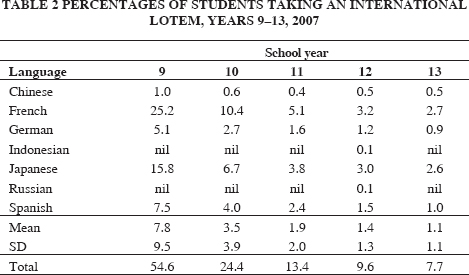
It is evident that, overall, over half the students in Year 9 were studying a language at the time of data collection. On average, fewer than 1 in 10 were studying a particular language, although French and Japanese were the two most popular languages (at 25 percent and 16 percent of those studying languages, respectively). By the time students reached Year 11 (the current final year of compulsory schooling), the overall figure had dropped to just over 1 in 10 students, with an average per language of fewer than 1 in 50. At the end of schooling (Year 13), by which time students’ subject choices become more specialised, figures had dropped further to below 1 in 10 overall, with just over 1 in 100 taking a specific language. Distributions for 2007 are typical of other years.
Bearing in mind the new entitlement to language learning in Years 7 and 8 (which has not yet taken effect), and that in England an MFL is a statutory requirement in Years 7 and 8, it is also useful to look at the take-up of languages in New Zealand in these years. Table 3 presents the available data for 2007, once more considered in percentage terms against the number of students in the 11+ to 12+ age range.
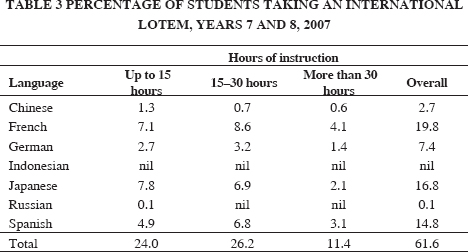
Considered across both year groups (7 and 8), it is evident that in 2007 almost two-thirds of students had the opportunity to study an international LOTEM (although it is impossible to tell what proportion received instruction in each of the two years). This figure was up from just over half in 2006, the increase being accounted for by an increase in students studying Japanese and Spanish. The largest number of students (one in four overall) received instruction for between 15 and 30 hours a year, with just over 1 in 10 receiving more than 30 hours a year (15–30 hours a year translates to the equivalent of roughly 20–45 minutes a week over the entire school year).
In England, and allowing for the “disapplication” of some students at KS3, virtually all school students in Years 7–9 would have been required to learn an MFL. In Years 10 and 11, when an MFL becomes an option choice for GCSE, a different scenario emerges. Table 4 illustrates the proportions of those entered for a GCSE in an MFL between 2001 and 2007. It is clear that since relaxing the rules on mandatory study of an MFL in 2004, take-up of MFLs at GCSE level has been in steep decline.
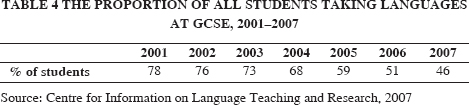
A comparison of the data in Tables 1–4 reveals the following trends. In New Zealand, 62 percent of students across Years 7 and 8, and 55 percent of students in Year 9, received at least some instruction in a LOTEM in 2007. In England, by contrast, the majority would have taken at least one MFL in Years 7–9 as a compulsory subject. In Year 11 in New Zealand the take-up of languages dropped to just over 1 in 10 (13 percent). In England just under one student in every two (46 percent) took a GCSE in at least one MFL at the end of KS4, a figure that was received by the government with some concern. Removing the statutory requirement to study an MFL at KS4 appears to have had a very negative effect on take-up, and it remains to be seen by how far entries to GCSEs in MFLs will fall before the numbers bottom out.
Some considerations for the future
In view of the comparatively low take-up of languages in New Zealand, the move towards widening opportunities for language learning by making languages an entitlement at both intermediate and secondary levels is a positive move. If the New Zealand Government is serious about addressing the issue of low language take-up (and it appears that it is), and in light of the different directions being taken in England at KS 2 and 4, several steps are necessary in order to help strengthen language learning in New Zealand’s schools.
The government could consider a compulsory requirement to take a language for either intermediate-level students (Years 7 and 8) or high school students (Years 9 and 10), or both cohorts of students. It is evident that Willis (2002), for example, is somewhat scathing of the notion of entitlement, suggesting that she sees it as an inferior option. From this perspective, lack of compulsion does little to signal that learning foreign languages is an important and worthwhile activity (and data from England suggest that lack of compulsion is having a negative effect).
A further significant problem associated with lack of compulsion at some stage in the system is that students are likely to receive very different levels of provision in different areas. This problem would be exacerbated as students move, at the end of Year 8, from a range of “feeder” schools to a range of secondary schools. There may be several layers of mismatch between what different students have done in one school and what they will be required to do in another. They may be required to switch from one language to an entirely different one, or to repeat material in the senior school they have covered and learnt quite adequately in their former school. This problem also confronts language planners and schools in England. As Boaks (1998) argues, there is, on the one hand, strong support for foreign-language learning in the early years. There is, on the other hand, concern about “the dangers of unequal, uncoordinated and unresourced growth … without regard to continuity into the secondary phase” (p. 35). In England, however, the three years of compulsion at KS3 at least allow for some level of co-ordinated approach.
Given the New Zealand split between intermediate and secondary schools, compulsion itself does not solve the problem of unequal growth, but it may be that limited compulsion (perhaps in Years 7 and 8) would go some way towards achieving some co-ordinated provision. Furthermore, co-ordinated provision on a regional basis, whereby intermediate and secondary schools in particular localities talk to each other about or share provision and choose to focus on a particular language or languages, would help to minimise the negative impact of this potential difficulty.
If, however, the opportunity to learn another language is to have any chance of success in New Zealand, perhaps the biggest practical problem to be solved is the staffing issue. It may, as Peddie (1997) suggests, be counterproductive to introduce compulsory languages in New Zealand because of the lack of availability of suitably qualified teachers. Even entitlement is likely to be hampered by inadequate staffing. The question must be asked whether an entitlement to starting younger will really work to the benefit of learners if staffing problems are not addressed. Hu (2005) argues:
Policy decisions on the starting age for foreign language education need to take into account a large number of contextual and resource factors. Early instruction itself is not a sufficient condition for effective learning to occur; there are other conditions that are required, for example, the availability of teachers with a high level of proficiency in the target language and professional training, rich opportunities for authentic communication in the language, ample instructional time, teaching methodology geared to the learning needs of young children, as well as consistent and well-designed follow-up instruction in the higher grades. (p. 18)
Hu here identifies several factors for successful language learning which present real challenges for New Zealand, namely:
•&;&;teachers who have a high level of linguistic competence (which is hampered by teacher supply issues)
•&;&;plenty of opportunity to use the language authentically (which can only happen if the teachers have sufficient linguistic expertise)
•&;&;plenty of teaching time (which many schools do not or cannot offer)
•&;&;a consistent and seamless approach across several years of schooling (which is difficult because of the transition from intermediate to secondary school).
In England, considerable financial investment has been committed to attracting more language graduates into teaching. New Zealand has thus far made no such investment. Even so, staffing issues remain a concern in both countries. When highly qualified, highly skilled new teachers are simply not available in sufficient numbers, we may, as Kaplan and Baldauf (1997, p. 130) assert, be forced to rely on those with a personal interest in promoting language learning, even though they themselves may have minimal language competence. In England this has not necessarily been perceived as a bad thing. Boaks (1998) suggests that “[p]rimary teachers who have good generic teaching skills, and who can offer a reasonable model of the spoken language, can provide a worthwhile MFL experience for their pupils” (p. 35). The difficulty with Boaks’ suggestion is how the terms “reasonable” and “worthwhile” may be defined.
In the European context a good deal of work has been done in an attempt to prescribe different levels of language competence that are transferable across a range of languages. The result of this work has been the publication of the Common European Framework of Reference for Languages, or CEF (Council of Europe, 2001). This framework classifies linguistic competence in six broad bands, from beginner’s level up to near-native-speaker competence. Several internationally recognised qualifications in European languages have been benchmarked against the CEF.
Seen in the light of Boaks’ (1998) argument that limited or partial competence is acceptable, it might be suggested that qualifications of this sort at the very least provide a minimum level of quality assurance concerning potential or practising language teachers. (Indeed, one New Zealand initiative has been to provide serving teachers with in-service opportunities to prepare for a beginner’s or intermediate-level CEF-benchmarked qualification.) However, bearing in mind Hu’s (2005) perspective that a necessary prerequisite for student success is to have teachers with a high level of target-language proficiency, it is a matter of debate whether teachers with levels of linguistic competence below the most advanced will be proficient enough to help their students to learn successfully. Nevertheless, in the context of the genuine constraints within which a policy of foreign-language entitlement must operate, in-service training of those with a personal interest is a definite start, signalling a commitment to having teachers who are (to a certain level) linguistically as well as professionally qualified. In the New Zealand context it may be that, in the shorter term at least, this is the best that can be done.
Conclusion
When it comes to the teaching and learning of foreign languages in schools, both England and New Zealand appear to face similar problems around arming young people with the linguistic skills they might need in the future. To begin to address these problems they have adopted different strategies for languages in education. At the time when England’s national curriculum required all school students to study at least one MFL for five years, Boaks (1998) observed that “the UK remains behind its European partners in total MFL provision. In those countries pupils start earlier and continue longer” (p. 35). Seen in this light, the removal of compulsion at KS4 has been a retrograde step—the creation of what Willis (2002) describes as “mere” entitlement. On the other hand, entitlement at KS2 is a more positive move. Also seen in this light, the New Zealand provision— entitlement only for four years—is definitely “found wanting”, and raises questions about what New Zealand is not achieving. As East et al. (2007) argue:
If we are serious about having New Zealanders who are fluent in additional languages that they have learned in the education system, then doing a few little courses in, for example, Japanese or French is just window dressing. Surely an ‘entitlement’ is meaningless if it does not facilitate high-level, high-quality language programmes in all schools, delivered by highly qualified staff. Without some form of compulsion, the problem of the minimal ‘taster’ option does not appear to have been satisfactorily addressed. (p. 25)
The debates and constraints around foreign-language teaching in schools bring us back to the essential problem explored towards the start of this article. Jones (1998) suggests that in England “one of the cries from a reluctant languages student which will be familiar to Modern Language teachers in schools is, ‘Why do we have to learn this? Everyone speaks English anyway!’” (p. 9). East (2000) asserted that, in New Zealand, two questions that often seem to be in the thinking of the young people seen in languages classrooms day in and day out are: ‘“Why do we need to bother with other languages? Surely they all speak English, don’t they?”’ (p. 9).
Entrenched monolingual and Anglocentric attitudes arguably work against the successful introduction of meaningful courses in foreign languages in schools. At a fundamental level an attitudinal change is required if foreign-language learning is to have a chance at real and lasting success. The foreword to England’s Languages for All strategy (Department for Education and Skills, 2002) concludes with a warning:
Changing the country’s attitude to teaching and learning languages will demand a huge cultural change. It will rely on action from Government, schools, LEAs [Local Education Authorities], colleges, universities, employers, parents and learners. Partnership is the key to making this strategy a reality. It is only if we work together on the implementation of this strategy that we will achieve real and lasting change for the future. (p. 4)
This message is also applicable to New Zealand. The strategy to provide a meaningful entitlement to all school pupils at Years 7–10 will require proactive action from all the sectors mentioned as being necessary in England. There is a very real sense in which New Zealand’s attitude to teaching and learning languages requires a genuine cultural change. The extent of the change required should not be underestimated. If we are to achieve genuine and lasting change, a serious consideration of some level of compulsion, coupled with the setting of a minimum level of language competence for teachers and an increase in quality preservice and in-service training opportunities, funded by the government, will arguably also be required.
It may have been suggested in the New Zealand context that “[a]ll students benefit from learning another language” (Ministry of Education, 1993, p. 10) and that “[w]e really must learn to speak other languages” (McKinnon, 1992, p. 1), but such claims require substantiation if foreign-language learning is to be, and to be seen to be, meaningful. Many reasons have been proposed for the learning of additional languages, including arguments relating to economic advantage, international networking, and cognitive gains (see, for example, Waite, 1992). Nevertheless, it remains to be seen how successful the new curriculum area will be in promoting second-language learning and enhancing the linguistic capability of New Zealand’s young people. East et al. (2007) note, however, that, despite genuine constraints, the introduction of the new learning area is “a positive move in the right direction” (p. 26). In comparison with the situation in England (and Europe), it arguably does not go far enough, but New Zealand does at least have something to build on.
Notes
1&;&;This is not to suggest that Māori or community languages in New Zealand are of less importance. The data presented here relate only to international LOTEMs, as defined by Waite (1992), in order to provide the most appropriate comparison with the UK, where in most cases students study a language of the European Union as opposed to a language of the community, or in addition to an indigenous language.
2&;&;Given the UK’s participation in the Council of Europe, the expectation that “others will reach out to the nation using English” sets up a unique tension for the UK which is absent from the New Zealand situation. The final report of the Nuffield Languages Inquiry (2000) is a research-based attempt to articulate this tension and to make recommendations to address it from a multilingual perspective.
3&;&;Statistical analysis can be problematic because the available data present the numbers of students enrolled in particular subjects, but do not indicate precisely how many students were in each year group (rather, overall numbers are grouped in terms of type of school attended or actual age). Percentage figures were calculated using several data configurations. It was found that the percentages did not differ greatly regardless of data configuration, and can therefore be considered reliable in terms of identifying trends.
References
Bell, A., Harlow, R., & Starks, D. (2005). Languages of New Zealand. Wellington: Victoria University Press.
Benton, R. (1996). Language policy in New Zealand: Defining the ineffable. In M. Herriman & B. Burnaby (Eds.), Language policies in English-dominant countries: Six case studies (pp. 62–98). Clevedon, UK: Multilingual Matters.
Boaks, P. (1998). Languages in schools. In A. Moys (Ed.), Where are we going with languages? (pp. 34–43). London: Nuffield Foundation.
Centre for Information on Language Teaching and Research. (2007). GCSE language entries trend analysis, all schools in England, 1994–2007. Retrieved 25 April 2007, from http://www.cilt.org.uk/research/statistics/education/gcse_trends_dfesdata2007.doc.
Council of Europe. (2001). Common European Framework of Reference for Languages. Cambridge, UK: Cambridge University Press.
Dearing, R., & King, L. (2007). Languages review. London: Department for Education and Skills.
Department for Education and Skills. (2002). Languages for all: Languages for life—a strategy for England. London: Author.
Department for Education and Skills. (2005). A boost for modern foreign languages. London: Author.
East, M. (2000). “But surely they all speak English, don’t they?”: Dominant English and the challenge of international languages. New Zealand Language Teacher, 26, 9–18.
East, M. (2003). Planning a multilingual future in a monolingual culture: Challenges for international language learning in New Zealand. TESOLANZ Journal, 11, 10–22.
East, M., Shackleford, N., & Spence, G. (2007). Promoting a multilingual future for Aotearoa/New Zealand: Initiatives for change from 1989 to 2003. Journal of Asian Pacific Communication, 17(1), 11–28.
Hu, G. (2005). English language education in China: Policies, progress, and problems. Language Policy, 4, 5–24.
Jones, S. (1998). How does Europe promote languages? In A. Moys (Ed.), Where are we going with languages? (pp. 6–13). London: Nuffield Foundation.
Kaplan, R., & Baldauf, R. (1997). Language planning—from practice to theory. Clevedon, UK: Multilingual Matters.
May, S. (2002). Where to from here? Charting a way forward for language and education policy in Aotearoa/New Zealand. TESOLANZ Journal, 10, 22–35.
May, S. (2005, August). Developing a national languages policy—overview. Paper presented at the New Zealand Diversity forum @ Te Papa, The Challenges of Diversity, Wellington. Retrieved 28 September 2008, from http://www.hrc.co.nz/hrc_new/hrc/cms/files/documents/28-Aug-2005_18-57-22_Stephen_May_NZDiversity.doc
McDonald, T., & Boyd, J. (1998). Foreword. In A. Moys (Ed.), Where are we going with languages? (p. 1). London: Nuffield Foundation.
McKinnon, D. (1992). Speech presented to the Asia 2000 Realising the Opportunities seminar, May 1992. Press release from the Office of the Minister of External Relations and Trade.
Ministry of Education. (1993). The New Zealand curriculum framework. Wellington: Learning Media.
Ministry of Education. (2002). Curriculum stocktake report to Minister of Education. Retrieved 1 December 2007, from http://www.minedu.govt.nz/index.cfm?layout=document&documentid=7823&data=l&goto=00
National Advisory Centre on Early Language Learning. (2007). Training to teach languages in primary education. Retrieved 9 April 2007, from http://www.nacell.org.uk/profdev/training.htm
Nuffield Languages Inquiry. (2000). Languages: The next generation. London: The Nuffield Foundation.
Peddie, R. A. (1997). Why are we waiting? Languages policy development in New Zealand. In W. Eggington & H. Wren (Eds.), Language policy: Dominant English, pluralist challenges. Canberra: Language Australia.
van Els, T. (2001). Language planning in the European Union. Current Issues in Language Planning, 2(4), 311–360.
Waite, J. (1992). Aotearoa: Speaking for ourselves. Part A: The overview. Part B: The issues. Wellington: Ministry of Education.
Willis, J. (2002, June). Evolution of a national strategy for foreign language learning. Paper presented at the Subject Centre for Languages, Linguistics and Area Studies conference, Setting the Agenda: Languages, Linguistics and Area Studies in Higher Education, Manchester Conference Centre, UMIST.
Willis, J. (2003). Foreign language learning and technology in England from the 17th to 21st centuries: An investigation into the functional and symbolic values attributed to foreign languages in England over four centuries of technological change. Unpublished doctoral thesis, University of Surrey, Guildford, UK.
The author
Martin East’s professional and research interests are in the fields of language teaching and learning, and applied linguistics. Within the School of Arts, Languages and Literacies of The University of Auckland’s Faculty of Education he teaches on the secondary preservice teacher education programme, with a specific focus on second-language learning. He is also a senior lecturer and academic leader in the School of Language Studies, Unitec New Zealand.
Email: m.east@auckland.ac.nz