Korean students’ transnational literacy and social networks in a business college
Jungyin Kim
https://doi.org/10.18296/cm.0057
Abstract
This study examined how a group of Korean international students enrolled in a writing class in a United States business programme navigated their literacy practices through the use of KakaoTalk, a social networking application for smartphones. On the basis of 29 student interviews and a detailed narrative of one focal student’s activities in KakaoTalk group sessions, the study aimed to elucidate the less studied feature of literacy studies: the social networking methods that students mobilise to make meaning of their school literacy activities collaboratively and individually. The study findings suggest that students’ identities and literacy performances shape one another through the intersection of local and global forces. Theories of identity and the Korean concept of “in-maek” offer important insights into the dynamic interchange of students’ social and literacy practices and identities. This study provides insights into the influence of such identity work on students’ academic experiences and the development of a curriculum for a business programme writing class.
Introduction
The continuous rise of globalisation has resulted in the need to modify literacy learning and teaching to further prepare students for learning in the new era. On a daily basis, students must now make sense of multimodal texts. In a globalised world, it seems insufficient for students to learn how to communicate in English only in classroom contexts. They must know how to learn, negotiate, and thus communicate discourses in the various communities they seek membership in. The result is the increased widespread and continuous circulation of languages, people, and culture through linguistic boundaries.
For language and literacy education in business colleges, scholars have addressed the transnational nature of young adults’ literacy practices and the need for many to acquire English as a lingua franca in international business (Planken et al., 2004; Seidlhofer, 2004). This has led scholars to draw attention to the real-world activities of those whose daily lives and experiences are significantly moulded by global relocation and the dominance of English. Transnational literacy research in the business context has marked the growing movement and flow of identities and literacies as shifts materialise and shape one another as a result of the intersection of local and global powers that are reflected in various communicative genres and the role of language(s) within them (Graddol, 2004; Suárez-Orozco & Todorova, 2003). For instance, Jackson (2004) described how Hong Kong international students utilised spoken and scripted discourses to support business networking in the United States. Horak and Klein (2016) investigated the nature and influence of South Korean informal social networks in international businesses and how these networks evolved over time.
Owing to the increasing economic growth and rise of the upper class, a steady increase in the number of South Korean students studying in the United States has been observed, with one Korean student in every four foreign students (Carnegie Classification of Institutions of Higher Education, 2020). While both public and private educational institutions in the United States and other English-speaking countries have offered admission to these mobile and wealthy students, many institutions in the United States have made efforts to address the evolving demographics, which has impacted the curriculum and life on campus (see Hewins-Maroney & Williams, 2013). By contrast, limited focus has been placed on the impacts these circumstances may have on students’ identities and literacy practices (Lim & Meier, 2012).
The purpose of this study was to further examine how a group of Korean international business students made use of local and distant sources to understand their English literacy practices and how they negotiated the academic hurdles in the writing course of a United States business programme. The English literacy practices informing the writing curriculum of the current business programme include basic reading and writing skills. These skills are intended to build students’ decision-making and leadership skills for embracing the theoretical and practical understanding of international business. Such literacy practices in the current business curriculum highlight the complex nature of learning English literacy for Korean international students as they (re)conceptualise their English literacy practices through social networking and the sources discovered in and across localised social groups in the figured world of business (in the Korean cultural context). The present study offers recommendations to help literacy educators assist international students in acculturating into new cultures and languages in business programmes. This study addressed the following research questions:
1)How does a group of Korean international business students build transnational identities and social networks collaboratively and individually within their local peer community of Korean students?
2)Among the types of cultural and linguistic sources enclosed in students’ figured worlds, which do students utilise to make meaning of their social networks, transnational literacies, and identities in the current business programme’s writing course?
Furthermore, the questions also addressed how a group of Korean students’ meaning making of the current literacy opportunities could also inform curricular and pedagogical initiatives that could influence literacy educators’ pedagogical decisions and students’ agency in literacy practices in the context of a United States business college and beyond.
At the forefront of the conversation on English literacy practices in international business, there exist multiple ways by which daily literacy practices are intertwined in and are important for the construction of identities, sociocultural meanings, and space for learning in the business college. Literacy instruction in the current business curriculum has offered reading and writing opportunities to assist students in discussing and communicating disciplinary knowledge in a range of business contexts. However, there is an increasing need to adopt a broader approach to literacy instruction in the new millennium if language and literacy instruction programmes are to cater to students from complex cultural contexts and adopt to the changing technological environments in the business world (Alyousef & Picard, 2011). The researcher suggests that literacy educators should assist students by becoming more aware of the cultural ways of learning that shed light on various students’ English literacy practices, which may be sometimes regarded as inconsistent with the current literacy curriculum and social beliefs that literacy educators are accustomed to.
Literature review
Learning literacy and transnational site
Educators and researchers in the field of literacy studies have maintained that transnational emigrants’ local literacy performances should not be examined in separation from their social interconnection and identity across geographic boundaries. Educators have strongly suggested ways in which, for example, Mexican migrants’ strong link to their motherland and recurrent migration of border crossing offer valuable and informative cultural sources for learning literacy (Gibson & Carrasco, 2009; Jiménez, 2003). Young migrants of transnational background may make use of their personal, creative, and cultural expertise that are rooted in emigration in order to expand their knowledge of culture and text (Ghiso & Campano, 2013; Jacobs, 2006). Young adults enlist diverse cultural and language sources to become members of, and participate in, figured diasporic social communities (Sánchez, 2008), redefine literacy with regards to the literacy needs and beliefs of out-migrating and in-migrating countries (Gibson & Carrasco, 2009; Warriner, 2007), and challenge grand narratives of transmigration and prescribed social identities (Paris, 2011; Sánchez, 2008).
Additionally, digital spaces have offered yet another point of place to witness literacy unfolding at the nexus of digital media, transnational emigration, and individuals. Researchers have examined ways in which learners of English create various global identifications (Alim & Pennycook, 2007; Lam & Rosario-Ramos, 2009), consider issues related to their real lives (Louie, 2006), and employ diverse cultural and semiotic sources to explore forms of youth global cultures (Albawardi & Jones, 2020; Lam, 2012). Specifically, with regards to transnational spaces, studies have noted that learners of English participate in careful social and semiotic designs to achieve various identities and memberships (Albawardi & Jones, 2020; Lam, 2006).
The importance of negotiating diverse linguistic and cultural worlds has become a matter of concern for the youth identities of transnational background. Educators have theorised the youth identities of transnational backgrounds as bifocal (Suárez-Orozco & Todorova, 2003) and being situated between two worlds (Sánchez, 2008). For instance, Sánchez (2008) characterised sojourners’ youth identities as co-created through various social outlooks and international experiences. Rather than perceiving these youth identities as situated in the “here and now” or in a particular site, they are part of an interwoven web of histories and landscapes associated with specific languages, places, and people (Hull & Stornaiuolo, 2014).
While studies have provided nuanced insights on ways students individually build new and old identities and social networks, less focus has been placed on ways in which such networks and relationships are developed and are made meaningful by various students within and throughout local student communities in academia. Much less attention has been paid to how such evolving social networks are collectively promoted, circulated, or disrupted. This lack of understanding confines our knowledge of the social practices that frame students’ literacies. This study makes an effort to examine the collaborative production of transnational networks, literacies, and social identities in students’ social networks as they make sense of their current English literacy practices (Brandt & Clinton, 2002).
Practising identity and network-based in-maek
From a sociocultural perspective, Lewis et al. (2007) broadly claimed that a person’s identity performance is not solely the result of a distinctive or singular production. Instead, it draws on cultural tools and paradigms from figured worlds: social spaces with distinct and unique networks of meanings, practices, customs, and historical narratives. Figured worlds, such as educational institutions and businesses, emerge within and grant shape to participants’ performances, artefacts, and use of language (Holland et al., 2001). In this study, the figured world of carrying out business in Korea presents important praxes and frameworks that shed light on ways students view social relations and how they interact with one another in academia.
In this study, an example of a cultural tool is seen in the Korean trope referred to as “in-maek” and the cultural implications linked to it. In-maek originates from familial, local, personal, and communal relations. A relation develops into an in-maek when it is meticulously nurtured and employed to acquire business-related and social gains. In-maek, as a significant aspect of Korean social structure, mediates ways in which people enact practices, connections, and identities, particularly in business contexts and the professional world (Horak, 2014).
In literacy research, in-maek is employed to describe how Korean students acquire sources and ensure the ability to move within and across cultures (Lee et al., 2016). Other researchers have noticed how the literacies of Korean game players are associated with the social practices of creating in-maek by establishing networks, winning over favours, and profiting from social capital (Horak, 2014). While such studies generally address current and developing in-maek networks associated with the literacy repertoires of students, there is little knowledge of how these situated practices begin to create such networks or how these practices work together to produce literacy activities. As seen in this study, such an understanding would offer important insights into the complex and dynamic nature of transnational literacy performances of a group of Korean students and beyond. It also offers educators around the world, such as those from New Zealand, a possible framework for thinking about multimodal literacy skills and how they relate to student learning (Locke et al., 2009; McDowall, 2010).
Research design
To gain insights into the ways in which a group of Korean international students’ social networking practices inform their English literacy practices, data were collected from semistructured interviews and records of students’ KakaoTalk online chat sessions. Semistructured interviews were chosen as a data collection method because they allowed for gaining an in-depth understanding of students’ thoughts and beliefs about the social networking practices in their literacy learning. A constant comparative approach (Urquhart, 2012) was employed to discover how and what types of 1) transnational identities and social networks were constructed collaboratively and individually by students and 2) what types of cultural and linguistic sources emerged in students’ literacy practices and social networking practices.
Setting and participants
Data were gathered within and outside a business programme’s writing course. The six sections of the same writing course had a total of approximately 100 English as a second language (ESL) students, of whom one-third are Korean students. Students who did not fulfil the threshold of the university’s standardised English proficiency score (e.g., TOEFL, SAT) were required to enrol in one of the writing course sections. The goal of the writing course was significant to the development of students’ ability to appropriate new linguistic and literacy practices and socialise into a new academic culture.
The researcher became acquainted with most of the Korean student participants through snowball sampling. The researcher knew the director of the business writing programme and the instructor who co-taught one of the business programme’s writing courses with the researcher. The researcher received their permission to introduce the research topic to the Korean students in the writing class. In the first week of classes, the research topic was introduced to the students. Initially, six Korean students showed interest in the current study. These six students then introduced the researcher to other Korean students in other sections of the writing course. During fieldwork, the researcher met with and talked to many Korean students in the programme who might contribute interesting insights into this study. A flyer was distributed explaining the procedure and purpose of this study to Korean students who showed interest in the study. However, the focal participant selection was mainly guided by the following questions: (1) How do students define and create social networking practices in the current local Korean community in the business programme? (2) How do these social practices work together to develop students’ literacy practices? Given these purposes, the Korean participants in this study were selected on the basis of their interest in this study and their active engagement in the social networking practices in their local Korean communities.
To examine the experiences of Korean students’ diverse literacy practices and languages, a survey questionnaire was distributed to the Korean students who showed interest in this study. Most of these students displayed active engagement in numerous study groups organised through KakaoTalk, a mobile instant messaging platform for smartphones that offers voice, text, and video messaging and has an average of 47 million active monthly users in Korea and worldwide in 15 languages (Department, 2019). The responses to the survey questionnaire indicated that KakaoTalk made essential contributions to the social and literacy practices of these students as they built new relationships and produced resources needed to grapple with the countless struggles in their new academic environment. A total of 33 Korean students registered in the writing course participated in this study, of whom 29 agreed to participate in a semistructured interview.
The focal participants of the study were freshman students. Most participants had future plans to obtain degrees related to the business field; thus, they were also enrolled in a required management and economics course while they were taking the business writing course. The researcher later realised that the overlapping courses would provide opportunities and the urgent need to maintain social relations across and outside these two courses.
The researcher became acquainted with a focal student, Han (pseudonym), through his rumoured popularity among other participants. While Han was a freshman, he was not enrolled in the writing class. Nevertheless, he was well known among the participants owing to his exceptional achievement in the management and economics course and his eagerness to help his peers. As Han’s experiences unveiled the intricate and multiple ways whereby an individual’s learning of literacy was involved in the cultural performance of fostering in-maek, the researcher began to show interest in selecting him as a focal participant.
The researcher met with several groups of Korean students and explained to them the consent form for the interviews, which was distributed at the first meeting so that the students would be aware that all conversations (whether formal or informal) would be written down. Participants were notified that any identifying information would be substituted with pseudonyms and that the participants were free to refuse to answer any questions without any repercussions. Most interviews with the student participants were conducted casually. Many interview questions emerged spontaneously as the conversation unfolded. However, interview protocols were always checked to make sure that all points were covered. To have all the participants expound on their responses, examples of the interview questions were provided.
During the interviews of several participants about their literacy practices and social networking, a number of participants suggested that the researcher “should meet with Han to understand its [KakaoTalk study groups’] important role” in students’ literacy practices. Through one student reference, an email contact was made with Han. One participant offered to assist the researcher in registering for a KakaoTalk account, while another participant willingly introduced the researcher to Han.
A consent form for participation in this study was sent to Han along with potential interview questions. Han consented to participate in the study through email. The researcher informed Han that a pseudonym will be used to identify him. Han accepted the researcher’s KakaoTalk friendship request and was open to converse about his experiences. Through the interviews, Han noted that he was nervous about how others might view his KakaoTalk activity as violating university policies. As a result, after a few initial meetings with Han, he requested that all interviews be conducted online. Thus, the researcher did not meet Han in person, and all interviews were conducted through KakaoTalk, email, and phone conversations.
The researcher’s role
Taking on the role of a researcher and instructor in this study, the researcher’s interest in this research sprang from a few similarities the researcher shares with the participants, which provided her with a unique understanding of the students’ literacy practices. As a fellow foreign student who first came to the United States from Korea at a young age, and now as a researcher and educator, the researcher had personally taken work and research interest in the transnational Korean community at the university. Her connection to the local Korean community and proficiency in the Korean language allowed her to build rapport with the Korean students. This in turn allowed the researcher to better understand the students’ informal literacy activities. However, owing to the researcher’s limited understanding of the internet language essential to the participants’ literacy performance, the participants often perceived the researcher as an outsider to the internet culture.
Data collection and analysis
Data collection was conducted between October 2020 and February 2021. The study employed a constant comparative approach. To build a grounded theory (Urquhart, 2012) of the participants’ identities and literacy experiences, group interviews were used. In-maek surfaced as a key concept that the researcher decided to further explore. To examine Han’s literacy with a specific focus on his literacy practices in KakaoTalk study groups, six interviews that roughly lasted between 1½ to 2 hours each were conducted online. Through the consent form, the researcher obtained formal permission from other students with whom Han chatted and captured screenshots of six KakaoTalk sessions. Han offered to share these screenshots and discuss the content with the researcher as part of the data sample. The interviews and records of the chatting sessions were transcribed in the original language, translated to English, and finally analysed.
By using a qualitative approach (Murchison, 2010), the data collected were inductively analysed. The data analysis was guided by the two research questions. Themes and categories that emerged from the KakaoTalk sessions and interviews were developed. Even though the discourses of literacy practice and social networking in the business programme were embedded throughout the data, the researcher separated the interviews with students who frequently engaged in the KakaoTalk sessions and those of students who did not, which directly or implicitly addressed the meaning of the KakaoTalk sessions in their literacy practices. All these “perception” data were organised in a way that would allow for building theoretically rich themes.
The themes that emerged from the data set were related to the theoretical concepts of cultural sources, in-maek, figured worlds, informal and formal literacies, and transnational identity. The themes were then arranged into broader analytical categories of identity theories, figured worlds, multilingual skills, and networking. The idea of in-maek surfaced as a valuable concept in the figured world of business when the dynamic interchange of the participants’ social and literacy practices and networking activities was investigated.
Research findings
Multilingual skills
Han participated in eight KakaoTalk chat groups. During the period of 4 months, he created and oversaw four of these groups. The online groups varied from a large group of 33 Korean students that Han was part of, to an exclusive group that consisted of five of his closest friends. Han was regarded as a “genius of learning” (공부의 신), which was an online expression his peers frequently used to depict individuals who perform exceptionally well without having to put in much effort.
At a foreign high school that Han previously attended in Korea, he had taken an economic advanced placement course prior to his arrival in the current university. Coupled with his keen interest in economics, Han’s knowledge and familiarity with the subject resulted in his exceptional performance in the class. Yet, learning in the subject area still required strategic management of multilingual sources. Han’s leisurely reading involved consulting a translated edition of Econ texts that he bought in Korea, top-seller Korean marketing and finance books, and frequent perusal of the business news in popular economic and business magazines.
For Han, the continuous shuffling of concepts throughout texts and languages offered both difficulties and opportunities. In order to tackle challenging disciplinary-related concepts, Han relied on Korean translations by utilising Korean translated textbooks and Papago (the Korean version of Google Translate). Han stated that this often resulted in disclosing an “increased entanglement of jargons that go endlessly [in] circles trying to explain each jargon” (part of translated personal interview, 1 December 2020). When such methods fell short, he turned to online public lectures directed by Korean professionals.
The strategic exchange between multimodal and multilingual tools assisted Han in acquiring disciplinary knowledge, which he then distributed across large KakaoTalk study groups that were currently enrolled in the course. Han’s peers soon recognised his disciplinary skills and requested his help. Due to the growing number of such inquiries, he organised multiple exclusive KakaoTalk groups to accommodate his diverse group of peers. During the academic semester, Han spent an average of 60 hours helping his peers. On a typical evening before an important exam, he would log in to KakaoTalk to tutor a number of students.
During numerous online group sessions as seen in the examples in Figures 1 and 2, Han engaged with his peers in a literacy activity he referred to as “turning the class ppt inside out” (강의 ppt 해부). The online session clarified and analysed difficult concepts from the PowerPoint slides that the course instructor had shared. Responding to a peer’s question based on the PowerPoint, Han interweaved all possible linguistic sources by, for example, code-switching between Korean and English, to explain disciplinary modes of reasoning and jargons.
Figure 1. A KakaoTalk online session with Han (pseudonym)
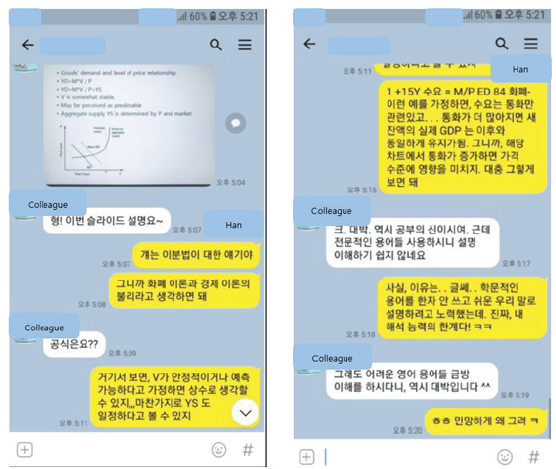
Figure 2. A KakaoTalk session transcript by Han
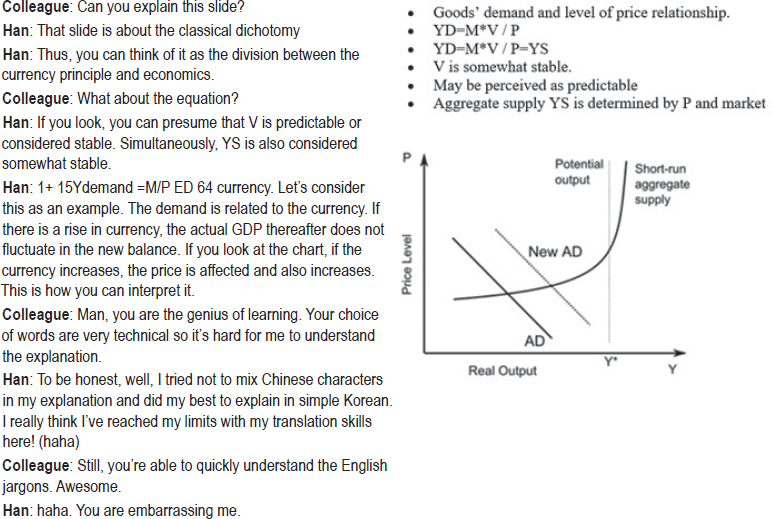
This interaction featured Han’s self-inscribed role as a peer mentor and tutor; he participated in various layers of translation across discourses (e.g., disciplinary knowledge and the internet), languages (e.g., Korean and English), and modes (e.g., visual and textual) in the hope of making disciplinary jargons and theories more easily understood. Although Han delivered the theoretical concepts in Korean, one peer complained that Han’s word choices were “very technical”, which made it difficult for him to understand his explanation (see Figure 2). In response to the complaint, Han compared his descriptive effort to “not mix Chinese characters” and “explain in simple Korean”. As briefly seen in the example, Han displayed a growing knowledge of his own disciplinary and linguistic border crossing, which consisted of challenges that applied to both Korean and English. It is here that Han carried out what Song (2010) referred to as intentional language performance (e.g., by way of translanguaging). He displayed an understanding of translation and re-making of meaning that continuously operated in and across language borders.
Even though Han was aware of the fact that the online sessions were repetitious and consumed much of his time, he strategically leveraged the sessions to his advantage. To Han, the need to explain disciplinary concepts to his peers led him to consolidate his understanding, recognise shortcomings in his own learning, and envision new learning strategies.
Building in-maek
Apart from using KakaoTalk online sessions to promote his learning, Han used the sessions to build his reputation and social connections. His peers recognised the market value of Han’s scholarly expertise; therefore, many students eagerly pursued his friendship through a cultural practice known as 아부 (to curry favour or flattery; n.d.). This Korean buzzword describes an individual of lower social position practising flattery or favour towards someone of higher social status or importance. The individual of a higher position is said to yield an advantage by granting social, material, or emotional resources to others (Kim, 2007). In this context, students showed flattery and favour towards Han in the hope of improving their academic standing.
Essential to the cultural performance of currying favour or flattery is a cultural presumption for developing and sustaining in-maek. This is performed through meaningful material exchanges and favours over a prolonged period of time (Lee, 2000). Han assisted his peers with their academics, and his goodwill was reciprocated with car rides, gifts, compliments, and lunch invitations. A number of students noted that it was only appropriate to reciprocate Han’s generosity since in-maek can only be maintained when there is an equivalent trade of material, social, and academic return. Rina, who identified herself as a low academic achiever, explained such relations as mutually profitable:
Consider the fact that studious students use all their time simply studying. Most of them don’t really know how to enjoy life the way we do. However, individuals like me know where and how to have fun. So, we introduce them to our friends, go out together and show them what they are missing out on. I mean, they are people just like us who want to enjoy life too. (Translated personal interview, 11 November 2020)
Han confirmed this comment, insinuating that his professional status brought about favours that assisted his adjustment at the new university. For instance, Han’s peers willingly provided him with car rides for grocery shopping and Sunday church meetings. These carpool rides saved Han great efforts in traversing the university campus’ dispersed landscape. He also enjoyed his social prestige, which resulted from the widespread recognition in his local peer community. For example, a number of his male peers noted Han’s “all-female entourage”, which made his status quite noticeable on campus. While these male peers admitted that they drew many female students’ interests through their lavish cars and small gift-giving, they envied Han’s skills to obtain the same goals through the KakaoTalk sessions. Moreover, Han affirmed other students’ narratives of gifting experts with lavish meals and weekly excursions, insinuating that he also took advantage of his academic skills for material benefits:
Since I am living on campus during summer term, having a car is helpful. But, since I don’t own any transportation, I texted my KakaoTalk circle for any suggestions on how I can get rides over the summer break. A number of colleagues offered to lend their cars. It’s nice because I now drive a Maserati on some days and a Mercedes on other days. (Translated personal interview, 11 November 2020)
Past studies have used the affinity space perspective of identity (Gee, 2000) as a concept to further delve into young adults’ identity in interest-focused, transnational social connections (Albawardi & Jones, 2020; Lam, 2006). Gee believed that such identities were motivated by self-motivated passion, mutual leadership, and fair participation. As a case in point, Black (2006) examined how affinity spaces allowed transnational story writers to obtain information that is present in people’s texts and resources across various sites.
In-maek offers an additional conceptual frame for exploring the literacy site produced here, where subject-related, linguistic and literacy skills are implicated in the interconnection of material and affective sources. In this social process, relationships are not built on shared enthusiasm and fairness, despite unequal circulation of skills. Instead, students of lower academic status intermingle with expert students. Instead of exchanging academic favours, students negotiate with a wider scope of social capital. While shared practices in affinity spaces support self-motivated and mutual learning, the learning site seen in this study was defined by practical interests for high grades. Therefore, such social relationships often expire at the end of the academic semester.
Moreover, students who declined to engage in such peer networks worried that learning through in-maek could conflict with the university’s ethics code of conduct, and further blemish the “Korean student image” through suspicious and “questionable practices”. One student, Park (pseudonym), claimed, “Right before the week of finals, a lot of students line up to give Han car rides. And they somehow get the chance to sit close to him [on exam day] to ask last-minute questions right before the exam” (translated personal interview, 10 December 2020). When asked why students would contend for such opportunities, Park avoided the inquiry, clarifying that she did not want to be seen as a “betrayer” among her friends, though another student claimed that sitting close to Han would make it easier to “glance at his exam”. When the researcher asked Han, he was slow to respond and replied that he hoped more of his Korean peers could be academically successful since they could support him now and at some point in the future.
Furthermore, several students were dissatisfied by a confining sense of community, which frequently caused self-isolation and hindered the possibility of interacting with non-Korean peers and professors. To begin with, Han rarely communicated with his professors for assistance and worried that his English-speaking skills had in fact become worse following his arrival at the new university. In fact, his close link to the local Korean community at the university appeared not to have helped Han in gaining access to the university’s professional and academic sources.
The practice of in-maek in the workplace and the curriculum
When the researcher asked Han the reasons for helping more students to be accepted into the competitive business programme, he described the need to build “yonjul” (연줄) (literally translated as a person’s ligament and broadly indicating a network of in-maek). Similar to in-maek, yonjul is a particular relation maintained by kin, school, and regional ties that is often built on close and personal relationships that can be beneficial for social or career progress (Yee, 2000). Students commonly referred to yonjul as one benefit for attending the university with a large Korean student community. Jung (pseudonym), a Korean student, claimed that his father advised him against upsetting his peers since any one of them could become a potential future client. To Han, his ability to gain provisional car loans from his circle of peers was one representation of how yonjul operated in his peer social group.
In significant ways, the practice of in-maek represents important practices and directions in the figured world of carrying out business in Korea. The majority of the participants claimed that their families were important shareholders of Korea’s economic growth in the past decades. These students have witnessed how past generations of family members had gained business opportunities in an emerging yet poorly managed market. They were also introduced into the family business through seed money and engagement in making business decisions. Many of the students have thus capitalised on their family wealth that had accrued at an unparalleled speed and scale. In significant ways, these experiences shaped the participants’ literacy and networking practices.
Jay (pseudonym), a 20-year-old student from a suburban area in Korea, dropped out of college during his freshman year to support his family business with managing clients. He became well aware of in-maek’s value when bidding for a local corporate funded project. After two unsuccessful acceptances of his business proposal, Jay decided to shift his plan of action by addressing one of the head officials of the local corporation in person:
During New Years, my parents invited some of their business clients for dinner. One of the head officials for the funding bureau happened to come with their young son to the gathering. Since I had nothing better to do, I chatted with their son and we talked about video games and school stuff. I heard he was struggling with his science classes, so we started talking about some of those problems. I was pretty good with science so I offered to tutor him for free. The point was not about tutoring him but getting to know him and building in-maek. He was also a troubled teenage kid, so I shared my experiences as an adolescent and took on the role of a ‘big brother’ mentor. We became pretty close and continued to communicate through KakaoTalk. I think his parents were grateful for my mentorship. The good news is, his parents helped me get the funded project. (Translated personal interview, 10 December 2020)
A number of students reiterated this observation by suggesting that in-maek networks framed one’s experiences in many facets of social life, extending from finding a good teacher for their children to finding a good business investment. In particular, entrepreneurs leveraged in-maek with shareholders to regulate small local business decisions. Han understood the significant role of in-maek from observing his family wrestle with the family business, indicating that the value of in-maek mattered in acquiring business benefits and increasing one’s likelihood for upward social mobility:
By adhering to the corporate rules, there is nothing left after taxes. If you follow the required regulations when submitting an application for a business permit, you have to meet a long list of criteria and wait for several months to a year. Then, by the time you open your business, the price of the land will have increased and you have to pay more estate fees. At the end, following all these rules gets you nowhere. (Translated personal interview, 10 December 2020)
In important ways, such awareness framed the literacy practices of the students. With the knowledge that in-maek could cause the dismantling or strengthening of one’s opportunity for professional and academic growth, participants such as Jay and Han strategically leveraged their disciplinary knowledge and literacy skills to build in-maek. Frames and processes enclosed in the figured world of business were mobilised to deliver meaning to such literacy experiences.
In both circumstances, in-maek consolidates around people of authority and unravels through interchange of favours. As Han noted, being “book smart only develops along with being street smart” when he interacts with peers from wealthy families. While Han’s multimodal literacy activities (e.g., Korean-translated textbooks, use of Papago, the internet) in the KakaoTalk sessions were cultivated in regards to the university’s literacy requirements, he reshaped such literacy practices to build networks that enabled him to obtain resources that may otherwise not have been accessible to him. At the end, “their families are thriving [. . .] better than ours, so I can only guess there must be a special reason for this difference (translated personal interview, 26 November 2020).
Discussion and implications
Suárez-Orozco and Todorova (2003) indicated that youths with transnational backgrounds negotiate multiple, contesting, and competing cultural rules enclosed in figured worlds extending across their native and residential countries, and young adults’ global culture. As demonstrated in this study, crossing borders produced various social, intellectual, and business opportunities that required the display of multiple identities and social networking. This study sheds light on how the cultural framework of in-maek mediated Korean students’ literacy experiences in influential ways.
First, in-maek offered the theoretical framework for examining the students’ literacy space, whereby literacy and language expertise were entangled in a network of affective, material, and social resources. The social networks construed by in-maek were not typically founded on an equitable distribution of sources. For example, Korean students of lower academic status coalesced around expert students for practical interests in gaining higher grades. Expert students, such as Han, strategically framed their in-maek networks to gather material, social, and literacy sources that circulated across individuals and spaces. As Han took advantage of his literacy practices to sustain his in-maek connections, he constructed an agentive identity as a professional in his disciplinary field of study.
Second, the Korean students also created various cultural and linguistic sources to make meaning of their social networks and literacy practices in the business programme. For example, the digital platform of KakaoTalk offered students a space to display different layers of translation across languages (Korean and English), modes (visual and textual), and discourses (disciplinary knowledge and the internet) to make disciplinary knowledge more accessible to students. This platform also afforded students a space to build social and professional affiliations that could potentially influence their future career goals when conducting business in Korea
Korean students also borrowed various types of linguistic sources to share their disciplinary knowledge through KakaoTalk. The constant juggling of disciplinary concepts across languages (Korean and English) and texts created challenges and opportunities for the students. For example, for Han to tackle challenging jargons, he relied on Korean translation of his textbooks and Papago (the Korean version of Google Translate). He also perused the business section of his university library and local bookstores. When these measures fell short, he and other Koreans often resorted to online educational lectures directed by Korean professionals. Such multilingual sources may have assisted students in tackling complex disciplinary concepts.
This study complicates the research narratives that display digital literacies as affording agentive identities and various opportunities for learning literacy across various social affiliations and communities. A multidimensional portrayal of students’ experiences in these networks indicates that such occurrences can present both opportunities and oppression, often resulting in failed opportunities for obtaining professional and academic sources and participating in the larger community of the university. As several participants in this study indicated, a self-confined sense of community may cause challenges in fully engaging in the social and language practices at the new academia.
Results from this study mirror Lam’s (2006) argument that it would be helpful if literacy educators could recognise the various relationships of transnational youths. Such awareness should come first before efforts to leverage their cultural and linguistic skills as learning resources. To begin with, it may be helpful for literacy educators to examine students’ literacy and digital resources in and beyond the classroom environment. As illustrated in this study, the digital platform of KakaoTalk offered a space for Korean international students to access tools for learning, discuss issues, and seek solutions about school learning. Educators can employ such digital resources and current social networks to assist in the circulation of course materials where no other digital learning platforms exist. For instance, KakaoTalk class groups may be adopted as a platform to assist in teacher conferences, student inquiries, and peer teamwork. Recognition from educators and open dialogue on students’ multiple literacies may assist students to make better use of literacy learning opportunities, thus maximising their access to tools for learning through different contexts.
In the university writing curriculum, educators in New Zealand and beyond may build literacy exercises to foster students’ constructive inquiry into their personal experiences of border crossing. As scholars have proposed, narratives on writing/reading border crossing may support students’ portrayal, thinking, and understanding of their multiplex experiences with diverse social realities and languages (Zamel & Spack, 2012). As Shah et al. (2017) iterated, situating transnational experiences as a topic and point of exploration helps redefine youths with transnational backgrounds as talented and intelligent users of literacies. Moreover, such analytical reflection may assist students in developing strategies to navigate language and cultural differences.
Here are a few pedagogical suggestions to utilise digital technology such as KakaoTalk in the literacy curriculum:
a)Build a space for students to converse about using digital resources in and outside the formal classroom environment. Questions to raise are how, when, and where students use digital resources such as KakaoTalk as opposed to the class website. These conversational topics may improve the ways students understand and acquire the learning tools available to them.
b)Educators may take advantage of KakaoTalk online groups as sites for providing teacher and student support. Moreover, they may examine how students approach assignments and communicate with peers in informal settings.
c)It will also be helpful to provide opportunities for students to explore their multilingual and transnational experiences by inviting students to participate in and reflect on narratives on navigating language and cultural differences in the business world.
Such exploration can be effectively facilitated through collaborative practice through digital platforms, of which KakaoTalk presents one possible platform. Thus, if we perceive learning and teaching as a situated practice, the focus should be on providing opportunities for students to construct their literacy and identity spaces.
References
Albawardi, A., & Jones, H. (2020). Vernacular mobile literacies: Multimodality, creativity and cultural identity. Applied Linguistics Review, 11(4). https://doi.org/10.1515/applirev-2019-0006
Alim, S., & Pennycook, A. (2007). Glocal linguistic flows: Hip hop culture(s), identities, and the politics of language education. Journal of Language, Identity and Education, 6, 89–100. https://doi.org/10.1080/15348450701341238
Alyousef, H. S., & Picard, M. Y. (2011). Cooperative or collaborative literacy practices: Mapping metadiscourse in a business students’ wiki group project. Australasian Journal of Educational Technology, 27(3). https://doi.org/10.14742/ajet.955
Black, R. W. (2006). Language, culture and identity in online fanfiction. E-Learning, 3(2), 170–184. https://doi.org/10.2304/elea.2006.3.2.170
Brandt, D., & Clinton, K. (2002). Limits of the local: Expanding perspectives on literacy as a social practice. Journal of Literacy Research, 34, 337–356. https://doi.org/10.1207/s15548430jlr3403_4
Carnegie Classification of Institutions of Higher Education. (2020, July 21). Carnegie Classification update facts & figures. https://en.wikipedia.org/wiki/Carnegie_Classification_of_Institutions_of_Higher_Education
Department, P. (2019, May 29). South Korea: KakaoTalk monthly active users 2020. https://www.statista.com/statistics/746249/south-korea-kakaotalk-monthly-active-users/
Gee, J. P. (2000). Identity as an analytic lens for research in education. Review of Research in Education, 25, 99–125. https://doi.org/10.3102/0091732X025001099
Ghiso, M., & Campano, G. (2013). Coloniality and education: Negotiating discourses of immigration in schools and communities through border thinking. Equity & Excellence in Education, 46, 252–269. https://doi.org/10.1080/10665684.2013.779160
Gibson, M., & Carrasco, S. (2009). The education of immigrant youth: Some lessons from the U.S. and Spain. Theory Into Practice, 48(4), 249–257. https://doi.org/10.1080/00405840903188118
Graddol, D. (2004). The future of language. Science, 303, 1329–1331.
Hewins-Maroney, B., & Williams, E. (2013). The role of public administrators in responding to changing workforce demographics: Global challenges to preparing a diverse workforce. Public Administration Quarterly, 37(3), 456–490.
Holland, D., Lachicotte, W. Jr, Skinner, D., & Cain, C. (2001). Identity and agency in cultural worlds. Harvard University Press.
Horak, S. (2014). Antecedents and characteristics of informal relation-based networks in Korea: Yongo, yonjul and inmaek. Asia Pacific Business Review, 20(1), 78–108. https://doi.org/10.1080/13602381.2013.791567
Horak, S., & Klein, A. (2016). Persistence of informal social networks in East Asia: Evidence from South Korea. Asia Pacific Journal of Management, 33(3), 673–694. https://doi.org/10.1007/S10490-015-9416-1
Hull, G., & Stornaiuolo, A. (2014). Cosmopolitan literacies, social networks, and “Proper distance”: Striving to understand in a global world. Curriculum Inquiry, 44, 15–44. https://doi.org/10.1111/curi.12035
Jackson, J. (2004). Case-based teaching in a bilingual context: Perceptions of business faculty in Hong Kong. English for Specific Purposes, 23, 213–232. https://doi.org/10.1016/j.esp.2003.05.001
Jacobs, G. E. (2006). Fast times and digital literacy: Participation roles and portfolio construction within instant messaging. Journal of Literacy Research, 38(2), 171–196. https://doi.org/10.1207/s15548430jlr3802_3
Jiménez, R. T. (2003). Literacy and Latino students in the United States: Some considerations, questions, and new directions. Reading Research Quarterly, 38(1), 122–128.
Kim, Y. T. (2007). Korean elites: Social networks and power. Journal of Contemporary Asia, 37, 19–37. https://doi.org/10.1080/00472330601104482
Lam, W. S. E. (2006). Culture and learning in the context of globalization: Research directions. Review of Research in Education, 30(1), 213–237. https://doi.org/10.3102/0091732X030001213
Lam, W. S. E. (2012). L2 literacy and the design of the self: A case study of a teenager writing on the internet. TESOL Quarterly, 34(3), 457–482. https://doi.org/10.2307/3587739
Lam, W. S. E., & Rosario-Ramos, E. (2009). Multilingual literacies in transnational digitally mediated contexts: An exploratory study of immigrant teens in the United States. Language and Education, 23(2), 171–190. https://doi.org/10.1080/09500780802152929
Lee, J. (2000). Society in a vortex? Yonjul network and civil society in Korea. Korea Journal, 40, 366–391.
Lee, J. Y., Park, S., Na, E. Y., & Kim, E. (2016). A comparative study on the relationship between social networking site (SNS) use and social capital among Australian and Korean youth. Journal of Youth Studies, 19(9), 1164–1183. https://doi.org/10.1080/13676261.2016.1145637
Lewis, C., Enciso, P., & Moje, E. (2007). Reframing sociocultural research on literacy: Identity, agency, and power. Routledge.
Lim, K., & Meier, E. B. (2012). International students’ use of social network services in the new culture: A case study with Korean youths in the United States. Asia Pacific Education Review, 13, 113–120. https://doi.org/10.1007/s12564-011-9173-x
Locke, T., Cawkwell, G., & Sila’ila’i, E. (2009). Teaching literature in the multicultural classroom. Teaching and Learning Research Initiative. http://www.tlri.org.nz/teaching-literature-in-the-multicultural-classroom/#teachingLocke
Louie, V. (2006). Growing up ethnic in transnational worlds: Identities among second-generation Chinese and Dominicans. Identities: Global Studies in Culture and Power, 13(3), 363–394. https://doi.org/10.1080/10702890600838118
McDowall, S. (2010). Literacy teaching and learning in e-learning contexts. Ministry of Education.
Murchison, J. (2010). Ethnography essentials: Designing, conducting, and presenting your research. Jossey-Bass.
Paris, D. (2011). Language across difference: Ethnicity, communication, and youth identities in changing urban schools. Cambridge University Press.
Planken, B., van Hooft, A., & Korzilius, H. (2004). Promoting intercultural communicative competence through foreign language courses. Business Communication Quarterly, 67, 308–315. https://doi.org/10.1177/1080569904268095
Sánchez, P. (2008). Coming of age across borders: Family, gender, and place in the lives of second-generation transnational Mexicanas. In R. Márquez & H. Romo (Eds.), Transformations of la familia in the U.S.–México border (pp. 185–208). Notre Dame Press.
Seidlhofer, B. (2004). Research perspectives on teaching English as a lingua franca. Annual Review of Applied Linguistics, 24, 209–239. https://doi.org/10.1017/S0267190504000145
Shah, R., McCormick, A., & Thomas, M. (2017). Shifting tides: Reflecting on regional aspects of our roles as comparative and international educators. International Education Journal: Comparative Perspectives, 16(3), 49–68.
Song, J. Y. (2010). Language ideology and identity in transnational space: Globalization, migration, and bilingualism among Korean families in the USA. International Journal of Bilingual Education and Bilingualism, 13(1), 23–42. https://doi.org/10.1080/13670050902748778
Suárez-Orozco, C., & Todorova, I. (2003). The social worlds of immigrant youth. New Directions for Youth Development, 100, 15–24. https://doi.org/10.1002/yd.60
Urquhart, C. (2012). Grounded theory for qualitative research: A practical guide. SAGE Publications.
Warriner, D. S. (2007). Transnational literacies: Immigration, language learning, and identity. Linguistics and Education, 18(3), 201–214. https://doi.org/10.1016/j.linged.2007.10.003
Yee, J. Y. (2000, March). Social networks of Koreans. Too modern too soon?: Dualism in civil society, everyday life, and social relations in contemporary Korea [Paper presentation]. The 52nd Annual Meeting of the Association for Asian Studies, San Diego, CA.
Zamel, V., & Spack, R. (2012). Negotiating academic literacies: Teaching and learning across languages and cultures. Lawrence Erlbaum Associates.
The author
Jungyin Kim is an associate professor in the Department of English Education at Jeonbuk National University in South Korea. Her research interests include theories of second language acquisition, literacy practices of second (L2) and foreign language education, qualitative research methods in language education with interest in ethnography and case studies, and academic discourse socialisation experiences of learners in bilingual and multilingual settings.
Email: luvjanny07@jbnu.ac.kr