Curriculum shockwaves? Geography, science, and the Canterbury earthquakes
Mike Taylor and Azra Moeed
Abstract
In a self-managing school system where localised curriculum decision-making prevails, this study asks the question “How were the geography and science senior secondary school curricula influenced by the Canterbury earthquake series?” Drawing on an ecological framework of teacher agency, the study found that responses to the Canterbury earthquakes were significantly impacted by the curriculum-assessment nexus, in addition to the individual beliefs, values, and attitudes of teachers. Nevertheless, spaces to manoeuvre were generated by some teachers seeking to use media coverage of the earthquakes to develop critical citizenship or scientific literacy approaches, or both, to disaster education.
Introduction
The bounce-back of the education system following the devastating Canterbury earthquake series of 2010–2011 has, like many other aspects of life in the region, been relatively quick when compared to similarly sized seismic events in other parts of the world (Alexander, 2012). Without downplaying the uncertainty, frustration, and emotionally draining conditions that many Cantabrians continue to face 2 years after the Christchurch earthquakes (see, for example, Miles, 2012), the dust has started to settle. As schools focus less on the psychological trauma of students and occupy strengthened and new buildings, the shockwaves of the earthquakes may, in the longer term, continue to be felt through the school curriculum.
This article follows a previous study in which geography and science teachers were shown to respond rapidly to the original Darfield earthquake of 4 September 2010 (Taylor & Moeed, 2013). While that study highlighted teacher responsiveness to a significant natural disaster, there was also evidence of variable outcomes of teacher agency in the curriculum decision-making process. The findings indicated that, although teachers viewed the original Darfield earthquake to be of national significance and of high student interest, some of these teachers chose to omit the earthquakes from their curriculum making because of the perception of constraining time frames imposed by the curriculum-assessment nexus. In this study, we are interested in longer-term curriculum impacts, with particular focus on the construction of disaster education within a curriculum-policy environment that promotes teacher agency through school-based curriculum-making decisions (Ministry of Education, 2007). Did, for example, the severity of the aftershock of 22 February 2011 change the geography or science curriculum response, or both? If so, which aspects of curriculum were emphasised by teachers and students? Or, did the February aftershock lead to muted science or geography curriculum responses? If so, was it to support traumatised students, or were there other factors influencing science and geography curriculum decisions?
Teacher agency and disaster education
Informing this article are two major themes: the process of teacher agency, and the product of disaster education. As part of an international trend to move from centrally prescribed curricula to more responsive, localised curricula (Priestly & Biesta, 2013), school-based curriculum design is predicated on the agency of teachers to construct school curricula. In New Zealand, however, the appealing discourse of professional autonomy that school-based curriculum making advances has recently been challenged because of the detrimental instrumental and competitive schooling environment in which teacher agency is situated (Wylie, 2012). The second theme is the notion of disaster education itself. Disaster requires consideration because, as one of many adjectival subjects1 to compete for space in the school curriculum, disaster education crosses disciplinary boundaries and theoretical roots. Disaster education is further complicated by subject approaches that are themselves variegated and contested. In the following section, therefore, we briefly distinguish between conceptualisations of teacher agency, and then highlight broad approaches to disaster education, with specific reference to its location across the disciplines of geography and science in New Zealand schools.
Teacher agency in curriculum making
As jurisdictions around the world respond to increased risks, then disaster education has a greater chance of becoming a feature of centrally mandated curricula (Chang & Chang, 2010; “Disaster Management”, 2010; Yau, 2009). Yet in countries which support localised, school-based curriculum development, disaster education inevitably competes for limited curriculum space. While prescribed curricula do not diminish the need for teacher agency in curriculum making, the limited prescription of contemporary outcomes-based curricula frameworks does enhance the need for teachers to consider moral (“what and why should I teach this?”) as well as instrumental (“how do I teach this?”) curriculum questions (Lambert & Morgan, 2010). A grassroots approach to curriculum-making may or may not foster principles of disaster education: on the one hand, its flexibility may promote development of community responses to disasters; on the other hand, the lack of central leadership may prove a barrier to developing coherent and robust disaster education approaches in cycles of curriculum review (Asia-Pacific Economic Co-operation, 2011).
Teacher agency has, in a broad sense, alternatively been viewed through psychological and sociological lenses. In the psychological view, teacher agency is linked to the autonomous actions of individuals as they make decisions about curriculum design. Thus studies that focus on the development of disaster-education curriculum resources are located in this frame (see, for example, Fuhrmann et al., 2008). Sociological framings, however, explore the structural forces that may facilitate or impinge on teacher curriculum making, such as Mitchell’s (2009) review of the influence of academic standards on the provision of hazard education in the southeastern United States. A third lens may be added to these psychological and sociological viewpoints: an ecological perspective recognises agency as a component of individual experiences, beliefs, values, and norms (which may be coherent or contradictory) as well as structural enablers and constraints operating at departmental, school, national and international scales (Priestly & Biesta, 2013; Priestly, Edwards, Priestly, & Miller, 2012). Such an ecological theorisation of teacher agency takes the middle ground between over-deterministic accounts of the structural forces that shape teachers’ decisions and contrasting accounts that position the culture and individual agency of teachers as free to create, respond, and choose at will. Our position takes this middle ground: while teachers are subject to structural forces, they are not its victims.
Approaches to disaster education
Disaster education in schools has the express purpose of supporting students to understand, prepare for, and respond to extreme natural events. In a sense, then, it is part of a wider citizenship education mission in which students develop the knowledge, understandings, and dispositions that provide resilience for good decision making in the face of adversity (Shaw, Shiwaku, Kobayashi, & Kobayashi, 2004). The enactment of disaster education, however, can be very different. For example, the primary school curriculum may emphasise disaster drills such as “drop, cover, hold” for earthquakes, evacuation for fires, and lock-down procedures for school intruders. Secondary students may make their own emergency “go bags” for rapid evacuation from their homes (Sharpe & Kelman, 2011). Internationally, these types of behavioural outcomes are viewed as key mitigation responses to protect one of society’s most vulnerable groups (United Nations Centre for Regional Development, 2009). Such behavioural approaches are, in the most literal sense, lifeskill approaches to disaster education. Nevertheless, such approaches to disaster education have been pronounced as “feeble” (Fuhrmann et al., 2008) and, for the most part, being useful for school staff yet positioning students as “either passive bystanders or casualties requiring treatment ... reinforc[ing] a belief that the locus of control lies not with the individual but with the ‘experts’ and authorities … [which] reinforces the previously mentioned stereotype of children and youth as helpless and passive victims” (Sharpe & Kelman, 2011, p. 336). As a result, more sophisticated teaching resources with a focus on the life skills for disaster preparation and survival have been developed (Fuhrmann et al., 2008).
In senior secondary schools, understandings of earth science processes have dominated disaster education approaches, largely as a product of the traditional approaches to science and geography as pre-professional education (Gluckman, 2011; Jarman & McClune, 2007). In the pre-professional approach to school subjects the emphasis is on developing the knowledge, skills, and attitudes of individuals who show an aptitude that may lead to future employment in the field. In the context of the Canterbury earthquakes, such an approach might add the terms “liquefaction”, and the “slap down effect” to the long list of substantive concepts associated with seismic disasters. An approach that focuses on developing skills and knowledge relevant to employment also serves as a form of citizenship education, albeit a conception narrowly linked to economic growth and social integration.
In response to some of the highly publicised social inequalities brought into sharp relief by so-called “natural” disasters, geography educators have advocated radical approaches to disaster education so that more critical forms of citizenship are promoted (Morgan, 2012). Sharing similar emancipatory theoretical roots, critical scientific literacy approaches to science education have also been advocated, so that socioscientific issues relevant to students, their families, and communities can be explored (Hodson, 2009, 2011). Such scientific literacy or citizen science approaches call for explicit attention to teaching about the nature of scientific evidence, while it “is stressed that students should be aware that science is a very human activity” (Jarman & McClune, 2007, p. 4). Critical scientific literacy is strongly linked to ideals of democratic citizenship, which include extending the capability of students to discriminate between the scientific basis of media reports (Jarman & McClune, 2007), solving problems, and taking social action (Hodson, 2011).
Disaster education in New Zealand schools
In New Zealand’s primary schools, disaster education is traditionally focused on decision-making skills and participatory outcomes as students design personal or family emergency plans and, in the context of earthquakes, practise drills of “drop, cover, hold”. In 2012, primary and secondary school children participated in New Zealand’s “Great ShakeOut” national earthquake drill, with over 80 percent of schools registering their participation (Civil Defence, 2012). Since 1988, schools have been supported by the provision of curriculum-resource materials as part of the outreach service of what is now the Ministry of Civil Defence and Emergency Management. A recent implementation review of the latest iteration of these resources has shown that although the materials are considered stimulating by teachers, they are used irregularly and sporadically (Johnson, 2011). It appears that teacher complacency during “quiet periods” results in disaster-education programmes being overlooked as other themes, such as road safety, are included in school curricula.
Much less is known about senior secondary schools’ curricula response to disasters. Teaching senior secondary school-aged students is likely to focus on cognitive as well as behavioural outcomes. To what extent geography and science teachers are engaging with disaster education from critical citizenship or scientific literacy perspectives is unknown. This article then, aims to broaden the scope of empirical evidence by including views of senior secondary school teachers and students of geography and science.
New Zealand secondary school geography’s contribution to disaster education can be traced through the 1975–85 period of curriculum development that produced a coherent geography syllabus across the senior secondary school (Davidson, 1987). This development marked school geography’s transition towards applied science constructions of geography (Slater, 1978). The growth of hazard studies reflected geographers’ investigations of how people perceived the risk of hazards as well as the mitigation of the risks. It is not surprising, therefore, that educators seeking to stress the usefulness of school geography welcomed hazards as showcasing geography-in-action (Macaulay, 2007). The teaching of a variety of natural hazards to reflect local conditions was commonplace in secondary geography classrooms by the mid-1980s, and has maintained very high levels of popularity in foundational Year 11 geography courses to this day (LeHeron, Lewis, & Harris, 2012).
In the absence of syllabus prescription, direction for geography teachers is provided by assessment standards (LeHeron et al., 2012). The most recent expression of disaster education in senior school geography is the expectation that Year 11 (age 15–16 years) students will demonstrate geographic understanding of environments that have been shaped by extreme natural events (New Zealand Qualifications Authority, 2010a). In 2011, 62,527 students were enrolled at Year 11, and almost 11,000 “extreme natural events” results were recorded at NCEA Level 1 (New Zealand Qualifications Authority, 2012a), although this near one-in-six figure is a significant drop from the one-in-three statistic recorded from 1987–2001 (Macaulay, 2007). We note that in recent geography curriculum-assessment realignment, the earth science processes have been occluded by the geography of vulnerability (New Zealand Qualifications Authority, 2010b). Although it is too early to know how this will shape teachers’ curriculum decision-making, it has the potential to move geographic explorations away from traditional earth science narratives to locate disaster vulnerability in economic, social, and political contexts (Taylor, 2013).
While links to disaster education in the school science curriculum emerged in the same period as geography, the uptake was far less widespread in the senior secondary school. A 1983 submission by the Geological Education Subcommittee of the Geological Society of New Zealand to the Minister of Education argued for greater attention to earth sciences in the senior school examination prescription (Neall, 1983). This submission was rebuffed by the Minister, who countered that its presence in junior science programmes and senior school geography was sufficient (Wellington, 1983). The 1993 science curriculum reform eventually positioned the Planet Earth and Beyond strand as equal to the Physical, Material, and Living World strands. A decade later, however, it remained the “poor cousin”, receiving most demand for further professional development from secondary school science teachers (McGee et al., 2003). Furthermore, the introduction of the National Certificate in Educational Achievement (NCEA) is identified as a significant barrier to curriculum change by science teachers (Hipkins, 2013).
The presence of the Planet Earth and Beyond strand in senior secondary school science has led to the recent development of earth science NCEA Level 1 achievement standards, namely Demonstrate understanding of the formation of surface features in New Zealand and Investigate an astronomical or earth science even. (New Zealand Qualifications Authority, 2012b). The former gives a strong message to teachers that, along with movement along fault lines, faulting and folding, students may be assessed for their understanding of land movement due to earthquakes. The second of these achievement standards gives an opportunity for students to study a contemporary event which, in the context of this study, could be, for example, the rupture of the Greendale fault and subsequent aftershocks. It is apparent, therefore, that while geography may have distanced itself from traditional earth science interpretations of disaster education, the development of these science achievement standards continues to legitimise earth science at the heart of disaster education. However, data from 2011 show that in a crowded suite of achievement standard choices for science teachers, the popularity of these Planet Earth and Beyond-related achievement standards is approximately 20 percent of that for the most popular internally assessed science standards (New Zealand Qualifications Authority, 2012a).
From “curriculum p-waves” to “curriculum s-waves”
In our previous study (Taylor & Moeed, 2013), we surveyed the initial curriculum response of geography and science teachers across New Zealand to the initial Canterbury (Darfield) earthquake. We described those curriculum responses as “curriculum p-waves”—those that were first felt and measured subsequent to the earthquake. The curriculum p-waves reported by senior school geography and science teachers in October 2010 were refracted by the focus on examinations at that time of the year. The material effects of this refraction differed: some teachers ignored or lightly taught about the earthquake, because they felt they were locked into a curriculum-assessment time frame from which they could not or would not deviate. Others, however, drew extensively on earthquake material in recognition of the significance of the event and its relevance to students. Such findings underscore the variable outcomes of teacher agency.
Extending the curriculum p-wave analogy, this article presents teacher and student perspectives on “curriculum s-waves”. We use this analogy to invoke more powerful curriculum deformation. Unlike p-waves (which produce no permanent deformation), as seismic s-waves move through the earth, they displace rock particles outward, pushing them perpendicular to the path of the s-waves. Thus this study aims to explore some of the curriculum s-waves that we might expect to see as a result of teachers responding to the Canterbury earthquakes several months after the event. In recognition of the likelihood of deeper and longer lasting curriculum s-wave deformation, this article draws on student as well as teacher voice.
Methodology
This study is located in a qualitative-interpretive paradigm of education research and poses the question “How were the geography and science senior secondary school curricula influenced by the Canterbury–Christchurch earthquake series?”
Sample
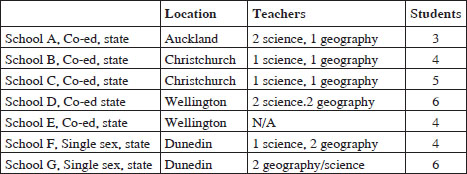
Groups of teachers were self-selecting, based on the participation of one of the members of their group in an earlier survey in response to the Darfield earthquake (Taylor & Moeed, 2013). Students were selected by their geography or science teacher in response to our request for a small group of articulate Year 11 (age 15–16) students who were currently participating in geography and science lessons. The distribution of groups is shown in Table 1.
Table 1: Study sample
Interviews and data analysis
Focus-group interviews with geography and science teachers were conducted in November–December 2011 and March 2012. For the purposes of this article, the key questions were:
1.To what extent, and how, has your curriculum changed in response to the earthquakes?
2.What questions did students have? What misconceptions did you address in your teaching?
3.Was there information arising from the earthquakes that you needed to find out more about?
4.What roles do you think geography and/or science have in teaching about the earthquakes?
An activity-centred approach to the seven student focus groups was adopted to facilitate discussion. Students were encouraged to “talk aloud” during the task activities, either by explaining their own thoughts or seeking clarification from their peers. In the 45–60 minute time frame the students engaged with three tasks:
1.Students discussed and ranked the influence of geography, science, media, family and friends, or another curriculum area on their understanding about the earthquakes. Students ranked 18 items related to their learning (see Table 2), broadly divided into the categories of earth science and socio-cultural items.
Table 2: Item list supporting discussion in student activity 1
| Earth science | Sociocultural |
| The location of fault lines | Canterbury Earthquake Recovery Authority (CERA) |
| The recurrence of aftershocks | Land use zoning |
| Liquefaction | The impact of quakes on family life |
| Fissures | The speed of Civil Defence responses to disaster |
| Types of fault line (e.g., strike-slip faults) | The impact of quakes on heritage sites and buildings |
| The depth of earthquakes in NZ | How local and national government respond to disasters |
| Scales to measure quakes | The significance of building codes |
| The impact of quakes on agriculture | The impact of quakes on retail/shops |
| | The Earthquake Commission (EQC) |
| | Living without amenities (e.g., power) |
2.Students discussed and then ranked, using a five-point Likert scale, the extent of their (dis)agreement with nine statements about the ability of geography and science to contribute to their learning about the earthquakes.
3.Ten sort cards were placed by students on a target map of three concentric rings, the inner ring representing the most significant focus of their learning, the outer ring the least. Drawn from a synthesis of literature related to the social science curriculum area (Aitken & Sinnema, 2008) but broad enough to be applicable to science, the following labels and descriptions of each were given to the students:
•Knowledge outcomes: the facts, concepts, and understandings—the “stuff” of the subject
•Skills outcomes: the processes of the subject, such as graphing, mapping, questioning, and thinking
•Participation outcomes: action related to the learning
•Affective outcomes: emotional and values-related learning that captures the heart as well as the mind
•Identity outcomes: learning in which you can relate yourself to, say, a place, people, or the environment.
It was the meanings given through the discussion that were analysed, rather than the quantitative dimensions of each of these three tasks. For student and teacher interviews a deductive approach to data analysis was taken, using a constant comparison technique (Cohen, Manion, & Morrison, 2000). The small number of transcripts meant we could discuss each code so that agreement be made over the final coded themes.
A limitation was that the student activity-based data collection approaches contained too many items and impinged on the quality of discussion and the participation of some students. We ensured that quiet students were given opportunities to contribute, but we acknowledge that there may have been unarticulated opinions and ideas that the chosen data-collection methods did not readily capture.
Curriculum s-waves
Stronger in geography, weaker in science
Geography teachers used the earthquakes as case-study material. Some chose to focus exclusively on the quake series; others chose to use it as “a really good comparative one to ask why didn’t so many people in Christchurch die as they did in Haiti?” (Geography teacher, school A). In geography, signs of related impacts of the Christchurch earthquake were also filtering into other parts of the curriculum, such as the exploration of population migration. All geography teachers, except one in Christchurch, indicated that the earthquake series had become part of their planned and taught curriculum.
The science curriculum s-waves, however, appeared to be less significant. All science teachers recognised their continuing responses to student questions, yet only one indicated it had become a strong feature of the planned curriculum. Students indicated that, while their science lessons were influential in learning about types of fault lines, fissures, and scales of measurement, their learning about other earth science phenomena, such as aftershocks and liquefaction, was influenced more by the media and geography—and, for students in Christchurch, family and friends. Overall, geography was considered to give a holistic picture of the earthquake series by students: “Science is more like the technical side of it like how the actual earthquake occurs but geography is also how it occurs and the effects of it afterwards” (Student, school D). The human distinction between geographical and scientific contributions to disaster knowledge was articulated by students from all eight schools, with one student emphasising that his science learning about the earthquakes was “dehumanising”.
As the interviews with teachers and students progressed it was clear that Year 11 science curriculum shockwaves in the months after the earthquakes were largely responses to student questions—a collection of teachable moments. To this end, it is questionable whether science-curriculum deformation was of sufficient force to warrant the label “curriculum s-waves”. There was general agreement from science teachers that curriculum s-waves were much more likely to be experienced in junior school science classes, where there was more time and scope to include the Canterbury quakes, than in the senior secondary level curriculum.
Knowledge s-wave dominance
Perhaps unsurprising in the context of senior secondary schools driven by assessment imperatives, knowledge outcomes were given prominence by teachers and students. Students perceived their science and geography learning to have focused most on knowledge outcomes: “What I thought liquefaction was when I was young was just when the pipes and stuff broke and the water came out from that. I didn’t know that it was actually the ground that did that as well” (Student, school D).
Knowledge outcomes were largely expressed in terms of the emergence of factual detail, which led some teachers to pursue new learning:
That’s something I did look up, ground force acceleration. Because that is fascinating and the September earthquake is currently listed as fourth in the world for peak ground force acceleration and the February quake is second. The other thing I went scurrying for information, was that there is a theory to the deceleration of aftershocks. (Science teacher, school B)
Science teachers interviewed took different approaches to deal with their content knowledge related to earthquakes, as the contrasting extracts detail:
Had it occurred in Wellington, then as scientists in our curriculum we could have said “look that’s why it happened, because it’s on the fault”. But because it’s wasn’t on the fault we really haven’t got the expertise to focus on why these sorts of events happen. (Science teacher, school A)
Suddenly these kids were asking me, ‘why is it that it hit Christchurch? That’s not where those [fault] lines are going Miss.’ And it was like, well how about we all get together and we see? … So it was really like a more collaborative thing because geology’s not my strong point so it was very much me learning with the girls as well. (Science teacher, school F)
In the first of these examples, the view of curriculum making advanced teachers as authorities of established knowledge while the second view of curriculum making offered a more emergent and collaborative view of the nature of scientific knowledge.
Science teachers from four schools indicated that the Nature of Science became a curriculum focus in response to Ken Ring’s claims of being able to predict the timing of earthquakes based on the phases of the moon (Keall, 2011). The “pseudo science” (Science teacher, school F) and “scientific jiggery-pokery” (Science teacher, school B) of the claims of Ken Ring (aka the “Moon Man”) were considered a useful opportunity to explore an authentic science-in-the-media controversy so that students think critically about the nature and weight of scientific evidence. A science and geography teacher from a Dunedin school was, however, a little more circumspect about the role of evidence when it was likely to come into conflict with raw emotion:
There were kids in Christchurch who were pulled out of schools and then teachers saying things about how silly that opinion was. But the people that had pulled them out of schools were their parents. You have to be very careful as to having a strong opinion when people are emotionally traumatized … but, at the same time, I never held any punches back about showing statistics that show that he’s only right 50% of the time, which is the law of averages, and that you can’t sell anything on an idea of it being based on a flip of a coin, that there needs to be hard evidence. (Geography and science teacher, school G)
Two teachers from a Dunedin school also indicated that they actively chose to discuss with their students what the local newspapers were not discussing in its coverage of the earthquakes: a critical approach which they felt was needed to challenge student thinking.
While skills outcomes—such as interpreting maps, analysing graphs, and recording aftershocks—were regularly cited by students of science and geography, other outcomes (such as identity and participation) were less often cited. Unsurprisingly, teachers from Christchurch and Dunedin articulated disaster risk-reduction strategies (e.g., “drop, cover, hold”, noting of available exits, storage of emergency supplies in accessible bins) as participatory outcomes that they included in their teaching. Given their local vulnerability to seismic activity, we were surprised that teachers from a Wellington school believed their own disaster-management protocols to be unpractised and even unknown. Nevertheless, students from the same school recognised the participatory outcomes that emerged from group discussion and decision making when their geography teacher asked them what they would do if an earthquake struck when “we did that trip down Cuba Street and we looked at all the buildings that were potential for damage when earthquakes came” (Student, school D).
Curriculum s-wave refraction
As outlined in our initial study (Taylor & Moeed, 2013), curriculum shockwave refraction is the term we used to indicate constraints that alter the trajectory of teachers’ curriculum making. In other words, these are the cultural factors of beliefs, values, attitudes, and norms that influence teacher agency (Priestly et al., 2012). From teacher focus-group interviews we could see that the mediums through which curriculum s-waves were refracted varied—teacher capacity, distance from Christchurch, curriculum pragmatism, compassion, and perspectives of learning were all given as reasons by teachers for omitting the Canterbury–Christchurch earthquakes from their curriculum-making:
I am quite interested in using geology for problem solving, hardness of minerals and identification but actually the dips and how the land changes, not really my cup of tea. (Science teacher, school A)
It happened in the South Island. It’s down there, and basically our kids are Auckland focussed ... If you asked half our kids ‘Where is Christchurch on a map?’ they would have no clue and so they weren’t really focussed on it. (Science teacher, school A)
The reason I have cut it out is because … it concerns me that a lot of people in that class that have been emotionally involved in it would just write from their own first-hand experience of what happened to them rather than what happened to the city. (Geography teacher, school C)
But you can do [earth science] at the junior level … I’d rather they had a good working appreciation of something, rather than just waving a bit of paper around saying, I got a merit in Planet Earth and Beyond. So we do a lot of stuff at the junior level instead. (Science teacher, school G)
There were also varied viewpoints on the need to protect students from the possibility of emotional or psychological harm, or both. In the two Christchurch schools, the science teachers articulated their desire to avoid teaching about the earthquakes as concern for the psychological wellbeing of students. Conversely, some teachers (in Christchurch and beyond) viewed the inclusion of earthquake material in their curriculum plans as a means to support students:
I think that students need to be educated as much as possible in regards to the processes and risks. But it needs to be realistic. It can seem scary, but the unknown is much scarier. Students need to understand the processes and be able to rationalise the events in their head and find comfort in their knowledge and understanding. (Science Teacher, school D)
We note some of the findings of this study may be an artefact of the timing of the research. Christchurch schools were still in a period of transition during the study and the responses of some of the teachers from Christchurch suggested a “holding-it-together” approach, in which teaching about earthquakes was deferred while “trying to do our best in what has been a crap year ... we might come back to it in five years” (Science teacher, school C). We suggest that a more complete study of the curriculum response by schools in Canterbury is undertaken 3–5 years from now in recognition that curriculum conservation has been, at least for some, the initial product of the earthquake series.
Discussion
In many crucial ways the school system responded admirably well to the Canterbury–Christchurch earthquake series. From a curriculum perspective, however, this study highlights how teacher agency in a context of disaster education has been mediated by a combination of structural forces and cultural factors (Priestly et al., 2012). Consequently, while there was an initial flurry of responses in both science and geography in the senior school (Taylor & Moeed, 2013), the more substantive curriculum s-waves reported in this study were mostly felt in Year 11 geography. The implications of this study speak to the challenge of fostering disaster education in a seismically active country through a system of localised school-based curriculum decision-making. In light of this small number of interviews, we tentatively concur with Sharpe & Kelman’s (2011) assessment that if curriculum making is devolved to the school level, variability of disaster education curriculum coverage is a very likely outcome. While we acknowledge that much learning will have been garnered from media channels and friends and family, we would also hope that the school curriculum can respond to significant natural disasters, not only to make sense of the present, but to educate for the future. In acknowledgement that the Canterbury–Christchurch earthquake series will not be the last, and that risk mitigation and response to natural disasters have become part of the fabric of New Zealand society, it is not unreasonable to expect that the school system should develop a broad and coherent curriculum approach to disaster education.
With scant appetite for the provision of curricula programmes emanating from the Ministry of Education, teacher agency is central to the curriculum-making process. The broad framework of The New Zealand Curriculum (Ministry of Education, 2007) is designed to enhance curriculum-making agency. This study highlighted, however, the perennial issue of the tension between permissive curriculum and constraining assessment in the senior secondary school. In the case of science, the senior school curriculum inertia, caused by the continued prioritisation of the three traditional sciences over the Planet Earth and Beyond strand, meant that curriculum s-waves were minimally detected. In contrast, the popularity of the assessment of students’ understanding of extreme natural events in geography meant that, in the senior secondary school at least, this is where curriculum s-waves were most concentrated.
In recognition of teacher agency in action, some notable teacher responses to the Canterbury earthquake series indicated manoeuvring into spaces of scientific literacy and critical geography. This was particularly the case when teachers seized on the media commentary about Ken Ring’s predictions of earthquakes based on phases of the moon. Such examples supported Jarman & McClunes’ (2007) advocacy of using news media in the classroom to introduce students to how “knowledge claims are developed and validated, the features of “science-in-the making’, how communities of scientists function ... judging evidence and judging experts” (p. 4). In contrast with these examples of heightened agency, some teachers who didn’t feel confident about explaining the original Darfield earthquake to students also demonstrated that teacher agency can be limited by the beliefs, values, and attitudes with which individuals are imbued.
As a consequence of this study, we recommend that in a self-managing school system located in the “shaky isles” (Macaulay, 2007) secondary schools review their curriculum engagement with natural disasters. As only one in six students in Year 11 study Extreme natural events and the number of students studying the Planet Earth and Beyond strand in science is extremely compromised by preference for biology, physics, and chemistry, greater access to disaster education may come through other senior subject options. While a strong tradition exists of Year 11 geography contributing to disaster education, a broader, longer-term cross-curricular approach may be worth pursuing. The pressing assessment focus of the senior school, which has been clearly illustrated in this study, may be accommodated by a hybrid disaster course that uses NCEA achievement standards from a range of subjects.
Like Macaulay (2007), we believe the school curriculum is one of the best places to educate young people about natural disasters. In this very small-scale study, the Canterbury earthquakes prompted curriculum responses which developed life-skill approaches to disaster education, further progress earth science knowledge, understanding and skills, and introduce critical citizenship and scientific literacy approaches to disaster education. Establishing the conditions for coherent disaster education to thrive in the senior secondary school is, however, yet another challenge for self-managing schools.
Acknowledgements
The data-collection phase of this study was supported by a grant awarded by the VUW Faculty of Education Grants and Leave Committee. We also acknowledge the contributing work of Chris McIntyre, Research Assistant and recipient of a “VUW Summer Scholars” award.
Note
References
Aitken, G., & Sinnema, C. (2008). Effective pedagogy in social sciences / Tikanga ä iwi: Best evidence synthesis iteration [BES]. Wellington: Ministry of Education.
Alexander, D. (2012). A tale of three cities and three earthquake disasters. Tafter Journal, 50. Retrieved from http://www.tafterjournal.it/2012/08/01/a-tale-of-three-cities-and-three-earthquake-disasters/
Asia-Pacific Economic Co-operation. (2011). Disaster education at schools. Retrieved from http://hrd.apec.org/images/d/dc/25.2.pdf
Chang, C.-Y., & Chang, Y.-H. (2010). Enhancing the capacities of natural hazard mitigation: A study on a typhoon curriculum module in high school earth science. Natural Hazards, 55(2), 423–440. http://dx.doi.org/10.1007/s11069-010-9538-1
Civil Defence (2012). New Zealand ShakeOut. Retrieved from: http://shakeout.govt.nz/participant_list.php?start=newzealand&category=schools
Cohen, L., Manion, L., & Morrison, K. (2000). Research methods in educatio. (5th ed.). London: Routledge Falmer.
Davidson, C. F. (1987). The changing topography of school geography. New Zealand Journal of Geography, 84, 20–22. http://dx.doi.org/10.1111/j.0028-8292.1987.tb00259.x
Disaster management in high school curriculum. (2010, 10 June). The Hindu. Retrieved from http://go.galegroup.com/ps/i.do?id=GALE%7CA228650484&v=2.1&u=vuw&it=r&p=AONE&sw=w
Fuhrmann, S., Stone, L. D., Casey, M. C., Curtis, M. D., Doyle, A. L., Earle, B. D., Schermerhorn, S. M. (2008). Teaching disaster preparedness in geographic education. Journal of Geography, 107(3), 112–120. http:/dx.doi.org/10.1080/00221340802458482
Gluckman, P. (2011). Looking ahead: Science education for the twenty-first century. Auckland: Office of the Prime Minister’s Science Advisory Committee.
Hipkins, R. (2013). NCEA one decade on: Views and experiences from the 2012 NZCER national survey of secondary schools. Wellington: NZCER.
Hodson, D. (2009). Teaching and learning about science. Rotterdam: Sense.
Hodson, D. (2011). Looking to the future. Rotterdam: Sense.
Jarman, R., & McClune, B. (2007). Developing scientific literacy: Using news media in the classroom. Maidenhead, UK: Open University Press.
Johnson, V. A. (2011). Disaster preparedness education in schools: Recommendations for New Zealand and the United States. Wellington: Fulbright New Zealand.
Keall, C. (2011, 1 March). Scientists back Campbell in Moon Man quake prediction row. The National Business Review. Retrieved from http://www.nbr.co.nz/article/scientists-side-campbell-moon-man-quake-prediction-dispute-ck-87208
Lambert, D., & Morgan, J. (2010). Teaching Geography 11–18: A conceptual approach. Maidenhead, UK: McGraw-Hill.
LeHeron, R., Lewis, N., & Harris, A. (2012). Contradictory practices and geographical imaginaries in the rolling out of education for sustainability in Auckland New Zealand secondary schools. In M. Robertson (Ed.), Schooling for sustainable development (pp. 65–86). Rotterdam: Springer.
Macaulay, J. (2007). Disaster education in New Zealand. In J. P. Stoltman, L. M. Dechano, & J. P. Stoltman (Eds.), International perspectives on natural disasters: Occurrence, mitigation and consequence (pp. 417–428). Rotterdam: Springer.
McGee, C., Jones, A., Cowie, B., Hill, M., Miller, T., Harlow, A., & McKenzie, K. (2003). Curriculum stocktake: National school sampling study. Teachers’ experiences in curriculum implementation: Science. Wellington: Ministry of Education.
Miles, S. (2012). The Christchurch fiasco: The insurance aftershock and its implications for New Zealand and beyond. Auckland: Dunmore.
Ministry of Education. (2007). The New Zealand curriculum. Wellington: Learning Media.
Mitchell, J. T. (2009). Hazards education and academic standards in the Southeast United States. International Research in Geographical and Environmental Education, 18(2), 134–148. http:/dx.doi.org/10.1080/10382040902861221
Morgan, J. (2012). Teaching secondary geography as if the planet matters. Abingdon, UK: Routledge.
Neall, V. E. (1983). Submission to Minister of Education. Newsletter of the Geological Society of New Zealand, 62, 28–29.
New Zealand Qualifications Authority. (2010a). Achievement standard 91007. Retrieved from http://www.nzqa.govt.nz/nqfdocs/ncea-resource/achievements/2011/as91007.pdf
New Zealand Qualifications Authority. (2010b). Review of geography Level 1 achievement and unit standards. Retrieved from http://www.nzqa.govt.nz/nqfdocs/summaries/2010/nov10/revsumnov10-13.html
New Zealand Qualifications Authority. (2012a). Annual report on NCEA and New Zealand scholarship data and statistics (2011). Wellington: Author.
New Zealand Qualifications Authority. (2012b). Science matrix for 2013. Retrieved from http://ncea.tki.org.nz/Resources-for-aligned-standards/Science/Science
Priestly, M., & Biesta, G. (Eds.). (2013). Reinventing the curriculum: New trends in curriculum policy and practice. Bloomsbury: London.
Priestly, M., Edwards, R., Priestly, A., & Miller, K. (2012). Teacher agency in curriculum making: Agents of change and spaces for manoeuvre. Curriculum Inquiry, 42(2), 191–214. http://dx.doi.org/10.1111/j.1467-873X.2012.00588.x
Sharpe, J., & Kelman, I. (2011). Improving the disaster-related component of secondary school geography education in England. International Research in Geographical and Environmental Education, 20(4), 327–343. http://dx.doi.org/10.1080/10382046.2011.619810
Shaw, R., Shiwaku, K. Y., Kobayashi, H., & Kobayashi, M. (2004). Linking experience, education, perception and earthquake preparedness. Disaster Prevention and Management, 13(1), 39–49. http://dx.doi.org/10.1108/09653560410521689
Slater, F. A. (1978). The NGCC Draft National Guidelines: An evaluation. New Zealand Journal of Geography, 65, 31–35. http://dx.doi.org/10.1111/j.0028-8292.1978.tb00621.x
Taylor, M. (2013), (Re)presenting disaster vulnerability in New Zealand school geography. New Zealand Geographer, 69. 158–166. http://dx.doi.org/10.1111/nzg.12018
Taylor, M., & Moeed, A. (2013). The 2010 Canterbury earthquake: Curriculum shockwaves. International Research in Geographical and Environmental Education, 22(1), 57–70. http://dx.doi.org/10.1080/10382046.2012.759693
United Nations Centre for Regional Development. (2009). Reducing vulnerability of school children to earthquakes. Retrieved from http://www.hyogo.uncrd.or.jp/publication/pdf/Report/SESI%20Outcome/SESI%20Outcome%20all%20final.pdf
Wellington, M. (1983). Reply from minister. Newsletter of the Geological Society of New Zealand, 62, 30.
Wylie, C. (2012). Vital connections: Why we need more than self-managing schools. Wellington: NZCER Press.
Yau, E. (2009, May 29). Landslide education added to curriculum. South China Morning Post. Retrieved from http://search.proquest.com/docview/266718060?accountid=14782
The authors
Mike Taylor is a social science education lecturer, specialising in geography and social studies curriculum papers for pre-service teachers. Azra Moeed is a science-education lecturer, specialising in secondary school biology curriculum and assessment. Both authors are from the Faculty of Education, Victoria University of Wellington, New Zealand.
Email: mike.taylor@vuw.ac.nz
1For example, education for enterprise, education for sustainability, financial literacy and the like.