Teacher and librarian perspectives on information literacy, and the secondary-school library’s relationship to information literacy in the classroom
Lisa Emerson, Anne Macaskill, Peter Rawlins, Anna Greenhow, Ken Kilpin, Heather Lamond, Senga White, Catherine Doughty, Angela Feekery, and Rose O’Connor
https://doi.org/10.18296/cm.0037
Abstract
This article reports on the quantitative data from a 2017 survey of secondary-school teachers and librarians in Aotearoa New Zealand. Findings suggest that librarians and library services are not seen by teachers or librarians to be centrally involved in the development of information literacy (IL) skills in students, and that teachers may lack full awareness of what services school libraries offer. There was mixed evidence for the idea that teachers and librarians share a definition of IL, and our findings suggest that, while both groups value IL skills, particularly in academic contexts, they don’t necessarily see those skills as promoted by The New Zealand Curriculum (NZC) and the National Certificates of Educational Achievement (NCEA). We conclude with a discussion of the implications of these findings and provide recommendations.
We must emphasize the responsibility of … educators, teachers, decision-makers, whose role is to protect and support children to exercise their rights in the digital world. Digital literacy is one of the eight key competencies in regular education. (Tanja Rankovic, UNICEF, 2018)
With the huge increases in the volume of information and students’ use of the internet, it has become crucial that students learn how to evaluate the authority, accuracy, objectivity, currency and coverage of the information they get from a wide range of sources. (Education Review Office [ERO], 2005, p. 1)
Introduction
The Christchurch massacre and, in particular, the terrorist’s choice to live-stream the attack and upload an online manifesto, highlight the threats posed by unregulated social media to a society based on the principles of tolerance and diversity. In response, the New Zealand Government has challenged conventional and social media providers to take responsible action to inhibit the publication of material that incites hatred and violence.
However, we would argue that an equally important response to these threats on the underlying principles of our society is to ensure that schools and tertiary institutions take responsibility for equipping students with the skills to critically evaluate source material and make informed decisions about how to engage with information, particularly in online spaces. Confirmation bias, filter bubbles, and echo chambers (Flaxman, Goel, & Rao, 2016; Pariser, 2011) all work to reinforce established bias, making students vulnerable to interest groups and shielding them from balanced information (UNICEF, 2017).
Multiple international studies (Emery & Fancher, 2017; Leetaru, 2016) have established that secondary and tertiary students do not have the skills to critique sources, to search for information outside of filter bubbles, or to make informed decisions about the ethical use of information. The Stanford History Education Group (2016), after investigating secondary and college students’ capacity to engage critically with digital sources, commented: “overall, young people’s ability to reason about information on the Internet can be summed up in one word: bleak” (p. 4).
Recent research to establish whether New Zealand students fare any better than the students in the Stanford study is sadly lacking and urgently needed. Nevertheless, earlier studies suggest that the infrastructure needed to support New Zealand students’ development of critical information literacy (IL) skills (e.g., whole-of-school IL policy and appropriate resourcing and integration of school library services) may be inadequate. The 2005 Education Review Office (ERO) report on school libraries and IL commented on IL development as a particular weakness of many secondary schools:
Information literacy was a particularly weak area. In most primary and secondary schools, teachers had incorporated aspects of IL (for example, information skills and library skills) into their teaching but there were few examples of a school-wide, integrated approach using an information process. (p.2)
Conceptions of critical information literacy (Elmborg, 2006, 2012; McDonough, 2014) shift the focus of IL instruction away from technical skill-focused library instruction that can limit student agency, and may contribute to the weakness mentioned above. The more holistic critical understandings of information literacy position students at the centre of learning (Elmborg, 2012; Simmons, 2005) and support creative, process-focused engagement with information, which enhances student agency (Tewell, 2018) and enables them to enter the research conversation (McDonough, 2014).
Further, ERO (2005) noted that only in 53% of secondary schools was the library set up to establish IL partnerships between library services and the teaching staff. They proposed a series of recommendations and planned actions by the ERO, but whether these recommendations were implemented remains unclear. Between the 2005 ERO report and the 2018 study of school libraries by the National Library there was no formal national investigation of the role of IL or libraries in secondary schools, making it difficult to determine whether progress has been made.
As a consequence of a lack of research in this area, we turn instead to the curriculum and to the resourcing of IL services to assess students’ IL skills in New Zealand secondary schools. We would suggest that two conditions are needed to ensure our students are equipped with the critical literacy skills to engage with the digital world. The first is a curriculum that supports IL across all disciplines, and the second is an effective school library that is fully integrated into curriculum delivery.
Do we have an information literacy-rich curriculum?
The New Zealand Curriculum (Ministry of Education, 2007) (NZC), as a national statement of official policy about teaching and learning in English-medium schools, takes a discursively broad view of how these skills are represented firstly in school-based curriculum design and secondly within subject learning areas. As a framework for localised curriculum development, NZC makes no specific reference to “Information Literacy Skills” per se (nor to school libraries). Rather, it interprets these skills more globally as those that underpin lifelong learning, study, work, and the effective seeking, creating, and communicating of knowledge. References to IL skills also sit within the curriculum’s socio-cultural aspirations to nurture active and critically informed citizenship, critical, creative, and reflective thinkers, and informed and ethical decision makers. NZC’s most direct referencing of IL is within the Competencies section, particularly in its descriptions of the thinking, using language, symbols, and texts, and participating and contributing competencies.
The representation of IL skills, then, is represented in the “back half” as skills specific to the demands of disciplinary (or subject content) learning. There are notable differences in each learning area’s identification and description, emphasis, and application of these skills. For example, at one end, the English learning area (the de facto national literacy curriculum) has dedicated “Processes and Strategies” achievement objectives and numerous indicators to explain how students need to find, use, and communicate information (see Levels 5–8 English learning areas). The Science learning area reconstructs IL as ways to understand, investigate, and communicate science information and critically participate and contribute in personal and socio-scientific discourses (Level 7, Science learning area). By contrast, Health and PE interpret IL as skills associated with personal health and development, growing healthy communities and environments, and analysing and sustaining relationships with other people.
There are strengths to this approach. IL skills are most meaningful to learners when they are relevant to the discipline (Shanahan & Shanahan, 2008). Nevertheless, without explicit and consistent goals for IL across the curriculum, we have no way of measuring whether students across all disciplines are being equipped for engagement with an information-rich world—whether, for example, our students show the same limited IL skills as their counterparts in the Stanford study. Further—and perhaps more importantly—the positioning of IL in the background of the curriculum means that there may be a danger of IL being invisible to teachers and learners, with the consequence that explicit instruction in IL skills may be minimised or overlooked.
Do we have effective library services in secondary schools that are fully integrated into curriculum delivery?
This second question is equally difficult to answer. There is certainly a stated intention to deliver effective library services in secondary schools (see, for example, The Ministry of Education and National Library of New Zealand, 2002), and the recent National Library 2018 survey and our own qualitative research (Emerson et al., 2018) suggest that libraries are valued in schools.
Yet the findings of the 2005 ERO report discussed above, and our initial analysis of libraries in the senior secondary school suggest that school library services are unlikely to be fully effective or fully integrated into the curriculum. Indeed, our research suggests that library services are largely marginalised in New Zealand secondary schools, and that collaboration between teachers and librarians is, at best, patchy. There is no statutory requirement for secondary schools to have a library (National Library, 2018) or minimum standards for library resources and staffing. Librarians are funded out of the operations grant rather than the staffing grant, thus underlining their marginalisation. More recently, we were concerned to note that school libraries are not mentioned in the recent Tomorrow’s Schools Independent Task Force (2018) report Te Whiria Nga Kura Tuatinitini: Our Schooling Futures: Stronger Together—even though other adjunct processional staff such as itinerant music teachers are mentioned (Kilpin, 2019). Informal conversations with secondary-school librarians indicated significant frustration, a sense that they have the capacity but not the opportunity to contribute more fully to the delivery of the curriculum—and this frustration is confirmed in recent research (Clarke, 2019).
Our qualitative research (Emerson et al., 2018) suggests that there are significant differences in the way teachers and librarians view the role and function of the library—and that these differences may be limiting the roles librarians play in schools, leaving significant skills expertise unavailable to the delivery of IL skills within the curriculum.
This marginalisation of the secondary-school library and librarian is important in the light of the international literature, which provides evidence of the positive impact of libraries and librarians on student learning outcomes, especially in relation to IL skills development (Hay, 2006; Hughes, Bozorgian, & Allan, 2014; Lance & Loertscher, 2003; Lance, Rodway, & Hamilton-Pennell, 2000; Lance, Rodway, & Russell, 2007; Lonsdale, 2003; Scholastic Research and Results, 2008; Williams, Wavell, & Coles, 2001; Williams, Wavell, & Morrison, 2013).
The significance of beliefs and attitudes for practice
In this context, we hypothesised that one possible cause of an apparent marginalisation of library services and IL in the curriculum might be attributed to differing beliefs and attitudes about the role of library services and the place of IL in the curriculum.
The significance of attitudes and beliefs and their impact on teacher practice is well established in the literature (Eagly & Chaiken, 1995; Gregoire, 2003; Herckis, cited in Matthews, 2017; Jones & Leagon, 2014). As explored in our earlier paper (Emerson et al., 2018), addressing attitudes and beliefs has been shown to be highly relevant to education reform, and teachers may be resistant to teaching in areas where they lack confidence or personal investment (attitudes) or which they consider unimportant (beliefs). An example of this occurred recently for one of the authors of this article: at a parent–teacher meeting with a Year 13 mathematics teacher, the teacher commented: “The next standard we are doing is about writing a report. I don’t like this—it’s not real maths—so I spend as little time on it as I can. Surprisingly, some of the girls like it and do well in it.” Note the way this teacher’s attitudes (“I don’t like this standard”) and beliefs (“it’s not real maths”) affect her practice (“I spend as little time on it as I can”).
Furthermore, attitudes and beliefs have been shown to be highly resistant to change (see Earl & Timperley, 2009; Eggen & Kauchak, 2007; Martinez, Sauleda, & Huber, 2001), meaning that reforms that focus on practice, without addressing attitudes and beliefs, are unlikely to succeed—and that attempts to change attitudes and beliefs for the sake of change in practice require sustained effort and triangulation to achieve even moderate outcomes (Alger, 2009; Emerson & Mansvelt, 2014; Patchen & Crawford, 2011; Wideen, Mayer-Smith, & Moon, B., 1998). The Year 13 mathematics teacher quoted above is therefore unlikely to give more time for the standard on report writing unless her attitudes and beliefs are addressed.
Identifying a problem
The key hypothesis of this study, then, was that possible weaknesses in the teaching of IL in the senior secondary school might be attributed to a disconnect in attitudes and beliefs between teachers and librarians in relation to IL and the library. We hypothesised that teachers and librarians would demonstrate different attitudes and beliefs related to IL and library services. Our expectation was that librarians, through their professional training or experience, would have developed contemporary attitudes and beliefs about the nature of IL and the role of library services. By contrast, we thought that teachers might fall back on older beliefs about the IL as simply information retrieval, and about the role of the librarian as the curator of the library’s collection, with little expertise to contribute to the delivery of the curriculum.
In this context, the aim of this article is to investigate teacher and librarian perceptions of IL in the curriculum: how do they define and value IL skills (for success in NCEA, tertiary study, and life skills) and do they see NZC as explicitly valuing these skills? Our central question is this:
Is there a difference in attitudes and beliefs between teachers and librarians in relation to information literacy and library service?
This article, based on the quantitative data from our 2017 survey of teachers and librarians, and a companion piece to our 2018 study, therefore investigates the following questions:
•Do teachers and librarians perceive the input of school library services in helping senior students develop IL skills differently?
•Do teachers and librarians perceive the library and its services differently?
•Do teachers and librarians define IL differently?
•To what extent do teachers and librarians value IL (for NCEA, for tertiary study, and for life)?
•To what extent do teachers and librarians perceive NCEA and NZC as promoting IL skills?
In analysing these questions, and placing our findings alongside the qualitative data from our survey (Emerson et al., 2018), we draw a more nuanced picture of IL and library services in the senior secondary school, and suggest ways in which a coherent view of IL and the library might be effected in New Zealand secondary schools, to more effectively prepare students for learning (at both secondary and tertiary levels) and for life.
Method
The data for this study comprised answers to eight questions in two nationwide 2017 surveys of New Zealand secondary schools (one of teachers; the other of librarians) which were designed to establish a comprehensive view of how IL and school library services are understood and positioned within the senior secondary school. Items included in the definition of IL were based on the ANCIL model of IL (Secker & Connan, 2011), while the list of potential library services was generated by the librarians in our research team. For questions relating to the value of IL, perceptions of how NCEA and NZC promote IL, and the perceived value of school library services in relation to IL instruction, participants were asked to provide an answer on a 5-point Likert scale; for some questions, we also included an “I’m not sure” option.
Surveys were sent to the office email address of all New Zealand schools on the Ministry of Education’s downloadable directory (https://www.educationcounts.govt.nz/data-services/directories/list-of-nz-schools) with a request to forward the survey to all teachers and librarians in their school. Two reminders were sent, and the survey was also promoted through discipline-specific interest groups, the School Library Association of New Zealand Aotearoa (SLANZA), and the school library list-serv. Eighty-five school librarians and 135 teachers completed the survey. These numbers are disappointingly low; further, because multiple distribution methods were used, the response rate cannot be established and the demographic factors suggest that the sample is not fully representative of teachers and librarians as a whole in New Zealand secondary schools. Hence, any findings must be treated with caution and suggest the need for further research.
The teachers who responded to the survey came from schools with a mean decile of 6.36, while the mean decile for librarians was 3.27. The teachers who responded to the survey were experienced (17.7 mean years working) and skewed towards English (49%) and the Social Sciences (17%)—subjects that traditionally have a stronger relationship with library services. The librarians, too, were experienced (9.98 mean years working), and a high proportion had a library qualification (71%).
Data analysis
The first question relating to IL asked teachers and librarians to indicate which of a list of 20 skills were examples of IL (16 of which conform to standard definitions of IL). We counted how many of the 16 items generally considered to be examples of IL skills each respondent selected. These counts were not normally distributed (Shapiro-Wilke all ps <0.05). We therefore used an Independent-Samples Mann-Whitney U test to determine whether there was a significant difference between the number of skills or services librarians and teachers selected. The first question related to library services asked respondents to indicate which of a list of typical school library services their library offered. Counts of these services selected by individuals were also non-normal. Therefore, we took the same approach to analysing these data. For the first question asking participants about which listed skills were examples of IL we also conducted Bonferroni-corrected Chi-square tests to identify specific skills selected at different frequencies by the two groups and used a Spearman’s rank correlation to determine whether there was a relationship between the percentages of each group that identified particular skills as examples of IL.
The other questions asked participants to rate the importance of IL for students in different domains and the extent to which NCEA and NZC promoted each skill. For these items, we used Chi-square tests to compare the distribution of responses from teachers and librarians. For some questions, we collapsed across response alternatives that very few respondents selected in order that analyses met the assumption that all cells had expected counts of at least 5. Within each question, we used a Bonferroni correction for multiple comparisons (corrected alpha = 0.0071). For most questions, very few respondents selected “I’m not sure” and so we excluded these responses from analysis except where noted below.
Findings: The library
We asked two questions specifically related to the library of our teachers and librarians:
•What services do the library and library services offer in your school?
•How do you perceive the role of the library in helping senior students develop IL skills?
In asking these questions we were looking for differences in beliefs about the role of library services, as well as investigating how closely participants were aware of services offered by the library.
These questions are important because, in the analysis of the open-ended questions in the teacher and librarian surveys reported earlier (see Emerson et al., 2018), a number of significant findings emerged around different beliefs about the role of the library and librarians. Teachers primarily perceived libraries as useful, but under-resourced, physical spaces, and librarians as support staff. They rarely described librarians as equal partners in teaching and learning. In contrast, librarians portrayed themselves as having complementary teaching and learning expertise that is underappreciated and underutilised. They described themselves as “outliers, deprofessionalised by being relegated by others to lesser roles in school life” (Emerson et al., 2018, p. 62).
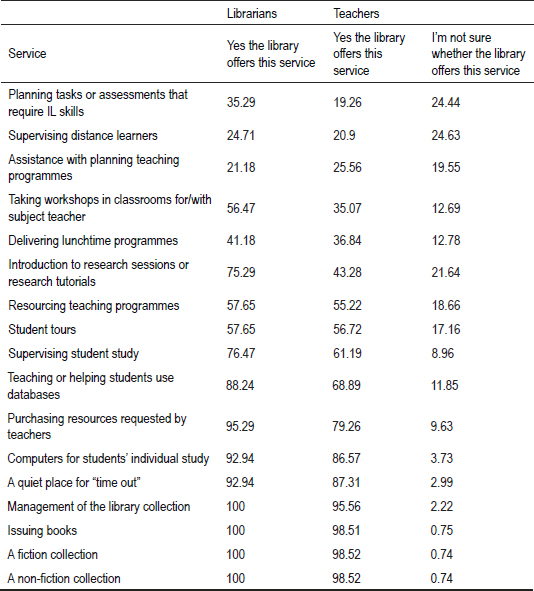
An analysis of these two closed questions in the surveys largely confirms that librarians and library services are not seen by teachers or librarians to be centrally involved in the development of IL skills in students. Teachers were also more likely to report that librarians were “not at all” involved in helping students develop IL skills. Results suggest that teachers lack full awareness of what services school libraries offer, and that they were far more aware of “traditional” library services such as managing the collection and issuing books than they were of more contemporary services such as assistance with teaching programmes or planning IL activities for students.
The analysis of the data is provided below.
How teachers and librarians perceive the library and its services
We provided teachers and librarians with a list of 17 services that were likely to be offered by New Zealand school libraries (see Table 1). Librarians on average reported that their school library offered 12.44 of the services listed while teachers reported that their library offered 10.67. An Independen-Samples Mann-Whitney U test indicated that librarians reported that their school offered significantly more services than did teachers.1 Teachers and librarians were not necessarily from the same set of schools, so we could not rule out the possibility that librarians responding were from schools with libraries offering more services than were teachers. Reviewing Table 1, we note that there are a number of services where a reasonable proportion of teachers were unaware of whether their library offered a particular service or not, consistent with the idea that teachers are not aware of all the services that their school libraries offer.
Table 1. Percentage of teachers and librarians reporting that various services were offered by their school library2,3
How teachers and librarians perceive the input of school library services in helping senior students develop information literacy skills
As can be seen from Figure 1, respondents varied widely in how involved they reported the library and/or librarian is in helping Years 11–13 students develop IL skills at their school.4 Teachers and librarians viewed the extent of libraries’ involvement differently, with significant differences in the distribution of responses between the two groups for all items. Typically, the largest difference between the two groups was that teachers were more likely to report that the librarian was “not at all involved” in helping students develop the skills listed than were librarians.
Findings: Definitions of information literacy
We asked our participants to define IL, using a range of prompts. This is important because a shared understanding of IL would be an important precondition of collaboration between teachers and librarians. Overall, while there were some differences, there was a considerable level of agreement between the groups on what constitutes IL.
Participants were asked to select from a list of 20 items which included 16 items generated from standard approaches to IL, including the ANCIL model, three items that are not commonly seen as IL (content, editing and proofreading, and time management), two items that are contentious in terms of definitions of IL and which more commonly align with Indigenous approaches to IL (asking an expert, and asking whānau and friends), and one item which is commonly confused with IL (IT and computer skills). The percentages of teachers and librarians indicating that each skill listed was an example of IL are given in Table 2.
Figure 1. Percentages of teachers and librarians making each response regarding the involvement of the school library and librarian in supporting students to develop the skills listed
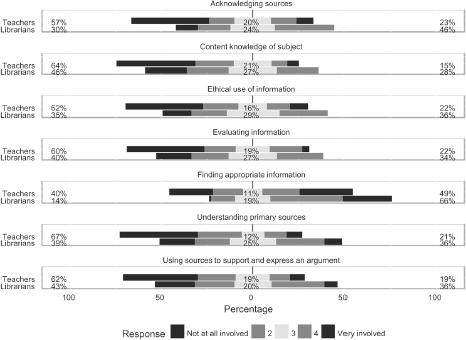
Note: Percentage values from left to right indicate percentages of respondents below, at, and above the scale midpoint.
There was mixed evidence for the idea that teachers and librarians share a definition of IL. For almost every item listed, some respondents in each group indicated that it was an example of IL while others indicated that it was not. Librarians on average indicated that 15 (94%) of the 16 IL skills listed were examples of IL skills, and teachers on average indicated fewer (13.5, 84%) were examples of IL. An Independent-Samples Mann-Whitney U test indicated that this difference was statistically significant.5 Thus, librarians indicated that more of the items listed were examples of IL skills. Of note is the fact that, the more likely librarians were to respond that an item was an example of IL, the more likely teachers were to respond the same way. That is, the percentages of teachers and librarians indicating that each skill was an example of IL were strongly correlated.6
We were interested to know what the similarities and differences between the two groups were in terms of identifying items as IL. For the differences, Chi-square tests indicated that significantly more librarians than teachers indicated that four specific items were examples of IL skills. These were “content knowledge of the subject”, “asking an expert for information”, “ethical use of information”, and “understanding primary sources”. These items are indicated as bold in Table 2. For the other items, there was no significant difference between the proportion of teachers and librarians identifying a particular item as IL, indicating the shared aspects of a definition.
There were, however, some surprising results from this question. For example, we had anticipated that very few teachers or librarians would identify content knowledge, time management, and editing and proofreading as IL skills, since these are not included in most definitions of IL—but, while these were the lowest scores, nevertheless, over half the librarians identified these as IL skills. We are unable to explain this result and further research is indicated.
In terms of more contemporary and Indigenous descriptions of IL (i.e., asking friends/whānau and experts) our results suggest an emerging understanding amongst teachers of these skills as a valid way of searching for information.
Table 2.* Percentages of teachers and librarians who reported that listed items were “an information literacy skill”
| | Librarians | Teachers |
| Other skills | 15.29 | 10.22 |
| Content knowledge of subject | 57.65 | 32.85 |
| Effective time management | 54.12 | 34.31 |
| Editing and proofreading writing | 64.71 | 50.36 |
| Asking friends and whānau for information | 74.12 | 56.93 |
| IT and computer skills | 65.88 | 62.77 |
| Asking an expert for information | 87.06 | 65.69 |
| Framing the inquiry | 87.06 | 73.72 |
| Note taking | 92.94 | 81.02 |
| Ethical use of information | 96.47 | 82.48 |
| Writing good research inquiry questions | 96.47 | 83.94 |
| Interpreting information presented visually | 88.24 | 86.13 |
| Evaluating database search results | 97.65 | 86.13 |
| Using sources to support and express an argument | 97.65 | 88.32 |
| Understanding primary sources | 100 | 88.32 |
| Acknowledging sources | 97.65 | 90.51 |
| Identifying and connecting related ideas from different sources | 94.12 | 90.51 |
| Ordering and organising information | 94.12 | 91.97 |
| Using specific key words when searching databases | 98.82 | 93.43 |
| Finding appropriate information | 98.82 | 96.35 |
| Evaluating information | 98.82 | 97.08 |
Items are ordered by the percentage of teachers endorsing them as examples of IL skills.
* Bolded items are those where a Chi-square test indicated a significant difference between groups with a Bonferroni corrected alpha of 0.0024.
Findings: How teachers and librarians value information literacy
For teachers and librarians to work together to integrate IL into the curriculum we would expect not only a shared understanding of what IL is, but also that they would share a similar valuing of IL. To investigate participants’ beliefs about the value of IL, we used six items from standard definitions of IL plus content knowledge, and asked participants how important these skills were for successful completion of Year 11 coursework, Year 13 coursework, tertiary studies, and for life.
Our findings suggest that, while both groups value IL skills, particularly in academic contexts, librarians value IL more highly than teachers. It might be argued that this is to be expected since IL is core work for librarians. But it could equally be argued that, as an aspect of constructing disciplinary knowledge, teaching IL is equally core business for teachers. Both teachers and librarians reported that all skills identified as examples were important but librarians often reported IL skills as significantly more important than teachers for success in educational contexts. This was particularly true for completing Year 11 coursework (all items except content knowledge of the subject) but it was also true for completing Year 13 coursework and tertiary study (acknowledging sources, understanding primary sources, and ethical use of information). Although both groups identified IL skills as important for success in life, their importance was generally less than for success in educational contexts. Furthermore, librarians were more likely to identify ethical use of information and acknowledging sources as more important for success in life than teachers.
Importance of IL skills for completing Year 11 coursework
Participants were asked to rate the importance of IL skills for completing Year 11 coursework on a 1–5 (unimportant–very important) scale. Distributions of teachers’ and librarians’ responses are presented in Figure 2. Note that only the 116 teachers who reported having taught Year 11 students in the past 3 years saw questions about the importance of skills for Year 11 students.
Figure 2. Percentages of teachers and librarians making each response regarding the importance of IL skills for Year 11 coursework
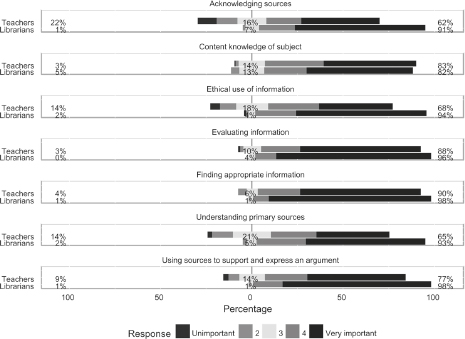
Note: Percentage values from left to right indicate percentages of respondents below, at, and above the scale midpoint.
When asked about the importance of IL skills for Year 11, teachers and librarians reported that all skills were important, but, nevertheless, librarians rated all, except content knowledge of the subject, as significantly more important.7 This might have indicated that librarians view Year 11 coursework as more demanding than teachers do in general, rather than that librarians have different views of the importance of IL skills specifically. Counter to this, however, when asked to rate the importance of content knowledge of the subject, the two groups responded similarly (see second row of Figure 2). Thus, the fact that librarians report that IL skills are more important for Year 11 coursework than do teachers does not simply reflect the fact that librarians perceive secondary coursework as more demanding but rather they appear to specifically emphasise the value of IL skills.
Importance of IL skills for completing Year 13 coursework
Figure 3. Percentages of teachers and librarians making each response regarding the importance of IL skills for Year 13 coursework
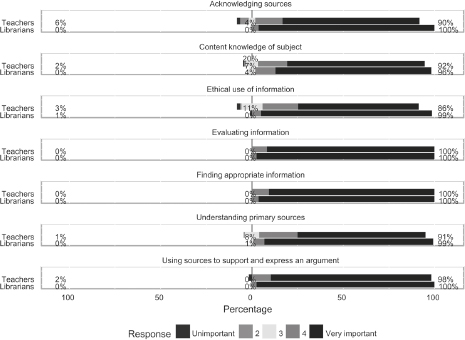
Note: Percentage values from left to right indicate percentages of respondents below, at, and above the scale midpoint.
The distributions of responses given about the importance of IL skills for Year 13 coursework are presented in Figure 3. Respondents generally reported that IL skills were more important for Year 13 coursework than for Year 11 coursework.8 Note that only the 110 teachers who reported they had taught Year 13 in the past 3 years saw these items.
For three IL skills (acknowledging sources, understanding primary sources, and ethical use of information) there was a significant difference in the response distributions for teachers and librarians. Librarians were more likely to report that these skills were “very important” for completing Year 13 coursework successfully than were teachers. For the remaining IL skills, there was no significant difference between the two groups. However, both teachers and librarians were very likely to report that these skills were “very important”, meaning that there was little room for a difference to emerge between the two groups (i.e., a ceiling effect). As at Year 11, there was no significant difference in teachers’ and librarians’ responses about the importance of content knowledge of the subject (and no evidence of a ceiling effect) perhaps again suggesting that differences between the two groups were somewhat specific to IL skills.
Importance of IL skills for success in university, polytechnic, or institute of technology study
Figure 4. Percentages of teachers and librarians making each response regarding the importance of IL skills for university, polytechnic, or institute of technology study
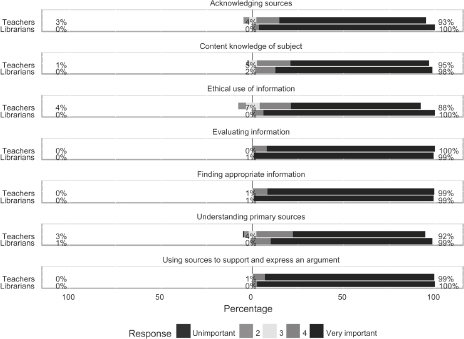
Note: Percentage values from left to right indicate percentages of respondents below, at, and above the scale midpoint.
The pattern of results for the importance of IL skills for tertiary study resembled that for the importance of IL skills for Year 13 (see Figure 4). Respondents reported that all skills listed were of high importance for students’ success in future higher-level study.9 Significantly more librarians than teachers, however, reported that three skills (acknowledging sources, understanding primary sources, and ethical use of information) were “very important” for tertiary study. For the remaining skills, there was no significant difference between the two groups in their distributions of responses, although it should be noted that for these items the percentage of teachers reporting that the skill was “very important” was so high that there was little space for a difference to emerge.
Importance of IL skills for success in life
Figure 5. Percentages of teachers and librarians making each response regarding the importance of IL skills for “life”
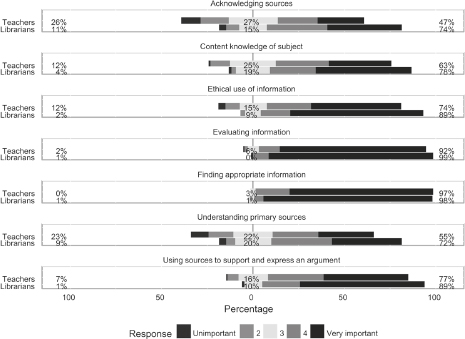
Note: Percentage values from left to right indicate percentages of respondents below, at, and above the scale midpoint.
While most teachers and librarians did report that skills listed would be important/very important for students’ “success in life” (see Figure 5), respondents did, however, evaluate the listed IL skills as less important for success in life than for success in educational contexts. Notably, only a minority of respondents considered that acknowledging sources and understanding primary sources would be “very important” for students’ success in life. Librarians were significantly more likely to report that ethical use of information and acknowledging sources would be important for students’ success in life than were teachers. Librarians were more likely to rate each remaining item as “very important” for life than were teachers; however, there was no significant difference between groups following Bonferroni correction. Thus, there was tentative evidence that librarians might evaluate IL skills as more important for life than do teachers.
Findings: NCEA and NZC and information literacy skills
There was a number of interesting findings in response to the question of whether NCEA and NZC promote IL skills. First is that a significant proportion of the librarians (almost 20%) were unable to answer the question (i.e., they answered “don’t know”).
Second, for over half the items, while individual respondents differed in the extent to which they reported that NCEA and NZC promoted IL skills, these differences were not linked to whether they were teachers or librarians. In other words, there was considerable variation in the way both groups responded. This bears further investigation: it may be, for example, that the variation between teachers relates to the discipline they teach.
But perhaps most interesting of all is that so many of the scores are low compared with previous questions, and that, while both teachers and librarians saw NZC and NCEA as supporting student skills in finding, evaluating, and using sources to support an argument, the scores are much lower for ethical use of information, and understanding primary sources. (Wilcoxon signed ranks test indicated median responses were significantly lower than those for content knowledge for both groups.) This has interesting implications for tertiary institutions that may assume that students will enter tertiary education already equipped with these skills.
Figure 6. Percentages of teachers and librarians making each response regarding whether NZC and NCEA promote the listed skills
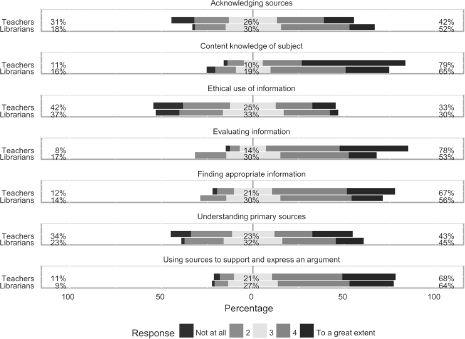
Note: Percentage values from left to right indicate percentages of respondents below, at, and above the scale midpoint.
For four out of the seven IL skills (acknowledging sources, using sources to support and express an argument, understanding primary sources, and ethical use of information), there were no significant differences in the distribution of responses between groups10 (see Figure 6). That is, while individual respondents differed in the extent to which they reported that NCEA and NZC promoted IL skills, these differences were not linked to whether they were teachers or librarians. There were significant differences in the extent to which teachers and librarians reported that NCEA and NZC supported students to develop skills relating to finding appropriate information and evaluating information, and the extent to which NZC and NCEA promote content knowledge of the subject. The most marked differences were that teachers were more likely to say that NCEA and NZC promoted these skills “to a great extent”, and librarians were more likely to respond that they were not sure whether the assessment framework and curriculum promoted these skills.
Of particular note is that the items within this question were the only set in which a large number of participants, particularly librarians, responded, “I’m not sure” (see Table 3).
Table 3. Percentages of librarians and teachers indicating that they weren’t sure whether NCEA and NZC promote the skills listed
| Skill | Librarians | Teachers |
| Finding appropriate information | 18.3 | 3.8 |
| Evaluating information | 18.3 | 3.7 |
| Acknowledging sources | 15.7 | 7.5 |
| Using sources to support and express an argument | 15.9 | 4.5 |
| Understanding primary sources | 16.9 | 11.2 |
| Ethical use of information | 19.5 | 11.3 |
| Content knowledge of subject | 19.5 | 3.7 |
Discussion
In this article, we have suggested that for students to be equipped with the IL skills needed to navigate a world awash with information and disinformation, two conditions are required: an information-rich curriculum, and an effective school library service that is fully integrated into curriculum delivery. Further, we suggested that teacher and librarian attitudes and beliefs may be critical to the collaborative delivery of these skills within the curriculum.
We begin with the library. Clearly, our findings suggest that the school library is not fully integrated into curriculum delivery, confirming the findings of our 2018 paper. Two issues stand out: the number of teachers who don’t know whether their school libraries offer particular services (particularly related to more contemporary services such as planning tasks or assessments that require IL skills, or resourcing teaching programmes), and some significant differences between the teachers and librarians in the services they see the library offering the school and how they see the library engaging with the curriculum. Teachers and librarians see the function and roles of the library differently. This has implications for the potential for collaborative partnerships between teachers and librarians in the delivery of the curriculum.
But it is also worth noting some other aspects of these data: for example, that not just the teachers but the librarians saw the function of the library as shaped by their school as primarily focused around traditional roles such as collation of the book collection: only 35% said their role involved planning tasks or assessments that require IL skills and only 21% said that their library is engaged in assisting with planning teaching programmes. Perhaps even more interesting are the data on how the librarian is involved with supporting senior students with IL skills: for example, 40% of teachers responded that the librarian was not involved in even that most basic of IL tasks, finding information.
If we broaden our scope to IL in the curriculum, our results raise significant questions. We again find some significant differences between the teachers and librarians, particularly in relation to the way the two groups see acknowledging sources, engaging with primary sources, and ethical use of information. But, again, other findings are perhaps more significant. The first relates to the valuing of IL and its role in the curriculum. The scores for the questions that investigated how much teachers and librarians value IL skills for success at Year 11, Year 13, and tertiary studies are very high for all items. Clearly, both groups value IL skills highly and see them as essential for academic success—both at school and beyond. But, the scores on items that ask participants to score the extent to which NCEA and NZC promote IL skills are lower. It seems that, while both groups value IL, they don’t necessarily see those skills as promoted by NZC and NCEA.
This bears some reflection and further research. Is the problem, as discussed in the introduction, the result of IL only appearing in the “back end” of the curriculum? Or, given the range of responses from the teachers, is the way teachers perceive IL in the curriculum discipline-specific (e.g., would teachers in science, technology, engineering, and mathematics [STEM] subjects see IL as less visible in the curriculum than text-rich subjects such as English or history)? Further investigation that intentionally targets teachers in the STEM disciplines is warranted.
Finally, we would like to pause for a moment over the findings in relation to librarians’ knowledge of NZC and NCEA. Just under 20% of the librarians were unsure about whether NZC or NCEA promoted particular IL skills. On one level this result may be seen as confirming the marginalisation of librarians: if you are kept away from the curriculum and relegated to cataloguing books in the library, how could you know how NZC and NCEA position IL skills? But it does also suggest a self-perpetuating cycle of marginalisation—if librarians lack knowledge of NCEA and NZC because they don’t engage with them in the classroom, how then can they be highly valued by the teachers or effectively contribute in the classroom? Even if librarians have extensive professional knowledge of IL skills, if they can’t contextualise that knowledge within the senior school curriculum (because they are not engaged with it), then their value to teachers will be limited. We should note that this is a small percentage of librarians—a full 80% were able to answer this question—but it is worth noting nevertheless.
Conclusions
Where do we go from here? If we accept that an integrated school library service and the embedding of IL in the curriculum are essential to the development of information-savvy citizens, then we have cause for concern.
In our 2018 article on attitudes and beliefs related to school library services, we suggested that “we need to address change not at the individual (librarian/teacher/principal) or even school level; more radical, systemic change is required” (Emerson et al., 2018, p. 63) if libraries were to be integrated fully into the work of the senior secondary school. To that end, we recommended a substantial review and revision of school library services that would re-set beliefs and attitudes relating to the library: that minimum standards for library services should be established, including a requirement for qualified librarians in schools, and stabilising this role through a more appropriate funding mechanism, and that it should be a statutory requirement for schools to have a library. This article, by broadening the scope of the investigation to include IL, suggests that the recommendations from our 2018 paper be placed in a broader context of IL in the curriculum. If our students are to be equipped to engage with an information-rich and information-distorted world, and with the skills to engage with the IL expectations of tertiary study, change is needed.
First, we would stress the need for further research into librarian and teacher perceptions of IL and the role of the secondary-school library in promoting IL skills in the classroom, with a larger sample size, which intentionally targets teachers in text-light disciplines. We might conjecture that, given the gaps in knowledge of the library amongst predominantly English and social studies teachers demonstrated in this study, a larger, more balanced sample would reveal an even more startling gap in teacher knowledge about the library than is revealed here. A larger sample size would also enable valuable analysis of the data by decile—allowing us to draw a more nuanced picture of perceptions of IL and secondary-school libraries in Aotearoa New Zealand.
Secondly, the need for more research should not suggest a delay in action. We would emphasise again the significance of the library and its marginalisation within schools. Given the weight of literature which stresses that the value librarians bring to the classroom, we could argue there needs to be concerted, systemic change—not at school level, but at the level of policy. As the New Zealand government, through the Tomorrow’s Schools Review, is currently engaging with questions of the management and administration of schools, it would seem timely to reconsider how secondary-school libraries are mandated and funded.
Thirdly, we would suggest that the positioning of the IL within the curriculum be reviewed. Given the essential nature of information and digital literacy skills in today’s society, it is not sufficient to embed IL within the curriculum and leave the integration of those skills to discipline areas or to individual teachers. We recommend that IL progressions and expectations in all disciplines be written explicitly into the curriculum.
Finally, in the light of these findings, we recommend that PLD for combined groups of teachers and librarians, which models ways of integrating information and digital literacy, be rolled out across the country. If we are to take seriously the responsibility of educators to enable future generations to engage fluently, safely, and creatively with a digital world, it is surely time to have these conversations.
Acknowledgement
This article draws on data from the first year of a 3-year research project on IL and the role of library services in senior secondary schools and tertiary institutions. Our three main aims are to: a) develop a baseline study of how IL and library services are currently used in schools and tertiary institutions; b) develop sustainable partnerships between teachers and librarians in seven provincial secondary schools from Invercargill to Kerikeri to deliver IL skills within the curriculum; and c) design a set of IL progressions to enable more effective learning and transition across sectors. See http://www.tlri.org.nz/tlri-research/research-progress/cross-sector/transforming-information-literacy-spaces-support. We would like to acknowledge the essential support of TLRI for this project, and particularly the mentorship and support of Dr Rosemary Hipkins.
References
Alger, C. L. (2009). Secondary teachers’ conceptual metaphors of teaching and learning: Changes over the career span. Teaching and Teacher Education, 25(5), 743–751.
Clarke, R. (2019). Student independence depends on the library management system. https://www.schoolnews.co.nz/2019/08/student-independence-depends-on-the-library-management-system/
Eagly, A. H., & Chaiken, S. (1995). Attitude strength, attitude structure, and resistance to change. Attitude Strength: Antecedents and Consequences, 4, 413–432.
Earl, L. M., & Timperley, H. (2009). Understanding how evidence and learning conversations work. In Professional learning conversations: Challenges in using evidence for improvement (pp. 1–12). Dordrecht, the Netherlands: Springer.
Education Review Office. (2005). Student learning in the information landscape. Wellington: Author.
Eggen, P., & Kauchak, D. (2007). Educational psychological: Windows on classrooms (7th ed.). Upper Saddle River, NJ: Pearson Education.
Elmborg, J.(2006). Critical information literacy: Implications for instructional practice. The Journal of Academic Librarianship, 32(2), 192–199.
Elmborg, J. (2012). Critical information literacy: Definitions and challenges. In C. Wetzel Wilkinson, & C. Bruch (Eds.), Transforming information literacy programs (pp. 75–95). Chicago, IL: Association of College and Research Libraries.
Emerson, L., Kilpin, K., White, S., Greenhow, A., Macaskill, A., Feekery, A.J., Lamond, H., Doughty, C., & O’Connor, R.. (2018). Under-recognised, underused, and undervalued: School libraries and librarians in New Zealand secondary school curriculum planning and delivery. Curriculum Matters, 14, 48–86.
Emerson, L., & Mansvelt, J. (2014). ‘If they’re the customer, I’m the meat in the sandwich’: An exploration of tertiary teachers’ metaphorical constructions of teaching. Higher Education Research & Development, 33(3), 469–482.
Emery, J. L., & Fancher, S. E. (2017). What do we need? Information criticality! When do we need it? Now! Brick and Click: An Academic Library Conference, November 3, 2017, 129.
Flaxman, S., Goel, S., & Rao, J. M. (2016). Filter bubbles, echo chambers, and online news consumption. Public Opinion Quarterly, 80(S1), 298–320.
Gregoire, M. (2003). Is it a challenge or a threat? A dual-process model of teachers’ cognition and appraisal processes during conceptual change. Educational Psychology Review, 15(2), 147–179.
Hay, L. (2006). Student learning through Australian school libraries—Part 2: A statistical analysis of student perceptions. Synergy, 4(2), 27–38.
Hughes, H., Bozorgian, H., & Allan, C. (2014). School libraries, teacher-librarians and student-outcomes: Presenting and using the evidence. School Libraries Worldwide, 20(1), 29–50.
Jones, M. G., & Leagon, M. (2014). Teacher attitudes and beliefs: Reforming practice. Handbook of research on science teaching, 2, 830-47.
Kilpin, K. (2019). Is presence by inference good enough? https://informationliteracyspaces.wordpress.com/2019/04/05/is-presence-by-inference-good-enough/
Lance, K. C., & Loertscher, D. V. (2003). Powering achievement: School library media programs make a difference: The evidence (2nd ed.). San Jose, CA: Hi Willow Research and Publishing.
Lance, K. C., Rodway, M. J., & Hamilton-Pennell, C. (2000). How school librarians help kids achieve standards: The second Colorado study. Denver, COL: Library Research Services.
Lance, K. C., Rodway, M. J., & Russell, B. (2007). How students, teachers & principals benefit from strong school libraries: The Indiana study. Indianapolis, IND: Association for Indiana Media Educators.
Leetaru, K. (2016). How data and information literacy could end fake news. Forbes.Retrieved from https://www.forbes.com/sites/kalevleetaru/2016/12/11/how-data-and-information-literacy-could-end-fake-news/#5cca03213399
Lonsdale, M. (2003). Impact of school libraries on student achievement: A review of the research. Retrieved from http://files.eric.ed.gov/fulltext/ED482253.pdf
Martinez, M. A., Sauleda, N., & Huber, G. L. (2001). Metaphors as blueprints of thinking about teaching and learning. Teaching and Teacher Education, 17, 965–977.
Matthews, D. (2017). Academics fail to change teaching due to fear of looking stupid. Times Higher Education. https://www.timeshighereducation.com/news/academics-fail-change-teaching-due-fear-looking-stupid
McDonough, B. A. (2014). Critical information literacy in practice: An interpretive synthesis (Doctoral Dissertation). Western Carolina University. Retrieved from http://libres.uncg.edu/ir/wcu/listing.aspx?id=15796
Ministry of Education. (2007). The New Zealand curriculum. Wellington: Learning Media.
National Library of New Zealand, SLANZA, LIANZA. (2018). School libraries and school library services in New Zealand Aotearoa. Available from https://natlib.govt.nz/schools/school-libraries/understanding-school-libraries/importance-of-the-school-library-in-learning-the-research#nzresearch
Pariser, E. (2011). The filter bubble: What the internet is hiding from you. New York, NY: Penguin.
Patchen, T., & Crawford, T. (2011). From gardeners to tour guides: The epistemological struggle revealed in teacher-generated metaphors of teaching. Journal of Teacher Education, 62(3), 286–298.
Scholastic Research & Results. (2008). School libraries work! (3rd ed.). www.scholastic.com/content/collateralresources/pdf/s/slw3_2008.pdf
Secker, J & Connan, E (2011) ‘A New Curriculum for Information Literacy’. Retrieved from ARCADIA University of Cambridge http://ccfil.pbworks.com/f/ANCIL_final.pdf
Shanahan, T., & Shanahan, C. (2008). Teaching disciplinary literacy to adolescents: Rethinking content area literacy. Harvard Educational Review, Spring, 78(1), 40–59.
Simmons, M. (2005). Librarians as disciplinary discourse mediators: Using genre theory to move toward critical information literacy. Portal: Libraries and the Academy, 5(3), 297–311.
Stanford History Education Group. (2016). Evaluating information: The cornerstone of civic online reasoning. Executive summary. Retrieved from: https://www.csai-online.org/resources/evaluating-information-cornerstone-civic-online-reasoning
Tewell, E.C. (2018). The practice and promise of critical information literacy: Academic librarians’ involvement in critical library instruction. College & Research Libraries, 79(1), 10–34
The Ministry of Education and National Library of New Zealand. (2002). The school library and learning in the information landscape: Guidelines for New Zealand schools. Wellington: Learning Media.
Tomorrow’s Schools Independent Task Force. (2018). Te whiria nga kura tuatinitini: Our schooling futures: Stronger together. Available from https://www.education.govt.nz/news/tomorrows-schools-report-released/
Unicef. (2017). Children in a digital world. United Nations Children’s Fund (UNICEF).
Wideen, M., Mayer-Smith, J., & Moon, B. (1998). A critical analysis of the research on learning to teach: Making the case for an ecological perspective on inquiry. Review of Educational Research, 68(2), 130–178.
Williams, D., Wavell, C., & Coles, L. (2001). Impact of school library services on achievement and learning: Critical literature review. London, UK: DfES. https://openair.rgu.ac.uk/bitstream/handle/10059/1382/Williams%20Impact%20of%20school%20library%20services%20on%20achievement%20and%20learning.pdf?sequence=1&isAllowed=y
Williams, D., Wavell, C., & Morrison, K. (2013). Impact of school libraries on learning. http://www.cldplanning.com/site/assets/files/9126/slic_rgu_impact_of_school_libraries_2013.pdf
The authors
The authors of this article are part of a team of researchers and librarians from Massey University, Victoria University of Wellington, and Invercargill City Library and Archives.
Lisa Emerson (corresponding author): L.Emerson@massey.ac.nz
1U = 3681, p <0.001
2Ten teachers (7.4%) and 21 (24.7%) librarians nominated additional services that we had not listed. For teachers, these included blogs and student reviews, careers advice, charging phones!!![sic], and transition courses to university. For librarians, these included competitions and activities (e.g., chess, training student librarians, E book seminars, organising lots of other things including student librarians, makerspace).
3Note that librarians were not given the option to indicate that they were not sure whether a particular service was offered.
4As a result, it was not necessary to collapse any response categories for this set of items for the Chi-squared test.
5U = 3855, p <0.001
6rs = 0.89, p <0.01
7For the Chi-squared analysis, the response categories were collapsed into “less important” (3 or less), “important” (4), and “very important” (5).
8Due to the low number of responses in the lower categories, it was necessary to collapse all response categories below “very important” together for the Chi-squared test.
9As a result, it was necessary to collapse all response alternatives except “very important” into one category for the Chi-squared test.
10Few teachers and librarians reported that NCEA and NZC promoted the skills listed “not at all” (1/5) and so we combined this response alternative with the next response alternative up (2/5) for analysis.