Working towards a motivational pedagogy for school programmes in additional languages
Martin East
Abstract
The teaching and learning of languages additional to English (L2) in English-dominant societies has reached a crisis point, with teachers often facing considerable challenges with recruiting, and then retaining, students. This article presents findings from a study in New Zealand, where the introduction of a revised curriculum has provided the opportunity for L2 teachers to reflect on current and future teaching practices. Data from interviews with teachers and curriculum support workers (advisers) are used to consider whether a learner-centred and experiential pedagogical approach might make a positive difference to L2 students’ classroom experiences, and thereby potentially contribute to alleviating the challenges of demotivated students, low enrolments and attrition.
Introduction
In Volume 4 of Curriculum Matters, I noted (East, 2008) that “[o]ne significant development in New Zealand’s recently launched school curriculum is the establishment of a new learning area—Learning Languages.” I went on to suggest that, in theory at least, this new learning area “will give the teaching and learning of second [i.e., additional] languages a higher profile and a greater status than it has thus far enjoyed in schools” (p. 113). I asserted nevertheless that the situation in New Zealand with regard to student take-up of additional languages has not been a positive one, with L2 teachers frequently facing demotivated students, low enrolments and considerable attrition (see also McLaughlan (2006) in this regard). I saw this not only as a local (New Zealand) problem, but also as a global phenomenon in evidence in any context where English is the dominant language. I concluded:
Entrenched monolingual and Anglocentric [English-only] attitudes arguably work against the successful introduction of meaningful courses in foreign languages in schools. At a fundamental level an attitudinal change is required if foreign-language learning is to have a chance at real and lasting success. (East, 2008, p. 129)
The present article takes my (2008) conclusion as the starting point for an exploration of what might be done to make real, through “attitudinal change”, the theoretical “higher profile and greater status” of language learning in New Zealand’s schools. The article is built on the aim of the revised curriculum to encourage schools to move away from a teacher-led pedagogy, with the teacher representing the authority figure, and towards a more learner-centred and experiential approach, with teacher and learner engaged in co-construction of knowledge (Kolb, 1984; Ministry of Education, 2007b, p. 38; Weimer, 2002). Co-construction parallels the Mäori concept of ako, which is defined as being “grounded in the principle of reciprocity” and “describes a teaching and learning relationship where the educator is also learning from the student” (Ministry of Education, 2008, para 3).
The introduction of a revised national curriculum has provided the opportunity for L2 teachers to consider more learner-centred, experiential and co-constructive approaches, based on the premise that “the most effective way to teach a language is by engaging learners in real language use in the classroom … by designing tasks—discussions, problems, games, and so on—which require learners to use language for themselves” (Willis & Willis, 2007, p. 1, emphasis added). This article presents data from interviews with teachers and curriculum support workers (advisers) in New Zealand, drawing out the implications of a more task-focused approach—so-called task-based language teaching or TBLT—for enhancing students’ experiences of L2 learning. Findings are used to highlight TBLT as “a potentially very powerful language pedagogy” (Van den Branden, Bygate, & Norris, 2009, p. 1), relevant in any context where teachers struggle with problems of attitudes, motivation, recruitment and retention.
Background
In many places around the world where English is the dominant language, the teaching and learning of L2 other than English has reached something of a crisis point, with enrolments into L2 courses, whether at secondary or tertiary level, on the decline (Debusmann, 2008; Gallagher-Brett, 2004; The Group of Eight Universities, 2007). It seems this crisis has been precipitated by a pervasive worldview that English is the only essentially important language, and that knowledge of English is all people need if they are to succeed in communicating with others across the globe (Bruthiaux, 2003; Pool, 1993).
Over 30 years ago, Simon (1980) used the word “crisis” to describe the situation in the US, where it appeared there was a general lack of interest in L2 study. Tonkin (2003) made reference to a 1979 President’s Commission which intimated that L2 learning was considered to be something of a peripheral and easily dismissed pastime, at least for “busy business people.” He concluded:
[M]ost executives don’t care much about languages, generally consider language a Good Thing, and have taken about all the time out of their busy schedules that they are willing to devote to thinking about the subject, thank you very much. As for learning foreign languages themselves, they did that once, and have gotten over it now, and, besides, everyone they deal with speaks English. (p. 149)
The US situation appears to have remained largely unchanged well into the 21st century. At the turn of the century, Kecht (1999) noted that, in the US, obstacles to L2 learning were caused by “a national culture uninterested in other cultures and peoples” (p. 17). Debusmann (2008) referred to Simon’s (1980) argument that “a deficit of language skills threatened U.S. business and national security”. He went on to note a continuing “pervasive lack of knowledge about foreign cultures and foreign languages” (para 2).
A recent research report into the Australian context for L2 learning (The Group of Eight Universities, 2007) continues the “crisis” metaphor. On the positive side, the report noted both that “[l]anguage skills are central to diplomacy, managing Australia’s national security and developing trade opportunities” (p. 6) and that “Languages Other Than English has been designated a key learning area [in schools] since 1989” (p. 2). On the negative side, the report pointed out that, at the time of the research, and despite measures designed to promote languages education, only 13 percent of school students were studying a language other than English in their final year of schooling. By contrast, about 30 years previously, when L2 study was removed as a prerequisite for university entry, the figure was 40 percent.
L2 learning in England also “appears to be at something of a crisis point” according to Gallagher-Brett (2004) in a publication designed to promote interest in L2 learning. She referred to the Nuffield Languages Inquiry (2000) which, she asserted, “pinpointed problems of motivation among many secondary school language learners and reported that nine out of ten students choose not to continue with language study post 16” (p. 5). Subsequent to the publication of these two reports, the UK government made a decision that, although L2 learning would continue to be compulsory in school Years 7 to 9 (11+ to 13+ years of age), study of an L2 would no longer be compulsory for students in Years 10 and 11 (14+ to 16+ years of age). The consequence of this decision has been a steady and dramatic decline in the numbers of students continuing with language study post-14 (CILT, 2009).
L2 teachers working in these contexts, who are often mindful that student motivation is crucial, face considerable challenges. According to Van Lier (1996), motivation is the most important factor in successful language learning. Dörnyei (2001b) maintains that motivation is an important component in educational success.
In the context of an “L2 crisis”, the most salient proposition often put forward to motivate students to learn an L2 has often focused on challenging the “English-only” myth and stressing the strategic and economic advantages of knowing and being able to communicate in another language. This perspective is implicit in the linking of paucity of L2 knowledge with words such as “business” (Simon, 1980) or “trade” (The Group of Eight Universities, 2007). In English-dominant contexts, presenting arguments about future work opportunities, and learning languages for real-world communicative purposes, may thereby potentially act as an extrinsic motivator, that is, the determiner of “those actions carried out to achieve some instrumental end” (Noels, Pelletier, Clement, & Vallerand, 2000, p. 61).
For students in schools, however, the employment prospects of being able to communicate in an L2 may be perceived as having limited relevance, especially if students believe the myth that “everyone speaks English” (Tonkin, 2003). Arguably more important is intrinsic motivation, what Noels et al. (2000) refer to as “motivation to engage in an activity because it is enjoyable and satisfying to do so” (p. 61). Huguet (2006) speculates that students’ attitudes towards the L2 and L2 speaking people, and consequently students’ motivation, may be modified through the process of learning the L2. These perspectives would suggest that the language learning experience itself may either enhance or diminish students’ intrinsic motivation, and that, if students become intrinsically motivated to learn the L2, recruitment and retention issues may be somewhat alleviated even when extrinsic motivation is not strong. In this connection, Lightbown and Spada (2006) suggest:
Teachers can make a positive contribution to students’ motivation to learn if classrooms are places that students enjoy coming to because the content is interesting and relevant to their age and level of ability, the learning goals are challenging yet manageable and clear, and the atmosphere is supportive. (p. 64)
Nevertheless, L2 courses have not necessarily been constructed in ways that fulfil Lightbown and Spada’s (2006) criteria. This is essentially because, despite having real-world communication as a goal, courses have frequently been delivered in a teacher-fronted, step-by-step, hierarchical way where attention to grammatical rules has been seen as an important precursor to effective communication. This was certainly the case in New Zealand, as reflected in the guidelines for a range of L2 that were published to support the former New Zealand curriculum (Ministry of Education, 1993). Long (2000) argues, however, that “despite the best efforts of highly skilled teachers and textbook writers” a teacher-led and grammar-focused approach “tends to produce boring lessons, with resulting declines in motivation, attention, and student enrolments” (p. 182). The “best motivational intervention” may therefore be “to improve the quality of our teaching” (Dörnyei, 2001a, p. 26).
The New Zealand context: An opportunity for change
The publication of a substantially revised curriculum for New Zealand’s schools (Ministry of Education, 2007b) has represented a significant opportunity to take a fresh look at L2 teaching and learning in schools. In common with all other learning areas, Learning Languages, created as a new component within the revised curriculum, is predicated on the development of a learner-centred, experiential and co-constructive pedagogical approach. This has facilitated the opportunity to consider the approach to language teaching and learning known as TBLT. The years 2008 and 2009 represented two years of transition between the publication of the revised curriculum (2007) and its full implementation (2010), during which time teachers have had opportunities to consider how TBLT fits with the published aims of the revised curriculum and Learning Languages.
TBLT is built upon an educational philosophy that sees “important roles for … experiential learning, and learner-centered pedagogy” (Norris, Bygate, & Van den Branden, 2009, p. 15). In TBLT the teacher provides a facilitative and supportive role in contrast to an authoritarian top-down role. Thus, a teacher-led and grammar-focused methodology has been superseded by an approach that focuses on communicative language use tasks in a learner-centred, experiential and co-constructive way.1 New curriculum support documents (e.g., Ministry of Education, 2007a, 2010, 2011a, 2011b) encourage this pedagogical approach.
The present study
The present study—part of a considerably larger study (East, 2012), which took place towards the end of 2009, into practitioners’ understandings of effective L2 pedagogy in light of the revised curriculum and new learning area—sought to investigate the perceived potential of TBLT to create a more motivating pedagogy, and, by implication, a potential solution to the recruitment/retention crisis. The following research question is addressed:
What contribution do practitioners believe that learner-centred and experiential communicative tasks might make to students’ motivation to study an L2?
Design
The broader study comprised two groups of participants: (1) currently practising teachers of one or more of the five most common international languages (n = 19),2 who were able to “provide perspectives from the practical viewpoint of the classroom in the micro-climate of a specific school context” (Carless, 2007, p. 598); and (2) former teachers who now work at some level in a range of school support agencies which exist to support teachers with their work in schools (n = 8), who were able to “view the terrain from a wider angle to complement the more narrowly (single-school) focused perspectives of the teachers” (Carless, 2007, p. 598).
The teacher sample was largely characteristic of experienced and “communicatively oriented” L2 teachers working in a representative range of New Zealand schools (Education Counts, 2010a, 2010b). “Communicatively oriented” was used to describe those teachers who were already aiming to emphasise the communicative value of language learning, and were likely to be the most sympathetic to learner-focused TBLT.
Participants were invited to take part in a semi-structured one-to-one interview. Interviews with teachers lasted up to an hour, and explored teachers’ current practices alongside their knowledge and understanding of the new learning area and its implications for pedagogy. All teachers were asked what they understood by the phrase “task-based language teaching” so that current levels of knowledge and understanding could be established. Interviews with advisors focused more exclusively on TBLT and were therefore shorter. All interviews were digitally recorded and transcribed. For subsequent reporting, and to protect anonymity, each participant was given a pseudonym representing the principal language taught or the person’s role (for example, Gail was a teacher of German, and Alison was an advisor).
Subsequent analysis was thematic, with a view to “identifying, analysing and reporting patterns (themes) within data” (Braun & Clarke, 2006, p. 79), and providing a “detailed and nuanced account” (p. 83) of the emergent themes. The principal aim was to interpret the data from the perspective of the potential and actual contributions of TBLT.
The findings presented in this article focus on the perspectives of a subset of teachers and advisors (see Table 1), with a view to illustrating ways in which a sample of practitioners, across a range of languages, reported that they were theorising and realising tasks in New Zealand classrooms in light of the requirements of a revised national curriculum.3
Table 1 Teacher and advisor perspectives
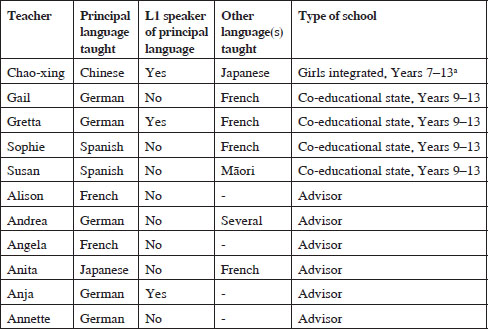
Note:
a integrated—government-funded school of “special character”, such as a church school.
Findings
Tasks from the advisors’ perspective
Several interviewed advisors identified TBLT as a means of promoting meaningful and authentic language use in ways that focused on the learner. Angela, for example, argued that TBLT “gives scope for authentic communication, you actually have a definite purpose for using the language.” Alison suggested that TBLT “means that students are actually using the language to communicate meaningful things, things they want to be able to say.” Annette concurred that the rationale for promoting TBLT was “meaningful use of the language … students given the opportunity to say what they want to say.”
Andrea and Anita brought out the potentially intrinsically motivating dimension of tasks that would enhance learners’ use of the L2. For Andrea, tasks provided “a context [and] the students have work to do around this context which allows them to grow in their own capacity to ask questions and go where they want to go.” Anita suggested, “I think it has more inherent interest to be using the language to do something else, whether it’s solving a puzzle or playing a game or doing some kind of investigation.” For Anita, TBLT would set the L2 and the L2 learner free from the constraints of more prescriptive or teacher-led approaches, and noted “once you start to hand that control over, it’s amazing what the students can actually do.”
Anja provided perspectives that related TBLT to her understanding of effective L2 pedagogy in the light of the more learner-centred aims of the revised New Zealand curriculum. In Anja’s view, a task “has a communicative reason that is not just practising a grammar point or a linguistic point … it is to emphasise the completion of a transaction, for instance, or finding commonalities or finding out about what another person thinks about [something].” Also, TBLT was a means of developing a new and collaborative teacher–learner relationship that would facilitate co-construction of knowledge—that is, “I now understand task-based language teaching as something that comes from a negotiated place, from a need that the students have, or that the students and the teachers have negotiated together.” For the advisors, therefore, TBLT provided scope for genuine communication focused on learners and their needs, with grammar playing a subsidiary rather than a central role. In turn, this was perceived as motivating.
Tasks from the teachers’ perspective
Gail provides an example of a teacher who, as head of a languages department, was aiming to take seriously what she understood to be the expectations of the revised curriculum with a view to enhancing her students’ motivation, and was working with her team to this end. She explained:
We’re just exploring different ways of doing [task-based]. I’m beginning to feel that we should be less and less using the textbook because textbooks date really quickly and are very structured and formal, and although they provide a good backbone to the course and a bit of, maybe, security, I think there’s so much more now that needs to be happening in teaching … just a whole range and variety of different things appeal to different kids to get the language across and to get them using it more and more.
In Gail’s thinking, therefore, the use of textbooks, which (in terms of their structure, sequencing and formality) might have been fully appropriate to meet the expectations of the former curriculum (Ministry of Education, 1993) was no longer necessarily appropriate for a revised learner-centred curriculum. As Gail and her team began to engage with a more learner-centred approach, they found themselves moving away from “structure and formality,” and “moving more towards the task-based style of learning.”
Gail asserted, “We’re trying to think ‘What’s authentic language?’ not just ‘We’re doing this topic because it’s in the textbook’, you know, but ‘How can we make it real?’”. She went on to explain the beliefs that underpinned the direction in which she was going. Arguing that it was necessary to move away from thinking that assumed that because, for example, the class is “going to do the topic of sport and leisure,” this should necessarily entail a structured linear process: learn all the sports as a list of vocabulary and a few grammatical structures to hang these together, so that “then we’ll be able to talk about sports and leisure.” Rather, in her thinking it was “more exciting if you can think of something real that involves bringing all that in … it’s just a way that makes it more relevant to the kids and draws them in more” (emphasis added). She concluded, “I think that is the way to go.” Gail’s understanding of transition from teacher-led to learner-centred was therefore influenced by notions such as “excitement, engagement and relevance”.
Tasks in senior classrooms
Whole-class debates
Gail was among several teachers who drew on whole-class debates as examples of motivational tasks in the senior school (Years 11 to 13). These debates often centred on “hot topics” as ways to stimulate and enhance student participation and use of language. Gail described the following scenario:
The most successful lessons this year with the seniors probably [were] when we got on to dealing with hot issues or controversial topics and we’d work on one for two or three days. We’d read articles, we’d gather back and then we’d talk about it … things like ‘should the drinking age be raised?’ or ‘body piercing’, that sort of thing where they have really strong opinions.
Sophie presented a similar debating task:
It was about cosmetic surgery. We were doing health, you see. I had an article from El Sol about cosmetic surgery so we talked about the health problems that could be associated and how important beauty was and character, beauty versus character. All in Spanish. All of us sitting around in a circle.
Sophie reported on what she perceived her students got out of the task: “[t]hey felt really pleased with themselves because they were producing all this Spanish, and I don’t think they knew they could because they kind of got involved with the topic.” Thus, the debate appeared to motivate Sophie’s students to become engaged with using the language for a genuine communicative purpose. She concluded, “I think [choosing a good topic] that’s what you can do. You can choose things that are different with task-based learning. It gives you a lot of freedom and it’s just what you can come up with in relation to that.” “Difference” and “freedom” therefore represented, for Sophie, what could be achieved when a teacher-dominated, structured and regulated approach was suspended.
Chao-xing initiated another “hot topic” debate with her Year 13 Chinese class. This time articles were not the stimulus; rather, her school had recently banned mobile phones and there were some strong feelings among students about the policy. Chao-xing explained that “because that’s the rule, I purposely set up this task.” Chao-xing facilitated the debate around the advantages and disadvantages of using mobile phones. She explained that this required the students to “express your own opinion by using the target language” and “give suggestions, recommendations and what kind of alternative method you think is best for the students.” The debate generated considerable discussion:
Some of them totally disagree, some of them say “It’s good because you come to school to study. Why do you have to use [phones]?” The others say “But we have a lot of after-curriculum activities. We need to inform the parents what time they need to come back to school to pick us up, you know.”
Just as Gail and Sophie had reported, Chao-xing concluded that the students “seemed really integrated into this topic.” In the perception of these teachers, therefore, open-ended debates provided excellent opportunities for L2 use. The debating tasks appeared not only to promote fluency but also to contribute to student motivation, satisfaction and enjoyment.
Playing games
Susan provided an example of a game, which she called “Psychologist”. This game provided the opportunity to focus primarily on language for communicative purposes but also to encourage active use of particular grammatical constructions in Spanish: conditional sentences (“If I were you, I would …”) and imperatives (“Do [such and such]”).
Each student in turn would leave the room. The rest of the group would give the student a “problem”. When the students came back into the room, they had to work out, via listening and asking questions, what their problem was. That is, “they’d come in and everybody had to give them advice to solve the problem … and they were giving each other just hilarious [problems].” Susan gave one example where the problem was “you’re a compulsive buyer”:
And so one would say “If I were you I would top up my credit cards” or “If I were you I’d lock myself in the room” or “If I were you I wouldn’t go shopping without my mum” until eventually the person was able to figure out what exactly their problem was.
Susan concluded, “Yeah, they were silly, but … it was very, very good for their language.”
Tasks in junior classrooms
One straightforward junior level (Years 9 and 10) task described by Chao-xing, who wanted to “design a task which … [is] student-centred rather than you [the teacher] speak for the whole time,” was a whole-class survey. Students surveyed each other about their hobbies using questions such as “What do you like?” and “What do you do in your leisure time?” After the survey each group was required to report back to the class in order to find out which activities were the most popular. This interactive task was an extension of a typical question-and-answer format that might traditionally have been practised in pairs or as a whole class. The value of this type of task is, however, arguably that it promotes a range of interactions, even if the language is simple, and focuses on the students themselves in a meaningful way.
Gretta was dealing with the topic of “clothing” with her Year 10 German class. She explained how her usual approach had been to teach the required vocabulary using a set of doll’s clothes in a very teacher-fronted way. With a view to finding a more innovative, learner-centred and co-constructive means of learning about clothing, Gretta decided to “set them a task, and the task was ‘You have to (with all the trimmings) actually make a fashion show.’” Gretta’s students were required to organise the entire event. This required thinking about not only the language that would be needed but also the practicalities such as loud speakers and microphone.
The students worked in pairs with the anticipated outcome that while one was walking on the runway the other would describe the outfit. For scaffolding purposes there was a pre-task preparation phase which incorporated an initial brainstorming of the type of language students would need, first in English and then in German. Gretta’s German language assistant also acted as a “walking dictionary” on whose support the students could draw as they engaged with the project. At the final event, Gretta and the German assistant acted as judges, and awarded prizes to ensure that people were rewarded for their efforts (that is, language quality was rewarded alongside, for example, “best male model” or “funniest design”).
This was, by Gretta’s admission, the first time that she had ventured into this kind of quite complex learner-centred task. This meant that her students had to negotiate their own way through it. She conceded that a limitation was getting the co-operation of all students. She concluded, however, that the shift from teacher-led to learner-centred, although challenging for all concerned, “made it really real and interesting for them,” and demonstrated both the motivational and the educational potential:
It was really an eye opener for me how students can actually get really engaged and find the next step that’s necessary … I mean it’s a learning curve for the students as well because up to then they just [thought] ‘Oh, you’re the teacher. She will do something.’
After the event, Gretta wanted to find out what her students thought:
I made a little survey afterwards and I said “You know, do you think you learnt more this way? Or better?” And they said “Perhaps we learnt from the quantity less, but what we learnt we will remember” … And they really ventured into interesting descriptions which I normally would never have done in this topic.
Implications of practitioners’ accounts
It was evident that several advisors displayed enthusiasm for the motivational potential of TBLT. Anja, for example, who (as reported earlier) saw the aim of TBLT to be “not just practising a grammar point or a linguistic point,” reasoned:
I think [TBLT] could feasibly enthuse students to learn language because they can see a reason for it … the reason behind it is to communicate for the fulfilment of something that you as a student actually want to learn or to be able to do. So I think it could feasibly be brilliant for retention.
Thus, the “reasons” for L2 learning were not seen primarily in terms of grammar or future career aspirations, but rather in terms of learner-centred communication and the “here and now”. Alison argued similarly that TBLT “is the way we have to go … this is the way to excite students more and actually be doing something that’s a bit more meaningful and a bit more interesting.” Andrea linked TBLT with freedom from hierarchical prescription, and opportunities to promote experiential learning and co-construction of knowledge:
It’s exciting … it’s exciting to let go and go where the kids want to go because they will take you some place where you’ve never thought of and where you haven’t been yourself … it allows greater autonomy for the learner; it allows new freedom for the teacher if they can relax and let go; it allows for this relationship with ako.
When teachers reflected on the tasks they described, they reported on how successful they believed these tasks had been in the perception of their students:
•Whole-class survey (Chao-xing): “They really enjoyed it because they used target language.”
•Psychologist game (Susan): “They got really into it, it was very good for their language.”
•Debate (Sophie): “They really liked it, they said heaps more than they normally say.”
•Debate (Gail): “They were really interested, they loved it.”
Comments reflecting teacher appreciation for the tasks included:
•Debate (Chao-xing): “I really enjoyed this topic.”
•Psychologist game (Susan): “It was a wonderful, wonderful activity.”
•Fashion show (Gretta): “The task was really interesting, really, really good.”
•Debate (Sophie): “It’s very exciting, very interesting. I’m dying to do more.”
As stated earlier, Gail summed up the potential of tasks in these words: “It’s more exciting if you can think of something real … it’s just a way that makes it more relevant to the kids and draws them in more. I think that is the way to go.” TBLT was therefore perceived as standing in contrast to a teacher-fronted, form-focused pedagogical approach, and as “the way of the future”, a means of promoting both motivation and linguistic proficiency. This was so both for several advisors who have the responsibility to support the aims of Learning Languages, and for several teachers who ultimately have the responsibility to realise the aims of Learning Languages in their own local contexts.
Limitations and conclusions
This study is limited in several respects. One limitation is that it did not explore, via observation, the extent to which teachers’ reports matched with their actual practices, or the extent to which students were really engaged and using the L2 in the tasks described. Future research might focus, alongside self-reports, on observation and collections of empirical data from task performance, with a view to establishing what is actually happening, and effective, in classrooms. Questions of focus might be the extent to which classroom observation substantiates teachers’ accounts, what students say about the use of tasks and the extent of language proficiency gains (perceived and actual).
Another limitation is that this study did not explore whether more wholesale introduction of TBLT will lead in practice to increased enrolment into L2 courses, and decreased attrition as students progress through the school. More longitudinal research is needed to establish enrolment trends; that is, whether recruitment and retention do increase over time, alongside whether TBLT is playing a role in this.
Thirdly, the data reported here draw on a very small and arguably unrepresentative and ungeneralisable sample (five teachers and six advisors, all of whom were sympathetic to TBLT and the aims and intentions of the revised New Zealand curriculum). Data collected from a broader range of practitioners may well reveal different perspectives on the value of tasks and a learner-centred pedagogical approach.
This study has, however, provided some evidence to answer the proposed research question (“What contribution do practitioners believe that learner-centred and experiential communicative tasks might make to students’ motivation to study an L2?”). Findings suggest that, at least in the New Zealand context where a learner-centred, experiential and co-constructive pedagogy is advocated, tasks are perceived to be intrinsically motivating, and can make L2 classrooms places students enjoy coming to. There was evidence, from both advisors and teachers, to suggest that tasks, which included discussions, problems and games (Willis & Willis, 2007), could enhance not only students’ intrinsic motivation but also extensive L2 use. In all reported practices, it appeared that teachers wanted to make positive contributions to students’ motivation by providing interesting and relevant tasks, with challenging but manageable learning goals and a supportive atmosphere (Dörnyei, 2001a; Lightbown & Spada, 2006; Noels et al., 2000).
In light of the “L2 crisis” that is apparent in several contexts where English is the dominant language (Debusmann, 2008; Gallagher-Brett, 2004; The Group of Eight Universities, 2007), and in contexts where it is considered important to promote L2 learning for genuine communicative purposes, the findings of this study suggest that TBLT is worthy of consideration as a motivating learner-centred and experiential pedagogy. Further research that draws on a broader range of practitioners and that includes the student voice will help to add more to our understanding of the potential of TBLT as a motivational pedagogy for school programmes in additional languages.
References
Braun, V., & Clarke, V. (2006). Using thematic analysis in psychology. Qualitative Research in Psychology, 3(2), 77–101.
Bruthiaux, P. (2003). Contexts and trends for English as a global language. In H. Tonkin (Ed.), Language in the twenty-first century: Selected papers of the millennial conferences of the Center for Research and Documentation on World Language Problems, held at the University of Hartford and Yale University (pp. 9–22). Philadelphia: John Benjamins.
Carless, D. (2007). The suitability of task-based approaches for secondary schools: Perspectives from Hong Kong. System, 35(4), 595–608.
CILT. (2009). What are the national trends in GCSE exam entries for languages? Retrieved from http://www.cilt.org.uk/home/research_and_statistics/statistics/secondary_education/gcse_national_exam_entries.aspx
Debusmann, B. (2008). Tongue-tied America, then and now. Retrieved from http://www.reuters.com/article/idUSEIC85455920080208
Dörnyei, Z. (2001a). Motivational strategies in the language classroom. Cambridge: Cambridge University Press.
Dörnyei, Z. (2001b). New themes and approaches in second language motivation research. Annual Review of Applied Linguistics, 21, 43–59.
East, M. (2008). Learning additional languages in New Zealand’s schools: The potential and challenge of the new curriculum area. Curriculum Matters, 4, 113–133.
East, M. (2012). Task-based language teaching from the teachers’ perspective: Insights from New Zealand. Amsterdam/Philadelphia: John Benjamins.
East, M. (in press). Taking communication to task—again: What difference does a decade make? The Language Learning Journal.
Education Counts. (2010a). School type. Retrieved from http://www.educationcounts.govt.nz/statistics/schooling/july_school_roll_returns/6048
Education Counts. (2010b). Teaching staff. Retrieved from http://www.educationcounts.govt.nz/statistics/schooling/ts/teaching_staff
Gallagher-Brett, A. (2004). Seven hundred reasons for studying languages. Highfield, Southampton: Subject Centre for Languages, Linguistics and Area Studies, University of Southampton.
Huguet, A. (2006). Attitudes and motivation versus language achievement in cross-linguistic settings: What is cause and what effect? Journal of Multilingual and Multicultural Development, 27(5), 413–429.
Kecht, M.-R. (1999). Integrated learning and internationalized education through languages across the curriculum. ADFL Bulletin, 30(3), 17–22.
Kolb, D. A. (1984). Experiential learning. Englewood Cliffs, NJ: Prentice-Hall.
Lightbown, P., & Spada, N. (2006). How languages are learned. Oxford: Oxford University Press.
Long, M. (2000). Focus on form in task-based language teaching. In R. D. Lambert & E. Shohamy (Eds.), Language policy and pedagogy: Essays in honor of A. Ronald Walton (pp. 179–192). Amsterdam/Philadelphia: John Benjamins.
McLaughlan, A. (2006). The negative L2 climate: Understanding attrition among second language learners. Palmerston North: The Sasakawa Fellowship Fund for Japanese Language Education.
Ministry of Education. (1993). The New Zealand curriculum framework. Wellington: Learning Media.
Ministry of Education. (2007a). Learning languages—second-tier guidelines. Retrieved from http://seniorsecondary.tki.org.nz/Learning-Languages
Ministry of Education. (2007b). The New Zealand curriculum. Wellington: Learning Media.
Ministry of Education. (2008). Ako. Retrieved from http://www.minedu.govt.nz/theMinistry/PolicyAndStrategy/KaHikitia/StrategyOverview/StrategyApproach/Ako.aspx
Ministry of Education. (2010). Learning languages—curriculum guides. Retrieved from http://learning-languages-guides.tki.org.nz/
Ministry of Education. (2011a). New Zealand curriculum guides senior secondary: Learning languages. Retrieved from http://seniorsecondary.tki.org.nz/Learning-languages
Ministry of Education. (2011b). What’s new or different? Retrieved from http://seniorsecondary.tki.org.nz/Learning-languages/What-s-new-or-different#vocab
Noels, K., Pelletier, L., Clement, R., & Vallerand, R. (2000). Why are you learning a second language? Motivational orientations and self-determination theory. Language Learning, 50(1), 57–85.
Norris, J., Bygate, M., & Van den Branden, K. (2009). Introducing task-based language teaching. In K. Van den Branden, M. Bygate & J. Norris (Eds.), Task-based language teaching: A reader (pp. 15–19). Amsterdam/Philadelphia: John Benjamins.
Nuffield Languages Inquiry. (2000). Languages: The next generation. London: The Nuffield Foundation.
Pool, J. (1993). Linguistic exploitation. International Journal of the Sociology of Language, 103, 31–55.
Simon, P. (1980). The tongue-tied American: Confronting the foreign language crisis. New York: The Crossroad Publishing Company.
The Group of Eight Universities. (2007). Languages in crisis: A rescue plan for Australia. Canberra: Group of Eight Universities.
Tonkin, H. (2003). Why learn foreign languages? Thoughts for a new millennium. In H. Tonkin (Ed.), Language in the twenty-first century: Selected papers of the millennial conferences of the Center for Research and Documentation on World Language Problems, held at the University of Hartford and Yale University (pp. 145–155). Philadelphia: John Benjamins.
Van den Branden, K., Bygate, M., & Norris, J. (2009). Task-based language teaching: Introducing the reader. In K. Van den Branden, M. Bygate & J. Norris (Eds.), Task-based language teaching: A reader (pp. 1–13). Amsterdam/Philadelphia: John Benjamins.
Van Lier, L. (1996). Interaction in the language curriculum. Awareness, autonomy and authenticity. London: Longman.
Waite, J. (1992). Aotearoa: Speaking for Ourselves: Part B: The Issues. A Discussion on the Development of a New Zealand Languages Policy. Wellington: Learning Media.
Weimer, M. (2002). Learner-centered teaching: Five key changes to practice. San Francisco: Jossey-Bass.
Willis, D., & Willis, J. (2007). Doing task-based teaching. Oxford: Oxford University Press.
Notes
The author
Martin East is currently Associate Dean (Research Development) in the Faculty of Education of The University of Auckland. He also plays a major part in language teacher education (languages other than English and Mäori) in the Faculty and teaches principally on the secondary pre-service programme. His research interests include language policy and planning, and the development and effectiveness of innovative teaching, learning and assessment opportunities for students of additional languages.
Email: m.east@auckland.ac.nz
1The use of the phrase “communicative language use tasks” implies that a task-based approach focuses predominantly or exclusively on spoken communication. I make it clear in East (2012), however, that tasks are not limited to spoken interaction, but can also provide learners with opportunities for communication through reading, listening, viewing, writing, presenting and performing, and that “many tasks can be integrative in that they involve two or more skills” (p. 81). Also, the central use of tasks in learner-centred, experiential classrooms should not be taken to mean that the teacher has no instructive role. See East (in press) for a discussion of this with regard to TBLT.
2As defined by Waite (1992).
3Readers who would like a more comprehensive exploration of the data drawn on for this article are commended to East (2012) where interview data from all participants across a range of issues relevant to the revised New Zealand curriculum and new learning area are examined.